Thai Chili vs Serrano: Can You Substitute?
Thai chili and serrano are both members of C. annuum, but they land in very different places on the heat scale. Thai chili runs 50,000-100,000 SHU while serrano tops out around 23,000 SHU — a gap that matters enormously in the kitchen. Substituting one for the other is possible, but you need to know what you're trading away.

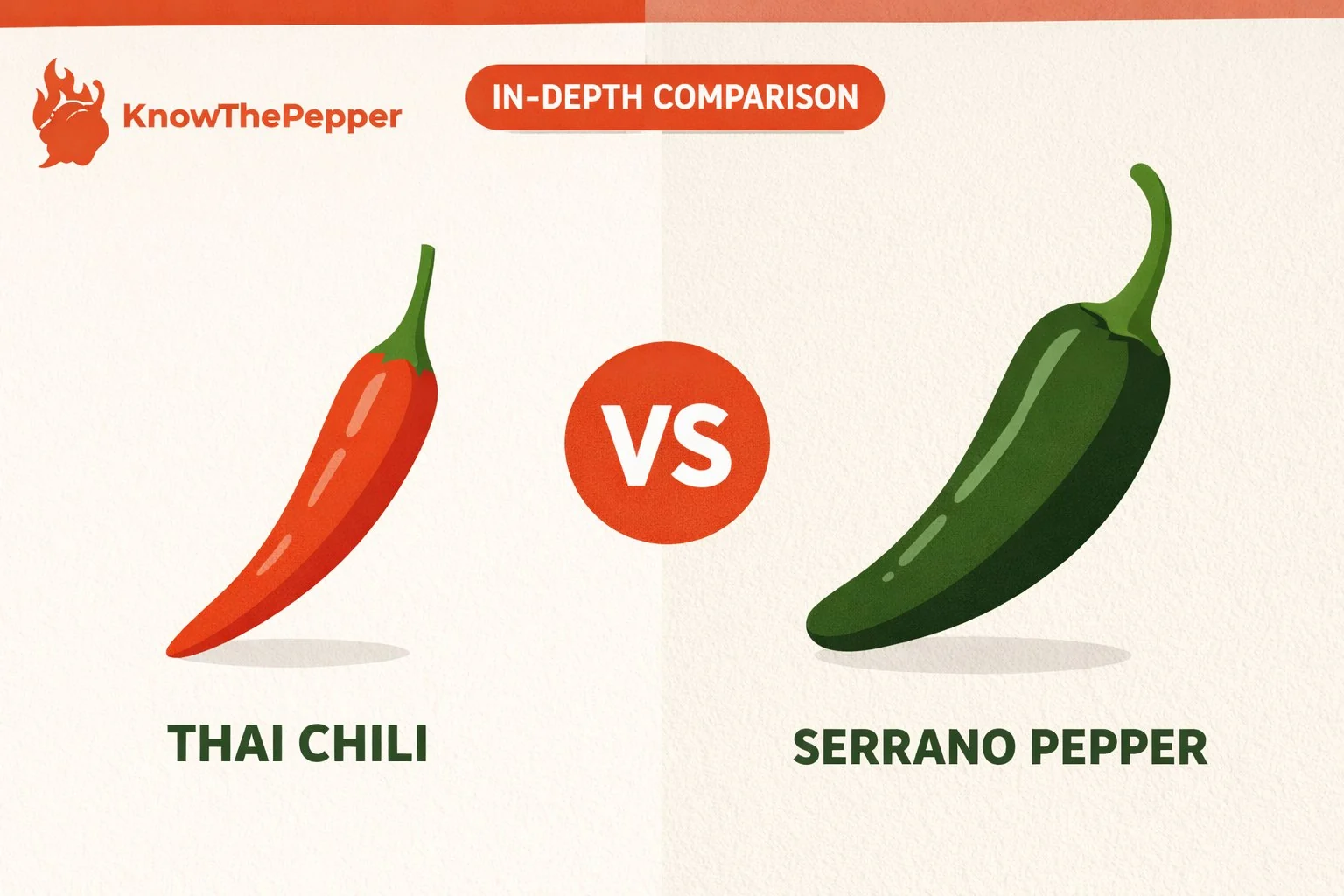
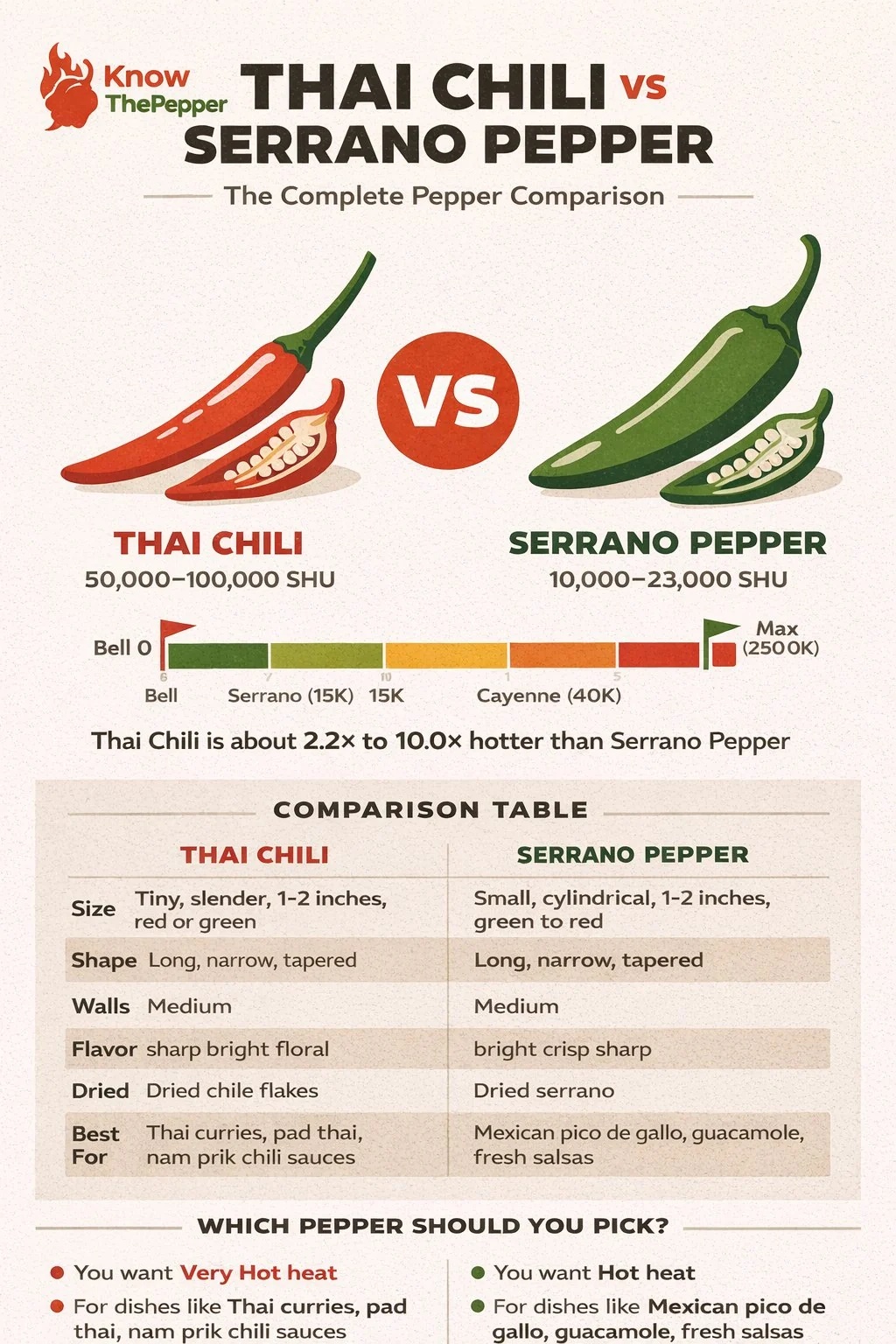
Thai Chili measures 50K–100K SHU while Serrano Pepper registers 10K–23K SHU — making Thai Chili 4× hotter. Thai Chili is known for its bright and peppery flavor (C. annuum), while Serrano Pepper offers bright and crisp notes (C. annuum).
- Heat difference: Thai Chili is 4× hotter
- Species: Both are C. annuum
- Best for: Thai Chili excels in hot sauces and extreme dishes, Serrano Pepper in fresh salsas and mild recipes
Thai Chili
Extra-HotSerrano Pepper
HotThai Chili vs Serrano Pepper Comparison
Thai Chili vs Serrano Pepper Heat Levels
Both peppers share a brightness that hits the front of the palate first — but that's where the similarity ends. Serrano delivers a clean, sharp snap of heat that builds gradually and fades relatively quickly. Thai chili comes in harder, with a more insistent burn that lingers and radiates.
On the Scoville heat units scale, the numbers tell the story clearly. Serrano registers 10,000-23,000 SHU, placing it solidly in the medium-high heat classification for everyday cooking peppers. Thai chili sits at 50,000-100,000 SHU — a range that puts it roughly 4 to 10 times hotter than serrano depending on individual fruit measurements.
Compared to a standard jalapeño at around 5,000 SHU, serrano runs about 2-4x hotter, while Thai chili can hit 10-20x hotter than a jalapeño. That's a meaningful jump for anyone using jalapeño as their personal heat benchmark.
The capsaicin chemistry behind this difference — specifically how it binds to pain receptors — is covered in detail in the how capsaicin triggers the burn response. What matters practically: Thai chili's heat is more diffuse and persistent, while serrano's burn is sharper but shorter-lived. Both belong to Capsicum annuum, the botanical family that spans an enormous heat range from bell peppers to cayenne.
Flavor Profile Comparison
Small enough to overlook, fierce enough to remember — the Thai chili punches well above its size.
Bite into a raw serrano and the first thing you notice is the aroma — green, grassy, almost herbal, like a jalapeño that decided to be serious.
Strip away the heat and you're left with two genuinely different flavor profiles, even if both get described as 'bright.'
Serrano — originating from the mountainous regions covered in our Mexican pepper origin guide — has a grassy, almost herbaceous quality. It's crisp and vegetal, with a clean finish that makes it exceptional for fresh preparations. Pico de gallo made with serrano has a particular clarity that other peppers struggle to replicate.
Thai chili carries a different kind of brightness — more peppery and forward, with a slight floral note that becomes apparent when you smell a freshly sliced pod. The flavor is less vegetal than serrano and more purely peppery. This makes sense given the different agricultural environments of Thailand's pepper-growing traditions versus Mexico's highland climate.
Aroma is another point of separation. Serrano smells like fresh green pepper with a hint of garden earthiness. Thai chili has a more assertive, almost sharp scent that telegraphs the heat to come.
For dishes where pepper flavor is meant to be subtle background heat, serrano is the more accommodating choice. Thai chili asserts itself — you'll taste it even when it's not the dominant ingredient. This distinction matters most in delicate broths, light salads, and raw applications where serrano's cleaner flavor won't overpower other ingredients.
Culinary Uses for Thai Chili and Serrano Pepper
Serrano shines in fresh applications: salsas, ceviches, guacamole, and raw sauces where its clean flavor and moderate heat let other ingredients breathe. It also holds up beautifully when roasted or charred — the skin blisters nicely and the flavor deepens without turning bitter. Mexican cooking relies on it heavily for exactly these reasons.
Thai chili is built for high-heat cooking. Stir-fries, curries, nam prik dipping sauces, and soups are its natural territory. The small size means it's often used whole or sliced thin, releasing heat gradually into a dish. It also dries exceptionally well — dried Thai chili is a pantry staple that retains both heat and flavor.
For substitution purposes, the heat gap requires adjustment. If a recipe calls for 1 Thai chili, use 3-4 serrano peppers to approximate the heat level. Going the other direction — replacing serrano with Thai chili — use roughly 1 Thai chili for every 3 serranos called for, and expect a flavor shift alongside the heat change.
The comparison with cayenne's similar-but-different heat profile vs. Thai chili is worth reading if you're working with dried forms, since cayenne powder substitutions follow different ratios than fresh pepper swaps.
For dishes that specifically need Thai chili's floral peppery note — pad kra pao, green papaya salad, Thai fish sauce dips — serrano is a functional but imperfect stand-in. The heat can be scaled, but that aromatic quality is harder to replicate. Bird's eye chili, covered in the bird's eye vs. Thai chili heat and size comparison, is actually a closer substitute in those cases.
Serrano works better as a Thai chili replacement in cooked applications where the pepper is one of several bold flavors, rather than the centerpiece.
Which Should You Choose?
The choice comes down to heat tolerance and dish origin.
Reach for serrano when cooking Mexican-inspired food, making fresh salsas, or cooking for people with moderate heat tolerance. Its clean flavor and manageable 10,000-23,000 SHU range make it one of the most versatile fresh peppers available. The full heat-level breakdown for this range confirms it sits right where most home cooks want their go-to hot pepper.
Thai chili is the right call when the dish specifically needs that persistent, high-intensity heat — curries, stir-fries, Southeast Asian dipping sauces. At 50,000-100,000 SHU, it's not a casual substitution for the heat-averse. The habanero vs. Thai chili comparison is useful context if you're scaling heat up further.
Both peppers are worth keeping on hand. They're not interchangeable so much as complementary — one for the fresh crunch of Mexican cooking, the other for the sustained heat of Southeast Asian cuisine.
Can You Substitute One for the Other?
Proceed with caution. Thai Chili is 4× hotter than Serrano Pepper.
Need a different option altogether? Search for peppers that match your target heat and flavor with precise swap ratios.
Growing Thai Chili vs Serrano Pepper
If you’re deciding which pepper to grow at home, consider your climate and patience level. Thai Chili and Serrano Pepper have different maturation times and temperature preferences. Hotter varieties generally need a longer, warmer growing season to develop their full capsaicin content. Our zone-based planting date tool can pinpoint the best sowing window for your area.
The hardest part of growing Thai chilies is not germination — it is managing heat stress during fruiting. These plants originate from a tropical climate and expect warmth, but sustained temperatures above 95°F (35°C) cause flower drop before pods can set.
Germination itself is straightforward at 80–85°F soil temperature, typically within 10–14 days. Start seeds indoors 8–10 weeks before last frost.
They prefer well-draining soil with consistent moisture but will tolerate brief dry spells better than waterlogging. Feed with a low-nitrogen fertilizer once flowering begins; too much nitrogen pushes leaf growth at the expense of pods.
Serranos are reliable producers that reward patient gardeners. Start seeds indoors 8–10 weeks before last frost — germination takes 10–21 days at soil temperatures around 80–85°F.
Transplant outdoors once nighttime temps stay above 55°F. Space plants 18–24 inches apart in full sun with well-draining soil amended with compost.
Days to maturity runs 70–80 days from transplant to green-ripe. Letting pods fully ripen to red adds another 2–3 weeks but intensifies both flavor and heat.
History & Origin of Thai Chili and Serrano Pepper
Both peppers carry centuries of culinary heritage. Thai Chili traces its roots to Thailand, while Serrano Pepper originates from Mexico. Understanding their backstory helps explain why each pepper developed its distinctive traits.
Buying & Storage
Whether you’re shopping for Thai Chili or Serrano Pepper, the same quality indicators apply. Fresh peppers should feel firm and heavy for their size, with taut, glossy skin and no soft or wet spots. Minor stem cracks known as “corking” are perfectly normal and often indicate a mature, flavorful pod.
- Firm pods with taut skin and consistent color
- Should feel heavy relative to size
- Minor stem cracks (“corking”) are normal
- Avoid anything soft, shriveled, or with dark wet spots
- Fresh: Paper bag, crisper drawer — 1–2 weeks
- Frozen: Wash, dry, freeze on sheet pan — 6+ months
- Dried: Airtight, away from light — up to 1 year
The Verdict: Thai Chili vs Serrano Pepper
Thai Chili and Serrano Pepper occupy very different positions on the heat spectrum. Thai Chili delivers 4× more heat with its distinctive bright and peppery character. Serrano Pepper, with its bright and crisp profile, excels in everyday cooking.
Frequently Asked Questions
Related Comparisons
Sources pending verification.