Pasilla de Oaxaca vs Pasilla Pepper – Heat & Flavor Compared
The Pasilla de Oaxaca is a smoked, dried chili from the mountains of Oaxaca, Mexico, registering 4,000-10,000 SHU with a deep, complex flavor built on smoke and dark fruit. The pasilla pepper (dried chilaca) is a much milder, unsmoked dried chili used widely across Mexican cooking. These two share a name and a general dried-pepper lineage, but they are distinct ingredients with different heat levels, preparation methods, and culinary roles.

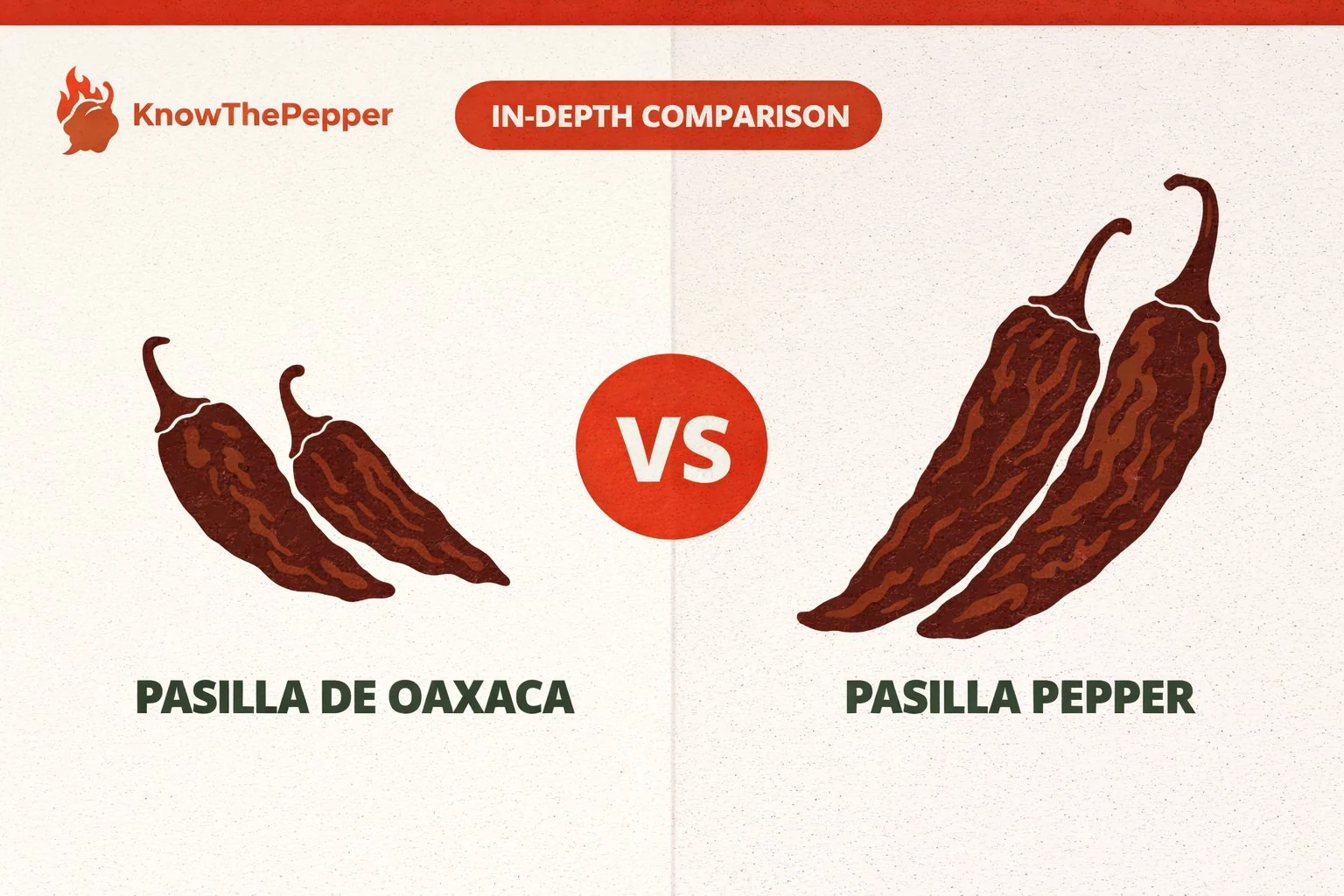
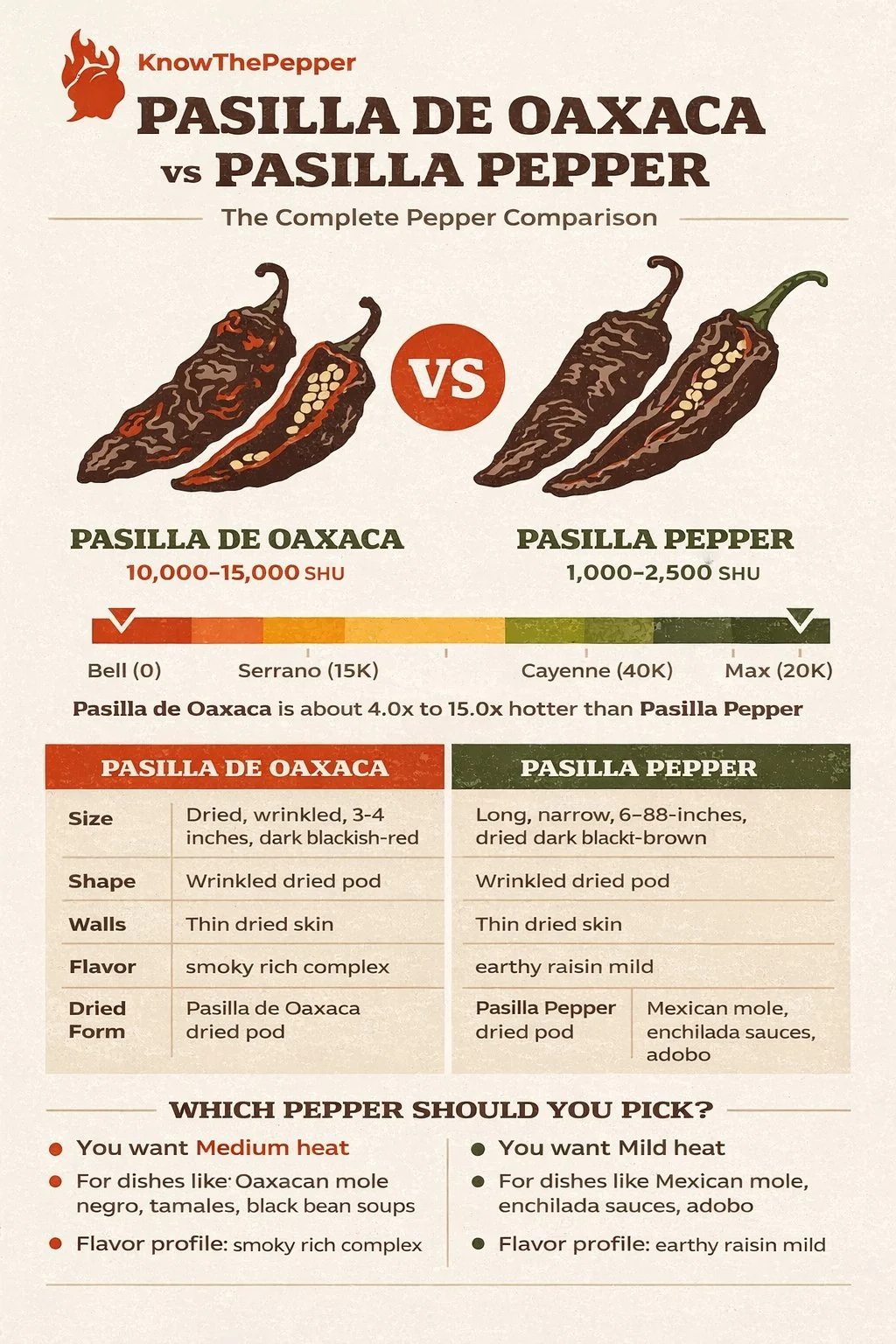
Pasilla de Oaxaca measures 4K–10K SHU while Pasilla Pepper registers 1K–3K SHU — making Pasilla de Oaxaca 4× hotter. Pasilla de Oaxaca is known for its smoky and rich flavor (C. annuum), while Pasilla Pepper offers earthy and rich notes (C. annuum).
- Heat difference: Pasilla de Oaxaca is 4× hotter
- Species: Both are C. annuum
- Best for: Pasilla de Oaxaca excels in everyday cooking and salsas, Pasilla Pepper in fresh salsas and mild recipes
Pasilla de Oaxaca
HotPasilla Pepper
MediumPasilla de Oaxaca vs Pasilla Pepper Comparison
Pasilla de Oaxaca vs Pasilla Pepper Heat Levels
The Pasilla de Oaxaca lands between 4,000 and 10,000 SHU, placing it in the medium heat zone alongside peppers like the ancho and the guajillo. At its upper end, it reaches roughly 1.25 times the heat of a typical jalapeño (which averages around 8,000 SHU at peak). At its lower end, it sits closer to a mild jalapeño. That range gives it genuine bite without overwhelming the palate.
The standard pasilla pepper — the dried form of the chilaca — is a different story. Published SHU data for the pasilla places it in a range that most sources describe as quite mild, generally under 2,500 SHU and often closer to 1,000 SHU. That puts it well below jalapeño territory, firmly in the mild dried chili bracket used in everyday Mexican sauces and moles.
The heat gap between these two peppers is real and matters in the kitchen. A dish built around Pasilla de Oaxaca will have a perceptible warmth that builds slowly — partly because capsaicin delivery in smoked, dried peppers tends to be gradual. The capsaicin burn mechanism in dried chilies works differently than in fresh ones; rehydration releases the compound more evenly, which is why the heat from a reconstituted Pasilla de Oaxaca feels less sharp than an equivalent SHU fresh pepper.
For anyone cross-referencing these on the Scoville heat index, the key takeaway is simple: the Pasilla de Oaxaca runs hotter, and that heat comes layered inside significant smoke.
Flavor Profile Comparison
Long before commercial chile processing existed, Zapotec communities in the mountains of Oaxaca were smoke-drying their local chiles over smoldering wood fires.
Pasilla sits in the medium heat intensity range — warm enough to notice, gentle enough to let flavor lead.
Smoke is the defining variable here. The Pasilla de Oaxaca is traditionally smoked over wood fires in the Sierra Juárez mountains — that process transforms its flavor into something closer to a dried, fruity barbecue element than a simple dried chili. Expect dark chocolate, dried plum, leather, and a slow-building tobacco note underneath the heat. It's dense and complex in a way that rewards slow cooking.
The standard pasilla pepper — properly called the dried chilaca — has its own character, but smoke is not part of it. Its flavor profile runs toward dried fig, mild earthiness, and a faint berry note. The skin is dark and wrinkled ("pasilla" literally means "little raisin" in Spanish), and the flavor is consistent with that description: concentrated, slightly sweet, and deeply savory without any of the campfire quality the Oaxacan version carries.
In blind tastings, cooks often describe the pasilla as a "background pepper" — it builds depth in a mole or sauce without asserting itself. The Pasilla de Oaxaca, by contrast, tends to dominate whatever it's in. That's not a flaw; it's the point. Oaxacan black mole (mole negro) depends on that assertive, smoky backbone.
Both peppers belong to the broader family of Mexican dried chilies with long culinary histories, but they were developed in different regional traditions and are not interchangeable without adjustment. The botanical classification under C. annuum covers the Pasilla de Oaxaca; the pasilla pepper's species is less consistently documented across sources.
Culinary Uses for Pasilla de Oaxaca and Pasilla Pepper
Pasilla de Oaxaca is a specialty ingredient. Its primary home is Oaxacan mole negro, where it works alongside mulato and chihuacle negro chilies to create the dish's characteristic dark, smoky base. Outside of mole, it shows up in tasajo marinades, black bean soups, and slow-braised meats where its smoke can permeate the dish over hours of cooking.
To use it: toast briefly in a dry skillet (30-45 seconds per side), then rehydrate in hot water for 20-30 minutes. The soaking liquid carries significant flavor — use it in the dish unless bitterness is a concern. One medium Pasilla de Oaxaca rehydrated and blended is roughly equivalent to 1-1.5 tablespoons of smoked paprika plus a pinch of cayenne if you're improvising a substitute, though the result won't be identical.
The standard pasilla pepper has a wider everyday range. It's a foundational chili in many mole negro and mole rojo recipes across central Mexico, but also appears in enchilada sauces, tamale fillings, and simple salsa negra. Its mild heat and clean dried-fruit flavor make it approachable for cooks still building their dried chili vocabulary.
For a head-to-head look at how the pasilla stacks up against the ancho — another common dried chili — the flavor difference is subtle but real. The chilaca-to-pasilla comparison is essentially a fresh vs. dried version of the same pepper, which puts the Pasilla de Oaxaca in sharp contrast: it's a separate cultivar, not just a dried version of something else.
When substituting Pasilla de Oaxaca for standard pasilla, use a 1:1 ratio by count but expect significantly more smoke and heat. Going the other direction — replacing Pasilla de Oaxaca with standard pasilla — add smoked paprika or a small chipotle to approximate the smokiness. For more swap options for the pasilla pepper, the options include ancho, mulato, and guajillo depending on what the recipe needs.
The chipotle vs. pasilla comparison is worth reading if smoke is the key variable in your recipe — chipotles are smoked jalapeños and bring a different heat profile entirely.
Which Should You Choose?
If your recipe calls for smoke as a primary flavor, the Pasilla de Oaxaca is the right tool. It's harder to find (specialty Mexican grocers, online importers), more expensive, and more assertive — but there's nothing quite like it for Oaxacan mole negro or a deeply flavored braise.
The standard pasilla pepper is the workhorse. Widely available, mild enough for heat-sensitive diners, and versatile across moles, sauces, and fillings. It's the pepper to reach for when you want dried chili depth without smoke or significant heat.
For everyday Mexican cooking, the pasilla wins on accessibility. For Oaxacan recipes specifically, or any dish where smoked chili character is the point, the Pasilla de Oaxaca is not a pepper you should substitute around — it's the ingredient the dish is built on.
Neither pepper is a beginner's mistake. They just serve different purposes, and knowing which one you need before you start cooking saves significant backtracking.
Can You Substitute One for the Other?
Yes — direct substitution works. Pasilla de Oaxaca and Pasilla Pepper are close enough in heat to swap at roughly 1:1. The main difference will be flavor. For more swap options, explore ranked alternatives with conversion ratios.
Growing Pasilla de Oaxaca vs Pasilla Pepper
If you’re deciding which pepper to grow at home, consider your climate and patience level. Pasilla de Oaxaca and Pasilla Pepper have different maturation times and temperature preferences. Hotter varieties generally need a longer, warmer growing season to develop their full capsaicin content. Our zone-based planting date tool can pinpoint the best sowing window for your area.
Growing Pasilla de Oaxaca from seed is straightforward for anyone experienced with C. annuum cultivation — the challenge is in the post-harvest processing, not the plant itself.
Start seeds indoors 8–10 weeks before last frost. Germination runs 10–14 days at soil temperatures around 80°F.
Compared to the mild-heat, high-yield growing style of Hatch-type chiles, Pasilla de Oaxaca plants are more compact and produce fewer pods — but each pod carries more flavor complexity when dried.
Pasilla plants are tall growers, often reaching 24–36 inches with good support. Start seeds indoors 8–10 weeks before last frost — the long growing season (roughly 80–85 days to maturity) means early starts matter.
Transplant after soil temperatures stabilize above 60°F. Space plants 18–24 inches apart — they branch outward as they mature, and crowding invites fungal issues on the dense foliage.
Water consistently but avoid waterlogged soil. These plants are somewhat drought-tolerant once established, but irregular watering during pod development causes blossom drop and misshapen fruit.
History & Origin of Pasilla de Oaxaca and Pasilla Pepper
Both peppers carry centuries of culinary heritage. Pasilla de Oaxaca traces its roots to Mexico, while Pasilla Pepper originates from Mexico. Understanding their backstory helps explain why each pepper developed its distinctive traits.
Buying & Storage
Whether you’re shopping for Pasilla de Oaxaca or Pasilla Pepper, the same quality indicators apply. Fresh peppers should feel firm and heavy for their size, with taut, glossy skin and no soft or wet spots. Minor stem cracks known as “corking” are perfectly normal and often indicate a mature, flavorful pod.
- Firm pods with taut skin and consistent color
- Should feel heavy relative to size
- Minor stem cracks (“corking”) are normal
- Avoid anything soft, shriveled, or with dark wet spots
- Fresh: Paper bag, crisper drawer — 1–2 weeks
- Frozen: Wash, dry, freeze on sheet pan — 6+ months
- Dried: Airtight, away from light — up to 1 year
The Verdict: Pasilla de Oaxaca vs Pasilla Pepper
Pasilla de Oaxaca and Pasilla Pepper occupy very different positions on the heat spectrum. Pasilla de Oaxaca delivers 4× more heat with its distinctive smoky and rich character. Pasilla Pepper, with its earthy and rich profile, excels in everyday cooking.
Frequently Asked Questions
Related Comparisons
Sources pending verification.