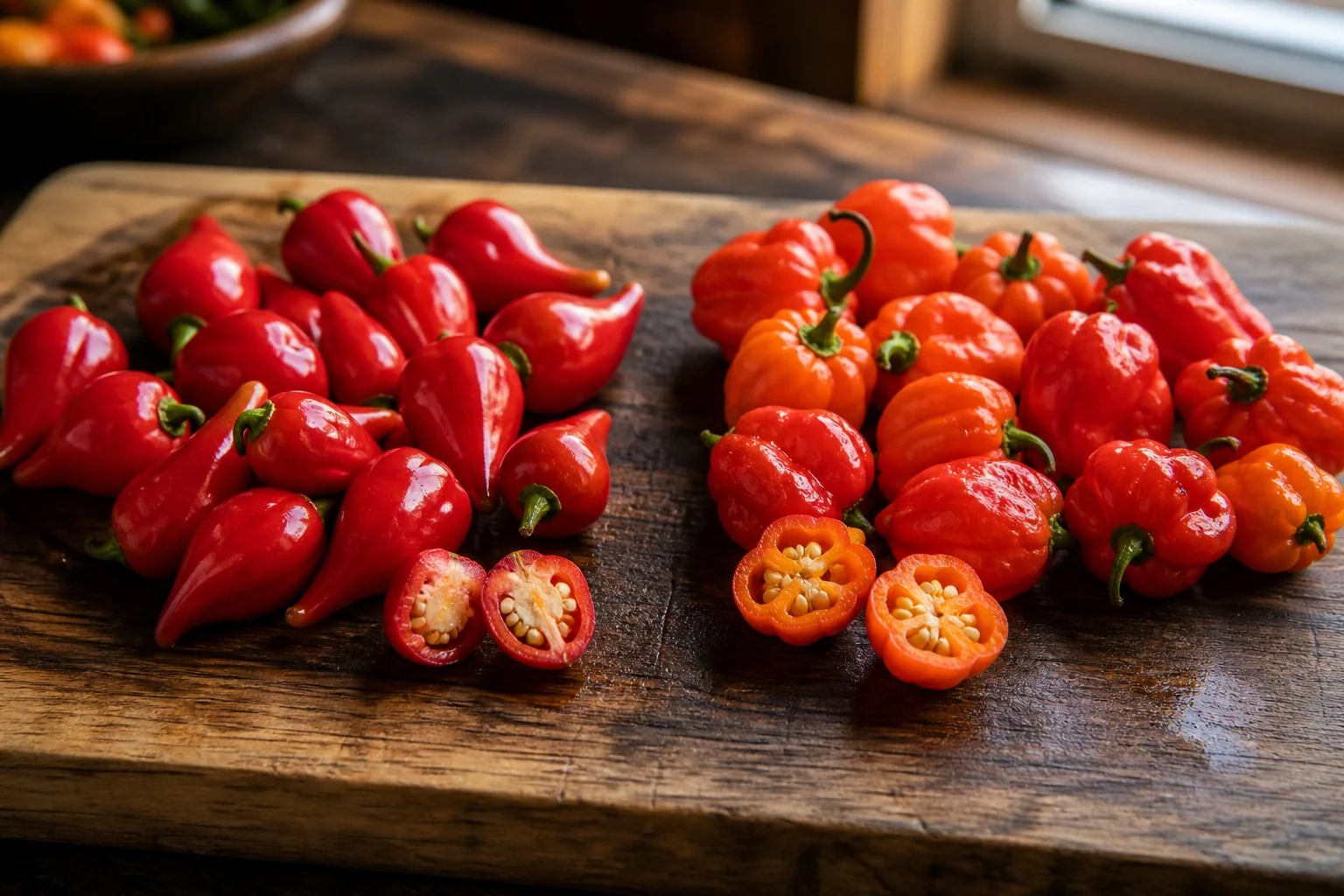
Aji Dulce is the better choice for sofrito, beans, rice, and Caribbean seasoning bases. Trinidad Perfume is the cleaner no-heat C. chinense aroma pepper when fragrance matters more than traditional sofrito identity.
Comparison Contributor·Updated Jun 29, 2026·
Reviewed by
Karen Liu
Quick Comparison
Aji Dulce measures 0–500 SHU while Trinidad Perfume registers 0–500 SHU. Their upper SHU ranges are close enough to treat as the same heat bracket. Aji Dulce is known for its sweet, fruity, aromatic flavor (C. chinense), while Trinidad Perfume offers fruity and floral notes (C. chinense).
Aji Dulce
0–500 SHU
Mild · sweet, fruity, aromatic
Trinidad Perfume
0–500 SHU
Mild · fruity and floral
Species: Both are C. chinense
Best for: Aji Dulce excels in everyday cooking and salsas, Trinidad Perfume in fresh salsas and mild recipes
Aji Dulce spans 0–500 SHU.
Trinidad Perfume spans 0–500 SHU.
Use the ranges to decide whether the recipe needs a measured dose, a mild overlap, or a hard substitution limit.
Tools: Scoville chart and SHU calculator.
Aji Dulce is a mild, aromatic Capsicum chinense pepper best known as a seasoning pepper for sofrito and recaito. It often looks like a small bonnet or lantern pepper, but the heat is usually only 0-500 SHU.
That low heat is the key distinction. PepperScale lists Aji Dulce at 0-500 SHU, which places it in the mild pepper heat tier, while New Mexico State University explains that SHU is an expression of capsaicinoid measurement.
Trinidad Perfume
fruityfloralC. chinense
Crack open a Trinidad Perfume and the first thing that hits you is the smell - a heady, tropical fragrance that would be right at home on a habanero. The taste follows through with ripe mango, citrus, and a faint floral sweetness that lingers on the palate.
At 0–500 SHU, this sits firmly in the the mild heat tier - closer to a sweet bell than anything that will challenge your heat tolerance. That makes it unusual among C. chinense varieties, a species known for producing some of the world's hottest peppers.
Both peppers belong to C. chinense, so they share some underlying flavor chemistry. However, Aji Dulce’s sweet, fruity, aromatic notes contrast with Trinidad Perfume’s fruity and floral character.
Aji Dulce brings sweet, fruity, aromatic notes, so it fits recipes where that flavor should remain visible.
Trinidad Perfume leans fruity and floral, which can change the sauce, filling, marinade, or garnish even when the heat range looks close.
Culinary Uses for Aji Dulce and Trinidad Perfume
Aji Dulce
Aji Dulce is most useful as an aromatic base pepper. It brings sweet fruit, floral chinense aroma, and almost no burn, which is why cooks blend it into sofrito, recaito, beans, rice, braises, stews, and meat marinades.
WorldCrops describes sofrito as a blended or finely chopped seasoning mix that is added to dishes, not a table sauce. Aji Dulce often works beside garlic, onion, culantro or recao, cilantro, and mild sweet pepper.
Use red-ripe pods when you want the fullest sweetness. Green pods can still season cooked food, but they taste sharper and less rounded than red or orange pods.
Trinidad Perfume
The aroma is the whole point here. Before you even taste a Trinidad Perfume, the fragrance - tropical, almost perfumed - tells you something interesting is about to happen.
Raw applications show it off best. Slice thin into ceviche, fruit salsas, or fresh relishes where the aroma can bloom.
Cooked, it softens quickly given its thin walls. Roasting concentrates the sweetness; a quick sauté in butter or coconut oil preserves more of the floral character.
Start near 1:1 by amount. The heat ranges are close enough that flavor, form, and recipe role matter more than a strict Scoville conversion.
Growing Aji Dulce vs Trinidad Perfume
Growing notes
Aji Dulce
Grow Aji Dulce like a warm-season Capsicum chinense pepper. Start seeds indoors before the frost-free transplant window, keep the seed tray warm, and move plants outside only after nights and soil have warmed.
The starting peppers from seed workflow covers the general steps: sterile seed mix, steady warmth, strong light after germination, and gradual hardening off. Aji Dulce usually needs a longer head start than fast C. annuum peppers.
Use full sun, steady moisture, and well-drained soil. University of Minnesota Extension pepper guidance is a good home-garden baseline: transplant after frost risk, avoid cold soil, and water consistently so fruit set does not stall.
Growing notes
Trinidad Perfume
Growing Trinidad Perfume follows the same rhythm as other C. chinense varieties, which means patience is required. Start seeds indoors 10–12 weeks before last frost - germination can be slow, often 14–21 days at soil temperatures of 80–85°F.
For anyone new to the species, the germination and full growing walkthrough covers the fundamentals well. Trinidad Perfume is considered approachable for the species - it is more forgiving of temperature swings than many of its hotter chinense relatives.
Transplant after all frost risk has passed into full sun with well-draining soil. Spacing matters more than many growers expect; the practical guidance on pepper plant spacing explains why crowding reduces airflow and invites disease.
Where They Come From
Origin & background
Aji Dulce
Caribbean and Venezuela · C. chinense
Aji Dulce sits in the Spanish-speaking Caribbean and northern South American seasoning-pepper lane. WorldCrops lists it in Puerto Rico, the Dominican Republic, and Cuba, and also notes Venezuelan forms that are often slightly spicy but far below habanero or Scotch bonnet heat.
The name simply means sweet chile or sweet pepper in Spanish, but that does not mean every market pod is identical. Local names, seed lines, and ripeness stages can change shape, color, and heat.
Origin & background
Trinidad Perfume
Trinidad · C. chinense
Trinidad Perfume originates from Trinidad and Tobago, where the broader regional pepper tradition has long produced both scorching and sweet C. chinense varieties side by side. The island's culinary culture prizes aromatic peppers in sauces, marinades, and fresh preparations, and the Trinidad Perfume fits squarely into that tradition.
The variety appears to have developed as a naturally low-capsaicin mutation within the chinense species - the same genetic lineage that produced the Scotch Bonnet and habanero. It gained wider attention in North American seed-saving communities during the 1990s and early 2000s as growers sought flavorful alternatives to standard sweet peppers.
Buying & Storage
Whether you’re shopping for Aji Dulce or Trinidad Perfume, the same quality indicators apply. Fresh peppers should feel firm and heavy for their size, with taut, glossy skin and no soft or wet spots. Minor stem cracks known as “corking” are perfectly normal and often indicate a mature, flavorful pod.
Selection
What to look for
Firm pods with taut skin and consistent color
Should feel heavy relative to size
Minor stem cracks (“corking”) are normal
Avoid anything soft, shriveled, or with dark wet spots
Storage
How to store them
Fresh: Paper bag, crisper drawer, 1 to 2 weeks
Frozen: Wash, dry, freeze on sheet pan, 6+ months
Dried: Airtight and away from light, up to 1 year
Mistakes to avoid
Common misses
Aji Dulce
Equating green with unripe. Different products.
Overcooking. Cell walls break down fast.
Sealed plastic storage. Causes rot. Use paper bags.
Common misses
Trinidad Perfume
Equating green with unripe. Different products.
Overcooking. Cell walls break down fast.
Sealed plastic storage. Causes rot. Use paper bags.
Final call
Aji Dulce vs Trinidad Perfume
Aji Dulce and Trinidad Perfume
sit in the same heat tier but serve different roles. Aji Dulce delivers its distinctive sweet, fruity, aromatic character.
Trinidad Perfume, with its fruity and floral profile, excels in everyday cooking.
Heat gap same bracketAji Dulce sweet, fruity, aromaticTrinidad Perfume fruity and floral
Choose Aji Dulce when the dish starts with a seasoning base. Puerto Rican, Dominican, Venezuelan, and Caribbean-style beans, rice, stews, and marinades need sweet chinense aroma mixed with garlic, onion, culantro, cilantro, and mild pepper.
Choose Trinidad Perfume when the pepper is meant to announce fragrance on its own. It works better in fresh relishes, fruit salsas, ceviche-style dishes, and mild hot sauces where habanero-like aroma is wanted without real burn.
Heat Is Not The Axis
Heat is the wrong first question here. Both peppers sit around 0 to 500 SHU, so the real split is cultural use, aroma shape, and how much heat uncertainty the buyer can accept.
Aroma And Ripeness
Aji Dulce brings sweet, fruity, aromatic depth that behaves like a base note. It is meant to disappear into a pot and make rice, beans, chicken, or pork taste seasoned from the start.
Trinidad Perfume is more top-note driven. The scent reads floral and tropical, so it can stay visible in raw preparations instead of melting into a cooked base.
Ripeness changes both peppers. Red or orange pods give fuller sweetness, while green pods can taste sharper and thinner.
The shared Capsicum chinense family explains the habanero-like aroma. It does not mean either pepper should be treated like a hot habanero.
Market Risk And Seed Choice
Aji Dulce has more market-name risk. WorldCrops notes that some Aji Dulce sold in markets can carry heat, so a cook making no-heat sofrito should ask the seller or taste a tiny piece first.
Trinidad Perfume is usually easier to treat as a no-heat seed-catalog variety. It is still specialty produce, but the name itself signals fragrance without pungency.
For gardeners, Aji Dulce is the better plant if the household cooks Caribbean staples often. Trinidad Perfume is the better plant if the goal is a reliable aromatic sweet chinense for fresh dishes.
Substitution Inside Aromatics
Trinidad Perfume can replace Aji Dulce in sofrito, but add it as part of the aromatic mix rather than as the whole identity. You may need extra sweet pepper or culantro to rebuild the familiar base.
Aji Dulce can replace Trinidad Perfume in mild sauces, but cooked dishes will hide some of the floral lift. For a hotter sibling decision, use Aji Dulce vs Scotch bonnet; this page is about two low-heat aromatic peppers.
Fact-Checked & Expert Reviewed
Editorial Standards: Head-to-head comparisons include blind tasting when applicable. Heat levels cross-referenced with multiple sources. All substitution ratios tested side-by-side.
Review Process:
Written by
James Thompson
(Lead Comparison Reviewer)
, reviewed by
Karen Liu
(Lead Fact-Checker & Science Editor)
. Last updated June 29, 2026.
Aji Dulce vs Trinidad Perfume FAQ
Usually no. Both are low-heat C. chinense peppers around 0 to 500 SHU. Some market Aji Dulce can carry unexpected heat, so taste a tiny piece if zero heat matters.
Aji Dulce is better for sofrito because it is the traditional aromatic pepper in many Caribbean seasoning bases. Trinidad Perfume can work, but it tastes more like a fragrant substitute.
They belong to the C. chinense family, the same broad aroma family as habanero and Scotch bonnet. These varieties were selected for fragrance with little to no pungency.
It can in many cooked dishes, but the flavor will be cleaner and more floral. For sofrito, balance it with sweet pepper, garlic, onion, and culantro or cilantro.
Aji Dulce is easier in Caribbean and Latin grocery channels. Trinidad Perfume is more often found through specialty growers, farmers markets, or seed catalogs.