Hatch Chile vs Poblano Pepper: What's the Difference?
Hatch chiles and poblanos are both mild-to-medium C. annuum peppers beloved in American and Mexican cooking, but they differ sharply in origin, heat range, and culinary identity. Hatch chiles come from a specific valley in New Mexico and carry 1,000-8,000 SHU of earthy, roasted heat. Poblanos are a Mexican staple with a rich, dark-green flavor profile that makes them the go-to pepper for stuffing and sauce.

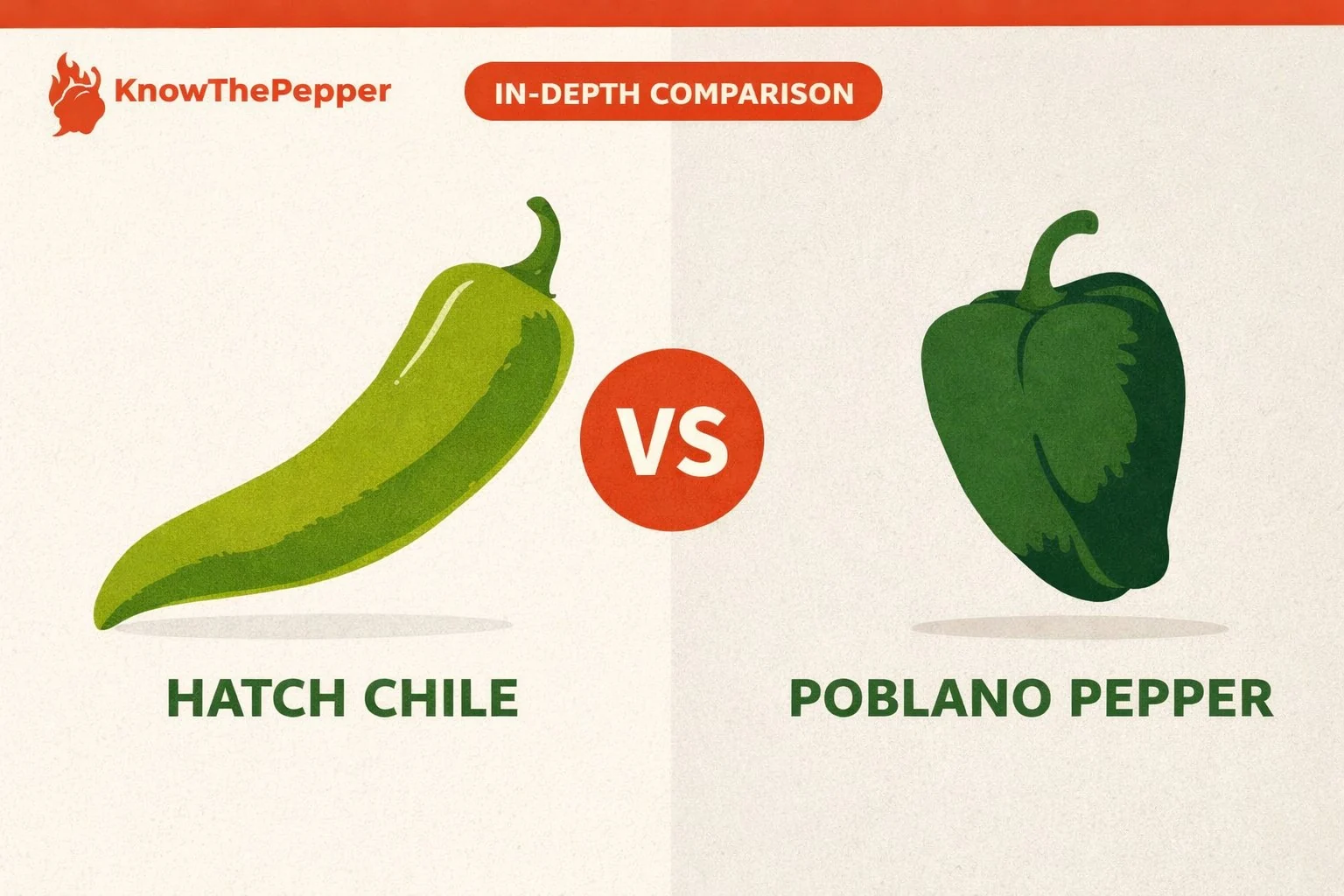
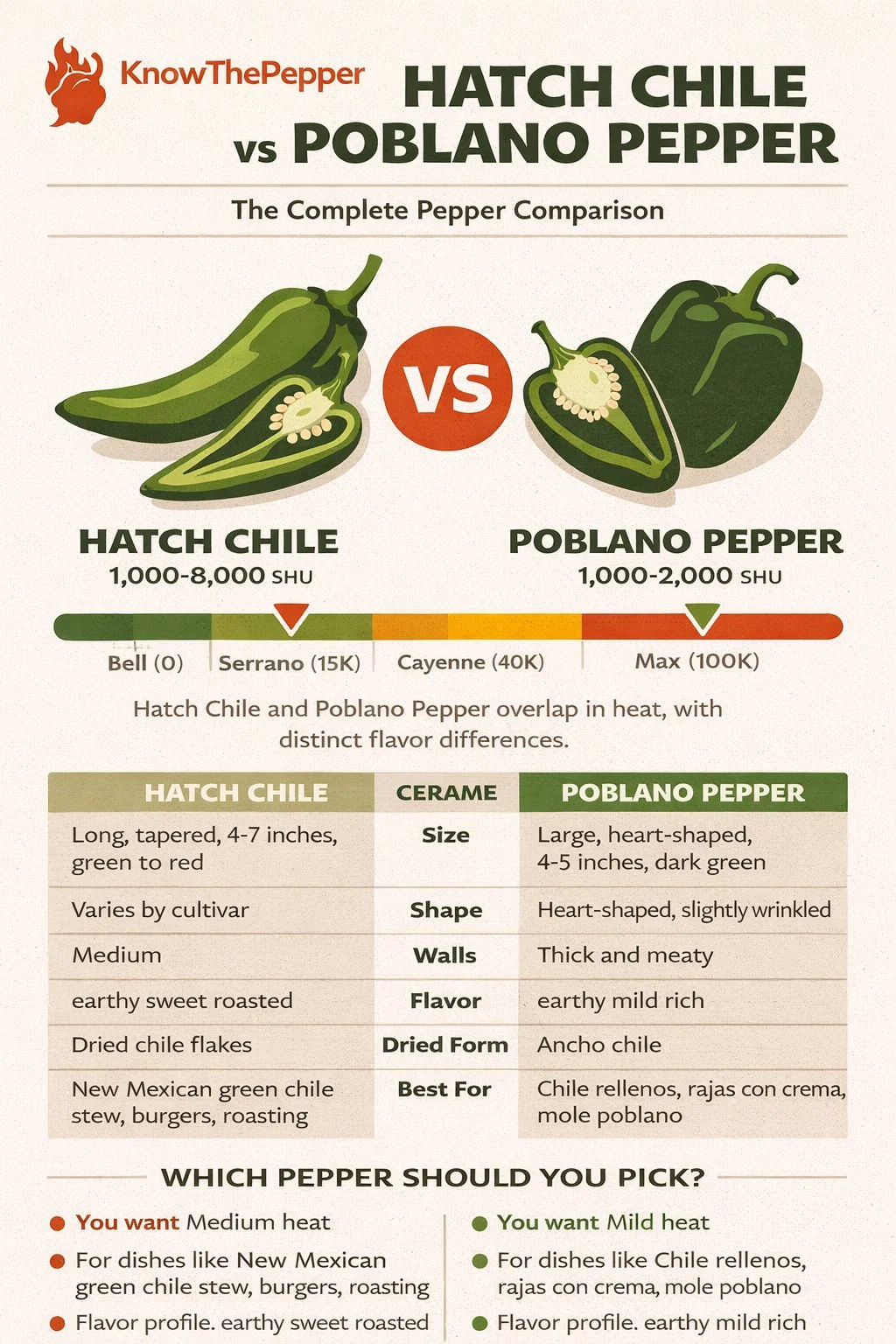
Hatch Chile measures 1K–8K SHU while Poblano Pepper registers 1K–2K SHU — making Hatch Chile 4× hotter. Hatch Chile is known for its earthy and sweet flavor (C. annuum), while Poblano Pepper offers earthy and rich notes (C. annuum).
- Heat difference: Hatch Chile is 4× hotter
- Species: Both are C. annuum
- Best for: Hatch Chile excels in everyday cooking and salsas, Poblano Pepper in fresh salsas and mild recipes
Hatch Chile
MediumPoblano Pepper
MediumHatch Chile vs Poblano Pepper Comparison
Hatch Chile vs Poblano Pepper Heat Levels
Hatch chiles land in the 1,000-8,000 SHU range, which puts them squarely in the medium-heat SHU bracket — starting where serranos begin to taper off at their mildest end and occasionally touching their lower range. That spread is wide enough to matter: a mild Hatch from an overcast growing season might barely register, while a hot one from a drought-stressed plant can genuinely surprise you.
The tricky part with Hatch is that the name is geographic, not varietal. 'Hatch chile' refers to peppers grown in the Hatch Valley of New Mexico — which can include NuMex Big Jim, NuMex Heritage 6-4, and other cultivars developed at New Mexico State University. Heat varies by cultivar and growing conditions, so a labeled 'hot' Hatch can push toward that 8,000 SHU ceiling while a 'mild' label might sit at 1,000-2,000 SHU.
Poblanos present a different challenge — the available data here shows 0 SHU as a placeholder, but real-world poblanos typically register around 1,000-1,500 SHU in most measurements, occasionally spiking toward 2,000 SHU in hotter growing conditions. They're reliably at the mild end of any comparison with Hatch.
Put simply: a mid-range Hatch runs roughly 3-4 times hotter than a typical serrano at its peak, while a poblano rarely approaches even half a serrano's heat. For cooks who want the capsaicin chemistry behind that burn explained, the difference is largely about compound concentration — Hatch chiles at their hottest accumulate significantly more capsaicinoids than a poblano ever will.
Flavor Profile Comparison
Few peppers carry the geographic identity that the Hatch Chile does.
Pick up a fresh poblano and the first thing you notice is the weight.
Hatch chiles have a flavor that's almost impossible to replicate — earthy, slightly sweet, with a sulfurous roasted depth that only intensifies when they hit a hot cast iron or open flame. The Hatch Valley's combination of high altitude, alkaline soil, and intense New Mexico sun creates growing conditions that concentrate sugars and aromatic compounds in a way that makes the side-by-side heat gap with Hatch almost secondary to the flavor conversation.
Roasting transforms a Hatch chile from good to exceptional. The skin blisters and chars, the flesh softens and sweetens, and what was a bright green pepper becomes something almost smoky and complex. Hatch devotees — and there are many — plan their late-August schedules around fresh roasted chiles from roadside roasters.
Poblanos operate in a different register entirely. Their flavor is darker, more vegetal, with a subtle bitterness that plays beautifully against rich fillings like cheese, meat, or black beans. Fresh poblanos have a mild grassy quality; dried, they become ancho chiles — raisiny, chocolatey, and deeply savory. That transformation is one of the more remarkable flavor shifts in the pepper world.
For aroma, Hatch chiles smell bright and slightly pungent when raw, then turn deeply fragrant when roasted. Poblanos smell grassy fresh and earthy when cooked. Neither is particularly fruity — both sit in the savory, vegetal camp that makes them kitchen workhorses rather than hot sauce ingredients.
The pasilla versus poblano flavor comparison is worth reading if you want to understand how poblanos fit into the broader family of dark Mexican chiles.
Culinary Uses for Hatch Chile and Poblano Pepper
Hatch chiles have a short fresh season — typically late July through September — which makes them a genuine culinary event in the Southwest. During peak season, they get roasted by the bushel and frozen for year-round use. Roasted Hatch chiles go into green chile stew, enchilada sauce, burgers, queso, eggs, and anywhere you want smoky, earthy heat. Canned Hatch chiles are available year-round and make a reasonable substitute for fresh-roasted, though the texture softens considerably.
For heat calibration: if a recipe calls for Hatch and you want to replicate the effect with another pepper, a roasted jalapeño's milder, grassier heat profile won't quite match — you'd want to use slightly more to compensate for the lower heat ceiling. Conversely, if subbing Hatch for poblano in a stuffed pepper recipe, reduce quantity or choose a mild Hatch to avoid overwhelming the dish.
Poblanos are built for stuffing. Their thick walls, large cavity, and mild heat make them the natural choice for chiles rellenos — the classic Mexican preparation where the pepper is stuffed, battered, and fried. They also anchor mole poblano, one of Mexico's most complex sauces, where dried anchos contribute deep, chocolatey bass notes.
In terms of American pepper cultivation and culinary heritage, Hatch chiles represent a distinct regional tradition — New Mexican cuisine treats green chile almost as a condiment, spooned over everything from breakfast burritos to cheeseburgers.
For substitution: poblanos can stand in for mild Hatch in stuffed applications at a 1:1 ratio. Going the other direction — using Hatch where a recipe calls for poblano — works best with mild-labeled Hatch chiles; hot Hatch will overpower dishes designed around poblano's gentle heat. Dried ancho (dried poblano) has no real Hatch equivalent, so that substitution doesn't transfer well.
Both peppers belong to the C. annuum botanical lineage that dominates North American pepper cooking — the same species that includes bell peppers, jalapeños, and cayenne.
Which Should You Choose?
Choose Hatch chile when you want heat with character — that roasted, earthy sweetness is worth planning your cooking schedule around during peak season. They're the right call for green chile sauce, Southwestern stews, and anywhere you want pepper flavor to be the centerpiece rather than the background.
Choose poblano when structure and mild flavor are the priority. Stuffed preparations, mole, and dishes where the pepper is more vessel than seasoning — that's poblano territory. Their predictable, gentle heat means no surprises at the dinner table.
For cooks who want both in the pantry: roasted Hatch (frozen from peak season) and dried ancho chiles cover most bases. The Hatch handles fresh applications; the ancho handles the deep, slow-cooked sauce work that poblanos do in their dried form.
If you're still exploring the mild-to-medium pepper spectrum and trying to understand where each fits, start by roasting one of each side by side — the flavor difference becomes immediately obvious in a way that no description fully captures.
Can You Substitute One for the Other?
Yes — direct substitution works. Hatch Chile and Poblano Pepper are close enough in heat to swap at roughly 1:1. The main difference will be flavor. For more swap options, explore ranked alternatives with conversion ratios.
Growing Hatch Chile vs Poblano Pepper
If you’re deciding which pepper to grow at home, consider your climate and patience level. Hatch Chile and Poblano Pepper have different maturation times and temperature preferences. Hotter varieties generally need a longer, warmer growing season to develop their full capsaicin content. Our zone-based planting date tool can pinpoint the best sowing window for your area.
Growing Hatch chiles outside New Mexico is possible, but manage expectations - the valley's specific terroir is genuinely difficult to replicate. That said, the cultivars themselves grow well across USDA zones 5-10 with proper care.
Start seeds indoors 8-10 weeks before last frost. Hatch varieties need soil temperatures above 65°F to germinate reliably - bottom heat helps significantly.
These plants prefer well-drained, slightly alkaline soil with pH around **6.5-7.
Poblanos are rewarding garden plants, but they need a long season. Start seeds indoors 10-12 weeks before your last frost date — this is one case where rushing transplant time costs you yield.
For a full breakdown of seed-starting methods and timing, the complete pepper growing guide covers everything from soil mix to hardening off. Poblanos specifically want consistent moisture — irregular watering leads to blossom end rot and cracked fruit.
Transplant into full sun once nighttime temps stay above 55°F. Space plants 18-24 inches apart; they can reach 3 feet tall with good conditions.
History & Origin of Hatch Chile and Poblano Pepper
Both peppers carry centuries of culinary heritage. Hatch Chile traces its roots to USA, while Poblano Pepper originates from Mexico. Understanding their backstory helps explain why each pepper developed its distinctive traits.
Buying & Storage
Whether you’re shopping for Hatch Chile or Poblano Pepper, the same quality indicators apply. Fresh peppers should feel firm and heavy for their size, with taut, glossy skin and no soft or wet spots. Minor stem cracks known as “corking” are perfectly normal and often indicate a mature, flavorful pod.
- Firm pods with taut skin and consistent color
- Should feel heavy relative to size
- Minor stem cracks (“corking”) are normal
- Avoid anything soft, shriveled, or with dark wet spots
- Fresh: Paper bag, crisper drawer — 1–2 weeks
- Frozen: Wash, dry, freeze on sheet pan — 6+ months
- Dried: Airtight, away from light — up to 1 year
The Verdict: Hatch Chile vs Poblano Pepper
Hatch Chile and Poblano Pepper sit in the same heat tier but serve different roles. Hatch Chile delivers 4× more heat with its distinctive earthy and sweet character. Poblano Pepper, with its earthy and rich profile, excels in everyday cooking.
Frequently Asked Questions
Related Comparisons
Sources pending verification.