Gochugaru vs Kashmiri Chili – Heat & Flavor Compared
Gochugaru and Kashmiri chili are both mild-to-moderate red pepper flakes prized more for color and flavor than raw fire. Gochugaru runs 1,500–10,000 SHU with a smoky, slightly sweet character, while Kashmiri chili sits at a gentler 1,000–2,000 SHU and leans toward pure sweetness and vivid crimson pigment. They overlap in heat territory but diverge sharply in flavor and culinary purpose.

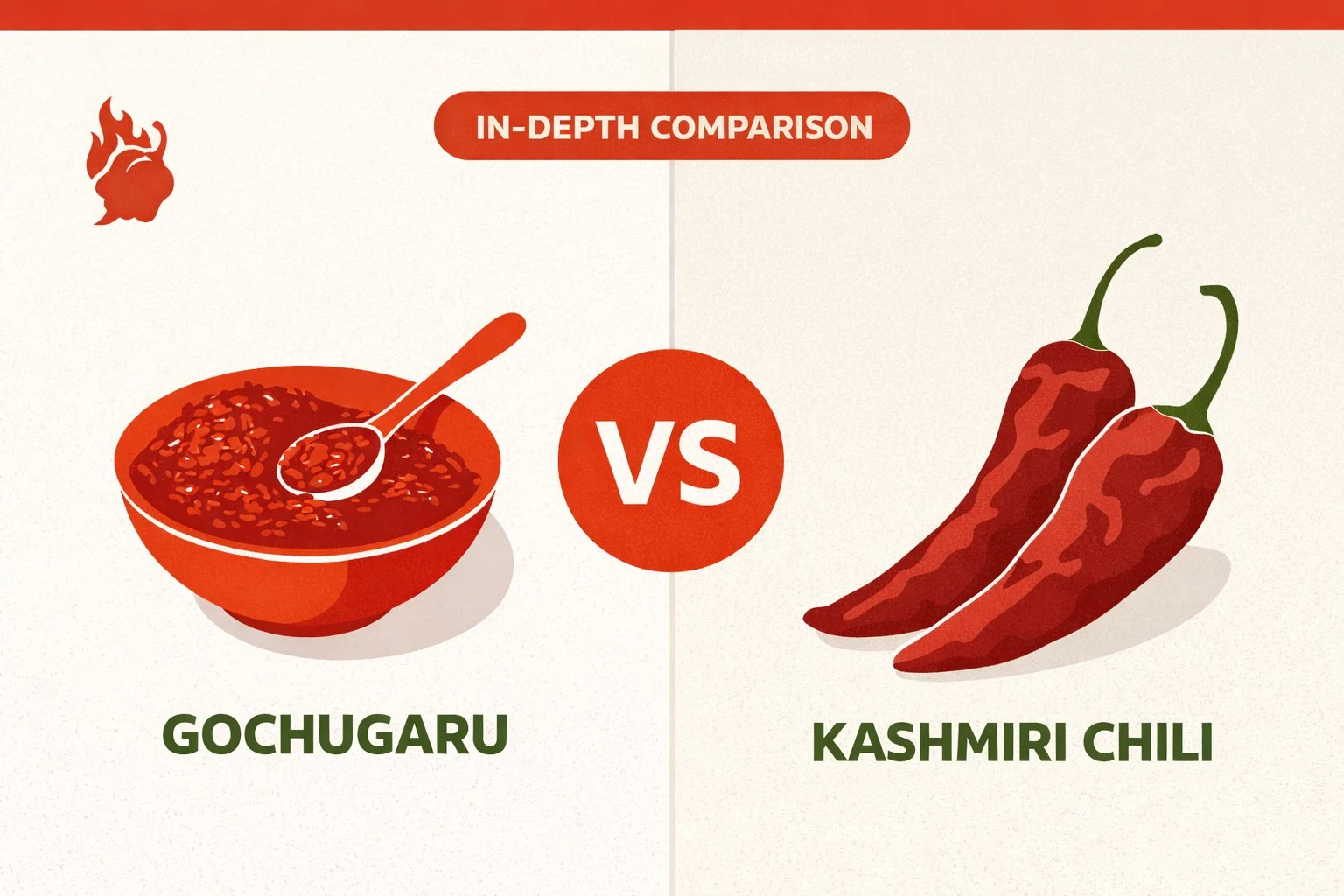
Gochugaru measures 2K–10K SHU while Kashmiri Chili registers 1K–2K SHU — making Gochugaru 5× hotter. Gochugaru is known for its smoky and sweet flavor (C. annuum), while Kashmiri Chili offers mild and sweet notes (C. annuum).
- Heat difference: Gochugaru is 5× hotter
- Species: Both are C. annuum
- Best for: Gochugaru excels in everyday cooking and salsas, Kashmiri Chili in fresh salsas and mild recipes
Gochugaru vs Kashmiri Chili Comparison
Gochugaru vs Kashmiri Chili Heat Levels
The first thing you notice about Kashmiri chili is not a burn — it's a warmth that spreads slowly across the palate, more like standing near a fire than touching one. Gochugaru turns up that dial noticeably, delivering a brighter, more present heat with occasional spikes depending on the batch.
On the Scoville scale's testing methodology, Kashmiri chili registers 1,000–2,000 SHU, which puts it comfortably in the mild-to-low SHU bracket — well below even a Fresno chili, which averages around 6,000 SHU. Gochugaru spans a wider range of 1,500–10,000 SHU; at its upper end, it can reach roughly 1.5 times hotter than a Fresno.
That variability in gochugaru matters. Korean pepper flakes are not standardized the way spice blends are — the heat depends on the cultivar, drying method, and grind. A bag labeled gochugaru from one producer might be barely detectable, while another hits with genuine warmth.
Kashmiri chili, by contrast, is remarkably consistent. Growers in the Kashmir Valley select specifically for low pungency and high color yield, which keeps the SHU range narrow and predictable. Both peppers belong to the broad C. annuum botanical lineage, which explains their structural similarity — but within that species, heat expression varies enormously by selection pressure.
For cooks who need to manage heat precisely — say, in a dish where children and adults share the same pot — Kashmiri chili is the safer call. Gochugaru gives you more range to work with, which is either a feature or a complication depending on your recipe.
Flavor Profile Comparison
The first time I cooked with gochugaru, I expected something close to crushed red pepper flakes.
Color is the whole point with Kashmiri chili.
These two peppers share a sweetness that makes them unusual among red chilies, but they express it differently enough that substituting one for the other will change a dish noticeably.
Gochugaru carries a smoky undercurrent — not the heavy wood-smoke of a chipotle, but a subtle earthiness that comes through in fermented applications like kimchi. There's also a fruity brightness, almost berry-like, that emerges when the flakes hit fat in a hot pan. Korean cuisine leans into this complexity; gochugaru is rarely a background player.
Kashmiri chili is more restrained. The flavor is clean, sweet, and slightly floral — its primary contribution to a dish is often its extraordinary deep red color rather than any dominant taste note. A teaspoon of Kashmiri chili powder can turn a curry sauce a vivid scarlet without adding meaningful heat or competing flavors. That neutrality is the point.
Aroma differs too. Gochugaru has a more assertive nose — you smell the pepper when the bag opens. Kashmiri chili is milder in fragrance, closer to sweet paprika than a pungent chili.
This contrast shows up clearly when you compare Kashmiri chili's sweet depth against paprika's milder profile — they're closer relatives in flavor terms than either is to gochugaru. Meanwhile, the smoky-sweet contrast between Aleppo and gochugaru illustrates how gochugaru's character holds its own against other complex dried chilies.
For dishes where you want the pepper to be a co-star, gochugaru. For dishes where you want brilliant color with a supporting role, Kashmiri chili.
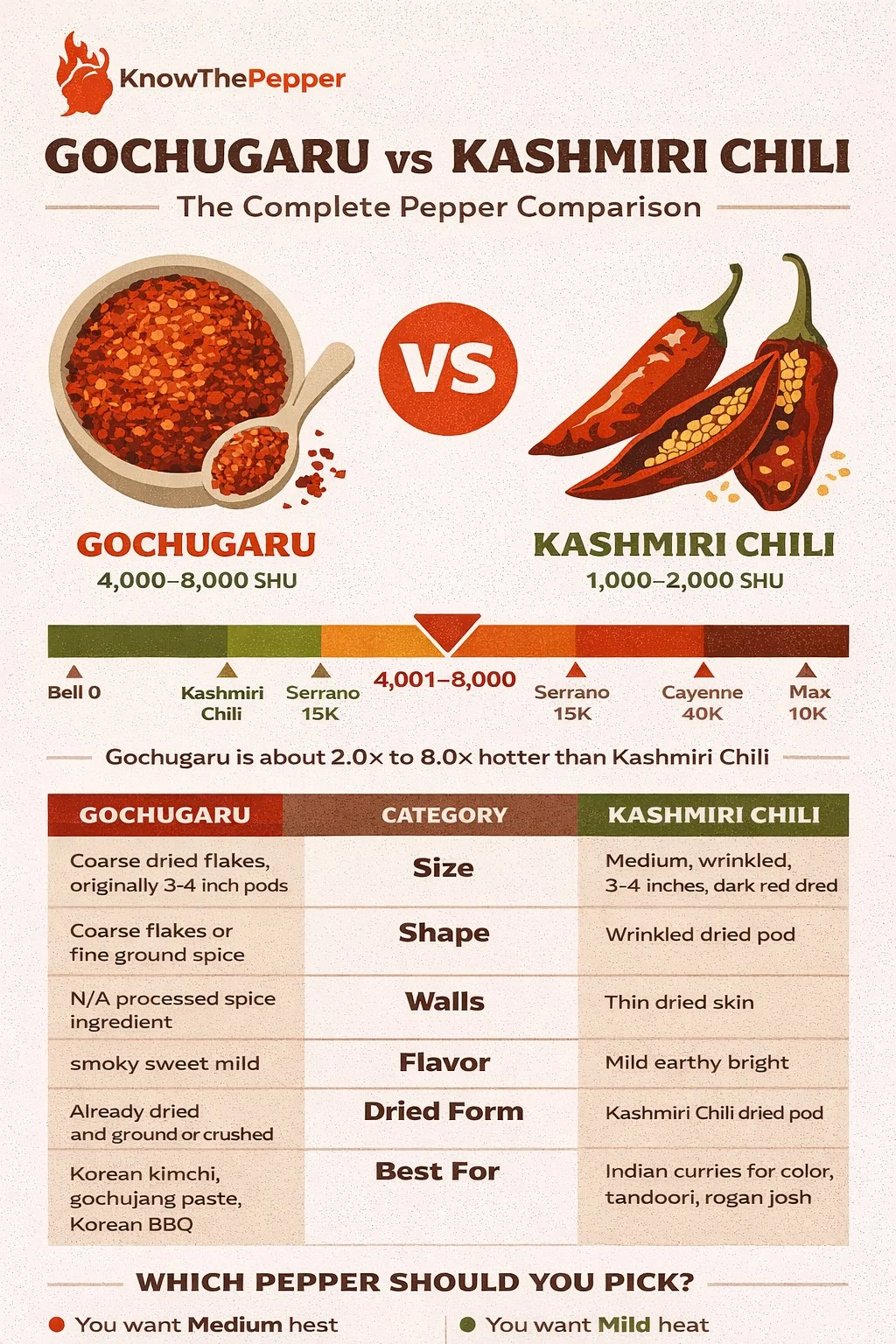
Culinary Uses for Gochugaru and Kashmiri Chili
Gochugaru is foundational to Korean pepper traditions — it's the backbone of kimchi, the base of gochujang paste, and the seasoning for tteokbokki, bulgogi marinades, and countless banchan. The flakes come in two grinds: coarse (굵은 고추가루) for kimchi fermentation, and fine (고운 고추가루) for sauces and soups. Using the wrong grind in kimchi changes the texture of the final product, not just the heat.
Outside Korean cooking, gochugaru works well in spiced oils, dry rubs for grilled meats, and anywhere you want smoky heat without the smokiness of chipotle. A tablespoon bloomed in sesame oil makes a fast chili oil that holds its own against restaurant versions.
Kashmiri chili is central to Indian pepper traditions — specifically Northern and Mughal-influenced cooking where color is as important as flavor. Rogan josh gets its characteristic brick-red hue from Kashmiri chili. Tandoori marinades, butter chicken, and many dal recipes rely on it for visual impact without overpowering heat.
It's also the honest alternative to artificial food coloring in spice blends. A pinch in a paella or a rice dish adds warmth of color without altering flavor balance.
Substitution ratios: If a recipe calls for Kashmiri chili and you only have gochugaru, use half the quantity and expect a smokier result. Going the other direction — swapping Kashmiri for gochugaru — use double the amount to approximate the color yield, but accept less complexity. Sweet paprika blended with a small amount of cayenne can substitute for either in a pinch.
For dishes where both color and fermentation are involved, there's no real substitute for gochugaru — its chemistry during fermentation is specific. Similarly, no other pepper replicates Kashmiri chili's color-to-heat ratio without additives. The Dundicut pepper compared to Kashmiri chili is a useful side-by-side for understanding how much color yield varies across mild Indian chilies.
Which Should You Choose?
If your priority is fermentation, bold Korean flavor, or smoky heat with some variability, gochugaru is the pepper. It's irreplaceable in kimchi and gochujang, and its flavor complexity rewards recipes that give it room to develop.
If your priority is vivid color, mild heat, and flavor neutrality, Kashmiri chili wins. It's the most elegant way to make a dish visually striking without committing to a particular flavor profile. Chefs who need to please heat-sensitive diners while maintaining a restaurant-quality red color reach for Kashmiri chili by default.
They're not interchangeable in any strict sense, but they do share enough heat range that you can substitute in casual cooking without disaster. The smoky-sweet complexity of gochugaru versus the clean sweetness of Kashmiri chili is the real dividing line — and that difference is about flavor identity, not just heat numbers.
For most home cooks, having both on the shelf makes sense. They fill different roles, and each one is inexpensive enough that stocking both costs less than a single restaurant meal.
Can You Substitute One for the Other?
Yes — direct substitution works. Gochugaru and Kashmiri Chili are close enough in heat to swap at roughly 1:1. The main difference will be flavor. For more swap options, explore ranked alternatives with conversion ratios.
Growing Gochugaru vs Kashmiri Chili
If you’re deciding which pepper to grow at home, consider your climate and patience level. Gochugaru and Kashmiri Chili have different maturation times and temperature preferences. Hotter varieties generally need a longer, warmer growing season to develop their full capsaicin content. Our zone-based planting date tool can pinpoint the best sowing window for your area.
Growing gochugaru-style peppers is straightforward if you can give them a long, warm season. Start seeds indoors 8-10 weeks before last frost - these are *C.
Transplant after all frost risk passes into full sun with well-draining soil. Plants reach 2-3 feet and produce heavily.
Drying is where most home growers get tripped up. Traditional sun-drying requires consistent heat and low humidity over several weeks.
Kashmiri chili is a warm-season annual that performs best in USDA zones 9–11 outdoors, though it grows well as a container plant in cooler climates when brought inside before frost. Start seeds indoors 8–10 weeks before last frost, maintaining soil temperature around 75–85°F for germination.
The plants are relatively compact — typically 18–24 inches tall — and moderately productive. They prefer well-drained, slightly acidic soil with consistent moisture.
For those comparing cultivation approaches, the Aji Panca's similarly low-heat growing profile offers a useful parallel — both reward patience over intensity manipulation.
History & Origin of Gochugaru and Kashmiri Chili
Both peppers carry centuries of culinary heritage. Gochugaru traces its roots to Korea, while Kashmiri Chili originates from India. Understanding their backstory helps explain why each pepper developed its distinctive traits.
Buying & Storage
Whether you’re shopping for Gochugaru or Kashmiri Chili, the same quality indicators apply. Fresh peppers should feel firm and heavy for their size, with taut, glossy skin and no soft or wet spots. Minor stem cracks known as “corking” are perfectly normal and often indicate a mature, flavorful pod.
- Firm pods with taut skin and consistent color
- Should feel heavy relative to size
- Minor stem cracks (“corking”) are normal
- Avoid anything soft, shriveled, or with dark wet spots
- Fresh: Paper bag, crisper drawer — 1–2 weeks
- Frozen: Wash, dry, freeze on sheet pan — 6+ months
- Dried: Airtight, away from light — up to 1 year
The Verdict: Gochugaru vs Kashmiri Chili
Gochugaru and Kashmiri Chili occupy very different positions on the heat spectrum. Gochugaru delivers 5× more heat with its distinctive smoky and sweet character. Kashmiri Chili, with its mild and sweet profile, excels in everyday cooking.
Frequently Asked Questions
Related Comparisons
Sources pending verification.