

KnowThePepper
Bolivian Rainbow Pepper: Edible Colors and Real Heat
The bolivian rainbow pepper is a compact ornamental Capsicum annuum that still brings real kitchen heat, usually landing around 10,000-30,000 SHU. Current seed sellers agree on the same identity cues: upright 3/4- to 1-inch pods, purple flowers, and a plant that can show purple, yellow, orange, and red fruit at the same time.
- Species: Capsicum annuum
- Heat tier: Hot (10K-100K SHU)
- Comparison: 1-12x hotter than a jalapeño, depending on where the jalapeño falls in its 2,500-8,000 SHU range
What Is Bolivian Rainbow Pepper Known For?
The bolivian rainbow pepper is one of the clearest examples of a pepper that earns its ornamental reputation and still deserves kitchen space. Siskiyou, Sandia, Tomato Growers, and Reimer all describe the same core traits: compact plants, upright fruit, purple flowers, and a ripening pattern that moves through several colors before finishing red.
Heat is real, not decorative. The most consistent published range for this cultivar is 10,000-30,000 SHU, which puts it above a typical jalapeno, overlapping serrano's upper heat range, and still below most cayenne's full heat range.
That range matters in practice because the pods are tiny. One fruit does not look intimidating, but a handful of them can season a jar of vinegar or a batch of pepper flakes quickly.
The plant is the real visual hook. Tomato Growers describes 2 to 3 foot plants with purple foliage and flowers, while Reimer and Sandia both call out the upright fruit and the multicolor display.
That combination is why this page should not be treated like a generic small hot pepper. The reader is usually asking whether Bolivian Rainbow is only for patio color, or whether it is worth cooking with too.
The honest answer is both. Bolivian Rainbow is one of the better container ornamentals because it stays compact and looks busy for a long stretch.
It is also one of the better small-fruited drying peppers because the thin walls lose moisture fast and the heat survives the trip into flakes and powder.
| Pod color | Harvest meaning | Best use |
|---|---|---|
| Purple | Early edible stage with the strongest visual contrast | Fresh garnish or mixed-color pickle |
| Yellow to orange | Mid-ripening fruit | Hot vinegar and whole-fruit pickle |
| Red | Fully mature stage | Drying, flakes, powder, and seed saving |
Where Does Bolivian Rainbow Pepper Come From?
Most current seed sources list Bolivia as the variety origin, but the exact breeder or preservation trail is not well documented. That is common for small ornamental annuum lines that moved through seed saving, home catalogs, and specialty sellers long before they picked up a clean modern paper trail.
What is documented clearly is the modern seed-trade identity. Reimer sells it as a Bolivian open-pollinated hot pepper with purple flowers and upright fruit.
Siskiyou lists the same rainbow ripening pattern and the same spicy, container-friendly habit. Sandia leans even harder into the ornamental story, but still marks the pods as edible and legitimately hot.
That matters because Bolivian Rainbow sits in a different role from bigger market peppers. It was not bred to be a thick-walled stuffer or a supermarket slicer.
It stayed in circulation because growers wanted a patio plant that looked dramatic and because cooks found that the little pods dried and pickled well enough to earn a place beyond decoration.
How Hot Is Bolivian Rainbow Pepper, and What Does It Taste Like?
The Bolivian Rainbow Pepper delivers 10K–30K Scoville Heat Units, placing it in the Hot tier (10K-100K SHU). That makes it roughly 1-12x hotter than a jalapeño, depending on where the jalapeño falls in its 2,500-8,000 SHU range.
Flavor notes: sharp, grassy, and lightly fruity.
Bolivian Rainbow Pepper Nutrition Facts
USDA FoodData Central is still the right general nutrition baseline for a pepper like Bolivian Rainbow: low calories, useful vitamin C, useful vitamin A precursors, and the usual water-rich fresh pepper profile when the pods are eaten raw. Because the fruits are small, most people eat several at a time or use them in preserved form instead of treating one pod as a serving.
The color shift is part of the nutrition story too. Purple-stage pods carry anthocyanin pigments, while the fully red stage leans harder into carotenoid development.
That does not turn Bolivian Rainbow into a special health product, but it does explain why the plant looks so unusual across the ripening window.
Heat stays in the moderate hot range, so the capsaicin story is still relevant without becoming the only story. If you want the chemistry behind that burn, capsaicin chemistry explains the burn.
On this page, the practical nutrition takeaway is simpler: this is a real edible pepper with more visual drama than most peppers people dry into flakes.
How Do You Use Bolivian Rainbow Pepper in the Kitchen?
Bolivian Rainbow works best when you use it for the jobs its shape supports. The fruits are small, upright, and thin walled, so they are more useful for drying, hot vinegar, pepper flakes, and whole-fruit pickles than for stuffing or roasting.
Reimer explicitly calls it an excellent drying pepper, and that is the most practical starting point for home cooks.
Fresh use still makes sense. Chopped raw, the peppers bring a fast, clean hit that sits closer to bird's eye chili's narrow, pointed heat than to a fleshy frying pepper.
The flavor is not especially sweet or smoky. It is sharper, greener, and more direct, which is why it works well in relishes, vinegar infusions, and small-batch hot sauces where the goal is brightness instead of bulk.
If you want a juicier fermented sauce pepper, Tabasco pepper's wetter flesh is easier to mash and strain. Bolivian Rainbow is better when you want the whole pod to dry cleanly or when you want a jar that looks as good as it tastes.
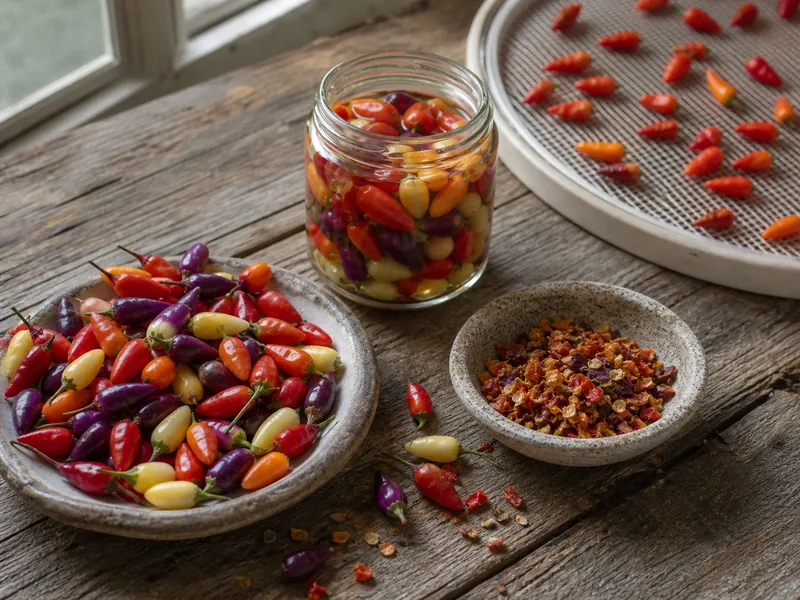
Mixed-color pickles are especially good here because the plant naturally gives you purple, yellow, orange, and red fruit in one harvest window.
The cultivar is also a smart flakes pepper. Dry the pods whole, crush them, and use them the way you would use a house pepper blend.
The heat is noticeable, but it does not flatten every dish the way a heavier superhot powder can.
Where Can You Buy Bolivian Rainbow Pepper, and How Do You Store It?
Fresh Bolivian Rainbow peppers are much easier to find as seeds or patio plants than as loose produce. Tomato Growers, Sandia, Siskiyou, and Reimer all sell seed, which tells you a lot about where this pepper lives commercially.
It is primarily a grower's variety, not a broad retail produce item.
When buying live plants, look for strong branching, visible flower set, and pods already moving through more than one color stage. That multi-stage fruiting is part of the point.
If the plant is all leaves and no buds, you are mostly buying promise instead of a finished ornamental display.
Fresh pods keep about 1 to 2 weeks in the refrigerator if they are dry and undamaged, but drying is the smarter long-storage move. Thin walls mean the fruits lose moisture fast and keep their heat well.
If you want to hold the harvest without dehydrating everything, freezing peppers also works because these fruits are usually destined for cooked or crushed uses anyway.
Which Peppers Can Replace Bolivian Rainbow Pepper?
Direct comparisons show where flavor, form, and preparation differ in the Aji Omnicolor vs Bolivian Rainbow matchups.
How Do You Grow Bolivian Rainbow Peppers?
Bolivian Rainbow follows the same warm-start rules as most hot annuums, but the published grow notes are unusually consistent. Sandia recommends starting seeds indoors about 8 weeks before warm weather with 85 F bottom heat.
Reimer gives a wider 14-28 day germination window at 80-85 F. Those numbers fit the standard University of Minnesota guidance for peppers: warm soil first, then steady light and careful hardening off.
Plant size is one of the big selling points. Tomato Growers puts the plant at 2 to 3 feet, Sandia says about 24 inches, and Reimer gives a broader 24-36 inch range.
In practice, that means the pepper is genuinely useful in containers, not just technically possible there. A 3 to 5 gallon pot with strong sun is enough for a productive patio plant, and container growing maps onto this cultivar cleanly.
Days to maturity vary by source from roughly 75 to 90 days after transplant, with Tomato Growers listing 80 days, Reimer listing 85 days, and Siskiyou listing 75-90 days. Use those numbers as a range, not as a promise.
If the plant is warm, well lit, and not overfed with nitrogen, it colors up fast and starts holding multiple ripening stages at once.
The biggest avoidable mistake is uneven watering during flowering and fruit set. Small ornamental plants still suffer from calcium and moisture swings, so pepper blossom end rot management matters here too.
For seed starting and transplant timing, the same rhythm from pepper seed-starting and the jalapeño growing schedule applies without much translation.
Bolivian Rainbow Pepper FAQ


- Siskiyou Seeds: Pepper, Bolivian Rainbow
- Sandia Seed Company: Bolivian Rainbow Pepper Seeds
- Reimer Seeds: Bolivian Rainbow Pepper Seeds
- University of Minnesota Extension: Growing peppers in home gardens
- USDA FoodData Central, SR Legacy 170106, Peppers, hot chili, red, raw
Species classification: Capsicum annuum - based on published botanical taxonomy.