

KnowThePepper
7 Pot Katie: Vendor Heat Figures and Disputed Parentage of a UK Superhot
7 Pot Katie is a UK-bred Capsicum chinense pepper that seed sellers place at 1,500,000 to 1,590,000 SHU. That span is useful for identifying it as a superhot, but it comes from vendor records rather than a cultivar-specific laboratory report, and sellers disagree about one side of its parentage.
- Species: C. chinense
- Heat tier: Super-Hot (1M+ SHU)
- Comparison: 188-636x hotter than a jalapeño, depending on where the jalapeño falls in its 2,500-8,000 SHU range
What Is 7 Pot Katie Known For?
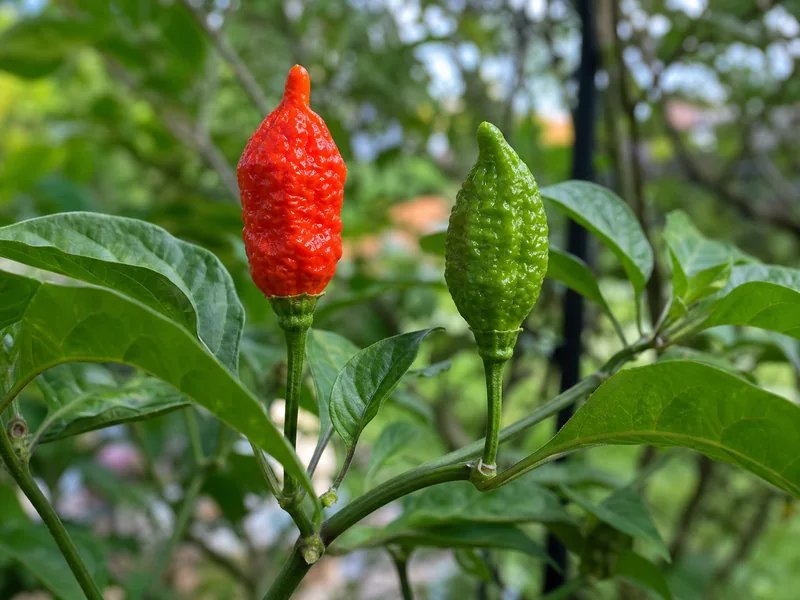
7 Pot Katie is a small, red, heavily wrinkled superhot associated with UK breeder Nick Duran, also known as Naga Nick. TummelstaChili identifies it as Capsicum chinense and describes irregular fruit about 5 cm long that points upward and changes from green to vivid red.
Vreeken lists the pepper at 1,500,000 SHU, while TummelstaChili publishes a ceiling of 1,590,000 SHU. No independent cultivar-specific laboratory report was located for this repair, so those numbers should be read as a vendor-published span rather than a verified record or ranking.
That evidence limit matters when a seller calls Katie hotter than another named superhot. Pepper heat can vary by genetics, fruit age, and growing conditions according to New Mexico State University, so unmatched catalog figures cannot prove that one cultivar will always outrun another.
The most useful identity clues are physical. TummelstaChili describes a deeply puckered, irregular pod near 5 cm, with fruit held upward and a green-to-red ripening sequence, while Pepper Joe's describes wrinkled pods in a roughly 1 to 3 inch range.
Flavor descriptions are less objective than the pod measurements. Vreeken calls the aroma fruity, and TummelstaChili uses tropical-fruit terms, so cooks can expect sellers to position Katie as fruit-forward while recognizing that KnowThePepper did not conduct a tasting trial.
| Source | Heat | Parentage |
|---|---|---|
| Vreeken | 1,500,000 SHU | Naga Viper x 7 Pot Jonah |
| TummelstaChili | up to 1,590,000 SHU | not stated |
| Pepper Joe's / Hugo | not stated | Naga Viper x Red Trinidad 7 Pot |
What Is the Origin of 7 Pot Katie?
The available seller records agree that Nick Duran, known as Naga Nick, developed 7 Pot Katie in the United Kingdom. They also agree that Naga Viper appears in the cross, which separates this cultivar's documented story from a generic claim that it is simply an old Trinidad 7 Pot selection.
The other parent is disputed. Pepper Joe's and Hugo Feed Mill describe a cross between Naga Viper and Red Trinidad 7 Pot, while Vreeken lists Naga Viper crossed with 7 Pot Jonah.
That disagreement should remain visible because it changes what a seed buyer can honestly claim about the line. A packet labeled only with the cultivar name does not settle the pedigree, so the best record is the breeder or seller's own generation and isolation information.
The number in the name still connects Katie to the broader 7 Pot naming tradition. It does not prove one pod will safely season seven pots, and it should never be used as a dosing rule for sauce or stew.
What Does 7 Pot Katie Taste Like, and How Hot Is It?
The 7 Pot Katie delivers 1.5M–1.6M Scoville Heat Units, placing it in the Super-Hot tier (1M+ SHU). That makes it roughly 188-636x hotter than a jalapeño, depending on where the jalapeño falls in its 2,500-8,000 SHU range.
Flavor notes: fruity and bright.
7 Pot Katie Nutrition Facts
USDA FoodData Central does not publish a cultivar-specific entry for 7 Pot Katie. Generic hot-pepper calorie, vitamin C, vitamin A, and 100 g values therefore cannot be presented as measurements of this seed line.
New Mexico State University identifies the placenta, the pale internal tissue that holds the seeds, as the site of capsaicinoid-producing glands. That anatomy explains why removing only loose seeds does not remove most of a superhot pepper's burn, but it is not a nutrition or health claim.
How Do You Use 7 Pot Katie in the Kitchen?
Use 7 Pot Katie where a very small measured addition can season an entire batch. Sauce, fermented mash, and dried powder make more sense than stuffing or eating a whole pod because they let the pepper disperse evenly and allow the amount to be recorded.
Vreeken describes a fruity aroma, while TummelstaChili uses mango and papaya language in its seller notes. Those descriptions support pairing Katie with fruit, vinegar, tomato, or other acidic sauce bases, but they remain vendor observations rather than an editorial tasting result.
There is no responsible universal rule such as one pod per quart. Pod size, actual capsaicinoid concentration, batch weight, and the eater's tolerance all change the result, so weigh the portion, blend it through the full batch, and increase only after the first addition is fully dispersed.
Drying turns the cultivar into a concentrated seasoning that is easier to divide than a fresh pod. Keep the powder away from the face, label the container with the cultivar and date, and open or grind it with ventilation because airborne particles can irritate eyes and airways.
A raw-pepper challenge does not add useful information about flavor or quality. For kitchen evaluation, use gloves, prepare a controlled batch, and let dilution rather than endurance determine the tasting amount.
How Do You Buy and Store 7 Pot Katie?
Buy 7 Pot Katie seed from a seller that states the breeder, generation, and isolation status. That record matters more than a dramatic heat claim because Pepper Joe's currently labels its Katie seed non-isolated and unstable, which means offspring may vary.
Use the mature pod as a second identity check. TummelstaChili describes fruit around 5 cm that is irregular, heavily wrinkled, held upward, and vivid red at maturity, so long smooth cayenne-shaped fruit should be treated as off-type or mislabeled.
For fresh pods, University of Minnesota Extension recommends harvesting peppers at the desired size or color and notes that refrigeration is suitable only for a short period because peppers can develop cold injury. Keep sound pods dry in a perforated bag, and discard fruit with soft, wet, or moldy areas.
For longer storage, the National Center for Home Food Preservation says hot peppers can be washed, stemmed, packaged, and frozen without blanching. Frozen pods lose crisp texture, so reserve them for sauce or cooked dishes and keep the package clearly labeled as a superhot.
What Is a Good Substitute for 7 Pot Katie?
No dedicated substitute guidance is published for 7 Pot Katie yet.
How Do You Start and Grow 7 Pot Katie Peppers?
Plan 7 Pot Katie as a long-season warm-weather pepper, but do not rely on an invented cultivar-specific maturity date. University of Minnesota Extension recommends starting peppers about 8 weeks before outdoor planting, while Utah State University Extension allows 8 to 10 weeks for transplants.
Warmth matters most at germination. Minnesota recommends a heat mat at 80 to 90 F until emergence, and Utah State uses about 80 F, so check the growing medium with a probe instead of assuming a warm room gives the same root-zone temperature.
Harden seedlings outdoors for 1 to 2 weeks and wait until frost risk has passed.
Minnesota advises transplanting after nights stay above 50 F, while Utah State uses soil near 60 F as a practical threshold.
Give the plant full sun, well-drained soil, and steady moisture. Both extension services recommend about 18 inches between pepper plants, and Minnesota warns that dry soil plus temperature extremes can weaken growth and fruit set.
Use color and pod form to decide when Katie is ripe. TummelstaChili describes an upward-pointing fruit that turns from green to vivid red, so harvest when the pod has reached full red color and remains firm rather than waiting for a fixed number of days.
Save seed only when the source plant matches the expected fruit and was isolated from other Capsicum chinense plants.
Without that isolation record, label saved seed as open-pollinated and expect variation instead of promising a true-to-type Katie plant.
7 Pot Katie FAQ


- TummelstaChili - 7 Pot Katie
- Vreeken - Peper 7 Pot Katie
- Pepper Joe's - 7 Pot Katie Pepper Seeds
- New Mexico State University - Chile Pepper Cultivars for New Mexico
- University of Minnesota Extension - Growing Peppers
- Utah State University Extension - Peppers in the Garden
- National Center for Home Food Preservation - Freezing Hot Peppers
Species classification: C. chinense - based on published botanical taxonomy.