
Its home-garden guidance pairs the higher row-weight figure with local planting, spacing, weather, and management information.

Growing Guide
How Many Peppers Per Plant? Realistic Yields by Type
A full-size bell pepper plant commonly produces about 6 to 8 or more marketable fruits in extension guidance, while documented small-fruited cultivars can produce dozens. Keep cultivar, setting, harvest window, ripeness, and measurement unit attached to any number before using it to forecast your plant.
Growing Guide
How Many Peppers Per Plant? Realistic Yields by Type
9 min
9 sections
How Many Peppers Can One Plant Realistically Produce?
A healthy full-size bell pepper plant commonly produces 6 to 8 or more marketable peppers, according to Michigan State Extension. Smaller-fruited peppers can produce dozens, but no single count applies across bells, mini sweets, jalapeños, habaneros, and tiny drying chiles.
6 to 8+full-size bell peppers in extension guidance
Dozenspossible on documented small-fruited cultivars
2 measuresfruit count and total harvest weight
Treat 6 to 8 or more as a full-size bell baseline, not a promise for every pepper.
A useful estimate also identifies the cultivar, growing setting, length of the harvest window, ripeness at picking, and whether yield means pieces or weight.
Those labels matter because a plant may hold five large bells or fifty slim chiles and still devote a similar share of its resources to fruit. Start with the nearest documented example, then replace that borrowed number with records from your own plant.
Which Pepper Yields Have Useful Source Context?
The strongest published numbers keep their boundaries attached. They identify a pepper or cultivar and tell you whether the count came from a home-garden recommendation, a variety trial, one concentrated crop, or several experimental harvests.
6 to 8+Bell
24 to 34Mini sweet
about 50Jalapeño
41 to 57Habanero
Context controls the comparison because these bars share a 0 to 60 fruit scale but do not come from one trial. Read the cultivar, setting, and harvest window in the table before using a value.
Michigan State uses the general bell figure of 6 to 8 or more fruits per plant. The University of Maine recorded 24 to 34 fruits per plant for Cupid, Lunch Box Mix, and Yummy Mix, which are three small-fruited sweet cultivars in its 2013 trial.
| Documented example | Reported count | What the number actually describes |
|---|---|---|
| Full-size bell pepper | 6 to 8 or more | General extension expectation, with variety affecting the result |
| Cupid, Lunch Box Mix, Yummy Mix | 24 to 34 per plant | Three small-fruited sweet cultivars in a University of Maine trial |
| San Joaquin F1 jalapeño | About 50 per plant | A determinate cultivar described by Nebraska Extension as holding most fruit at once |
| Experimental habanero plants | 41 to 57 per plant | Five treatments measured across three greenhouse harvests in a peer-reviewed study |
Nebraska Extension's San Joaquin F1 example is especially easy to misuse. Its roughly 50 fruits describe a named determinate jalapeño that sets a concentrated crop, not every jalapeño grown through a full summer.
The habanero figures need the same restraint. Researchers counted 41 to 57 fruits per plant across three harvests under greenhouse treatments, so the numbers demonstrate a measured range within that experiment rather than a backyard guarantee.
Why Do Credible Yield Estimates Disagree?
Even university extension figures can look contradictory when the denominator disappears. Iowa State reports about 15 to 20 pounds per 10-foot row with good management, while Maryland gives an approximate range of 2 to 8 pounds per 10-foot row.
Its Mid-Atlantic guidance publishes a wider, lower row-weight estimate alongside local maturity, spacing, container, and heat-stress notes.
Neither source supplies enough shared information to divide pounds by an assumed plant count and call the result universal. Row spacing, within-row spacing, pepper mix, harvest color, season length, losses, and local weather can all change the denominator.
A number also changes meaning when one source reports marketable fruit count and another reports total weight.
Before borrowing any yield claim, ask which pepper, where, how many pickings, and measured in what unit.
Why Does Fruit Size Matter More Than One Generic Count?
Fruit count answers how many individual peppers you can pick. Harvest weight answers how much sauce, roasted pepper, frozen product, or dried material the crop can supply.
Researchers often record both because they are not interchangeable. A plant with thirty mini sweets can beat a bell plant on pieces while the bells still provide more flesh per fruit.
| Your planned use | Best primary measure | What count alone misses |
|---|---|---|
| Stuffed peppers or individual servings | Marketable fruit count | Wall thickness and usable cavity size |
| Salsa, sauce, freezing, or roasting | Total fresh weight | Trim loss, water content, and wall thickness |
| Drying whole pods | Count plus dry weight | Fresh weight includes water that will leave |
| Comparing two plants | Count and weight at the same maturity | Green and fully colored fruit stayed on the plant for different lengths of time |
Countpieces harvested from one labelled plant
Weightusable mass after each picking
Stagegreen, turning, or fully colored at harvest
Record the three together. A note such as “Plant A, picking 3, nine green jalapeños, 410 grams” supports a real comparison, while “nine peppers” loses variety, weight, stage, and harvest timing.
What Counts as One Plant's Seasonal Yield?
Seasonal yield is everything harvested from one labelled plant between its first usable fruit and the final picking. It is not the number hanging on the branches during one inspection.
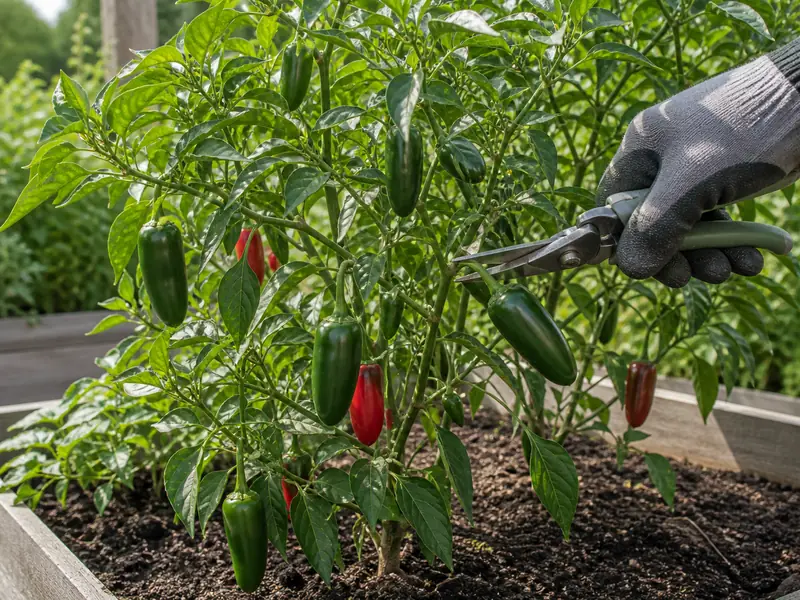
Utah State says pepper fruit may take about 35 to 45 days to move from flowering to full color, depending on temperature and variety.
That delay means one plant can hold flowers, newly set fruit, mature green pods, and coloring pods at the same time.
- Completed yield includes every sound pepper already picked from that plant.
- Current crop load includes established fruit still attached, separated by size or maturity if timing matters.
- Conditional crop includes newly set fruit that still needs enough warm weather to finish.
- Flowers stay separate because heat, cold, water stress, and incomplete pollination can prevent them from becoming harvestable fruit.
Choose one harvest definition before comparing plants. Counting mature green peppers on one plant and only fully colored fruit on another gives the second plant a longer per-fruit waiting period and makes the totals hard to interpret.
Research trials solve this by defining harvest rules and adding repeated pickings. A home gardener can use the same principle with a simple notebook, kitchen scale, and plant label.
How Can You Estimate the Final Total Before Frost?
A forecast works best as a range with two confidence levels. The low case counts what is already secure, while the upper case includes fruit that can finish only if weather and plant health cooperate.
- Add every completed picking. Use the running count from the labelled plant rather than memory.
- Count established fruit. Include firm fruit with visible growth, but note any sunscald, rot, insect damage, or broken stems that may remove it from the marketable total.
- Separate newly set fruit. Keep tiny fruit in the conditional column until growth continues after the next inspection.
- Check time to frost. Compare the warm period remaining with the variety's maturity information and Utah State's 35 to 45 day flower-to-color context.
- Recalculate after each harvest. Move picked fruit into the completed total and revise the conditional group from what actually set and grew.
A plant with 18 peppers already picked, 11 sound established fruits, and 7 newly set fruits has a conservative forecast of 29 peppers. Its conditional upper estimate is 36 only if those seven young fruits keep growing and the season is long enough.
- Low estimate = completed harvest + sound established fruit.
- Conditional estimate = low estimate + newly set fruit likely to finish.
- Do not add every flower because a flower is potential, not a marketable pepper.
If the plant will be picked green, more of the current load may fit inside a short remaining window. A fully colored harvest needs extra time on the plant, so the same late-season crop can produce a lower finished count before frost.
Does a Container Change the Expected Yield?
A container can support a strong pepper harvest, but its volume changes how stable the root zone remains between waterings.
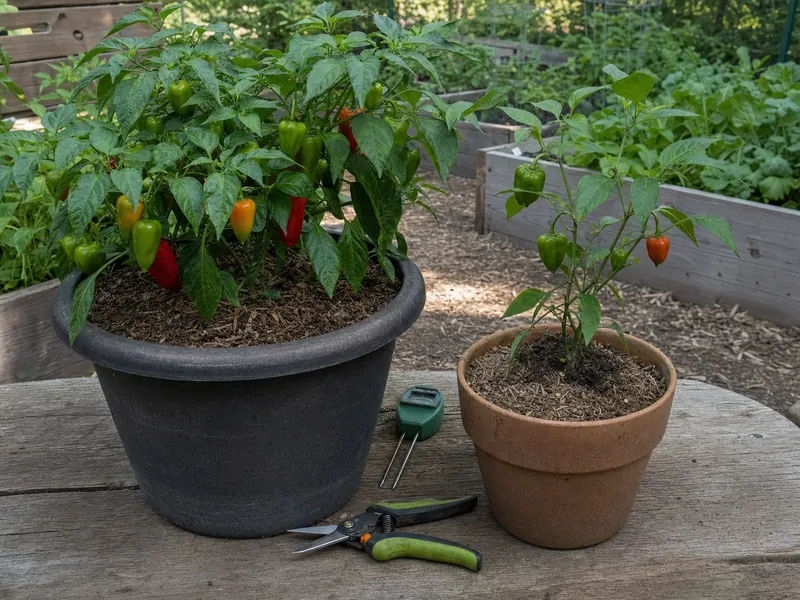
Maryland Extension recommends a 5-gallon minimum for peppers grown in containers.
Pot size does not rewrite the cultivar's genetics. It changes the room available for roots and the speed at which the mix can heat, cool, dry, or become saturated.
The pot is at least five gallons, drains freely, and retains usable moisture between normal checks. Keep recording actual pickings.
The plant recovers each evening but wilts before scheduled watering. Treat flowers and tiny fruit as less certain until moisture stays steadier.
Roots circle a very small pot, water runs through immediately, or the mix stays saturated. The present count cannot predict a full-season crop reliably.
Do not subtract a generic 20 or 30 percent because a plant grows in a pot. No extension source supports one penalty across container size, mix, climate, cultivar, and watering practice.
Instead, lower confidence in the conditional forecast when moisture swings or root restriction interrupt new growth. Once the root zone stabilizes, the plant's recorded pickings provide better evidence than the word “container.”
When Is a Small Pepper Harvest Still Normal?
A low count is normal when the plant is young, fruit set has only just begun, or a temperature extreme temporarily interrupted flowering. It becomes a diagnosis problem when suitable conditions return but new flowers still fail, growth stops, or fruit damage keeps reducing the marketable total.
| What you see | First check | How to read the count |
|---|---|---|
| Stocky young plant with buds but no fruit | Days since transplant and variety maturity | Too early to judge. Track the first successful fruit set. |
| Flowers dropped during hot days or cold nights | Recent daytime and nighttime temperatures | Interrupted set. Look for new fruit after milder weather returns. |
| Dark leafy growth with few flowers | Recent nitrogen applications | Growth imbalance. Stop treating leaf size as yield progress. |
| Wilt followed by blossom or tiny-fruit drop | Moisture below the surface and drainage | Unstable forecast. Separate drought from saturated roots before watering again. |
| Flowers continue but no fruit sets in suitable weather | Flower condition, pollinator access, pests, and plant health | Needs diagnosis. The count is no longer explained by timing alone. |
Iowa State reports strongest bell pepper fruit set around 70 to 80°F and notes that colder nights or hotter days can abort flowers. Utah State likewise describes weather-related flower abortion and warns that irregular watering can cause flower drop.
Wait for a specific recovery signal such as fresh flowers holding tiny fruit or established fruit resuming growth. If that signal never appears, diagnose the symptom itself rather than adding fertilizer merely because the count is low.
How Many Pepper Plants Should You Grow Per Person?
Utah State suggests 3 to 4 pepper plants per person for fresh use, plus 5 to 10 additional plants when the goal includes pickling, canning, drying, or freezing. That is a regional starting range, not a household requirement.
Your own plan should begin with how many peppers or pounds the household will use.
A family that adds one jalapeño to dinner twice a week needs a different garden from a family filling several jars in one weekend.
| Use goal | Planning input | How to convert it |
|---|---|---|
| Fresh bells for weekly meals | Meals per week × bells per meal × harvest weeks | Divide by a conservative full-size bell yield, then round up |
| Fresh small hot peppers | Pods used per week × harvest weeks | Divide by a named cultivar estimate or last year's recorded plant total |
| One preserving batch | Pounds or pods required by the tested recipe | Plan the batch separately from routine fresh use |
| Uncertain weather or plant loss | The specific number of plants you can afford to lose | Add a buffer only for that named risk and available space |
For example, suppose a household wants 36 full-size bells and uses the grounded lower figure of six marketable bells per plant. The arithmetic gives six plants, before any adjustment for a short season, disease history, or the desire to harvest every bell fully colored.
- Choose the unit. Plan in peppers for individual servings or in pounds for bulk processing.
- Estimate total use. Separate fresh meals from one-time preserving batches.
- Select a conservative yield. Prefer a cultivar trial, extension figure, or your own prior record.
- Divide and round up. Six plants from the calculation means six, not an automatic ten.
- Name the buffer. Add another plant only when it covers a real risk such as a known disease loss or unreliable transplant survival.
The first season creates the most valuable local benchmark. Label each plant, total its pickings, record weight and maturity stage, and use that evidence to replace generic online ranges the next time you order seed.
Handy tools
Editorial Review
Editorial Standards: Instructions and factual claims are checked against available source material and editorial notes before publication.
Review Process:
Prepared by
Know The Pepper Editorial Team
(Editorial review desk)
. Last updated September 3, 2026.
Sources & References
- Michigan State University Extension - How to Grow Peppers
- University of Maine Cooperative Extension - Evaluation of Sweet Pepper Varieties 2013
- Nebraska Extension Backyard Farmer - Pepper, Jalapeño
- Induced Systemic Resistance in the Bacillus spp.-Capsicum chinense-PepGMV Interaction
- University of the West Indies - Evaluation of Yield and Agronomic Traits in Capsicum chinense
- Iowa State University Extension - Growing Peppers in the Home Garden
- Utah State University Extension - How to Grow Peppers in Your Garden
- University of Maryland Extension - Growing Peppers in a Home Garden
Sources Listed