Cayenne is the better seasoning when you need dry, even, controllable heat. Thai chili is the better pepper when the dish needs fresh pod bite, Southeast Asian aroma, and sharper heat in small pieces.
Comparison Contributor·Updated Jun 29, 2026·
Reviewed by
Karen Liu
Quick Comparison
Cayenne Pepper measures 30K–50K SHU while Thai Chili registers 50K–100K SHU. That makes Thai Chili about 2x hotter by upper SHU range. Cayenne Pepper is known for its neutral and peppery flavor (C. annuum), while Thai Chili offers bright and peppery notes (C. annuum).
Cayenne Pepper
30K–50K SHU
Hot · neutral and peppery
Thai Chili
50K–100K SHU
Hot · bright and peppery
Heat difference: Thai Chili is about 2× hotter by upper SHU range
Species: Both are C. annuum
Best for: Cayenne Pepper excels in everyday cooking and salsas, Thai Chili in hot sauces and spicy dishes
Thai Chili is
about 2× hotter than Cayenne Pepper.
Cayenne Pepper spans 30K–50K SHU, roughly 6× a jalapeño at the upper end.
Thai Chili spans 50K–100K SHU, about 13× a jalapeño at the upper end.
Use the ranges to decide whether the recipe needs a measured dose, a mild overlap, or a hard substitution limit.
Tools: Scoville chart and SHU calculator.
Few peppers have traveled as far or worked as hard as cayenne. Originating in French Guiana, it spread through trade routes to become a fixture in cuisines from Louisiana to Sichuan to Ayurvedic medicine cabinets.
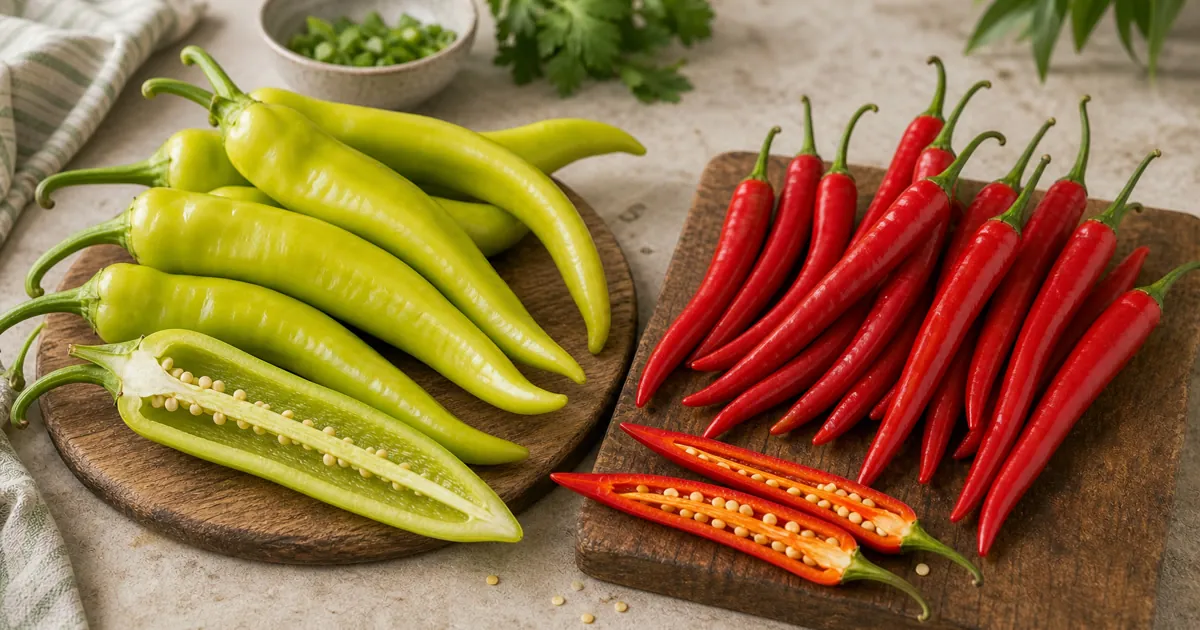
The fresh pods are long, slender, and bright red at maturity - typically 4–6 inches with a tapered tip. As a C. annuum botanical species, cayenne shares its genetic family with jalapeños, bells, and serranos, though its heat - 30,000–50,000 SHU - puts it well above most of its relatives in the hot heat tier.
Thai Chili
brightpepperyC. annuum
Thai chilis are small, thin, fierce, and essential. At 50,000-100,000 SHU, they punch well above their size - roughly 6-40x hotter than a jalapeño - in pods that are typically 1-3 inches long and no wider than a pencil.
The term 'Thai chili' covers a range of related Capsicum annuum varieties used across Thai cuisine and throughout Southeast Asia. Two are most common in Western markets.
Both peppers belong to C. annuum, so they share some underlying flavor chemistry. However, Cayenne Pepper’s neutral and peppery notes contrast with Thai Chili’s bright and peppery character.
Cayenne Pepper brings neutral and peppery notes, so it fits recipes where that flavor should remain visible.
Thai Chili leans bright and peppery, which can change the sauce, filling, marinade, or garnish even when the heat range looks close.
Culinary Uses for Cayenne Pepper and Thai Chili
Cayenne Pepper
Ground cayenne is a workhorse ingredient. A quarter teaspoon can lift an entire pot of soup; a full teaspoon starts to build serious heat.
Cooking ratio to remember: 1/4 teaspoon ground cayenne approximates the heat of 1 medium fresh cayenne pepper in a dish for 4 people. Scale from there based on preference.
For peppers for grilling, whole dried cayenne pods rehydrate well in hot water for 20 minutes and can be blended into sauces. The rehydrated form has more body than ground powder and adds texture to salsas.
Thai Chili
In Thai cooking, chilis function in three distinct modes: fresh in salads and as table condiment, pounded into curry pastes, and dried or fried in stir-fries. Each mode produces a different flavor output from the same pepper.
Fresh Thai chilis sliced thin and added directly to som tam (green papaya salad) contribute their full fresh sharpness. A traditional recipe uses 2-4 prik kee nu per serving - adjustable to taste.
For homemade red or green curry paste, 6-8 dried or fresh Thai chilis per cup of curry paste is a baseline for medium heat in the final dish. Adjust up or down based on preference, then scale by how much paste goes into the dish.
Use approximately 1/2 the amount. Start with less and add gradually.
Milder replacement
Replacing Thai Chili with Cayenne Pepper
Use 2× the amount, but you still won’t reach the same heat intensity.
Growing Cayenne Pepper vs Thai Chili
Growing notes
Cayenne Pepper
Cayenne is one of the more forgiving hot peppers to grow, which explains its global reach. Start seeds indoors 8–10 weeks before last frost.
Cayenne wants 8+ hours of direct sun daily. It tolerates more heat than many peppers and continues setting fruit at temperatures that cause jalapeños to drop blossoms - a key advantage in hot summer climates.
Space plants 18–24 inches apart in well-drained soil with pH 6.0–6.
Growing notes
Thai Chili
Thai chili plants are compact, prolific, and heat-loving - one of the easier ornamental/culinary hot peppers to grow in containers. Plants reach 12-24 inches tall and produce pods that stand upright when young, pointing skyward, then droop as they mature - a natural harvest indicator.
Start seeds indoors 8-10 weeks before last frost at 75-85°F soil temperature. Germination takes 10-21 days.
Transplant spacing: 12-18 inches apart - plants are more compact than jalapeños and can be positioned closer. They want 8+ hours of direct sun for maximum production and heat development.
Where They Come From
Origin & background
Cayenne Pepper
French Guiana · C. annuum
Cayenne traces back to French Guiana on South America's northeastern coast, where indigenous peoples cultivated Capsicum annuum varieties long before European contact. Portuguese and Spanish traders carried the pepper eastward in the 16th century, and it took root across Asia, Africa, and Europe with remarkable speed.
By the 18th century, cayenne had become a staple in European apothecaries, listed as 'capsicum tincture' for digestive complaints and circulation. This medicinal reputation persisted well into the 19th century - cayenne tinctures appeared in the British Pharmacopoeia until the mid-20th century.
Origin & background
Thai Chili
Thailand · C. annuum
Capsicum peppers arrived in Southeast Asia via Portuguese traders in the 16th century, moving from the Americas through Portuguese trade routes that connected Goa, Malacca, and the Spice Islands. What happened next was rapid adoption: within a century, chili peppers had replaced or supplemented indigenous heat sources (long pepper, black pepper, galangal) across Thai, Vietnamese, and Indonesian cuisines.
Thai cuisine's integration of chili was particularly thorough. By the 18th century, the pepper had become structurally embedded in Thai cooking - not an addition to existing dishes but a defining element of new flavor combinations that emerged from the integration.
Buying & Storage
Whether you’re shopping for Cayenne Pepper or Thai Chili, the same quality indicators apply. Fresh peppers should feel firm and heavy for their size, with taut, glossy skin and no soft or wet spots. Minor stem cracks known as “corking” are perfectly normal and often indicate a mature, flavorful pod.
Selection
What to look for
Firm pods with taut skin and consistent color
Should feel heavy relative to size
Minor stem cracks (“corking”) are normal
Avoid anything soft, shriveled, or with dark wet spots
Storage
How to store them
Fresh: Paper bag, crisper drawer, 1 to 2 weeks
Frozen: Wash, dry, freeze on sheet pan, 6+ months
Dried: Airtight and away from light, up to 1 year
Mistakes to avoid
Common misses
Cayenne Pepper
Blaming the seeds. Membranes hold most capsaicin.
Adding heat too early. Capsaicin breaks down with cooking.
Not tasting individual pods. Heat varies 30%+.
Common misses
Thai Chili
Blaming the seeds. Membranes hold most capsaicin.
Adding heat too early. Capsaicin breaks down with cooking.
Not tasting individual pods. Heat varies 30%+.
Final call
Cayenne Pepper vs Thai Chili
Cayenne Pepper and Thai Chili
sit in the same heat tier but serve different roles. Thai Chili delivers about 2× more upper-range heat with its distinctive bright and peppery character.
Cayenne Pepper, with its neutral and peppery profile, excels in everyday cooking.
Heat gap about 2× by upper rangeCayenne Pepper neutral and pepperyThai Chili bright and peppery
The useful answer starts with form, not heat. Cayenne usually enters the kitchen as powder. Thai chili usually enters as a fresh pod, whole dried pod, or pounded paste.
Powder disappears into fat, flour, broth, spice blends, and sauces. Fresh Thai chili stays visible, aromatic, and sometimes sharp in a single bite. That changes timing: cayenne can go in early; Thai chili often matters most when it is pounded, fried, sliced, or added near the finish.
Heat Delivery And Dose
Thai chili usually has the higher ceiling, often 50,000-100,000 SHU compared with cayenne around 30,000-50,000 SHU. Both belong in the hot pepper tier, but they do not feel the same.
Cayenne is easier to scale. A measured 1/4 teaspoon can season a pot, and another pinch can be added without changing texture.
Thai chili is easier to over-localize. One sliced pod can make one forkful much hotter than the rest of the dish, especially when seeds and placenta stay attached.
Regional Role And Texture
Thai chili is part of the texture and aroma in many Southeast Asian dishes: pounded with garlic and lime, sliced into fish sauce, fried into oil, or crushed into curry paste. Cayenne is better when heat should stay in the background of a rub, buffalo sauce, chili, stew, or smooth dip.
Substitution Without Flattening
When Thai chili is missing, choose the substitute by dish instead of reaching for cayenne every time. A raw garnish needs fresh serrano or another small fresh chile. A cooked sauce can take cayenne. A paste may need dried Thai pods or another chile that can be pounded without turning watery.
When cayenne is missing, Thai chili works only if you control moisture and texture. Minced fresh pods add liquid and pieces. Dried Thai pods can be ground closer to powder, but they still taste brighter and less neutral.
Match delivery first. A dry rub needs powder. A salad needs fresh crunch and aroma. A smooth sauce needs dispersed heat.
For a safer starting point, replace one small fresh Thai chili with a pinch of cayenne in cooked food, then adjust after the dish rests. For raw sauces, start even lower because the heat has nowhere to hide.
Pantry And Market Choice
Best practice is to keep cayenne in the spice cabinet and buy Thai chilies when the recipe names them. They solve different jobs, so one does not make the other redundant.
Choose bright red-orange cayenne powder that smells clean rather than dusty. Choose firm Thai chilies with glossy skin and no damp stem rot. Freeze extra Thai chilies whole; their thin walls handle it better than many larger fresh peppers.
Fact-Checked & Expert Reviewed
Editorial Standards: Head-to-head comparisons include blind tasting when applicable. Heat levels cross-referenced with multiple sources. All substitution ratios tested side-by-side.
Review Process:
Written by
James Thompson
(Lead Comparison Reviewer)
, reviewed by
Karen Liu
(Lead Fact-Checker & Science Editor)
. Last updated June 29, 2026.
Cayenne Pepper vs Thai Chili FAQ
Usually yes. Thai chili is commonly listed at 50,000 to 100,000 SHU, while cayenne is about 30,000 to 50,000 SHU. The form still matters because powder spreads differently than fresh pods.
Yes in cooked sauces, soups, and dry seasoning. Start with 1/8 to 1/4 teaspoon cayenne for one small Thai chili, then adjust after the dish cooks.
Yes when fresh texture is acceptable. Use about half a small minced Thai chili for 1/4 teaspoon cayenne, or grind dried Thai pods for a closer dry substitute.
Use Thai chili. Curry paste needs chile flesh and fresh aroma, not only heat. Cayenne can adjust heat, but it will not give the same paste texture.