Guajillo Pepper vs New Mexico Chile: What's the Difference?
The guajillo and New Mexico chile are both dried red peppers central to North American cooking, but they come from different traditions and deliver noticeably different results on the plate. Guajillo brings a tangy, berry-forward complexity with relatively mild heat, while New Mexico chile offers a cleaner, earthier sweetness with a wider heat range topping out around 8,000 SHU. Understanding what separates them makes substitution decisions — and sourcing decisions — much clearer.

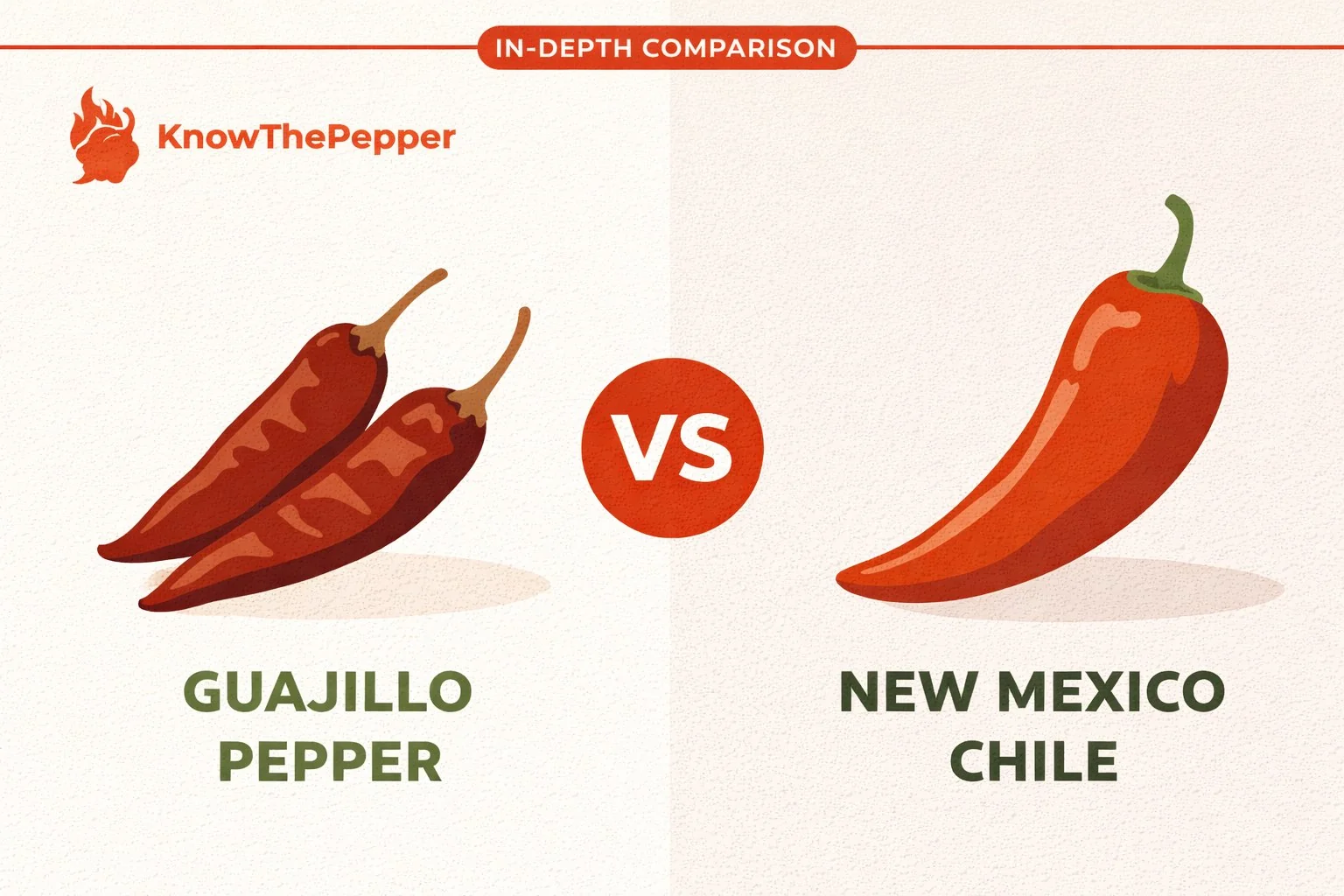
Guajillo Pepper measures 3K–5K SHU while New Mexico Chile registers 1K–8K SHU — making New Mexico Chile 2× hotter. Guajillo Pepper is known for its tangy and sweet flavor (C. annuum), while New Mexico Chile offers earthy and sweet notes (C. annuum).
- Heat difference: New Mexico Chile is 2× hotter
- Species: Both are C. annuum
- Best for: Guajillo Pepper excels in everyday cooking and salsas, New Mexico Chile in fresh salsas and mild recipes
Guajillo Pepper
MediumNew Mexico Chile
MediumGuajillo Pepper vs New Mexico Chile Comparison
Guajillo Pepper vs New Mexico Chile Heat Levels
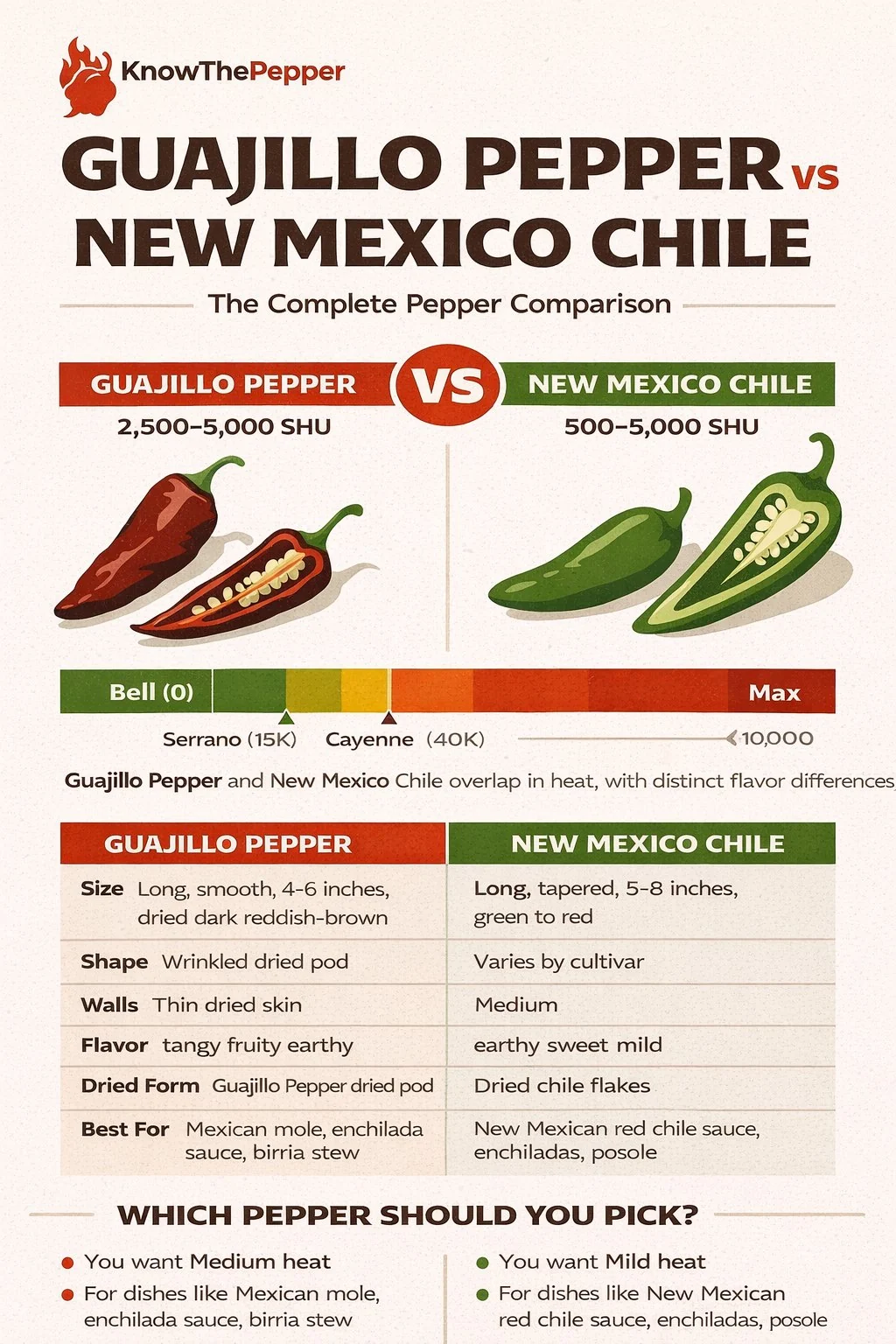
Here is where things get interesting: guajillo peppers are often listed with a heat range of 2,500–5,000 SHU in most culinary references, though some sources show variation depending on growing conditions and drying methods. New Mexico chile spans 1,000–8,000 SHU, placing it in the mild-to-medium heat classification that makes it so versatile for everyday cooking.
At their respective midpoints, these two peppers are closer in heat than most people expect. A guajillo at peak heat sits around 5,000 SHU — roughly 1.5 to 2 times milder than a typical jalapeño (which runs 2,500–8,000 SHU). New Mexico chile at its hottest matches a jalapeño's upper range, but the mildest specimens barely register.
The character of the heat differs too. Guajillo's burn is slow-building and lingers at the back of the palate — you notice it after the flavor arrives. New Mexico chile's heat is more upfront and dissipates faster, which is part of why it works so well in dishes where heat should accent rather than dominate.
For context on where both fall on the Scoville heat ranking index, neither approaches the intensity of something like a habanero or serrano. These are cooking peppers first, heat sources second — which shapes everything about how they perform in a recipe.
Flavor Profile Comparison
Long before supermarkets stocked dried chiles by the bag, guajillo peppers were already a cornerstone of Mexican cooking.
Here's something that trips up even experienced cooks: the New Mexico chile and the Anaheim pepper share common ancestry, but they've diverged significantly through decades of selective breeding.
Guajillo has a flavor profile that is genuinely hard to replicate. It leads with a tangy, almost cranberry-like acidity, followed by notes of green tea and dried plum. There is a subtle smokiness even without any roasting — just the natural result of the drying process applied to mirasol peppers. The skin is thin and the flesh rehydrates smoothly, releasing those complex flavors into sauces, marinades, and braises.
New Mexico chile's flavor is described consistently as earthy and sweet — and that is accurate. It has a clean, straightforward red chile character without the fruity complexity of guajillo. Roasting deepens its natural sweetness and adds mild smokiness. The flavor is assertive without being sharp, which is why it became the backbone of Southwestern red chile sauce.
Culinary traditions shaped these differences. Guajillo is a staple of Mexican pepper traditions rooted in mole and adobo, where layered flavor complexity matters enormously. New Mexico chile, developed through selective breeding at New Mexico State University in the early 20th century, was designed for consistent flavor and reliable heat — agricultural goals that produced a pepper with a cleaner, more predictable taste.
Aroma is another point of contrast. Dried guajillo smells faintly of dried fruit and mild spice. New Mexico chile smells more like classic red chile powder — warm, dusty, and direct. Both are excellent, but they are not interchangeable when flavor nuance matters.
Culinary Uses for Guajillo Pepper and New Mexico Chile
Guajillo is the workhorse of Mexican red sauces. It anchors birria, enchilada sauce, pozole rojo, and countless adobo marinades. When rehydrated and blended, it produces a deep brick-red sauce with that characteristic tang. Most recipes call for 3–5 dried guajillos per cup of sauce — remove the stems and seeds, toast lightly in a dry skillet, then soak in hot water for 20–30 minutes before blending.
New Mexico chile dominates Southwestern cooking — particularly the red chile sauce served over enchiladas in New Mexico, the base for carne adovada, and the seasoning in green chile stews when the green (fresh Hatch) version is unavailable. The head-to-head heat gap between Hatch and New Mexico chiles is worth understanding if you are sourcing dried pods versus fresh. Dried New Mexico chiles rehydrate similarly to guajillo but produce a smoother, less acidic sauce.
Substitution works in one direction better than the other. New Mexico chile can stand in for guajillo when you need mild red chile flavor without the tang — use a 1:1 ratio but expect a flatter, less complex result. Going the other way, guajillo substituting for New Mexico chile will add noticeable acidity that can throw off a simple red chile sauce. Adding a small amount of ancho alongside the guajillo helps balance this.
For a comparison of how Anaheim pepper's milder character differs from both of these dried varieties, that page covers the fresh vs. dried dimension in more detail. Also worth noting: guajillo pairs exceptionally well with ancho and mulato in mole blends — the three together create depth that no single pepper achieves alone. New Mexico chile, by contrast, often performs best as a solo ingredient where its clean flavor can carry a dish without competition.
Which Should You Choose?
Choose guajillo when flavor complexity is the priority — moles, birria, adobo marinades, and any sauce where that tangy, berry-forward depth will be noticed. It is the more expressive pepper of the two, and its thin skin makes it easy to work with.
Choose New Mexico chile when you want clean, straightforward red chile flavor with controllable heat. It is the right call for Southwestern red sauce, carne adovada, and dishes where a consistent, earthy backbone matters more than complexity. The comparison between pasilla and guajillo's distinct roasted profiles is worth reading if you are building a mole and trying to decide which dried peppers to layer.
If your pantry only has room for one, New Mexico chile is slightly more versatile across North American cooking styles. But if Mexican cuisine is your focus, guajillo is the one to stock. They are close enough in heat that either works in heat-sensitive recipes — the flavor difference is what actually drives the choice.
Can You Substitute One for the Other?
Yes — direct substitution works. Guajillo Pepper and New Mexico Chile are close enough in heat to swap at roughly 1:1. The main difference will be flavor. For more swap options, explore ranked alternatives with conversion ratios.
Growing Guajillo Pepper vs New Mexico Chile
If you’re deciding which pepper to grow at home, consider your climate and patience level. Guajillo Pepper and New Mexico Chile have different maturation times and temperature preferences. Hotter varieties generally need a longer, warmer growing season to develop their full capsaicin content. Our zone-based planting date tool can pinpoint the best sowing window for your area.
Growing guajillo means starting with the mirasol variety — the fresh pepper that becomes guajillo after drying. If you're new to starting chiles from seed indoors, mirasol is a forgiving choice: germination is reliable, and the plants are vigorous once established.
Start seeds 8–10 weeks before your last frost date. Mirasol plants prefer full sun and well-drained soil, thriving in USDA zones 9–11 or as annuals in cooler climates.
The upward-pointing fruit habit (the 'looking at the sun' trait) means pods dry naturally on the plant in hot, dry climates. In humid regions, harvest before the first frost and finish drying indoors using a dehydrator set to 135°F for 8–12 hours.
New Mexico chile thrives in hot, dry conditions — it was bred for the Southwest's climate. That said, it performs well across [*C.
Start seeds indoors 8–10 weeks before last frost. Germination is reliable at 80–85°F soil temperature.
Spacing matters: 18–24 inches between plants. These grow 2–3 feet tall with decent lateral spread, and heavy pod sets benefit from cage support.
History & Origin of Guajillo Pepper and New Mexico Chile
Both peppers carry centuries of culinary heritage. Guajillo Pepper traces its roots to Mexico, while New Mexico Chile originates from USA. Understanding their backstory helps explain why each pepper developed its distinctive traits.
Buying & Storage
Whether you’re shopping for Guajillo Pepper or New Mexico Chile, the same quality indicators apply. Fresh peppers should feel firm and heavy for their size, with taut, glossy skin and no soft or wet spots. Minor stem cracks known as “corking” are perfectly normal and often indicate a mature, flavorful pod.
- Firm pods with taut skin and consistent color
- Should feel heavy relative to size
- Minor stem cracks (“corking”) are normal
- Avoid anything soft, shriveled, or with dark wet spots
- Fresh: Paper bag, crisper drawer — 1–2 weeks
- Frozen: Wash, dry, freeze on sheet pan — 6+ months
- Dried: Airtight, away from light — up to 1 year
The Verdict: Guajillo Pepper vs New Mexico Chile
Guajillo Pepper and New Mexico Chile sit in the same heat tier but serve different roles. New Mexico Chile delivers 2× more heat with its distinctive earthy and sweet character. Guajillo Pepper, with its tangy and sweet profile, excels in everyday cooking.
Frequently Asked Questions
Related Comparisons
Sources pending verification.