De Arbol vs Japones Pepper Showdown: Heat, Flavor & Uses
De Arbol and Japones peppers occupy the same general heat territory and look nearly identical dried, yet they behave differently in the kitchen. De Arbol brings a grassy, slightly tannic bite while Japones leans toward a cleaner, more neutral heat. Knowing which to reach for can make or break a salsa roja or a bowl of ramen.

De Arbol measures 15K–30K SHU while Japones Pepper registers 15K–30K SHU — roughly equal in heat. De Arbol is known for its smoky and nutty flavor (C. annuum), while Japones Pepper offers bright and smoky notes (C. annuum).
- Species: Both are C. annuum
- Best for: De Arbol excels in everyday cooking and salsas, Japones Pepper in fresh salsas and mild recipes
De Arbol vs Japones Pepper Comparison
De Arbol vs Japones Pepper Heat Levels
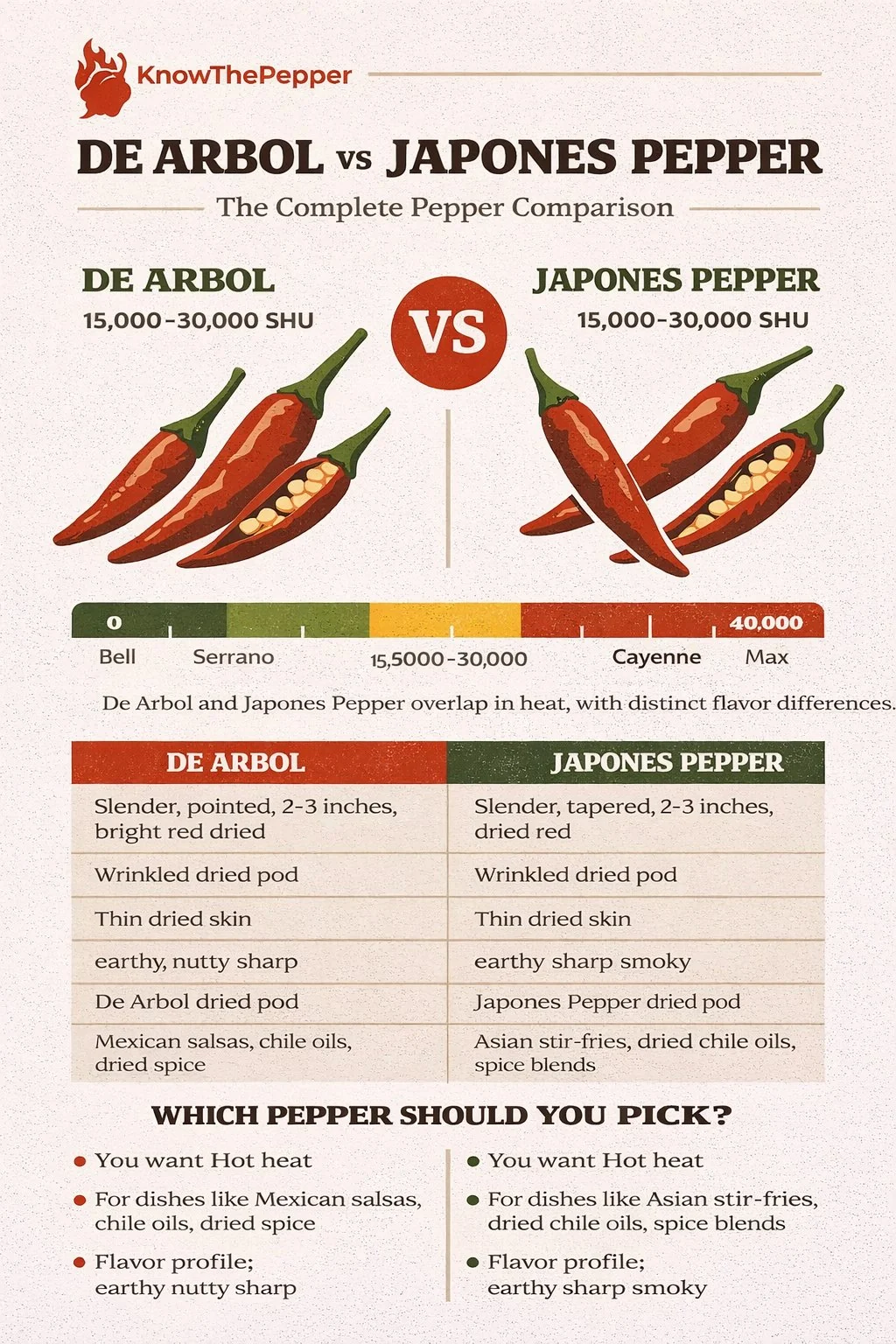
Before getting into numbers, the flavor of the heat tells you something important. De Arbol burns bright and fast - it hits the front of the mouth and fades relatively quickly, while Japones tends to build more gradually and linger on the back palate. Both sit in the 15,000-30,000 SHU range on the Scoville testing scale, placing them firmly in what most spice charts call the hot pepper zone - roughly 3 to 12 times hotter than a typical jalapeño at its peak.
For context, a standard jalapeño tops out around 8,000 SHU, so at their upper limits both of these dried chiles can hit nearly four times that intensity. Neither pepper competes with habaneros or anything in the super-hot classification bracket, but they are not casual additions either.
The practical heat difference between the two is narrow enough that many cooks use them interchangeably. That said, De Arbol tends to test slightly hotter on average in side-by-side comparisons, and its capsaicin delivery feels more aggressive up front. Japones, by contrast, distributes its burn more evenly across the palate. If you want to understand the chemistry behind why that burn registers differently in the mouth, it comes down to how capsaicinoids bind to receptors at different rates - not just total SHU.
Bottom line on heat: both peppers are solidly hot, De Arbol edges slightly higher in peak intensity, and Japones is the one you want if you prefer a slow, building warmth over an immediate punch.
Flavor Profile Comparison
The first time a de arbol found its way into my kitchen, I mistook it for a decorative dried chili.
Japones peppers are thin, finger-length dried chilies measuring about 2–3 inches long with a glossy, deep red skin when mature.
Dried De Arbol has a flavor profile that experienced cooks describe as grassy with a faint nuttiness - almost like a toasted grain note underneath the heat. There is a slight bitterness at the finish, which is actually an asset in sauces where you want complexity rather than pure fire. The aroma when toasted is sharp and herbal.
Japones peppers smell cleaner when dried, with less of that tannic edge. The flavor is more neutral, which sounds like a downgrade but is actually what makes Japones so useful in Asian cooking traditions - it adds heat without steering the dish in any particular direction. It is sometimes compared to a dried Thai bird chile in its cleaner burn, though it is milder than most Thai varieties.
Toasting changes both peppers significantly. De Arbol develops deeper, almost smoky undertones when dry-toasted in a skillet, making it ideal for complex red sauces. Japones, when toasted, stays relatively neutral but gains a pleasant roasted quality that works in stir-fries and broth-based dishes without asserting itself too aggressively.
In terms of aroma, De Arbol is the more pungent of the two - you can smell it across the kitchen when it hits a hot pan. Japones is subtler on the nose, which aligns with its reputation as a background-heat pepper rather than a featured ingredient.
For dishes where the chile itself is the star - think a proper salsa de arbol or a Mexican table sauce - De Arbol is the obvious choice. For dishes where heat is supporting cast, Japones earns its place.
Culinary Uses for De Arbol and Japones Pepper
De Arbol is a cornerstone of Mexican cooking. It is the backbone of salsa roja, the dried chile you thread into chile oil, and the pepper that gives certain Jalisco-style birria its characteristic sharp heat. Dried De Arbol chiles are typically stemmed, seeded, and either toasted dry or rehydrated in hot water before blending. A standard salsa de arbol ratio uses about 10-15 dried chiles per cup of liquid for a medium-hot sauce.
For heat comparisons in the Mexican chile family, the sharp heat contrast between De Arbol and serrano is worth understanding - serrano is fresh and bright while De Arbol is dried and earthy, so they are not direct swaps despite overlapping SHU ranges. Similarly, the smoky depth gap between De Arbol and guajillo matters when building a complex mole or braising liquid - guajillo adds body, De Arbol adds fire.
Japones peppers are most associated with Chinese and Japanese cooking - specifically Sichuan stir-fries, ramen tare, and Japanese chile oil (rayu). They are added whole to hot oil to bloom their heat into the fat, then either left in as a garnish or removed before serving. Because Japones does not muddy the flavor of a dish, it is the preferred dried chile for infusing neutral oils.
Substitution works in both directions with some caveats. Swapping De Arbol for Japones in a Mexican sauce adds a slight grassy note that most people will not notice. Going the other direction - Japones in place of De Arbol in Asian applications - produces a slightly more complex result, which may or may not suit the dish.
For those building a dried chile pantry, the heat and flavor differences between cayenne and De Arbol are also worth knowing - cayenne powder behaves very differently from whole dried De Arbol even when SHU ranges overlap. Use 1 De Arbol for every 1.5 Japones if scaling a recipe between the two varieties.
Which Should You Choose?
If your cooking is rooted in Mexican tradition - salsas, chile oils, braised meats, enchilada sauces - De Arbol is the one to stock. Its grassy, slightly bitter complexity is part of what makes those dishes taste right, and no neutral-flavored substitute fully replicates it.
If you cook a lot of East Asian food, particularly anything Sichuan-influenced, Japanese, or Korean, Japones is more versatile. Its clean heat integrates without competing, and it is the better choice for infusing oils or building broths where you want warmth without a strong chile flavor.
For cooks who only want one dried hot chile in the pantry, De Arbol is the more expressive option - it can approximate Japones in most applications, but Japones cannot fully stand in for De Arbol where that earthy, grassy character is the point. Both are worth keeping on hand if you cook across cuisines. Neither is difficult to find at Latin grocery stores, Asian markets, or online.
For anyone starting from seed, a complete growing guide for hot peppers covers both varieties since their cultivation requirements are nearly identical.
Can You Substitute One for the Other?
Yes — direct substitution works. De Arbol and Japones Pepper are close enough in heat to swap at roughly 1:1. The main difference will be flavor. For more swap options, explore ranked alternatives with conversion ratios.
Growing De Arbol vs Japones Pepper
If you’re deciding which pepper to grow at home, consider your climate and patience level. De Arbol and Japones Pepper have different maturation times and temperature preferences. Hotter varieties generally need a longer, warmer growing season to develop their full capsaicin content. Our zone-based planting date tool can pinpoint the best sowing window for your area.
De arbol is a reliable producer once established, though it demands heat to perform. Start seeds indoors 8-10 weeks before last frost — germination runs 10-14 days at soil temperatures around 80-85°F.
Transplant outdoors only after nighttime temps stay consistently above 55°F. De arbol needs full sun and well-drained soil; waterlogged roots stall growth quickly.
Pods mature from green to bright red in 80-90 days from transplant. The plants set fruit prolifically — a single established plant can carry dozens of pods simultaneously.
Japones plants behave like most compact C. annuum varieties — manageable, productive, and forgiving for growers with some pepper experience.
Transplant outdoors once nighttime temps stay reliably above 55°F. Full sun is non-negotiable; these plants need 6–8 hours of direct light daily to produce well.
Compared to the cultivation characteristics of the thick-walled manzano, japones is considerably easier to grow in standard garden conditions — no altitude requirements, no unusual soil preferences. Consistent moisture matters more than heavy feeding; let the soil dry slightly between waterings to avoid root rot.
History & Origin of De Arbol and Japones Pepper
Both peppers carry centuries of culinary heritage. De Arbol traces its roots to Mexico, while Japones Pepper originates from Japan. Understanding their backstory helps explain why each pepper developed its distinctive traits.
Buying & Storage
Whether you’re shopping for De Arbol or Japones Pepper, the same quality indicators apply. Fresh peppers should feel firm and heavy for their size, with taut, glossy skin and no soft or wet spots. Minor stem cracks known as “corking” are perfectly normal and often indicate a mature, flavorful pod.
- Firm pods with taut skin and consistent color
- Should feel heavy relative to size
- Minor stem cracks (“corking”) are normal
- Avoid anything soft, shriveled, or with dark wet spots
- Fresh: Paper bag, crisper drawer — 1–2 weeks
- Frozen: Wash, dry, freeze on sheet pan — 6+ months
- Dried: Airtight, away from light — up to 1 year
The Verdict: De Arbol vs Japones Pepper
De Arbol and Japones Pepper sit in the same heat tier but serve different roles. De Arbol delivers its distinctive smoky and nutty character. Japones Pepper, with its bright and smoky profile, excels in everyday cooking.
Frequently Asked Questions
Related Comparisons
Sources pending verification.