Carolina Reaper vs Chocolate Bhutlah: What's the Difference?
Two American-bred super-hots going head to head: the Carolina Reaper (1,400,000-2,200,000 SHU) holds a Guinness record, while the Chocolate Bhutlah (1,500,000-2,000,000 SHU) is a lesser-known but equally punishing hybrid. Both are C. chinense, both were developed in the USA, and both will end your afternoon if you're not careful.

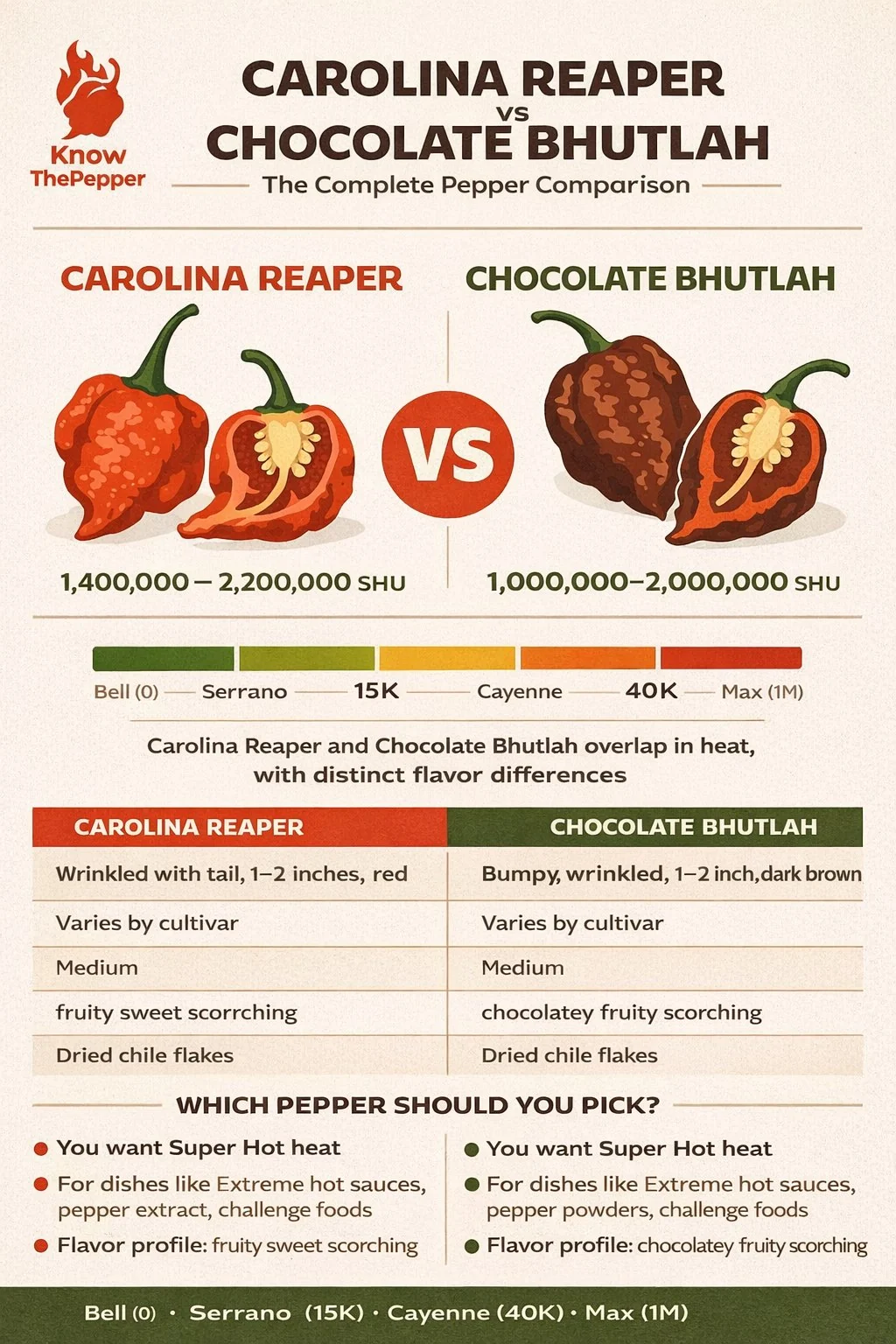
Carolina Reaper measures 1.4M–2.2M SHU while Chocolate Bhutlah registers 1.5M–2M SHU — roughly equal in heat. Carolina Reaper is known for its fruity and sweet flavor (C. chinense), while Chocolate Bhutlah offers smoky and intense notes (C. chinense).
- Species: Both are C. chinense
- Best for: Carolina Reaper excels in hot sauces and extreme dishes, Chocolate Bhutlah in hot sauces and spicy dishes
Carolina Reaper
Super-HotChocolate Bhutlah
Super-HotCarolina Reaper vs Chocolate Bhutlah Comparison
Carolina Reaper vs Chocolate Bhutlah Heat Levels
The first time someone handed me a Chocolate Bhutlah without warning, I assumed it was a dark habanero. That assumption lasted about four seconds.
On paper, these two peppers overlap almost completely. The Carolina Reaper clocks 1,400,000 to 2,200,000 SHU, while the Chocolate Bhutlah runs 1,500,000 to 2,000,000 SHU. Both sit firmly in the super-hot upper tier — a category that starts where most people's pain tolerance ends.
For a useful comparison point: a guajillo averages around 2,500 SHU. That means both of these peppers can hit roughly 560 to 800 times hotter than a guajillo at peak measurements. That's not a seasoning difference — that's a different planet of heat.
The Reaper's ceiling is technically higher at 2,200,000 SHU, which is what earned it the Guinness World Record in 2013 (later contested by Pepper X, also from breeder Ed Curlin). But averages tell a more honest story: most Reapers tested fall in the 1,500,000-1,800,000 SHU range under normal growing conditions.
The Chocolate Bhutlah's floor starts slightly higher at 1,500,000 SHU, meaning a typical specimen may actually outpace a typical Reaper. The biochemistry of what triggers that burn — capsaicin binding to heat-sensing receptors — is identical in both; it's just the concentration that shifts.
Character of the heat differs meaningfully. The Reaper builds fast and stays high for 20-30 minutes with intense throat burn. The Bhutlah hits with a deep, spreading heat that feels heavier in the chest and gut — slower to peak but arguably harder to shake.
Flavor Profile Comparison
Behind the Carolina Reaper's scorpion-tailed, wrinkled exterior is a flavor profile that catches first-timers completely off guard.
Before the numbers even come up, the Chocolate Bhutlah announces itself through smell — a dark, almost tobacco-like smokiness that sets it apart from the sharp, fruity blast you get from something like the Reaper's intense culinary heat.
Strip away the heat for a moment and you're looking at two genuinely different flavor profiles, which matters if you're actually trying to cook with either of these rather than just survive them.
The Carolina Reaper leads with fruity and sweet notes — there's a distinct tropical quality, almost like a distorted version of a ripe peach or mango, with a slight floral edge. That sweetness isn't subtle; it's recognizable even through the heat, which is part of why the Reaper became popular in hot sauce formulations. It adds complexity, not just fire.
The Chocolate Bhutlah goes a completely different direction. Smoky and intense is the honest description — think dark chocolate bitterness layered with an earthy, almost savory depth. The chocolate coloration isn't just aesthetic; it correlates with a flavor profile that's denser and less sweet than red super-hots. Some tasters pick up a dried fruit quality, but it's nothing like the Reaper's brightness.
Aroma reflects this divide clearly. Fresh Reapers smell almost candy-like when cut — genuinely inviting until the capsaicin hits your mucous membranes. Bhutlahs smell darker, more complex, with an earthiness that signals what's coming.
For sauce making, the Reaper's fruity character pairs naturally with mango, pineapple, or citrus bases. The Bhutlah's smoky depth works better alongside roasted tomatoes, dark beer, or chocolate-based mole-style applications. They're not interchangeable in recipes where flavor matters — the heat might be similar, but the taste destination is different.
Both are products of American pepper breeding, and both belong to C. chinense — the same botanical family as habaneros and Scotch bonnets, though the flavor complexity here is several magnitudes more concentrated.
Culinary Uses for Carolina Reaper and Chocolate Bhutlah
Neither of these peppers is a casual cooking ingredient — but that doesn't mean they're only for stunt eating. Used with intention, both can add serious depth to the right applications.
The Carolina Reaper excels in hot sauces and fermented mash. Its fruity sweetness survives the fermentation process and complements acidic bases well. A single pod, deseeded and blended into a 5-6 cup batch of mango-habanero sauce, adds scorching heat without turning the sauce one-dimensional. For the heat-level matchup between the Reaper and habanero, the Reaper brings roughly 10x the intensity — adjust ratios accordingly.
Dried and powdered Reaper is used in rubs for smoked meats where you want heat that builds slowly over a long cook. Start with 1/8 teaspoon per pound of meat if you're new to it — that's not a typo.
The Chocolate Bhutlah suits applications where smokiness is an asset: dark chili, barbecue sauce, or anything with a mole-adjacent profile. Its earthy intensity pairs with beef, lamb, and dark chocolate in ways the Reaper's fruitiness doesn't. Roasting the Bhutlah before use deepens the smoke character further.
For substitution: swapping one for the other is possible since SHU ranges overlap, but expect flavor drift. A Bhutlah standing in for a Reaper will taste darker and less sweet. If you need the Reaper's fruity quality specifically, a red habanero plus a small amount of superhot powder gets closer than a Bhutlah will.
Both peppers are worth growing yourself if you want consistent access — a step-by-step approach to raising super-hot varieties from seed is the most reliable path, since fresh pods from either pepper are rarely stocked in standard grocery stores.
For the Reaper versus Pepper X breakdown — another American-bred super-hot from the same breeder — the Reaper is actually the milder option, which says everything about where these peppers sit on the spectrum.
Which Should You Choose?
Choosing between these two comes down to what you need from a super-hot pepper.
The Carolina Reaper is the better choice when fruit-forward flavor matters — hot sauces, tropical salsas, anything where sweetness and heat should coexist. Its Guinness record status also makes it the more recognizable name, which matters if you're making products or cooking for an audience who cares about provenance.
The Chocolate Bhutlah wins when you want smoky depth and a heavier, more complex heat character. It's the better fit for dark chili, barbecue applications, or any recipe where earthiness is a feature rather than a distraction. Its floor SHU is slightly higher, meaning a typical pod may actually outperform a typical Reaper.
For the Reaper versus Trinidad Moruga Scorpion comparison, the Reaper again leans fruity while the Scorpion goes floral — a pattern that shows how much flavor varies even at extreme heat levels.
If you can only grow or buy one: the Reaper is more versatile. If you want the one fewer people have tried: the Bhutlah is the more interesting conversation.
Can You Substitute One for the Other?
Proceed with caution. Carolina Reaper is 1× hotter than Chocolate Bhutlah.
Need a different option altogether? Search for peppers that match your target heat and flavor with precise swap ratios.
Growing Carolina Reaper vs Chocolate Bhutlah
If you’re deciding which pepper to grow at home, consider your climate and patience level. Carolina Reaper and Chocolate Bhutlah have different maturation times and temperature preferences. Hotter varieties generally need a longer, warmer growing season to develop their full capsaicin content. Our zone-based planting date tool can pinpoint the best sowing window for your area.
Starting Carolina Reapers from seed requires patience - germination takes 14 to 21 days at soil temperatures between 80-85°F. Bottom heat from a seedling mat is essentially non-negotiable for reliable germination rates.
Transplant outdoors only after nighttime temperatures stay consistently above 60°F. The plants need a long season - 150 to 180 days from transplant to mature red pods - so starting seeds indoors 10 to 12 weeks before last frost is standard.
Full sun and well-draining soil with a pH around **6.0 to 6.
The Chocolate Bhutlah grows like most extreme C. chinense varieties — slowly, demandingly, and with significant reward for patient gardeners.
Transplant outdoors only after nighttime temperatures stay consistently above 60°F. These plants need full sun — 8+ hours daily — and warm soil to perform.
Feed with a balanced fertilizer through vegetative growth, then shift to a lower-nitrogen, higher-phosphorus formula once flowers appear. Inconsistent watering causes blossom drop, which is the most common frustration with this variety.
History & Origin of Carolina Reaper and Chocolate Bhutlah
Both peppers carry centuries of culinary heritage. Carolina Reaper traces its roots to USA, while Chocolate Bhutlah originates from USA. Understanding their backstory helps explain why each pepper developed its distinctive traits.
Buying & Storage
Whether you’re shopping for Carolina Reaper or Chocolate Bhutlah, the same quality indicators apply. Fresh peppers should feel firm and heavy for their size, with taut, glossy skin and no soft or wet spots. Minor stem cracks known as “corking” are perfectly normal and often indicate a mature, flavorful pod.
- Firm pods with taut skin and consistent color
- Should feel heavy relative to size
- Minor stem cracks (“corking”) are normal
- Avoid anything soft, shriveled, or with dark wet spots
- Fresh: Paper bag, crisper drawer — 1–2 weeks
- Frozen: Wash, dry, freeze on sheet pan — 6+ months
- Dried: Airtight, away from light — up to 1 year
The Verdict: Carolina Reaper vs Chocolate Bhutlah
Carolina Reaper and Chocolate Bhutlah sit in the same heat tier but serve different roles. Carolina Reaper delivers its distinctive fruity and sweet character. Chocolate Bhutlah, with its smoky and intense profile, excels in everyday cooking.
Frequently Asked Questions
Related Comparisons
Sources pending verification.