Aleppo Pepper vs Gochugaru: Heat, Flavor & Key Differences
Aleppo pepper and gochugaru are both dried, flaked chili products built for everyday cooking — but they come from opposite ends of the flavor map. Aleppo brings a fruity, oily, almost sun-dried-tomato warmth from the Syrian-Turkish border, while gochugaru delivers the backbone of Korean cuisine with its smoky-sweet punch. Neither is a fire-breather, but they are not interchangeable.

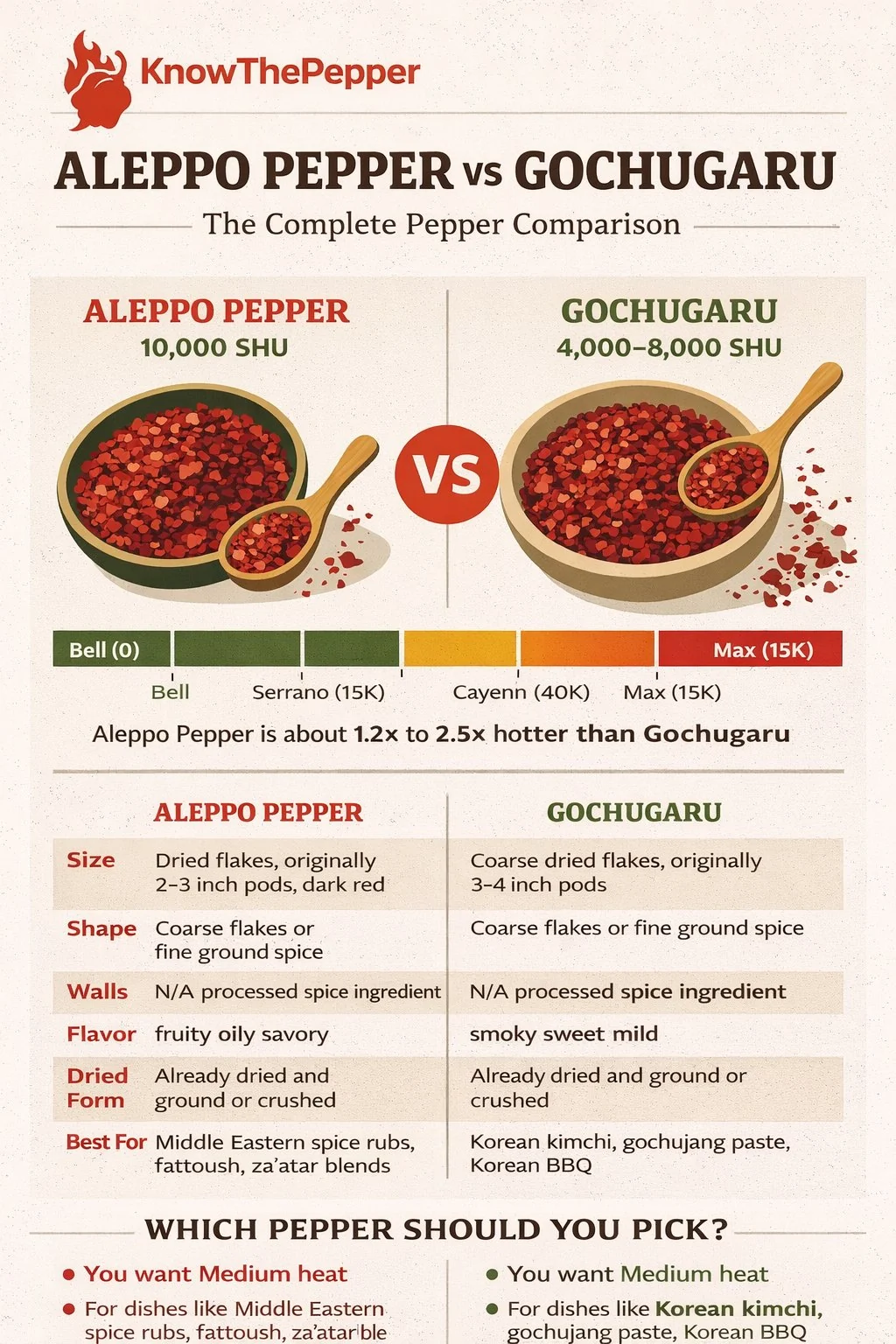
Aleppo Pepper measures 10K–30K SHU while Gochugaru registers 2K–10K SHU — making Aleppo Pepper 3× hotter. Aleppo Pepper is known for its fruity and earthy flavor (C. annuum), while Gochugaru offers smoky and sweet notes (C. annuum).
- Heat difference: Aleppo Pepper is 3× hotter
- Species: Both are C. annuum
- Best for: Aleppo Pepper excels in everyday cooking and salsas, Gochugaru in fresh salsas and mild recipes
Aleppo Pepper vs Gochugaru Comparison
Aleppo Pepper vs Gochugaru Heat Levels
Here's where things get interesting: Aleppo pepper sits at roughly 0–10,000 SHU depending on the source, though most commercial Aleppo flakes land closer to 10,000 SHU — a gentle, slow-building warmth that rarely startles anyone. Gochugaru spans a wider range, from 1,500 SHU on the mild end up to 10,000 SHU for hotter grades. Both peppers technically overlap at the top of their ranges, but in practice they feel different on the palate.
Aleppo's heat tends to arrive late and fade slowly, cushioned by its natural oil content. Gochugaru's burn is more immediate and cleaner — less oily, more direct. Neither approaches jalapeño territory (2,500–8,000 SHU), so both qualify comfortably within the lower end of the hot pepper heat classification spectrum, with Aleppo often feeling milder despite similar numbers on paper.
For context: a standard jalapeño at 5,000 SHU is roughly equivalent to mid-range examples of either pepper. Neither will challenge heat-seekers. What separates them isn't intensity — it's delivery. Aleppo coats; gochugaru cuts. That distinction matters far more in cooking than any SHU figure.
If you want to track where these fall on a broader Scoville heat ranking index, both sit in a range accessible to most palates — which is precisely why they're workhorse pantry peppers rather than novelty heat sources.
Flavor Profile Comparison
Most peppers ask you to choose between heat and flavor.
The first time I cooked with gochugaru, I expected something close to crushed red pepper flakes.
Flavor is where this comparison really opens up. Aleppo pepper — named for the Syrian city of Aleppo and also produced in southern Turkey — has a profile unlike almost any other dried chili. It's fruity in a raisin-like way, with undertones of sun-dried tomato, mild acidity, and a faint brininess from the salt used in its traditional drying process. The texture is moist and oily, which means it blooms differently in fat than a standard dried flake.
Gochugaru, the foundational chili of Korean cooking, is made from sun-dried red peppers ground to a coarse or fine powder. Its flavor hits smoky and sweet first, with a clean vegetal brightness underneath. Quality gochugaru has almost a fruity-floral note — different from Aleppo's dried-fruit depth, more like fresh red pepper that's been concentrated. The smoke is real but subtle, not the campfire intensity of a chipotle.
Aleppo's aroma is almost Mediterranean — think warm spice markets, olive oil, cumin-adjacent. Gochugaru smells like Korean barbecue prep: bright red, faintly sweet, with that characteristic dried-pepper dustiness. Both are aromatic in ways that cheap red pepper flakes simply aren't.
For anyone comparing these to understand the smoky versus sweet contrast gochugaru has with paprika, it's worth noting that Aleppo occupies a middle ground — more complex than paprika, less assertively smoky than gochugaru. They're related in spirit but distinct in character.
Culinary Uses for Aleppo Pepper and Gochugaru
These two peppers live in different kitchens, but creative cooks borrow across traditions constantly.
Aleppo pepper shines in Middle Eastern and Mediterranean cooking. It's the finishing spice on hummus, the seasoning in muhammara, the rub on lamb kebabs. Because it's semi-moist and salty, it dissolves beautifully into olive oil — drizzle that over labneh or roasted vegetables and you get something extraordinary. It also works in eggs, pasta, and anywhere you'd use a mild chili flake with more personality. Start with 1 teaspoon where a recipe calls for red pepper flakes; Aleppo is milder and richer, so you'll typically use more.
Gochugaru is non-negotiable in Korean cooking. It's the primary ingredient in kimchi, the base of gochujang paste, and essential to dishes like tteokbokki and sundubu-jjigae. It comes in two textures — coarse (for kimchi and marinades) and fine (for sauces and soups) — and the distinction matters. Substituting fine for coarse in kimchi changes the texture noticeably. Use 1 tablespoon as a baseline for most Korean recipes; the quantity scales up significantly in kimchi, where 1/4 to 1/2 cup per head of cabbage is standard.
Can you swap one for the other? In a pinch, yes — with adjustments. Aleppo replacing gochugaru works in non-Korean contexts where you want mild heat and fruitiness. Going the other direction, gochugaru for Aleppo, loses the oily Mediterranean character but maintains heat level. Neither substitution is seamless.
For a closer look at how gochugaru compares to the most common pantry substitute, the heat and texture differences between gochugaru and standard red pepper flakes are substantial enough that the swap deserves careful thought. Both peppers also share some overlap in use cases with Urfa biber — the dark, raisin-like depth of Urfa versus gochugaru's brighter profile is a useful reference point for understanding where Aleppo fits between them.
Aleppo is harder to find fresh but available from Middle Eastern grocers and specialty spice shops. Gochugaru is stocked at any Korean market and increasingly at mainstream grocery stores. Store both in airtight containers away from light — gochugaru especially loses its vibrant red color and flavor quickly once opened.
Which Should You Choose?
Choose Aleppo pepper when you want warmth without aggression — a complex, oily, fruity heat that enriches Mediterranean dishes, egg preparations, and anything finished with olive oil. It's a flavor builder first, a heat source second. Cooks drawn to Korean pepper traditions and their regional flavor history will find gochugaru essential rather than optional — there's no real substitute in kimchi or authentic Korean stews.
If your pantry holds only one, gochugaru is the more versatile workhorse purely by volume of recipes that require it. Aleppo is more of a specialist — but a spectacular one. Both belong to the Capsicum annuum botanical species, which explains their manageable heat levels and the structural similarities beneath very different flavor identities.
For cooks building a serious spice shelf: stock both. They don't compete — they fill different roles entirely. Aleppo is your finishing spice; gochugaru is your building block.
Can You Substitute One for the Other?
Yes — direct substitution works. Aleppo Pepper and Gochugaru are close enough in heat to swap at roughly 1:1. The main difference will be flavor. For more swap options, explore ranked alternatives with conversion ratios.
Growing Aleppo Pepper vs Gochugaru
If you’re deciding which pepper to grow at home, consider your climate and patience level. Aleppo Pepper and Gochugaru have different maturation times and temperature preferences. Hotter varieties generally need a longer, warmer growing season to develop their full capsaicin content. Our zone-based planting date tool can pinpoint the best sowing window for your area.
Growing Aleppo pepper in North America is straightforward for anyone familiar with C. annuum cultivation basics — the plant doesn't demand special treatment, just warmth and patience.
Start seeds indoors 8–10 weeks before last frost. Germination is reliable at 75–85°F soil temperature, typically within 10–14 days.
The plants reach 24–36 inches tall and prefer full sun with well-draining soil. Once established, they're relatively drought-tolerant — overwatering is a more common mistake than underwatering.
Growing gochugaru-style peppers is straightforward if you can give them a long, warm season. Start seeds indoors 8-10 weeks before last frost - these are *C.
Transplant after all frost risk passes into full sun with well-draining soil. Plants reach 2-3 feet and produce heavily.
Drying is where most home growers get tripped up. Traditional sun-drying requires consistent heat and low humidity over several weeks.
History & Origin of Aleppo Pepper and Gochugaru
Both peppers carry centuries of culinary heritage. Aleppo Pepper traces its roots to Syria, while Gochugaru originates from Korea. Understanding their backstory helps explain why each pepper developed its distinctive traits.
Buying & Storage
Whether you’re shopping for Aleppo Pepper or Gochugaru, the same quality indicators apply. Fresh peppers should feel firm and heavy for their size, with taut, glossy skin and no soft or wet spots. Minor stem cracks known as “corking” are perfectly normal and often indicate a mature, flavorful pod.
- Firm pods with taut skin and consistent color
- Should feel heavy relative to size
- Minor stem cracks (“corking”) are normal
- Avoid anything soft, shriveled, or with dark wet spots
- Fresh: Paper bag, crisper drawer — 1–2 weeks
- Frozen: Wash, dry, freeze on sheet pan — 6+ months
- Dried: Airtight, away from light — up to 1 year
The Verdict: Aleppo Pepper vs Gochugaru
Aleppo Pepper and Gochugaru sit in the same heat tier but serve different roles. Aleppo Pepper delivers 3× more heat with its distinctive fruity and earthy character. Gochugaru, with its smoky and sweet profile, excels in everyday cooking.
Frequently Asked Questions
Related Comparisons
Sources pending verification.