
7 Pot Douglah vs Carolina Reaper: Key Differences Explained
The 7 Pot Douglah and Carolina Reaper both hail from the super-hot classification tier, but they arrive there through very different characters. The Douglah is a dark, earthy Trinidad native; the Reaper is a fruity, scorpion-tailed American creation bred for maximum pain. Choosing between them comes down to whether you want depth of flavor or sheer incendiary spectacle.

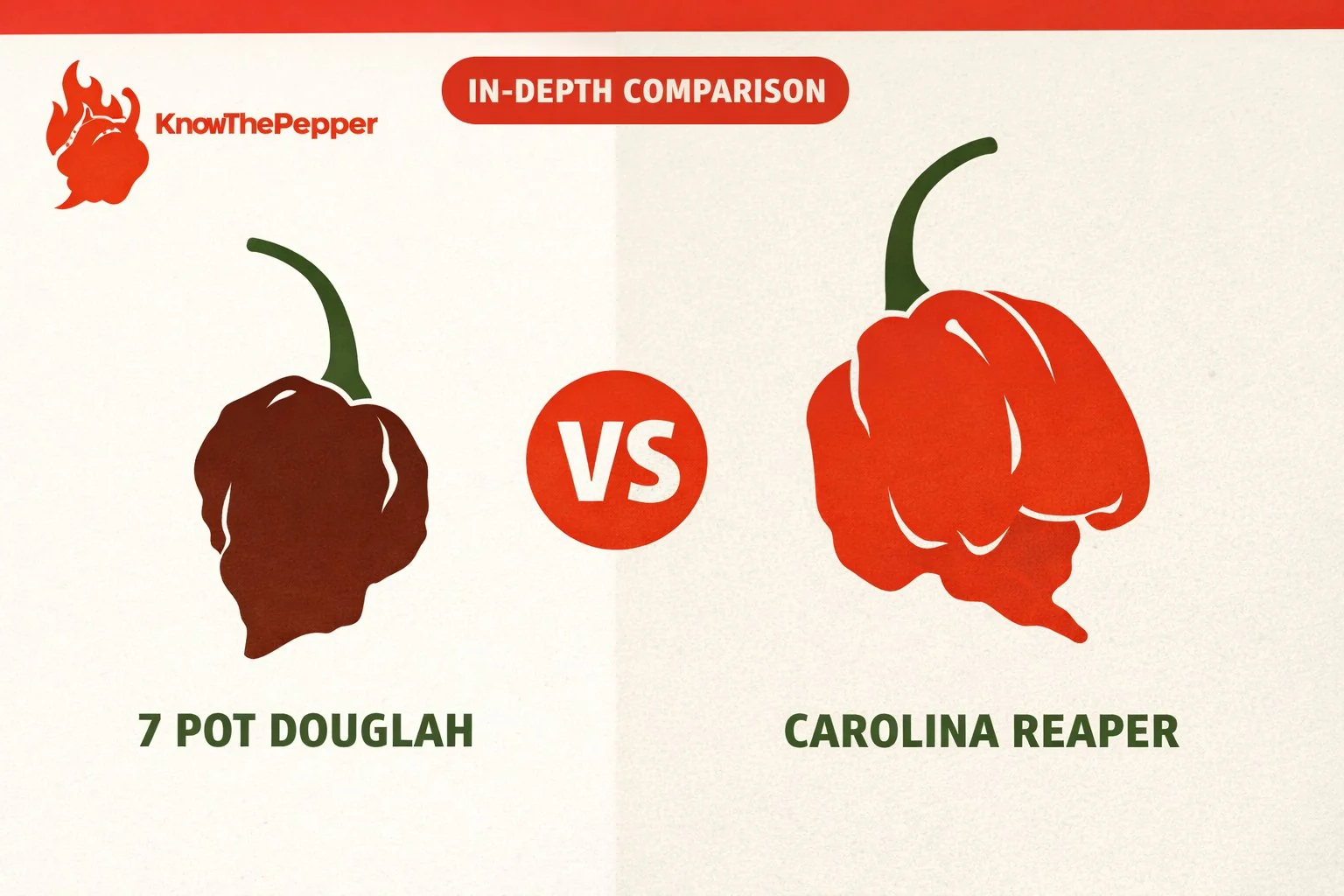
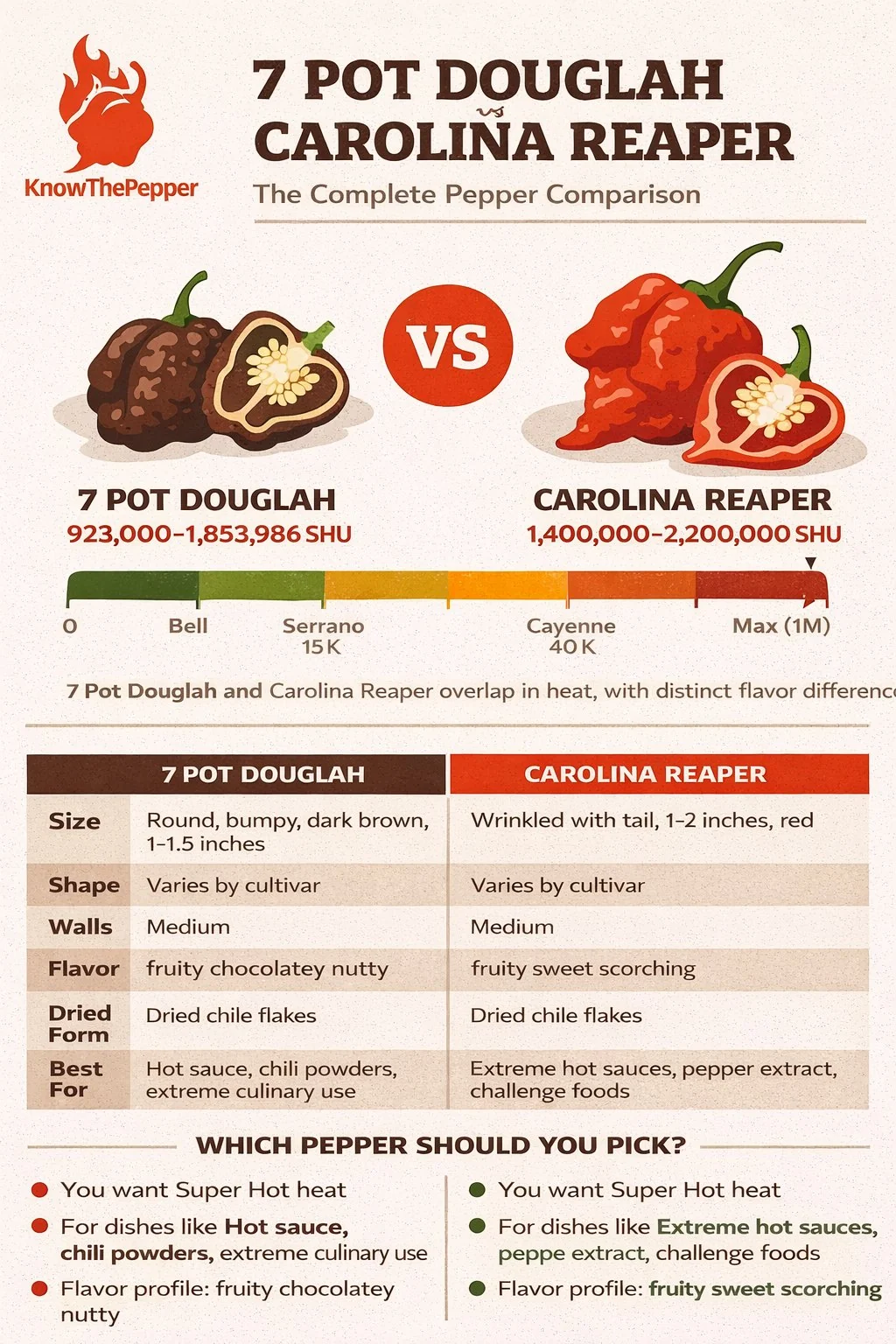
7 Pot Douglah measures 1.2M–1.9M SHU while Carolina Reaper registers 1.4M–2.2M SHU — roughly equal in heat. 7 Pot Douglah is known for its nutty and earthy flavor (C. chinense), while Carolina Reaper offers fruity and sweet notes (C. chinense).
- Species: Both are C. chinense
- Best for: 7 Pot Douglah excels in hot sauces and extreme dishes, Carolina Reaper in hot sauces and spicy dishes
7 Pot Douglah
Super-HotCarolina Reaper
Super-Hot7 Pot Douglah vs Carolina Reaper Comparison
7 Pot Douglah vs Carolina Reaper Heat Levels
Both peppers sit at the extreme end of the Scoville ranking system, but the numbers tell slightly different stories. The 7 Pot Douglah registers between 1,200,000 and 1,853,986 SHU, while the Carolina Reaper pushes further, ranging from 1,400,000 to 2,200,000 SHU - the Reaper held the Guinness World Record for hottest pepper with an average of 1,641,183 SHU in 2013 testing.
To put that in chipotle terms: a smoked chipotle typically lands around 2,500-8,000 SHU. That means the Douglah at its peak is roughly 230 times hotter than a chipotle, while the Reaper at its maximum is a staggering 275 times hotter. Both numbers are almost meaningless in practical cooking terms - a little goes an enormous distance.
The heat character differs as much as the ceiling. The Douglah builds with a slow, deep burn that spreads across the palate and lingers in the throat. Experienced growers describe it as a 'full-body' heat - you feel it in waves rather than as an immediate assault. The Reaper, by contrast, hits fast and hard, with an intense frontal burn followed by prolonged suffering that many attribute to its TRPV1 receptor activation being particularly aggressive. The Reaper's scorpion-like tail is more than aesthetic; the pods tend to concentrate capsaicinoids in ways that make heat distribution unpredictable even within the same plant.
Flavor Profile Comparison
Most super-hots taste like pure fire.
Behind the Carolina Reaper's scorpion-tailed, wrinkled exterior is a flavor profile that catches first-timers completely off guard.
This is where the two peppers genuinely diverge, and for serious cooks, flavor matters as much as heat. The 7 Pot Douglah carries a distinctive nutty, earthy profile that sets it apart from nearly every other super-hot on the market. The dark chocolate-brown skin isn't just visual - it signals a depth of flavor that has more in common with roasted ingredients than with tropical fruit. There's a subtle smokiness even in fresh pods, and when dried, the Douglah develops complex, almost mushroom-like undertones.
The Carolina Reaper goes in the opposite direction entirely. Its flavor is fruity and sweet, with strong tropical notes - think concentrated peach or citrus with a floral edge - before the heat completely takes over. That sweetness is genuine, not imagined, and it makes the Reaper surprisingly effective in hot sauces where the fruit notes can balance vinegar and complement mango or pineapple bases.
For cooking purposes, the Douglah's earthiness pairs naturally with chocolate-based moles, bean dishes, and slow-cooked meats where you want heat that integrates rather than dominates. The Reaper's fruitiness makes it a better match for tropical salsas, fruit-forward BBQ glazes, and Caribbean-style preparations. Neither pepper's flavor survives industrial processing particularly well - both reward fresh or minimally processed applications where their distinct characters can actually be tasted before the heat takes over.
Culinary Uses for 7 Pot Douglah and Carolina Reaper
Working with either pepper demands respect for their potency. Gloves are non-negotiable, and good ventilation matters - cutting either pepper releases capsaicin vapor that can irritate eyes and airways.
The 7 Pot Douglah shines in applications where its earthy depth can carry through. Small amounts - we're talking 1/8 to 1/4 of a fresh pod - work well in large-batch chili, slow-cooked stews, or fermented hot sauces where the flavors have time to develop. Dried and ground Douglah powder adds a dark, complex heat to dry rubs for brisket or lamb. Its flavor profile also makes it a natural companion to cacao-based dishes; a pinch of Douglah powder in a mole negro adds both heat and a complementary earthiness that no other super-hot quite replicates.
The Carolina Reaper is more versatile in commercial-style hot sauce production, where its fruit-forward sweetness creates a recognizable flavor foundation. For home cooks, a single Reaper pod can heat an entire pot of salsa for 20-30 people. The Reaper also dehydrates well and retains its fruity notes in powder form, making it useful for seasoning blends where a tropical heat element is wanted.
As a substitution, the two peppers are roughly interchangeable by weight in recipes that call for either, though expect flavor shifts. Swapping Douglah for Reaper in a fruit-based sauce will push it earthier and less sweet; going the other direction will brighten and sweeten. If you need a milder stand-in for either, the fruity Caribbean heat of a Scotch Bonnet offers some of the same flavor DNA at a fraction of the intensity.
For those interested in growing their own supply, both species respond well to the same indoor starting and transplanting approach - long season, warm soil, and patience.
Which Should You Choose?
The 7 Pot Douglah is the better choice for cooks who want complexity alongside extreme heat. Its earthy, nutty character integrates into food in ways that the Reaper's fruit-bomb profile doesn't always allow. If you're building a hot sauce, a chili, or a spice blend where the pepper's flavor should contribute beyond pure fire, the Douglah rewards careful use.
The Carolina Reaper wins on spectacle and heat ceiling. It's the right call for challenge-oriented cooking, fruit-forward hot sauces, and any application where tropical sweetness and maximum Scoville numbers are both desirable. The Reaper also has broader name recognition, which matters if you're labeling products.
Both peppers belong to the same Capsicum chinense botanical lineage that produces the world's hottest varieties - a tradition with deep roots in Trinidad's pepper heritage and, more recently, in American pepper breeding. Neither is a casual kitchen ingredient. But between the two, the Douglah is the more interesting pepper to cook with; the Reaper is the more interesting pepper to talk about.
Can You Substitute One for the Other?
Proceed with caution. Carolina Reaper is 1× hotter than 7 Pot Douglah.
Need a different option altogether? Search for peppers that match your target heat and flavor with precise swap ratios.
Growing 7 Pot Douglah vs Carolina Reaper
If you’re deciding which pepper to grow at home, consider your climate and patience level. 7 Pot Douglah and Carolina Reaper have different maturation times and temperature preferences. Hotter varieties generally need a longer, warmer growing season to develop their full capsaicin content. Our zone-based planting date tool can pinpoint the best sowing window for your area.
Growing a Douglah requires patience before anything else. Seeds take 14-21 days to germinate and need soil temperatures of 80-85°F - a heat mat under your seed tray is not optional at this stage.
Start seeds 10-12 weeks before last frost. Transplant outdoors only after nighttime temperatures stay consistently above 60°F.
Full sun is non-negotiable: 8+ hours daily. The plants are heavy feeders; a balanced fertilizer through vegetative growth transitioning to a lower-nitrogen, higher-phosphorus formula once flowering begins will push pod development.
Starting Carolina Reapers from seed requires patience - germination takes 14 to 21 days at soil temperatures between 80-85°F. Bottom heat from a seedling mat is essentially non-negotiable for reliable germination rates.
Transplant outdoors only after nighttime temperatures stay consistently above 60°F. The plants need a long season - 150 to 180 days from transplant to mature red pods - so starting seeds indoors 10 to 12 weeks before last frost is standard.
Full sun and well-draining soil with a pH around **6.0 to 6.
History & Origin of 7 Pot Douglah and Carolina Reaper
Both peppers carry centuries of culinary heritage. 7 Pot Douglah traces its roots to Trinidad, while Carolina Reaper originates from USA. Understanding their backstory helps explain why each pepper developed its distinctive traits.
Buying & Storage
Whether you’re shopping for 7 Pot Douglah or Carolina Reaper, the same quality indicators apply. Fresh peppers should feel firm and heavy for their size, with taut, glossy skin and no soft or wet spots. Minor stem cracks known as “corking” are perfectly normal and often indicate a mature, flavorful pod.
- Firm pods with taut skin and consistent color
- Should feel heavy relative to size
- Minor stem cracks (“corking”) are normal
- Avoid anything soft, shriveled, or with dark wet spots
- Fresh: Paper bag, crisper drawer — 1–2 weeks
- Frozen: Wash, dry, freeze on sheet pan — 6+ months
- Dried: Airtight, away from light — up to 1 year
The Verdict: 7 Pot Douglah vs Carolina Reaper
7 Pot Douglah and Carolina Reaper sit in the same heat tier but serve different roles. Carolina Reaper delivers its distinctive fruity and sweet character. 7 Pot Douglah, with its nutty and earthy profile, excels in everyday cooking.
Frequently Asked Questions
Related Comparisons
Sources pending verification.
