Fresno Pepper vs Jalapeño: What's the Difference?
Fresno peppers and jalapeños look nearly identical in the grocery store, but they diverge in meaningful ways once you start cooking with them. The Fresno runs 2,500–8,000 SHU — roughly the same ceiling as a jalapeño — yet delivers a noticeably different flavor and texture that makes the swap anything but neutral. Understanding these differences helps you pick the right pepper for the right dish.

Fresno Pepper measures 3K–10K SHU while Jalapeño registers 3K–8K SHU — roughly equal in heat. Fresno Pepper is known for its fruity and smoky flavor (C. annuum), while Jalapeño offers bright and grassy notes (C. annuum).
- Species: Both are C. annuum
- Best for: Fresno Pepper excels in everyday cooking and salsas, Jalapeño in fresh salsas and mild recipes
Fresno Pepper vs Jalapeño Comparison
Fresno Pepper vs Jalapeño Heat Levels
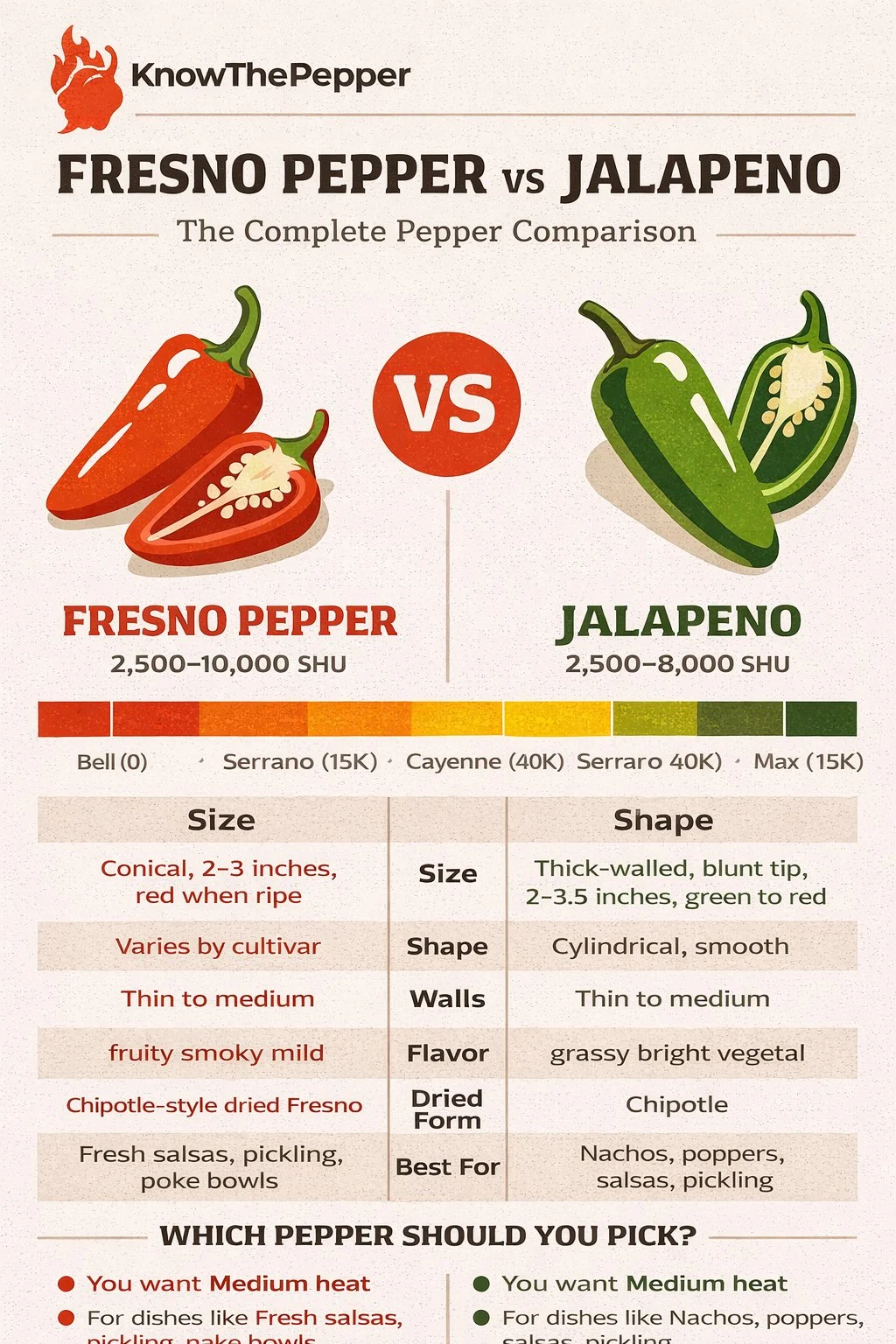
Here's the thing that surprises most people: Fresno peppers and jalapeños share almost the same Scoville Heat Unit range. Both sit between 2,500 and 8,000 SHU, which puts them squarely in the medium heat classification on the pepper spectrum. At their respective peaks, neither is dramatically hotter than the other — you're not dealing with a heat gap the way you would comparing, say, a Fresno against habanero-level intensity.
That said, real-world heat perception between the two does differ. Jalapeños tend to front-load their burn — you feel it immediately on the tip of the tongue. Fresnos build slightly more gradually, with a warmth that spreads across the palate before fading. Neither will leave you reaching for milk, but the character of the heat is distinct enough that experienced cooks notice.
Ripeness also matters here. Both peppers are sold green (unripe) and red (fully ripe), and red versions of each are measurably hotter than their green counterparts. A red Fresno can hit the upper end of its range more consistently than a green jalapeño, which is part of why red Fresnos have developed a reputation for being "hotter" — it's often a ripeness comparison rather than a species difference.
For context on where these two land against hotter varieties, the head-to-head heat gap between Fresnos and serranos is a useful reference — serranos run 10,000–23,000 SHU, making them roughly 2–3x hotter than either pepper discussed here.
Flavor Profile Comparison
The Fresno pepper gets mistaken for a red jalapeño constantly — same conical shape, similar color, sold side by side at the grocery store.
Few peppers have earned their reputation as thoroughly as the jalapeño.
Flavor is where the Fresno and jalapeño genuinely part ways. The jalapeño's bright, grassy character is one of the most recognizable tastes in North American cooking — vegetal, sharp, with a clean heat that cuts through rich dishes. It's a flavor that reads as "fresh" even when cooked.
Fresno peppers are fruitier. There's a sweetness underneath the heat that becomes more pronounced as the pepper ripens to red. Where a jalapeño tastes like a pepper first and a fruit second, a Fresno leans the other direction — the fruity, slightly smoky undertone is upfront, with the heat following behind. Red Fresnos in particular develop a complexity that green jalapeños don't have.
Texturally, the two also differ. Jalapeño walls are thick and waxy, which makes them ideal for stuffing and holding up to high heat. Fresno walls are thinner, meaning they cook down faster and release moisture more quickly — better for sauces and salsas where you want the pepper to meld into the dish rather than hold its shape.
Aroma is another tell. Raw jalapeños have that sharp, almost herbaceous smell. Fresnos smell sweeter off the vine, closer to a mild chile than a sharp capsicum. This aromatic difference carries into finished dishes: jalapeños announce themselves, Fresnos integrate.
For cooks comparing the smoky depth of chipotle versus jalapeño's fresh bite, it's worth noting that Fresnos don't smoke as cleanly as jalapeños — their higher moisture content and thinner walls make them less ideal for traditional smoking methods.
Culinary Uses for Fresno Pepper and Jalapeño
Both peppers show up in similar contexts, but they each have a lane where they genuinely excel.
Jalapeños dominate anywhere you want fresh, assertive pepper flavor. Nachos, poppers, pickled slices on tacos, raw in pico de gallo — the jalapeño's thick walls and bright flavor are built for these applications. Stuffing a jalapeño with cream cheese and grilling it is practically a genre unto itself. The pepper holds its structure under heat, which is why it appears in so many preparations where texture matters.
Fresno peppers shine in cooked applications where their fruitiness can develop. Blended into hot sauces, roasted into salsas, or charred for a smoky-sweet condiment, Fresnos bring a depth that jalapeños don't quite match. Many craft hot sauce producers favor red Fresnos specifically because the flavor complexity reduces the need for added sweeteners.
For substitution: if a recipe calls for jalapeños and you only have Fresnos, the swap works in most cooked dishes at a 1:1 ratio. The flavor will be slightly sweeter and less grassy, but the heat level stays comparable. The reverse — using jalapeños in place of Fresnos — works less cleanly in sauces, since the jalapeño's thicker walls don't break down as readily.
Raw applications are where you notice the difference most. Fresno slices in a salsa cruda taste fruitier and less sharp than jalapeño slices. Some people prefer this; others miss the jalapeño's punch. In pickled preparations, Fresnos pickle beautifully and hold color well — their red flesh stays vibrant in brine where green jalapeños can turn drab.
For anyone curious about Fresno pepper swap options in specific recipes, the heat range overlap with jalapeños makes them the most logical starting point, though serranos work when you want more intensity. Mexican pepper traditions inform both peppers' culinary DNA, which is why they're so often interchangeable in Tex-Mex and Mexican-American cooking.
Which Should You Choose?
If you're buying peppers for stuffing, go jalapeño — the walls are thicker, the flavor is sharper, and the structure holds up. If you're making a hot sauce, salsa roja, or any cooked condiment where the pepper will be blended or roasted, the Fresno's fruity complexity gives you more to work with.
The heat difference between the two is minimal enough that it shouldn't drive your decision. Both sit in the same medium heat range and neither will overwhelm a dish. What separates them is flavor character and texture.
For everyday grocery shopping, they're interchangeable in most recipes with a 1:1 swap. But when the pepper is the star of the dish — a salsa, a hot sauce, a chile-forward preparation — the choice matters. Jalapeño for fresh, grassy, assertive; Fresno for sweet, fruity, integrated.
Both belong in a well-stocked kitchen. They're not the same pepper, even if they look like it at the store.
Can You Substitute One for the Other?
Yes — direct substitution works. Fresno Pepper and Jalapeño are close enough in heat to swap at roughly 1:1. The main difference will be flavor. For more swap options, explore ranked alternatives with conversion ratios.
Growing Fresno Pepper vs Jalapeño
If you’re deciding which pepper to grow at home, consider your climate and patience level. Fresno Pepper and Jalapeño have different maturation times and temperature preferences. Hotter varieties generally need a longer, warmer growing season to develop their full capsaicin content. Our zone-based planting date tool can pinpoint the best sowing window for your area.
Fresnos are straightforward to grow but reward growers who manage water stress deliberately. Start seeds indoors 8–10 weeks before last frost — they germinate well at 80–85°F soil temperature and typically sprout within 10–14 days.
Transplant after all frost risk has passed, spacing plants 18 inches apart in full sun. They need at least 6–8 hours of direct light daily.
For more heat in your harvest, reduce watering by about 30% during the final 2–3 weeks of ripening. This mild drought stress increases capsaicin concentration noticeably — the same technique used commercially to push Fresnos toward the upper end of their 10,000 SHU ceiling.
Jalapeños are among the most forgiving hot peppers to grow, but they do have preferences worth knowing.
Start seeds indoors 8–10 weeks before your last frost date. Soil temperature for germination should stay between 75–85°F — a heat mat under the seed tray makes a real difference in germination speed and uniformity.
Transplant outdoors once nighttime temps stay consistently above 55°F. Jalapeños want full sun — at least 6 hours daily — and well-drained soil with a pH around **6.
History & Origin of Fresno Pepper and Jalapeño
Both peppers carry centuries of culinary heritage. Fresno Pepper traces its roots to USA, while Jalapeño originates from Mexico. Understanding their backstory helps explain why each pepper developed its distinctive traits.
Buying & Storage
Whether you’re shopping for Fresno Pepper or Jalapeño, the same quality indicators apply. Fresh peppers should feel firm and heavy for their size, with taut, glossy skin and no soft or wet spots. Minor stem cracks known as “corking” are perfectly normal and often indicate a mature, flavorful pod.
- Firm pods with taut skin and consistent color
- Should feel heavy relative to size
- Minor stem cracks (“corking”) are normal
- Avoid anything soft, shriveled, or with dark wet spots
- Fresh: Paper bag, crisper drawer — 1–2 weeks
- Frozen: Wash, dry, freeze on sheet pan — 6+ months
- Dried: Airtight, away from light — up to 1 year
The Verdict: Fresno Pepper vs Jalapeño
Fresno Pepper and Jalapeño occupy very different positions on the heat spectrum. Fresno Pepper delivers its distinctive fruity and smoky character. Jalapeño, with its bright and grassy profile, excels in everyday cooking.
Frequently Asked Questions
Related Comparisons
Sources pending verification.