Anaheim Pepper vs NuMex Big Jim: Key Differences Explained
The Anaheim pepper and NuMex Big Jim are both long, green mild peppers that look nearly identical at the farmers market — but they diverge in heat, size, and breeding history. NuMex Big Jim tops out at 3,000 SHU with occasional bite, while the Anaheim sits at essentially zero heat. Knowing which to grab changes how a dish turns out.

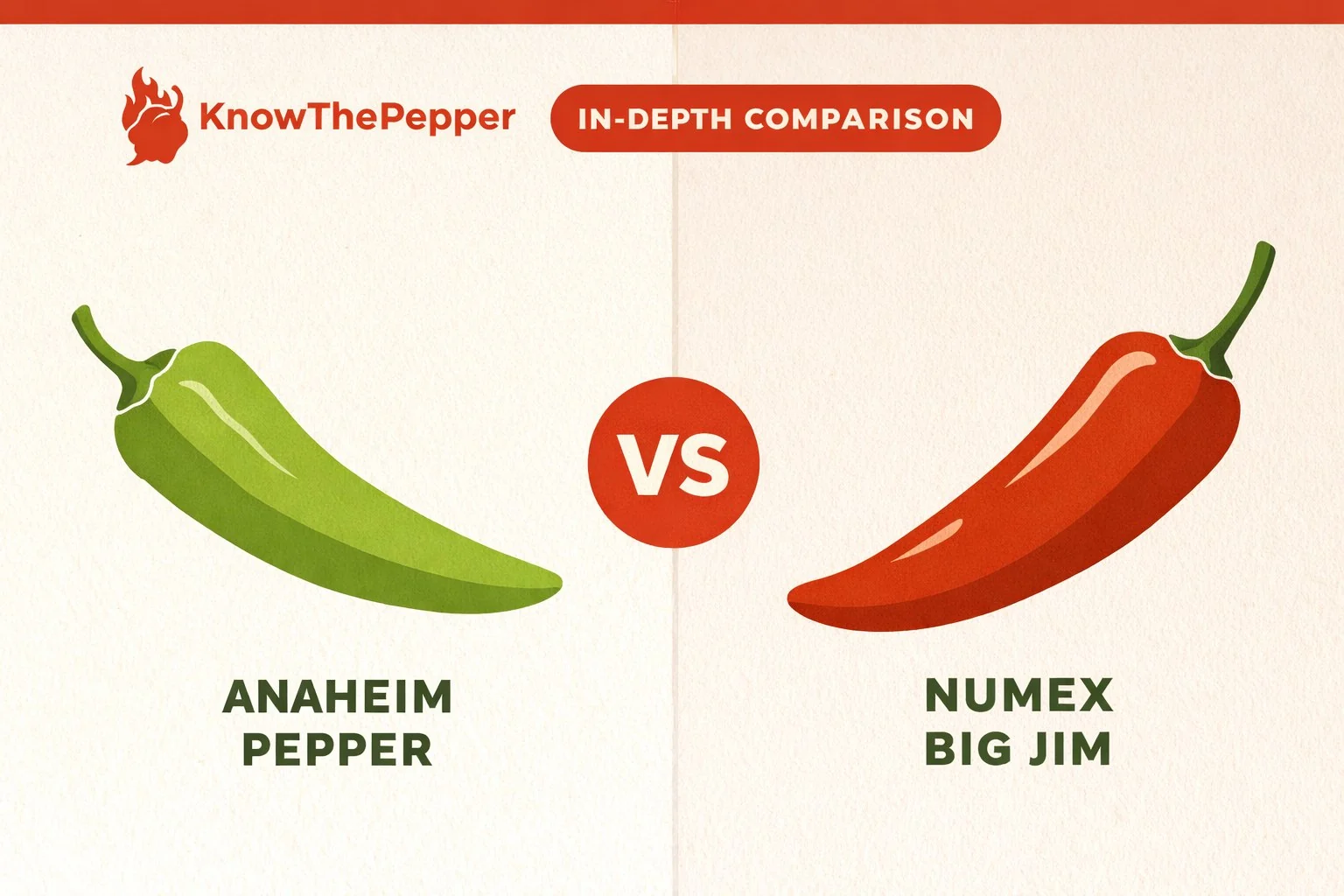
Anaheim Pepper measures 500–3K SHU while NuMex Big Jim registers 500–3K SHU — roughly equal in heat. Anaheim Pepper is known for its mild and sweet flavor (C. annuum), while NuMex Big Jim offers mild and sweet notes (C. annuum).
- Species: Both are C. annuum
- Best for: Anaheim Pepper excels in everyday cooking and salsas, NuMex Big Jim in fresh salsas and mild recipes
Anaheim Pepper vs NuMex Big Jim Comparison
Anaheim Pepper vs NuMex Big Jim Heat Levels
Pull an Anaheim off the plant and taste it raw — you get pure sweet pepper flavor, no warmth at all, not even a whisper of tingle at the back of the throat. That's the reality of a pepper that measures at effectively 0 SHU. It belongs in the mild-heat SHU bracket alongside banana peppers and pimentos, where capsaicin is functionally absent.
NuMex Big Jim sits in a different tier entirely. Developed at New Mexico State University in 1975 and released as a world-record-sized chile at the time, it ranges from 500 to 3,000 SHU — putting it squarely in the low-medium heat intensity zone. At its hottest, Big Jim reaches roughly 40% of a Fresno chili's heat, since a typical Fresno peaks around 8,000 SHU. Most Big Jims you'll encounter land closer to the 1,000 SHU midpoint, which is a gentle, background warmth rather than anything that demands a glass of milk.
The character of Big Jim's heat is also worth noting: it builds slowly and sits at the front of the palate, the way New Mexico green chiles tend to. It doesn't spike and fade like a Fresno; it lingers pleasantly. Anaheim, by contrast, delivers zero of that experience — it's all sweetness and vegetal depth. For cooks who want just a hint of pepper warmth without committing to anything spicy, Big Jim is the smarter pick. Those who need heat-free cooking — for kids, sensitive guests, or dishes where pepper flavor should dominate without any burn — the Anaheim is the clear answer. The capsaicin chemistry and receptor science behind why even mild peppers can vary so dramatically in perceived heat comes down to individual capsaicinoid concentrations that differ pod to pod.
Flavor Profile Comparison
At 500–2,500 SHU, the Anaheim sits at the gentler end of the medium heat peppers category — closer to a bell pepper in burn than anything that'll make you reach for milk.
The story of NuMex Big Jim starts in a university greenhouse, not a home garden.
Both peppers share the grassy, vegetal backbone common to long green New Mexico-type chiles, but they diverge quickly once you get past that baseline.
Anaheim peppers have a clean, bright sweetness with a slightly watery crunch when raw. Roasted, they develop a deeper, almost earthy sweetness with a thin skin that blisters and peels easily. The flavor is neutral enough to play a supporting role in almost any dish — it adds pepper presence without asserting itself. Think of it as the green bell pepper's leaner, more interesting cousin.
NuMex Big Jim carries more complexity. The sweetness is there, but there's a subtle earthiness underneath, plus that slow-building warmth that makes the flavor feel more complete. Roasted Big Jims develop a richer, slightly smoky quality — partly because the thick flesh holds up better to high heat, caramelizing at the edges rather than going limp. The aroma when roasting is noticeably more pungent than an Anaheim, with that characteristic New Mexico green chile smell that's almost herbaceous.
Size matters for flavor too: Big Jim pods regularly reach 12 to 13 inches, giving you more flesh per pepper and a better flesh-to-skin ratio after roasting. Anaheim pods average 6 to 8 inches and have thinner walls, which means they can get slightly papery if overcooked. For dishes where the pepper is the star — chile rellenos, stuffed peppers, green chile stew — Big Jim's meatier flesh delivers noticeably better texture. For raw preparations like salsas or thin-sliced garnishes, the Anaheim's lighter, crisper bite actually works in its favor. The side-by-side flavor contrast between Anaheim and New Mexico chile illustrates just how much breeding and terroir shape what looks like the same pepper.
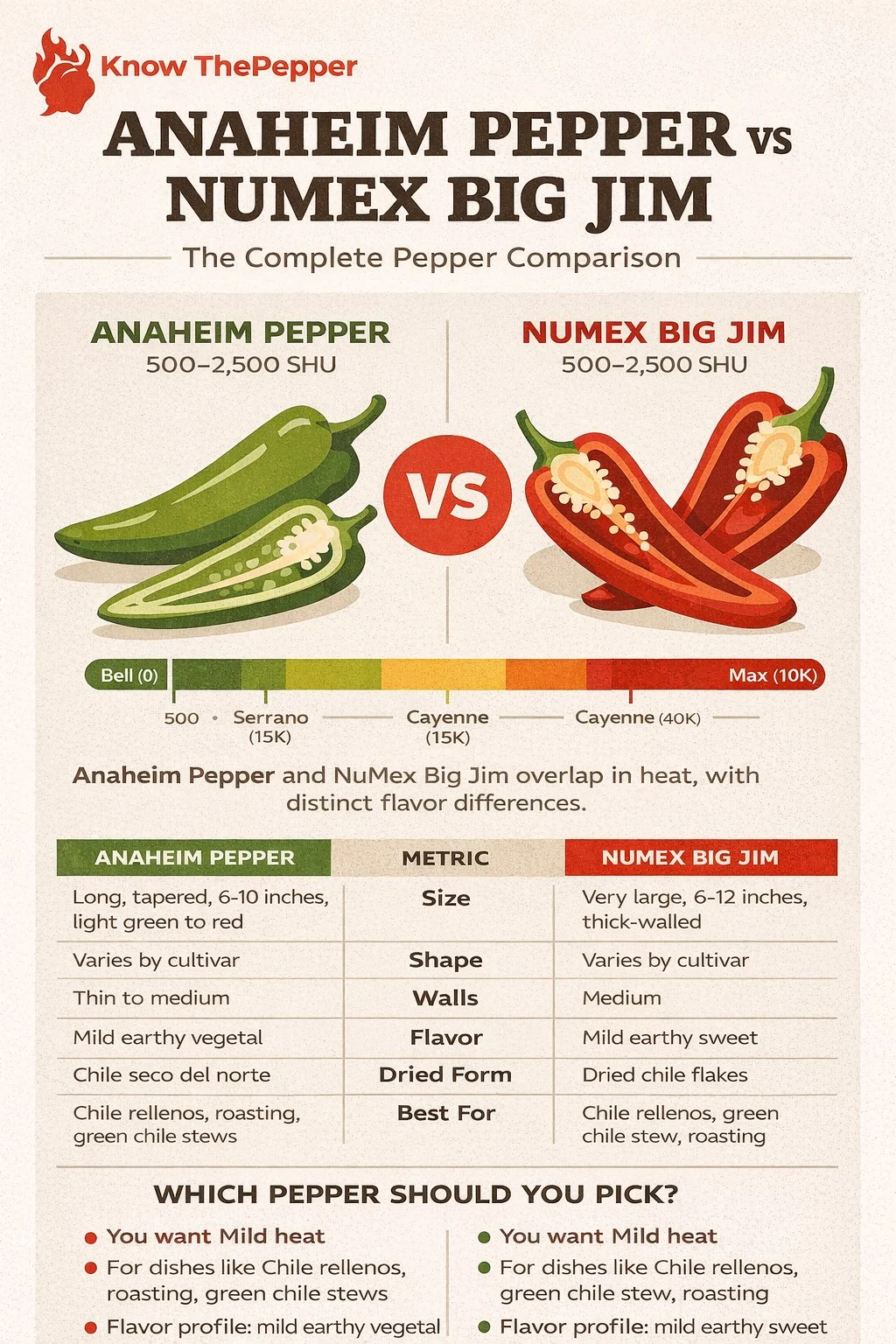
Culinary Uses for Anaheim Pepper and NuMex Big Jim
Both peppers shine in roasted preparations, but their best applications split based on heat tolerance and texture needs.
Anaheim peppers are the workhorse of mild green chile cooking in California and the Southwest. They're the standard choice for chile verde when you want pure flavor without heat, and they stuff beautifully for chile rellenos — though their smaller size means you'll want to pick the largest pods available. Slice them raw into salads, dice them for omelets, or char them directly over a gas flame for a quick roasted pepper. Because the heat is zero, they're also the safe choice for large-batch cooking where you can't predict everyone's spice tolerance.
For substitution: if a recipe calls for Anaheim and you only have Big Jim, use a 1:1 ratio but expect a mild background warmth. Going the other direction — replacing Big Jim with Anaheim — also works 1:1, but you'll lose that subtle heat character. Adding a pinch of mild red pepper flakes can approximate what's missing.
NuMex Big Jim was bred specifically for commercial green chile production in New Mexico, and it shows. The large, thick-walled pods roast, peel, and freeze exceptionally well — a key reason it became the dominant variety for canned green chiles. For home cooks, that means Big Jim is the better choice for green chile sauce, posole, and the classic New Mexico-style smothered burrito. Its size also makes it the superior stuffing pepper: there's genuine room to work with, whether you're filling it with cheese, picadillo, or a grain mixture.
Both peppers appear in the broader Anaheim vs. jalapeño heat and flavor comparison, which is useful context if you're scaling heat up from either of these mild options. For green chile sauce specifically, roast Big Jims at 450°F for 20-25 minutes, turning once, then steam in a covered bowl for 15 minutes before peeling. The flesh practically falls away from the skin and freezes in flat bags for up to a year.
Anaheim works well pickled — its thin walls absorb brine quickly, producing a tangy, sweet pickled pepper in under 48 hours. Big Jim can be pickled too, but the thicker flesh takes longer and benefits from a hot-pack method rather than a quick refrigerator pickle.
Which Should You Choose?
If you're cooking for a heat-averse crowd or need a completely neutral pepper vehicle for other flavors, Anaheim is the right call. It's widely available, predictable, and genuinely zero-heat.
For anything where you want the classic New Mexico green chile experience — roasted, peeled, and folded into a sauce or stew — NuMex Big Jim is the better pepper. Its larger size, thicker flesh, and gentle 500-3,000 SHU warmth make it the more interesting cooking pepper of the two. It's the variety that built New Mexico's green chile industry, and there's a reason it's still dominant.
Growers should know Big Jim is also the more rewarding garden plant: the pods are impressive enough to show off, and the yields are high. The seed-starting and full growing guide for peppers covers both varieties, but Big Jim particularly benefits from a long season — start seeds indoors 10-12 weeks before last frost. Anaheim is slightly more forgiving for first-time growers.
Both are C. annuum species peppers with excellent culinary versatility. The choice usually comes down to one question: do you want any heat at all? If yes, Big Jim. If no, Anaheim.
Can You Substitute One for the Other?
Yes — direct substitution works. Anaheim Pepper and NuMex Big Jim are close enough in heat to swap at roughly 1:1. The main difference will be flavor. For more swap options, explore ranked alternatives with conversion ratios.
Growing Anaheim Pepper vs NuMex Big Jim
If you’re deciding which pepper to grow at home, consider your climate and patience level. Anaheim Pepper and NuMex Big Jim have different maturation times and temperature preferences. Hotter varieties generally need a longer, warmer growing season to develop their full capsaicin content. Our zone-based planting date tool can pinpoint the best sowing window for your area.
Anaheims are among the more forgiving chiles to grow, though they still need warm conditions to produce well. Start seeds indoors 8–10 weeks before last frost.
Transplant outdoors after all frost risk has passed, spacing plants 18–24 inches apart. They prefer full sun and well-drained soil with consistent moisture.
Plants reach 24–36 inches tall and begin producing pods around 75–80 days after transplant. Green pods are ready to harvest when they reach full size; leave them longer for red-ripe fruit.
Big Jim thrives in full sun with 6–8 hours of direct light daily. It was bred for New Mexico conditions — hot days, cool nights, low humidity — but performs well across most of the American Southwest and in any climate with a long growing season of 75–80 days from transplant.
Start seeds indoors 8–10 weeks before last frost. Soil temperature for germination should be at least 70°F, ideally 80–85°F.
For those without ground space, Big Jim adapts reasonably well to large containers — check the practical guidance on container peppers for pot sizing and soil mix recommendations. It needs at least a 5-gallon container to support its root system.
History & Origin of Anaheim Pepper and NuMex Big Jim
Both peppers carry centuries of culinary heritage. Anaheim Pepper traces its roots to USA, while NuMex Big Jim originates from USA. Understanding their backstory helps explain why each pepper developed its distinctive traits.
Buying & Storage
Whether you’re shopping for Anaheim Pepper or NuMex Big Jim, the same quality indicators apply. Fresh peppers should feel firm and heavy for their size, with taut, glossy skin and no soft or wet spots. Minor stem cracks known as “corking” are perfectly normal and often indicate a mature, flavorful pod.
- Firm pods with taut skin and consistent color
- Should feel heavy relative to size
- Minor stem cracks (“corking”) are normal
- Avoid anything soft, shriveled, or with dark wet spots
- Fresh: Paper bag, crisper drawer — 1–2 weeks
- Frozen: Wash, dry, freeze on sheet pan — 6+ months
- Dried: Airtight, away from light — up to 1 year
The Verdict: Anaheim Pepper vs NuMex Big Jim
Anaheim Pepper and NuMex Big Jim sit in the same heat tier but serve different roles. NuMex Big Jim delivers its distinctive mild and sweet character. Anaheim Pepper, with its mild and sweet profile, excels in everyday cooking.
Frequently Asked Questions
Related Comparisons
Sources pending verification.