Aleppo vs Kashmiri: Heat, Flavor & Uses
Aleppo and Kashmiri are both C. annuum peppers prized more for color and flavor than raw firepower, but they land in very different heat territories. Aleppo sits at 10,000-30,000 SHU, while Kashmiri clocks in at just 1,000-2,000 SHU - making the Syrian pepper up to 15 times hotter than its Indian counterpart. Despite that gap, both are essential pantry spices in their respective cuisines, each delivering vivid red color with distinct aromatic personalities.

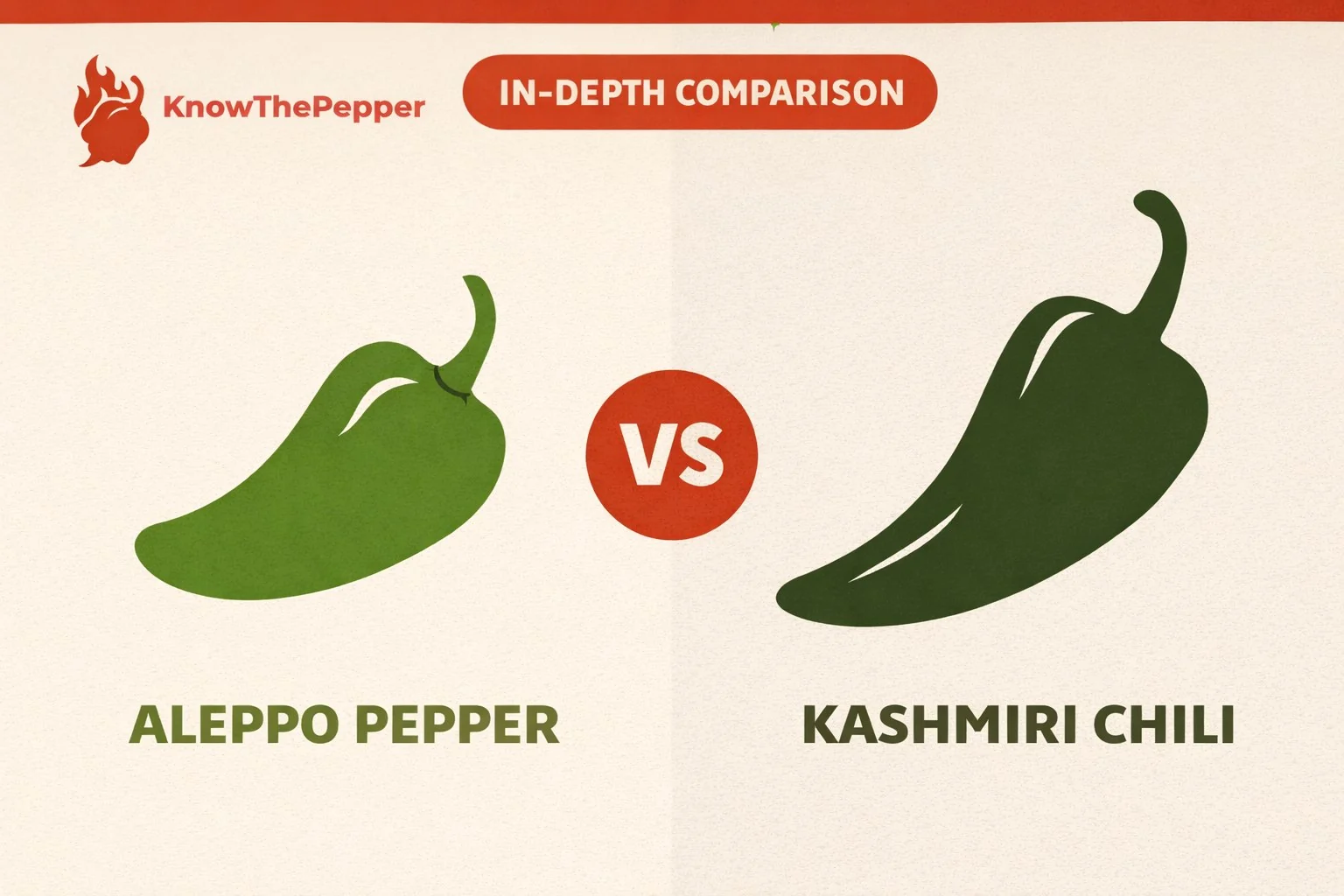
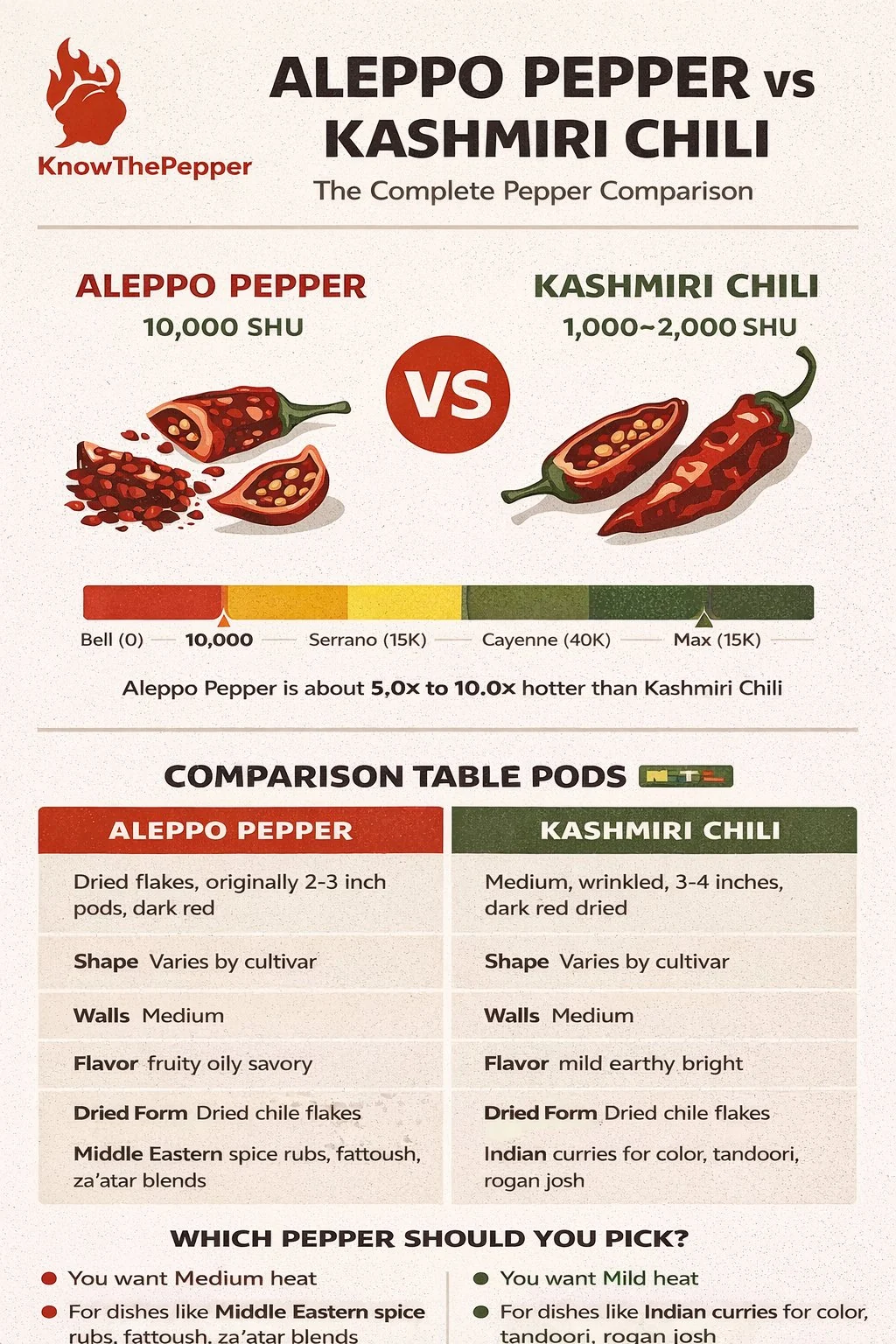
Aleppo Pepper measures 10K–30K SHU while Kashmiri Chili registers 1K–2K SHU — making Aleppo Pepper 15× hotter. Aleppo Pepper is known for its fruity and earthy flavor (C. annuum), while Kashmiri Chili offers mild and sweet notes (C. annuum).
- Heat difference: Aleppo Pepper is 15× hotter
- Species: Both are C. annuum
- Best for: Aleppo Pepper excels in everyday cooking and salsas, Kashmiri Chili in fresh salsas and mild recipes
Aleppo Pepper
HotKashmiri Chili
MediumAleppo Pepper vs Kashmiri Chili Comparison
Aleppo Pepper vs Kashmiri Chili Heat Levels
The numbers tell a clear story: Kashmiri chili registers 1,000-2,000 SHU, placing it firmly in the mild intensity range where heat is barely a consideration. Aleppo, at 10,000-30,000 SHU, occupies the heat category for Aleppo - a meaningful jump that changes how each pepper functions at the table.
For context, a Fresno chili typically runs 2,500-10,000 SHU. Kashmiri sits well below even the mildest Fresno, while Aleppo at its peak can hit three times the top of a Fresno's range. That's not a small difference - it's the gap between background warmth and a noticeable, lingering burn.
Aleppo's heat is often described as slow-building and oily, which makes sense given its traditional preparation: the peppers are dried, seeded, and packed in salt and oil before grinding. That process mellows the sharpest edge of the capsaicin while concentrating the fruity, sun-dried character. The result is heat that arrives late and fades gently - nothing aggressive, but definitely present.
Kashmiri's 1,000-2,000 SHU means most people register almost no burn at all. The pepper is used in Indian cooking almost entirely for its deep red pigmentation rather than any thermal contribution. You can use it generously without worrying about heat management, which is exactly the point in dishes like rogan josh where color is the goal.
For the receptor science behind why these peppers burn differently, the key is capsaicin concentration - Kashmiri simply has very little, while Aleppo carries enough to register clearly on the palate.
Flavor Profile Comparison
Most peppers ask you to choose between heat and flavor.
Color is the whole point with Kashmiri chili.
These two peppers share almost nothing in flavor beyond a basic dried-chili earthiness. Aleppo is fruity, complex, and slightly salty from its oil-cured processing. There's a raisin-like sweetness underneath, followed by cumin-adjacent earthiness and a hint of acidity - some describe it as sun-dried tomato meeting mild chili flake. The oil content gives Aleppo flakes a moist, almost waxy texture that distinguishes them from standard dried chili flakes.
Kashmiri chili is mild and sweet with very little complexity beyond its color contribution. The flavor is clean and slightly fruity, but nowhere near as developed as Aleppo's layered profile. Its primary function is chromatic: it produces an intensely red-orange oil when bloomed in fat, which is why it's irreplaceable in dishes where appearance matters as much as taste.
Aroma is another point of divergence. Aleppo has a pronounced, almost Mediterranean fragrance - warm, slightly smoky, with that dried-fruit quality. Kashmiri smells more neutral, with a faint sweetness that doesn't dominate a dish's aromatic profile.
In practical cooking terms, Aleppo adds flavor AND color AND mild heat simultaneously. Kashmiri adds color with minimal flavor interference. That makes Kashmiri the more neutral canvas - useful when you want a specific spice blend to shine without the chili competing. Aleppo, by contrast, is a flavor contributor in its own right and needs to be treated as such in recipe development.
Both belong to the botanical family for Aleppo, which spans an extraordinary range from bell peppers to cayenne - a reminder of how much variation exists within a single species.
Culinary Uses for Aleppo Pepper and Kashmiri Chili
Murgh makhani (butter chicken) is the dish that best illustrates Kashmiri's role: the sauce gets its signature deep red-orange color almost entirely from Kashmiri chili powder, not from tomatoes or other pigments. Swap it out for cayenne or paprika and the color shifts noticeably. At 1,000-2,000 SHU, you can add it by the tablespoon without worrying about heat creep - rogan josh recipes routinely call for 2-4 tablespoons in a single pot.
Aleppo belongs to the regional origin for Aleppo and anchors the spice profiles of Syrian, Turkish, and Lebanese cooking. It's the finishing spice on hummus, the seasoning in muhammara, the chili element in za'atar blends. Sprinkle it over labneh with olive oil, stir it into shakshuka, or use it as the primary heat source in spiced lamb dishes. Its oil-cured preparation means it disperses differently than dry-ground spices - it tends to clump slightly and release flavor more slowly.
For substitution: replacing Aleppo with Kashmiri means losing both heat and flavor complexity. If you go that route, add a small amount of smoked paprika and a pinch of cayenne to approximate what's missing. The reverse substitution - Kashmiri for Aleppo - works better in color-forward applications but will leave the dish noticeably milder and less aromatic.
Ratio guidance when substituting Aleppo for Kashmiri: start at half the volume and taste, since even mild Aleppo carries significantly more heat. Going the other direction, use 1.5x the Kashmiri to match Aleppo's color output, then supplement heat separately.
Both peppers work well in spiced oils and compound butters. Aleppo chili butter on grilled fish or roasted vegetables is a straightforward weeknight move. Kashmiri oil - made by blooming the powder in neutral oil - is the base for countless Indian restaurant-style dishes and worth making in larger batches.
For anyone interested in making homemade chili oil or spiced blends with either pepper, the process is straightforward but temperature control matters - both can turn bitter if the oil gets too hot.
Which Should You Choose?
Kashmiri chili is the right call when color is the priority and heat must stay invisible. It's a professional-grade colorant that happens to be a spice, and at 1,000-2,000 SHU, it's accessible to anyone regardless of heat tolerance. Use it in Indian curries, tandoori marinades, and any dish where that specific red-orange hue is part of the visual identity.
Aleppo is the choice when you want heat, flavor, and color working together. At 10,000-30,000 SHU it's not a fire-breathing pepper, but it's assertive enough to define a dish's character rather than just color it. It's the better everyday finishing spice for Mediterranean-style cooking and holds its own against stronger flavors like lamb, aged cheese, and concentrated tomato.
They're not interchangeable in any meaningful sense - the flavor profiles are too different and the heat gap is too wide. But both deserve space in a well-stocked spice cabinet, because they solve different problems. Kashmiri for Indian cooking, Aleppo for Middle Eastern and Mediterranean applications. Neither is a substitute for the other without significant adjustment.
Can You Substitute One for the Other?
Yes — direct substitution works. Aleppo Pepper and Kashmiri Chili are close enough in heat to swap at roughly 1:1. The main difference will be flavor. For more swap options, explore ranked alternatives with conversion ratios.
Growing Aleppo Pepper vs Kashmiri Chili
If you’re deciding which pepper to grow at home, consider your climate and patience level. Aleppo Pepper and Kashmiri Chili have different maturation times and temperature preferences. Hotter varieties generally need a longer, warmer growing season to develop their full capsaicin content. Our zone-based planting date tool can pinpoint the best sowing window for your area.
Growing Aleppo pepper in North America is straightforward for anyone familiar with C. annuum cultivation basics — the plant doesn't demand special treatment, just warmth and patience.
Start seeds indoors 8–10 weeks before last frost. Germination is reliable at 75–85°F soil temperature, typically within 10–14 days.
The plants reach 24–36 inches tall and prefer full sun with well-draining soil. Once established, they're relatively drought-tolerant — overwatering is a more common mistake than underwatering.
Kashmiri chili is a warm-season annual that performs best in USDA zones 9–11 outdoors, though it grows well as a container plant in cooler climates when brought inside before frost. Start seeds indoors 8–10 weeks before last frost, maintaining soil temperature around 75–85°F for germination.
The plants are relatively compact — typically 18–24 inches tall — and moderately productive. They prefer well-drained, slightly acidic soil with consistent moisture.
For those comparing cultivation approaches, the Aji Panca's similarly low-heat growing profile offers a useful parallel — both reward patience over intensity manipulation.
History & Origin of Aleppo Pepper and Kashmiri Chili
Both peppers carry centuries of culinary heritage. Aleppo Pepper traces its roots to Syria, while Kashmiri Chili originates from India. Understanding their backstory helps explain why each pepper developed its distinctive traits.
Buying & Storage
Whether you’re shopping for Aleppo Pepper or Kashmiri Chili, the same quality indicators apply. Fresh peppers should feel firm and heavy for their size, with taut, glossy skin and no soft or wet spots. Minor stem cracks known as “corking” are perfectly normal and often indicate a mature, flavorful pod.
- Firm pods with taut skin and consistent color
- Should feel heavy relative to size
- Minor stem cracks (“corking”) are normal
- Avoid anything soft, shriveled, or with dark wet spots
- Fresh: Paper bag, crisper drawer — 1–2 weeks
- Frozen: Wash, dry, freeze on sheet pan — 6+ months
- Dried: Airtight, away from light — up to 1 year
The Verdict: Aleppo Pepper vs Kashmiri Chili
Aleppo Pepper and Kashmiri Chili occupy very different positions on the heat spectrum. Aleppo Pepper delivers 15× more heat with its distinctive fruity and earthy character. Kashmiri Chili, with its mild and sweet profile, excels in everyday cooking.
Frequently Asked Questions
Related Comparisons
Sources pending verification.