7 Pot Douglah vs Ghost Pepper: Which Pepper to Use?
The 7 Pot Douglah and the Ghost Pepper sit at opposite ends of the super-hot spectrum in terms of character — one is a dark, nutty Trinidad beast pushing nearly 1,853,986 SHU, the other a smoky, fruity legend from Northeast India that made history as the world's first certified hottest pepper. Both will test your limits, but they do it differently and taste different doing it.

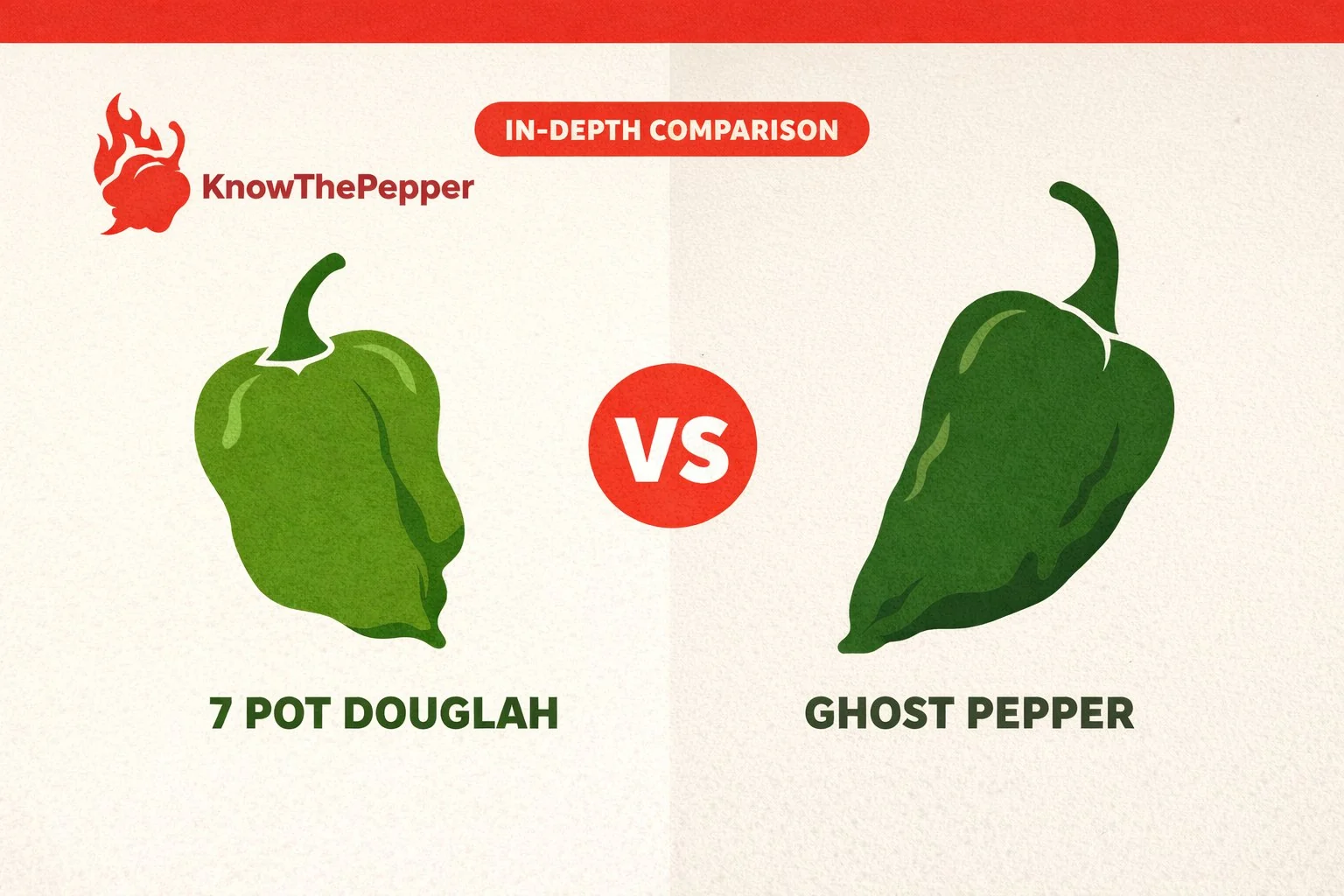
7 Pot Douglah measures 1.2M–1.9M SHU while Ghost Pepper registers 855K–1M SHU — making 7 Pot Douglah 2× hotter. 7 Pot Douglah is known for its nutty and earthy flavor (C. chinense), while Ghost Pepper offers smoky and sweet notes (C. chinense).
- Heat difference: 7 Pot Douglah is 2× hotter
- Species: Both are C. chinense
- Best for: 7 Pot Douglah excels in hot sauces and extreme dishes, Ghost Pepper in hot sauces and spicy dishes
7 Pot Douglah
Super-HotGhost Pepper
Super-Hot7 Pot Douglah vs Ghost Pepper Comparison
7 Pot Douglah vs Ghost Pepper Heat Levels
The 7 Pot Douglah registers between 1,200,000 and 1,853,986 SHU, placing it firmly in the super-hot pepper intensity zone alongside the Carolina Reaper and Moruga Scorpion. The Ghost Pepper (Bhut Jolokia) clocked in at roughly 1,041,427 SHU when it earned its Guinness World Record in 2007 — a number that still commands respect even though newer cultivars have since surpassed it.
Put those numbers in context: a serrano pepper sits around 10,000-23,000 SHU. The Ghost Pepper is roughly 45-100 times hotter than a serrano. The Douglah, at its peak, can hit 80 times hotter than that same serrano — and at its lower end still clears 50x. That gap between the two peppers narrows and widens depending on growing conditions, but the Douglah consistently comes out hotter in controlled testing.
The heat character differs just as much as the numbers. Ghost Pepper heat builds slowly — there's a delay before the full burn arrives, giving you a false sense of security. The Douglah hits faster and spreads across the entire mouth and throat almost simultaneously. Both trigger capsaicin receptor chemistry that causes the same physiological burning response, but the Douglah's capsaicinoid profile produces a more sustained, full-body heat that lingers longer.
For anyone using the Scoville rating system to plan heat tolerance, treat the Douglah as roughly 20-30% hotter than a Ghost Pepper in practical terms — not just on paper.
Flavor Profile Comparison
Most super-hots taste like pure fire.
Long before it became a dare on YouTube, the ghost pepper was a staple of Naga cuisine in Assam, Nagaland, and Manipur — used in traditional pickles, meat preparations, and even as a topical remedy against arthritis.
This is where things get genuinely interesting. The 7 Pot Douglah has a flavor profile that sets it apart from most super-hots: nutty and earthy, almost chocolatey in its depth, with a richness that comes through even in small quantities. The dark brown-to-chocolate skin color signals what your palate is about to receive. It's the kind of pepper that makes you pause before the heat arrives — there's actual flavor worth noticing.
The Ghost Pepper leans in a different direction entirely. It carries a fruity, smoky quality with floral undertones that reflect its C. chinense lineage and the humid growing conditions of Nagaland and Assam. Some describe it as almost tropical, though the smoke note can dominate depending on how it's prepared. Dried Ghost Peppers amplify that smokiness considerably.
For cooking applications, the Douglah's earthy nuttiness makes it a natural fit for dark mole-style sauces, BBQ rubs, and fermented hot sauces where complexity matters. The Ghost Pepper's fruity character pairs better with fruit-forward salsas, chutneys, and South Asian-influenced dishes where the floral note complements rather than clashes.
Neither pepper is particularly well-suited to raw applications where you want to taste the full profile — the heat overwhelms everything at these SHU levels. Cooking both down or fermenting them unlocks their flavor potential more effectively than using them fresh. The Douglah's flavor survives high-heat cooking better; the Ghost Pepper's delicate floral notes can fade quickly at high temperatures.
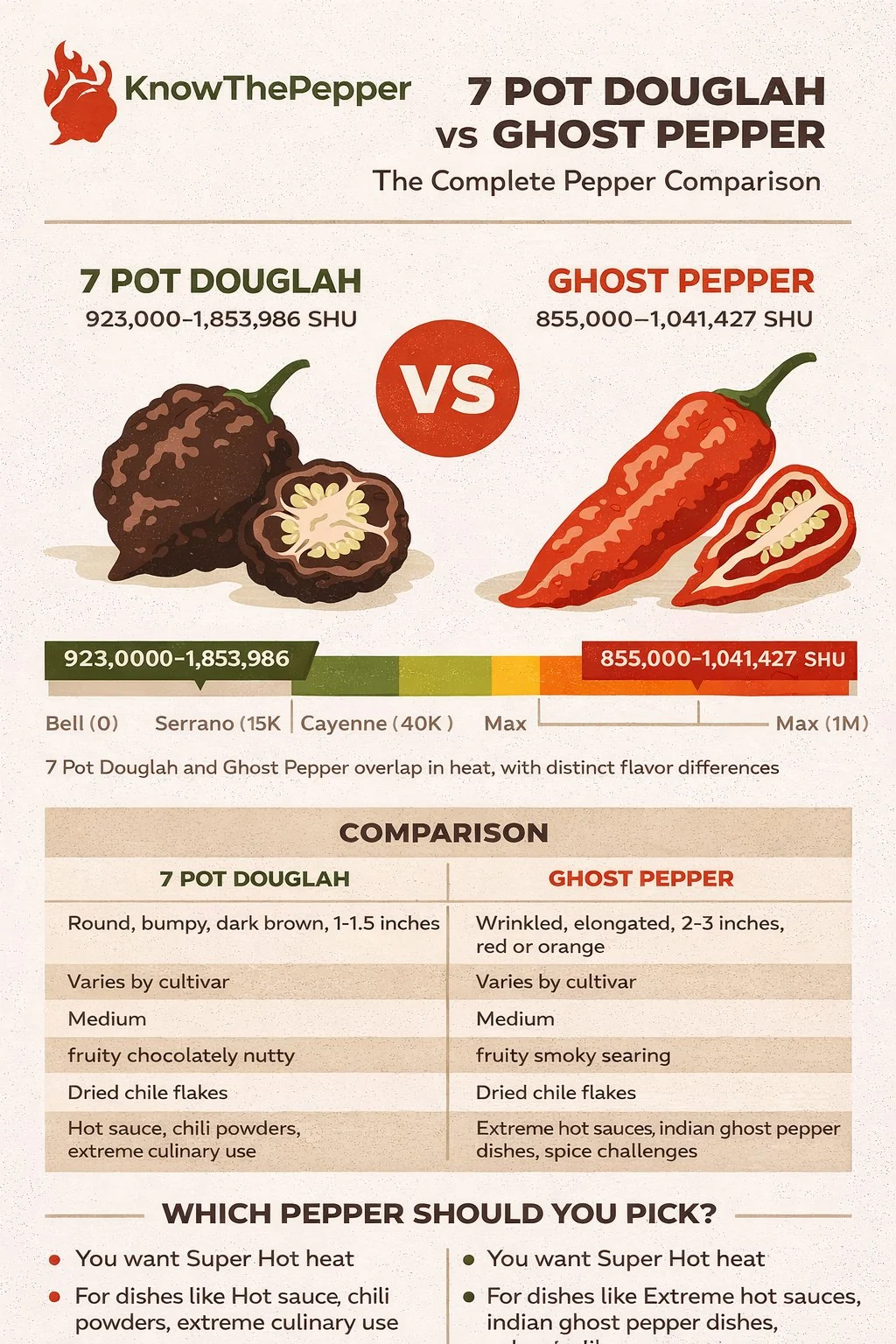
Culinary Uses for 7 Pot Douglah and Ghost Pepper
Both peppers demand respect in the kitchen, but they earn their place in very different dishes.
7 Pot Douglah shines in applications where you want depth alongside heat. Its nutty, earthy character holds up in long-cooked sauces, slow-smoked BBQ glazes, and dark fermented hot sauces. A single dried Douglah pod can season a pot of chili for 6-8 people — use it whole, then remove before serving if you want flavor without maximum heat. For hot sauce, a ratio of 1 Douglah to every 10-15 milder peppers gives you a manageable burn with serious flavor complexity. Check the Douglah's full earthy flavor profile for more specific ratios.
Ghost Pepper works beautifully in South Asian-inspired dishes, fruit-based hot sauces, and pickled preparations. Its fruity quality pairs naturally with mango, tamarind, and coconut — flavor combinations common in the Northeast Indian cuisine where it originates. For a Ghost Pepper hot sauce, blend with roasted garlic, vinegar, and fruit at a 1:20 ratio (one Ghost Pepper to 20 parts other ingredients) as a starting point. The smoky-fruity character of Ghost Pepper also makes it a compelling addition to marinades for grilled meats.
Substituting one for the other requires adjustment. If a recipe calls for Ghost Pepper and you only have Douglah, use 70-75% of the quantity and expect a nuttier, less fruity result. Going the other direction — Douglah to Ghost Pepper — increase quantity by about 25-30% and accept that the earthy depth won't fully replicate.
For swap options when you're out of Douglah, the Chocolate Bhutlah or Trinidad Moruga Scorpion come closest in heat and flavor character. For Ghost Pepper alternatives, habaneros at higher volume or Red Savina work reasonably well for the fruity profile at lower heat levels.
Which Should You Choose?
Choose the 7 Pot Douglah when you want maximum heat paired with genuine flavor complexity — it's the better pepper for dark sauces, fermented hot sauces, and any application where that nutty depth can express itself. It's also the choice for heat-seekers who want to push past what the Ghost Pepper offers.
Choose the Ghost Pepper when the fruity, floral character matters to the dish — South Asian cooking, fruit-based sauces, or recipes where a smoky tropical note is an asset. It's also more approachable for people stepping into super-hot territory for the first time, though "approachable" is relative at over a million SHU.
For a side-by-side look at how Ghost Pepper stacks up against the Carolina Reaper, that comparison gives useful context on where Ghost Pepper sits in the broader super-hot landscape. If the Douglah's heat profile interests you, the heat and flavor contrast with Trinidad Moruga Scorpion is worth reading — they're close relatives with meaningful differences.
Can You Substitute One for the Other?
Proceed with caution. 7 Pot Douglah is 2× hotter than Ghost Pepper.
Need a different option altogether? Search for peppers that match your target heat and flavor with precise swap ratios.
Growing 7 Pot Douglah vs Ghost Pepper
If you’re deciding which pepper to grow at home, consider your climate and patience level. 7 Pot Douglah and Ghost Pepper have different maturation times and temperature preferences. Hotter varieties generally need a longer, warmer growing season to develop their full capsaicin content. Our zone-based planting date tool can pinpoint the best sowing window for your area.
Growing a Douglah requires patience before anything else. Seeds take 14-21 days to germinate and need soil temperatures of 80-85°F - a heat mat under your seed tray is not optional at this stage.
Start seeds 10-12 weeks before last frost. Transplant outdoors only after nighttime temperatures stay consistently above 60°F.
Full sun is non-negotiable: 8+ hours daily. The plants are heavy feeders; a balanced fertilizer through vegetative growth transitioning to a lower-nitrogen, higher-phosphorus formula once flowering begins will push pod development.
The hardest part of growing ghost peppers isn't germination — it's maintaining the long, hot season they need to fully ripen. In most of North America, that means starting seeds indoors 10–12 weeks before last frost and providing supplemental heat throughout the season.
Soil quality matters enormously. Ghost peppers want well-draining, slightly acidic soil (pH **6.
Fertilize with a lower-nitrogen mix once flowering begins — too much nitrogen pushes leafy growth at the expense of pods. Consistent calcium (through gypite or foliar spray) helps prevent blossom end rot, which ghost peppers are prone to during dry spells.
History & Origin of 7 Pot Douglah and Ghost Pepper
Both peppers carry centuries of culinary heritage. 7 Pot Douglah traces its roots to Trinidad, while Ghost Pepper originates from India. Understanding their backstory helps explain why each pepper developed its distinctive traits.
Buying & Storage
Whether you’re shopping for 7 Pot Douglah or Ghost Pepper, the same quality indicators apply. Fresh peppers should feel firm and heavy for their size, with taut, glossy skin and no soft or wet spots. Minor stem cracks known as “corking” are perfectly normal and often indicate a mature, flavorful pod.
- Firm pods with taut skin and consistent color
- Should feel heavy relative to size
- Minor stem cracks (“corking”) are normal
- Avoid anything soft, shriveled, or with dark wet spots
- Fresh: Paper bag, crisper drawer — 1–2 weeks
- Frozen: Wash, dry, freeze on sheet pan — 6+ months
- Dried: Airtight, away from light — up to 1 year
The Verdict: 7 Pot Douglah vs Ghost Pepper
7 Pot Douglah and Ghost Pepper sit in the same heat tier but serve different roles. 7 Pot Douglah delivers 2× more heat with its distinctive nutty and earthy character. Ghost Pepper, with its smoky and sweet profile, excels in everyday cooking.
Frequently Asked Questions
Related Comparisons
Sources pending verification.