7 Pot Douglah vs Chocolate Bhutlah: What's the Difference?
Both the 7 Pot Douglah and the Chocolate Bhutlah sit at the extreme end of the pepper world, but they're not equals. The Douglah tops out near 1,853,986 SHU while the Bhutlah pushes to 2,000,000 SHU - and the difference in how that heat lands is just as significant as the numbers. One brings earthy depth, the other delivers a smoky, almost suffocating intensity.

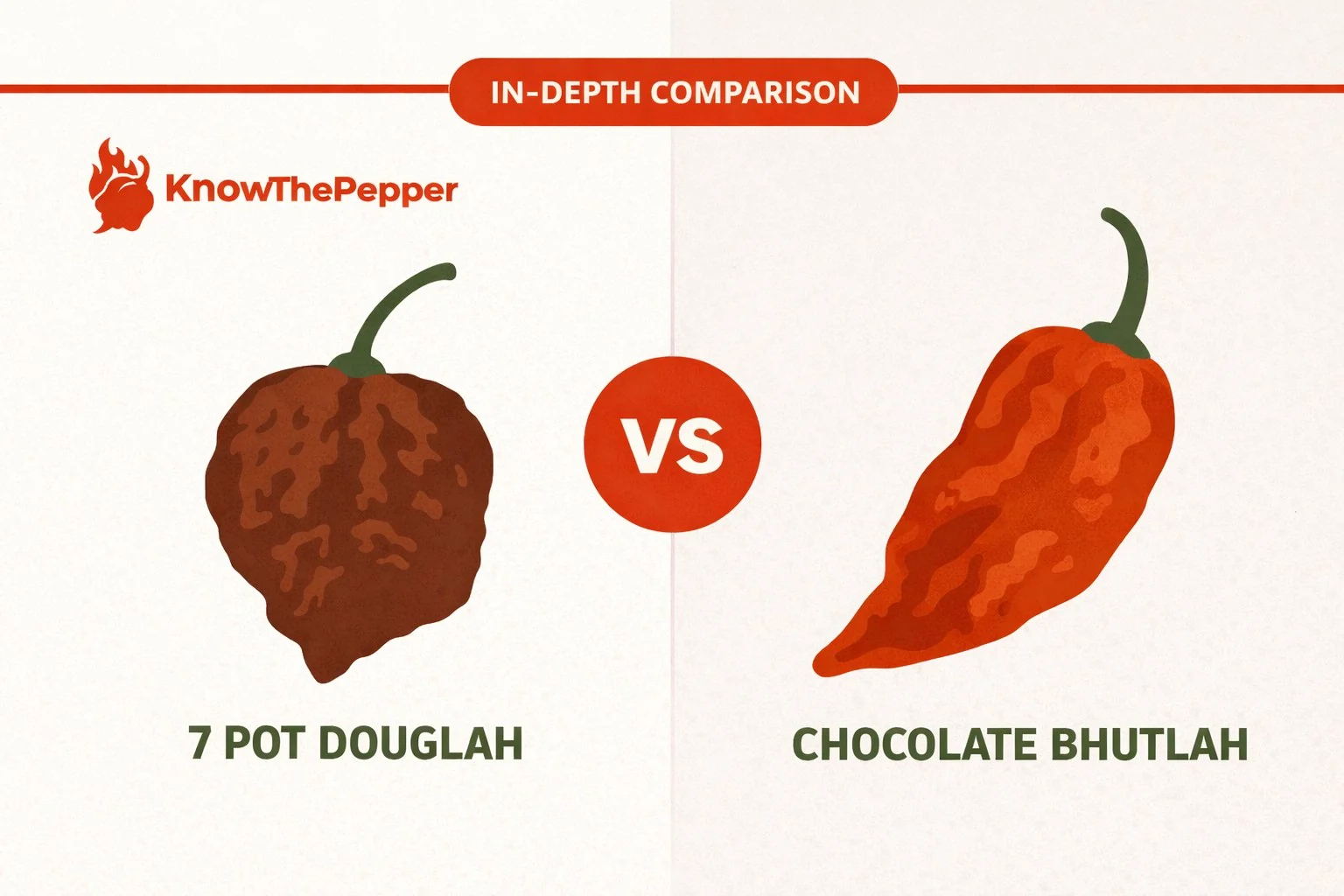
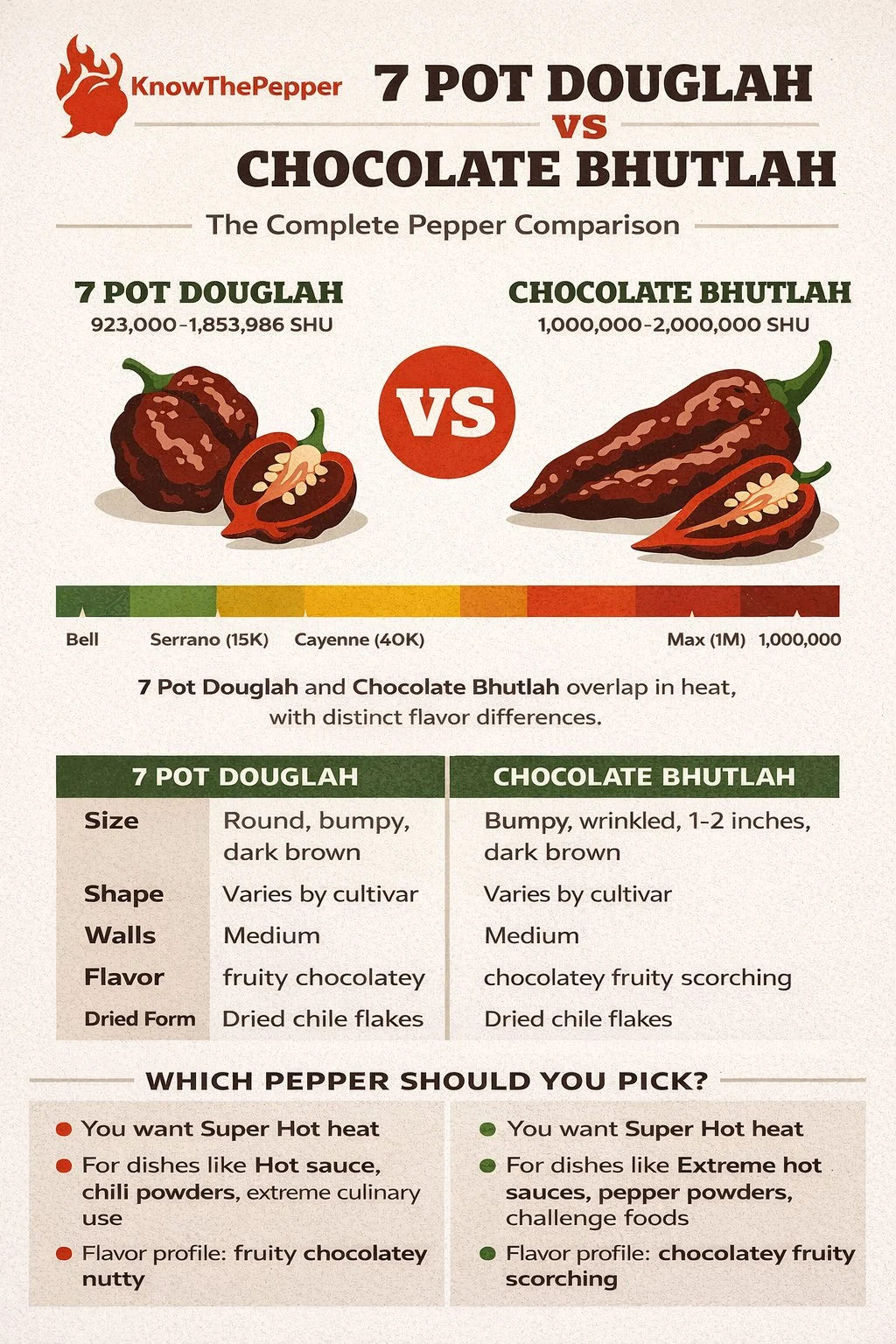
7 Pot Douglah measures 1.2M–1.9M SHU while Chocolate Bhutlah registers 1.5M–2M SHU — roughly equal in heat. 7 Pot Douglah is known for its nutty and earthy flavor (C. chinense), while Chocolate Bhutlah offers smoky and intense notes (C. chinense).
- Species: Both are C. chinense
- Best for: 7 Pot Douglah excels in hot sauces and extreme dishes, Chocolate Bhutlah in hot sauces and spicy dishes
7 Pot Douglah
Super-HotChocolate Bhutlah
Super-Hot7 Pot Douglah vs Chocolate Bhutlah Comparison
7 Pot Douglah vs Chocolate Bhutlah Heat Levels
The 7 Pot Douglah ranges from 1,200,000 to 1,853,986 SHU, making it one of the most respected super-hots out of Trinidad's pepper-growing tradition. The Chocolate Bhutlah edges it out at 1,500,000 to 2,000,000 SHU, a hybrid developed in the USA that some enthusiasts consider one of the hottest peppers ever documented.
To put those numbers in context using an Anaheim pepper as a baseline - Anaheims sit around 1,000 SHU - the Douglah is roughly 1,200 to 1,850 times hotter, and the Bhutlah hits 1,500 to 2,000 times hotter. The gap between them sounds modest on paper, but at these extremes, even a 150,000 SHU difference is felt immediately.
Both belong to the super-hot classification on the Scoville scale, but their heat characters diverge sharply. The Douglah's burn builds steadily - a deep, rolling heat that spreads across the palate and lingers without the same immediate shock as some other C. chinense varieties. The Bhutlah, by contrast, hits fast and hard, with a front-loaded intensity that doesn't give much warning before it overwhelms.
The Scoville scale's measurement methodology matters here too - these figures reflect High-Performance Liquid Chromatography (HPLC) results, and individual pod variation means a single Bhutlah can swing wildly. Neither pepper is consistent across every harvest, so treating either as a fixed number is misleading.
Flavor Profile Comparison
Most super-hots taste like pure fire.
Before the numbers even come up, the Chocolate Bhutlah announces itself through smell — a dark, almost tobacco-like smokiness that sets it apart from the sharp, fruity blast you get from something like the Reaper's intense culinary heat.
Strip away the heat for a moment - which is admittedly difficult with either of these - and the flavor profiles are genuinely distinct. The 7 Pot Douglah carries a nutty, earthy character that sets it apart from the fruity brightness typical of most C. chinense peppers. There's an almost chocolatey undertone (hence the dark brown color at full ripeness) that makes it oddly pleasant before the capsaicin takes over.
The Chocolate Bhutlah goes in a different direction entirely. Its flavor reads as smoky and intensely savory, with a depth that feels more like a roasted pepper than a fresh one. Where the Douglah has a kind of rounded, mellow quality in its non-heat components, the Bhutlah is aggressive from the first bite - the smoke and intensity don't wait for the heat to arrive.
Aroma matters too. The Douglah has a subtle, almost musty earthiness when sliced - reminiscent of dried spices. The Bhutlah smells more pungent and sharp, with a volatile quality that hits the sinuses before the pepper even touches your lips.
For cooking, these differences are real and practical. The Douglah's earthy-nutty notes work surprisingly well in fermented hot sauces and dark mole-style preparations where you want depth without brightness. The Bhutlah's smokiness pairs naturally with barbecue applications and slow-cooked braises where it can meld into the background of a complex flavor profile rather than dominating as a single sharp note.
Culinary Uses for 7 Pot Douglah and Chocolate Bhutlah
Neither pepper belongs in dishes where subtlety matters. These are tools for specific applications, and using them well means respecting both the heat ceiling and the flavor character each brings.
The 7 Pot Douglah earns its place in fermented hot sauces - its earthy profile deepens during lacto-fermentation in a way that fruity peppers don't. A small batch sauce using 1-2 pods per quart of mash is enough to produce a genuinely dangerous product. It also works in dry rubs when dehydrated and ground; the powder has a complex, nutty heat that layers well with smoked paprika and cumin. For comparing the Douglah against other Trinidadian super-hots, the flavor differences become clearer when both are used in the same base recipe.
The Chocolate Bhutlah leans into its smoky intensity best in oil infusions and slow-cooked chili bases. A single pod split and simmered in 2 cups of neutral oil for 20 minutes creates an infused oil that adds serious heat with a barbecue-adjacent smokiness. In chili, half a pod per gallon is a reasonable starting point for experienced heat-seekers.
Substitution between the two is workable but imperfect. If a recipe calls for Douglah and you only have Bhutlah, reduce quantity by about 15-20% to account for the higher ceiling and adjust for the smokier profile. Going the other direction, use slightly more Douglah and expect a less aggressive front-end heat.
Both peppers respond well to the indoor starting approach for growing if you're working from seed - they need a long season and consistent warmth. Neither is widely available fresh, so dried pods or powder are the practical reality for most cooks. Store dried pods in an airtight container away from light; they hold potency for 12-18 months without significant degradation.
Which Should You Choose?
Choosing between these two depends entirely on what you're trying to accomplish. If the goal is maximum heat with a smoky, aggressive character, the Chocolate Bhutlah wins - its upper range of 2,000,000 SHU and front-loaded intensity make it the more extreme option.
But the 7 Pot Douglah is the more interesting cooking pepper. Its nutty, earthy flavor gives it dimension that the Bhutlah's blunt smokiness lacks, and it's somewhat more predictable in heat delivery. For fermented sauces, spice blends, and dishes where the pepper contributes flavor alongside heat, the Douglah is the better choice.
Heat-seekers chasing records should look at the Bhutlah. Cooks who want a super-hot with actual flavor character should reach for the Douglah. Neither is appropriate for casual use - both sit firmly in the super-hot bracket where a small mistake ruins an entire batch.
For context on how the Douglah stacks up against more familiar extremes, the Douglah versus Ghost Pepper contrast shows just how far past the ghost pepper both of these reach.
Can You Substitute One for the Other?
Proceed with caution. Chocolate Bhutlah is 1× hotter than 7 Pot Douglah.
Need a different option altogether? Search for peppers that match your target heat and flavor with precise swap ratios.
Growing 7 Pot Douglah vs Chocolate Bhutlah
If you’re deciding which pepper to grow at home, consider your climate and patience level. 7 Pot Douglah and Chocolate Bhutlah have different maturation times and temperature preferences. Hotter varieties generally need a longer, warmer growing season to develop their full capsaicin content. Our zone-based planting date tool can pinpoint the best sowing window for your area.
Growing a Douglah requires patience before anything else. Seeds take 14-21 days to germinate and need soil temperatures of 80-85°F - a heat mat under your seed tray is not optional at this stage.
Start seeds 10-12 weeks before last frost. Transplant outdoors only after nighttime temperatures stay consistently above 60°F.
Full sun is non-negotiable: 8+ hours daily. The plants are heavy feeders; a balanced fertilizer through vegetative growth transitioning to a lower-nitrogen, higher-phosphorus formula once flowering begins will push pod development.
The Chocolate Bhutlah grows like most extreme C. chinense varieties — slowly, demandingly, and with significant reward for patient gardeners.
Transplant outdoors only after nighttime temperatures stay consistently above 60°F. These plants need full sun — 8+ hours daily — and warm soil to perform.
Feed with a balanced fertilizer through vegetative growth, then shift to a lower-nitrogen, higher-phosphorus formula once flowers appear. Inconsistent watering causes blossom drop, which is the most common frustration with this variety.
History & Origin of 7 Pot Douglah and Chocolate Bhutlah
Both peppers carry centuries of culinary heritage. 7 Pot Douglah traces its roots to Trinidad, while Chocolate Bhutlah originates from USA. Understanding their backstory helps explain why each pepper developed its distinctive traits.
Buying & Storage
Whether you’re shopping for 7 Pot Douglah or Chocolate Bhutlah, the same quality indicators apply. Fresh peppers should feel firm and heavy for their size, with taut, glossy skin and no soft or wet spots. Minor stem cracks known as “corking” are perfectly normal and often indicate a mature, flavorful pod.
- Firm pods with taut skin and consistent color
- Should feel heavy relative to size
- Minor stem cracks (“corking”) are normal
- Avoid anything soft, shriveled, or with dark wet spots
- Fresh: Paper bag, crisper drawer — 1–2 weeks
- Frozen: Wash, dry, freeze on sheet pan — 6+ months
- Dried: Airtight, away from light — up to 1 year
The Verdict: 7 Pot Douglah vs Chocolate Bhutlah
7 Pot Douglah and Chocolate Bhutlah sit in the same heat tier but serve different roles. Chocolate Bhutlah delivers its distinctive smoky and intense character. 7 Pot Douglah, with its nutty and earthy profile, excels in everyday cooking.
Frequently Asked Questions
Related Comparisons
Sources pending verification.