Which Jalapeno Varieties Fit Your Garden and Kitchen?
Jalapeno cultivars separate heat, fruit size, ripe color, plant habit, harvest rhythm, and seed genetics. Match the named evidence to your limiting kitchen or garden job instead of looking for one universal best variety.
Jalapeno varieties differ in more than heat. Breeders have selected cultivars for larger stuffing cavities, concentrated pickling harvests, compact container plants, unusual ripe colors, disease resistance, and predictable seed traits.
Choose the job first. NuMex Primavera gives a documented mild direction, NuMex Jalmundo and Emerald Fire produce large stuffing fruit, the NuMex Spice series adds yellow and orange ripe colors, Pot-a-peno fits small containers, San Joaquin concentrates its crop, and Jedi spreads harvest across a longer season.
What changes between jalapeno varieties?
A named jalapeno variety is a cultivar, meaning a cultivated selection with traits people maintain through seed production.
All-America Selections uses San Joaquin as a pepper cultivar example, while these jalapenos still belong to the same Capsicum annuum species.
The name therefore identifies a selected package of traits, not a separate species.
Two packets can both say jalapeno and still produce plants with different height, fruit length, wall thickness, mature color, harvest rhythm, or seed-saving behavior.
| Trait on the listing | What it changes | Question to ask |
|---|---|---|
| Heat measurement | The likely direction of pungency within a named trial | Was the value measured on fresh or dry material? |
| Fruit size and walls | Stuffing cavity, slicing yield, and processing speed | Are dimensions and wall thickness stated? |
| Mature color | The appearance of fully ripe pods | Does the description separate green harvest from ripe color? |
| Plant habit | Container fit, support needs, and picking access | Is mature plant height listed? |
| Fruit set | A concentrated batch or repeated harvests | Is the plant described as determinate or continuous-set? |
| Seed type | Uniformity and what happens when seed is saved | Is the packet F1 hybrid or open-pollinated? |
No cultivar wins every row.
A compact plant may solve a balcony constraint while producing fewer large stuffing pods, and a concentrated harvest may suit one pickling day while leaving less fruit for weekly salsa.
Pick the requirement that would make the crop unusable if it were wrong. Space, pod size, ripe color, heat direction, or harvest timing should narrow the shortlist before brand popularity does.
Trial context matters whenever a listing gives a number. Days to harvest depend on the stated starting point, and Scoville results depend on fruit maturity, sample preparation, environment, and the tested population.
Read a variety name as a traceable claim that still needs supporting measurements. A name without dimensions, timing, seed type, or a source gives less decision value than a shorter listing with those details.
Which jalapeno varieties are milder?
NuMex Primavera is the clearest documented mild choice in the available comparative research.
New Mexico State University reported about 7,500 Scoville Heat Units for Primavera, about 17,000 SHU for NuMex Jalmundo, and about 48,000 SHU for Early Jalapeno in the same dry-weight comparison.
Those figures establish direction within that study.
They do not predict the exact heat of a fresh pod from another garden because the research used dry material and a defined trial population.
| Cultivar | Published figure | Source basis | Practical reading |
|---|---|---|---|
| NuMex Primavera | About 7,500 SHU | NMSU dry-weight comparison | Mildest direction among the three NMSU entries |
| NuMex Jalmundo | About 17,000 SHU | NMSU dry-weight comparison | Middle position with large fruit |
| Early Jalapeno | About 48,000 SHU | NMSU dry-weight comparison | Hot reference in that trial |
| Emerald Fire F1 | About 2,500 SHU | AAS fresh-fruit listing | Mild, large-fruited hybrid direction |
Emerald Fire appears lower at 2,500 SHU in its All-America Selections listing, but that number cannot be ranked directly against the NMSU dry-weight values. The useful conclusion is narrower: both the breeder-backed listing and the fruit description position Emerald Fire as a mild stuffing jalapeno.
Choose NuMex Primavera when the heat comparison matters most and you want an open-pollinated NMSU cultivar.
Choose NuMex Jalmundo when a large popper pod matters and the NMSU middle heat position is acceptable.
Use Early Jalapeno as evidence that familiar jalapeno types can run much hotter in a dry-weight trial.
Heat can also vary among pods on one plant.
Growing temperature, water conditions, fruit maturity, and plant genetics affect the result, so a cultivar label reduces uncertainty without eliminating it.
Use a small piece before filling a raw salsa or serving a whole stuffed pepper. A published cultivar value supports selection, but it is not a guarantee for one fruit.
For guests who want very little heat, the variety decision is only the first control. Removing the internal pale tissue reduces the main capsaicin-bearing material, while dairy or a larger filling changes how strongly the remaining heat is perceived.
Which jalapenos are best for poppers or pickling?
Large, thick-walled fruit suits poppers, while a concentrated crop suits batch pickling. Length alone is not enough because a narrow fruit can be awkward to fill and a thin wall may soften before the filling is hot.
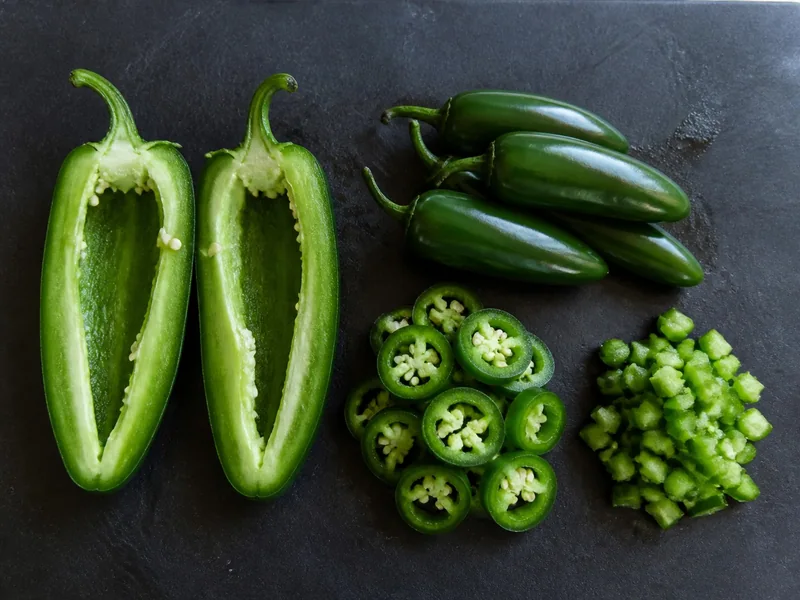
NMSU describes NuMex Jalmundo as an open-pollinated, large-fruited jalapeno developed for poppers. Its trial fruit averaged 9.45 centimeters long and 34.1 grams, giving seed savers a documented alternative to a large F1 hybrid.
Emerald Fire F1 follows a different path to the same kitchen job. All-America Selections lists extra-large fruit about 3.3 inches long and 1.2 inches wide with thick walls, plus uses that include stuffing, grilling, salsa, fresh eating, and canning.
| Kitchen job | Strong candidate | Trait that earns the choice | Tradeoff to check |
|---|---|---|---|
| Large poppers | Emerald Fire F1 | Wide, thick-walled fruit and mild listed heat | F1 seed does not reproduce as a uniform saved line |
| Open-pollinated poppers | NuMex Jalmundo | Large documented fruit and open-pollinated seed | Published heat is higher than NuMex Primavera in the NMSU trial |
| Batch pickling | San Joaquin | About 50 thick-walled fruits concentrated in a short window | A concentrated crop needs jars and brine ready together |
| Repeated fresh salsa | Jedi F1 | Large plant with continuous fruit set | Needs more space and a longer picking plan |
San Joaquin is especially practical when the processing day owns the decision. AAS describes a determinate plant about 30 inches tall that can carry roughly 50 four-inch fruits, with a concentrated set suited to canning, pickling, or a large batch of stuffed peppers.
Jedi F1 serves the opposite schedule. Johnny's Selected Seeds describes a large continuous-set plant with four to four-and-a-half-inch fruit, so it better supports repeated salsa or market harvests than one large processing day.
Prioritize width, wall thickness, and a cavity that stays open after halving. Emerald Fire and Jalmundo provide documented size evidence.
Prioritize synchronized fruit set and uniform pods. San Joaquin moves many usable fruits into the same harvest window.
Prioritize a plant that keeps setting fruit. Jedi spreads supply instead of forcing one large harvest.
Pod checking, the fine tan lines that can form on jalapeno skin, does not determine whether a cultivar fits a recipe. Judge the usable cavity, wall, harvest timing, and heat direction before treating surface appearance as a quality ranking.
Which jalapenos ripen yellow or orange?
NuMex Lemon Spice ripens yellow, NuMex Orange Spice ripens orange, and NuMex Pumpkin Spice reaches a deeper pumpkin-orange color. New Mexico State University released all three as open-pollinated jalapenos with compact plants.
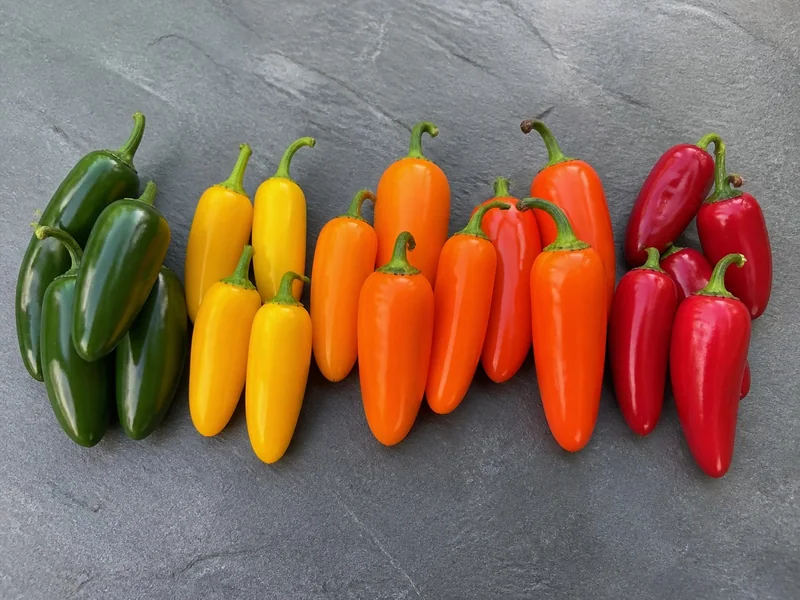
Every cultivar in that Spice series begins with green immature fruit. The named color describes the ripe stage, so a green pod on a Lemon Spice plant is not mislabeled or off-type merely because it has not matured.
Green immature fruit ripens bright yellow. This cultivar is open-pollinated.
The green pod reaches clear orange at full maturity. NMSU released it as open-pollinated seed.
Green fruit finishes pumpkin orange. This cultivar is also open-pollinated.
The NMSU description places these plants at about 36 to 45 centimeters tall. That compact habit can combine ripe color and limited space in one selection, although container volume and climate still control how large the plant becomes.
Ripe color changes harvest recognition and presentation.
Yellow and orange slices remain visually distinct in relishes or fresh salsas, and mixed plantings make it easier to build a multi-color harvest without waiting for every pod to turn red.
A yellow or orange jalapeno is not automatically milder than a red one. Mature color and capsaicin level are separate traits, so use cultivar-specific heat evidence when pungency matters.
Leave pods on the plant until the expected mature color fills most of the surface when color is the goal. Harvest them green when the recipe needs a firmer immature jalapeno, accepting that this gives up the distinguishing ripe color.
Which jalapenos fit your space and harvest window?
Pot-a-peno fits the smallest footprint, San Joaquin fits a concentrated processing harvest, and Jedi fits a longer continuous harvest.
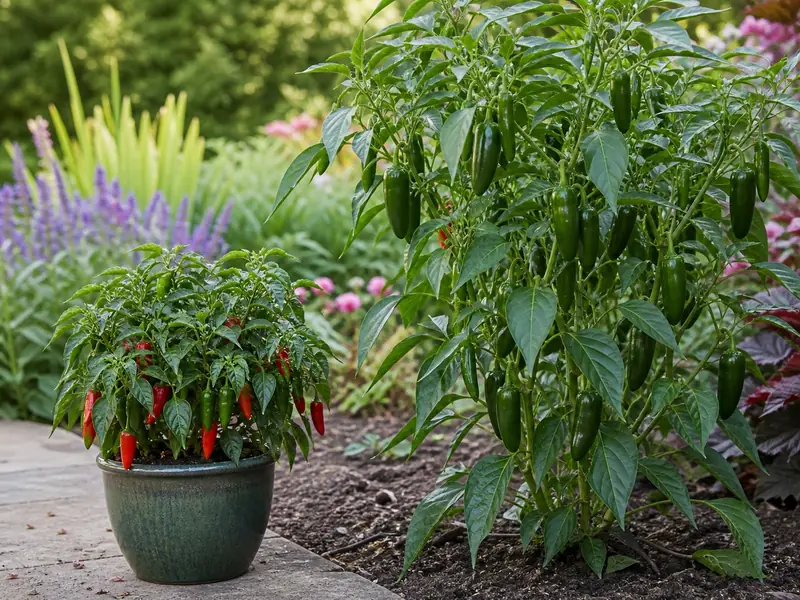
These choices solve different garden constraints even before fruit flavor enters the decision.
All-America Selections lists Pot-a-peno at only 12 to 15 inches tall, with three to four-inch fruit and suitability for containers or hanging baskets. Its listing gives 45 to 50 days to green fruit and 60 to 65 days to red fruit.
San Joaquin stands about 30 inches in the AAS description and reaches green harvest around 60 days from transplant. The determinate habit concentrates its fruit, which is useful when one preserving session matters more than a steady trickle.
Jedi F1 needs more room because Johnny's describes it as a large plant with continuous set. Its current listing gives about 72 days to green harvest and 82 days to red, also counted from transplant rather than from sowing.
| Garden constraint | Cultivar direction | Published timing or habit | Planning consequence |
|---|---|---|---|
| Small patio or hanging basket | Pot-a-peno | 12 to 15 inches tall, green fruit in 45 to 50 days from transplant | Use one adequately sized container and keep the fruit within easy reach |
| Shorter wait for a green crop | Pot-a-peno | Earlier listed green window than the other compared cultivars | Choose it when footprint and first harvest matter more than maximum plant size |
| One pickling or canning day | San Joaquin | Determinate set, about 60 days from transplant | Prepare equipment before the concentrated crop reaches size |
| Repeated harvests | Jedi F1 | Continuous set, about 72 days green and 82 days red | Allow more space and keep picking through the season |
Days to harvest are useful only with their starting point attached. A seed catalog that counts from transplant excludes the indoor seedling period, while another listing may count from sowing and appear slower even when the plants mature at similar times.
- Measure the final spaceUse mature plant height and spread, not the seedling pot, to decide whether the plant fits.
- Choose green or ripe timingRipe red, yellow, or orange fruit needs more time on the plant than a green harvest.
- Match the harvest rhythmChoose determinate concentration for batch processing or continuous set for repeated meals.
- Schedule from the same starting pointAdd seedling time when the listing counts days from transplant.
- Prepare support and containersLarge plants and fruit-heavy determinate plants can both need support, but for different reasons.
Plant size and pod load should also determine support. A compact hanging-basket plant needs a stable container, while a larger continuous plant needs enough root volume and stakes that keep laden branches off the ground.
How should you compare jalapeno seed listings?
Verify the exact seed type, timing basis, fruit measurements, plant habit, resistance codes, and current seller description.
A familiar cultivar name can appear in copied catalog text long after the original source changes or the seed is unavailable.
An F1 hybrid is the first generation of a controlled cross, selected for a uniform commercial result. Emerald Fire and Jedi are sold as F1 seed, so saved seed can segregate into different traits in the next generation.
An open-pollinated cultivar can reproduce its selected traits when pollen stays within that line. NuMex Jalmundo and the three NuMex Spice colors fit this category, but a garden containing several pepper cultivars still needs pollen control if true-to-type seed matters.
- Seed type should say F1 hybrid or open-pollinated rather than leaving genetics implied.
- Days to harvest should identify whether counting begins at sowing or transplanting.
- Fruit dimensions should support the promised stuffing, slicing, or processing use.
- Plant habit should state height, compactness, and determinate or continuous set when known.
- Resistance claims should name the disease and exact race or code instead of saying disease resistant.
- Packet treatment should disclose treated seed and explain handling on the label.
Johnny's current Jedi listing illustrates why the details matter. It names the seed as treated F1, gives separate green and red timing, states fruit size, describes continuous set, and lists bacterial leaf spot resistance by named races.
Resistance is not immunity, and a code does not transfer automatically to every disease strain in every region. Match the exact code to the disease pressure documented by a local extension service before allowing resistance to outweigh fruit or harvest needs.
Buy open-pollinated seed and control pollen when preserving a cultivar is part of the goal. Buy an F1 for its listed first-generation performance, not with the expectation that saved seed will reproduce the same plant.
Availability should be checked at purchase time because seed catalogs change. Use the breeder or current seller page to confirm packet status, treatment, and resistance details, then keep the label until harvest so observations stay attached to the correct cultivar.
The best jalapeno variety is therefore the one whose documented traits solve your limiting job.
Heat, pod shape, color, plant size, harvest rhythm, and seed genetics remain separate decisions even when one cultivar happens to satisfy several of them.
Which Jalapeno Varieties Fit Your Garden and Kitchen? FAQ
- All-America Selections: Seed Buying 101 Glossary
- New Mexico State University: NuMex Jalmundo Jalapeno
- All-America Selections: Emerald Fire Pepper
- New Mexico State University: NuMex Spice Jalapenos
- All-America Selections: Pot-a-peno Pepper
- All-America Selections: San Joaquin Jalapeno
- Johnny's Selected Seeds: Jedi F1 Jalapeno