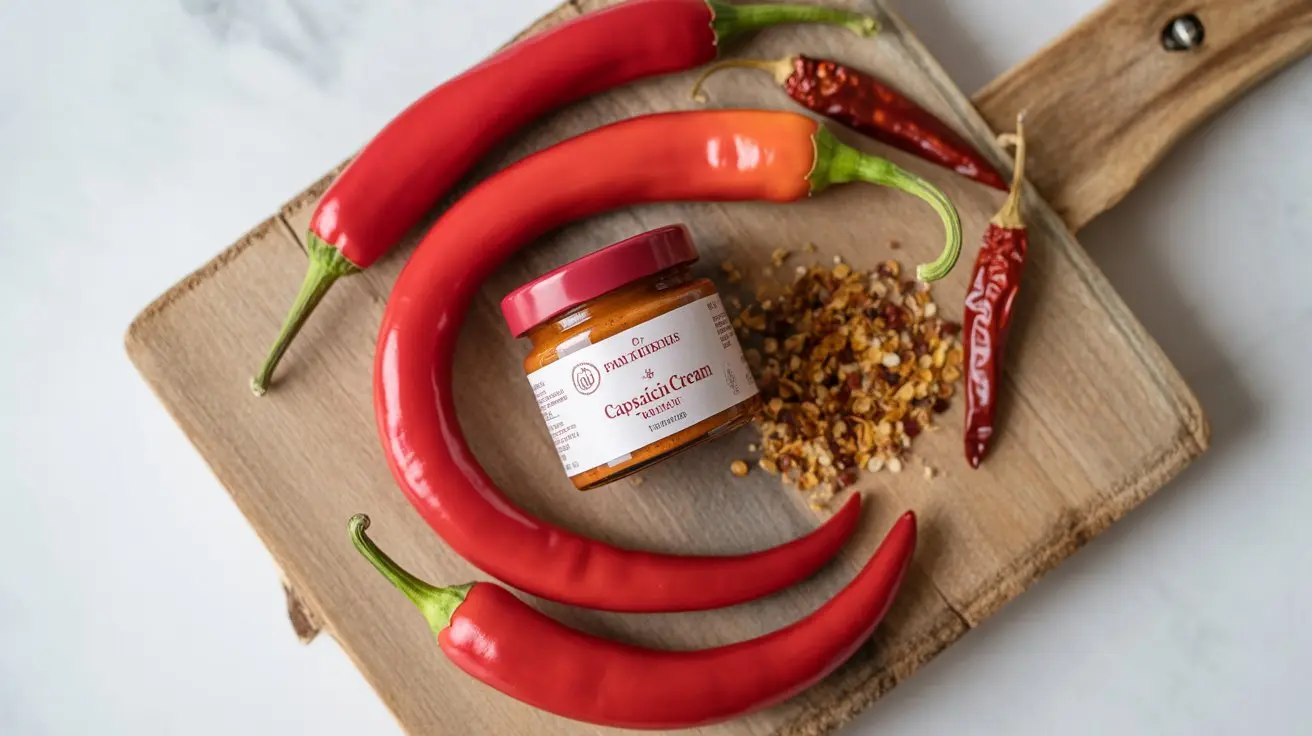
Capsaicin for Pain Relief
How capsaicin creams and patches relieve arthritis, nerve pain, and muscle soreness. Find your perfect heat level.

What Capsaicin Actually Does to Pain
The same compound that makes a fiery African bird pepper unbearable to eat is now an FDA-approved ingredient in prescription pain patches. That's not a coincidence — it's chemistry.
Capsaicin binds to TRPV1 receptors, the ion channels your nervous system uses to signal heat and pain. When capsaicin locks onto these receptors repeatedly, it doesn't just trigger a pain signal — it eventually desensitizes the receptor entirely, blocking pain transmission for weeks at a time.
Understanding why the capsaicin receptor responds the way it does helps explain why this treatment works differently from ibuprofen or lidocaine. It's not masking pain — it's temporarily shutting down the signaling pathway.
This mechanism, called defunctionalization, is what separates capsaicin therapy from most topical analgesics. The initial burn is real, but what follows is genuine neurological quieting.
The Science Behind the Burn-Then-Relief Cycle
First-time users often bail during the initial application because the burning sensation feels counterproductive. That reaction is completely understandable — and also exactly what's supposed to happen.
TRPV1 receptors flooded with capsaicin fire intensely at first, releasing Substance P, the neuropeptide responsible for transmitting pain signals to the brain. With repeated exposure, Substance P stores become depleted and the receptor becomes temporarily unresponsive.
Clinical research published in Pain journal confirms that this depletion effect can last 8-12 weeks after a single high-concentration application. Low-concentration over-the-counter creams work differently — they require daily application to maintain the desensitization effect.
The distinction matters when choosing a product. High-dose patches (8% capsaicin) produce one intense session with lasting relief. Low-dose creams (0.025%-0.1%) require consistent daily use but are far more manageable for home application.
Conditions with the Strongest Evidence
Diabetic peripheral neuropathy responds similarly well. A 2017 meta-analysis in PLOS ONE found that topical capsaicin significantly outperformed placebo for both conditions, with the high-concentration patch showing stronger effects than low-concentration creams.
Osteoarthritis of the hands and knees also shows consistent benefit in clinical trials. The Cochrane Collaboration reviewed 6 trials involving over 650 patients and concluded that 0.075% capsaicin cream provided moderate pain relief compared to placebo after 4 weeks of use.
Psoriasis, cluster headaches (applied nasally in research settings), and chronic low back pain have emerging evidence — promising but not yet at the same evidence tier as neuropathic pain.
OTC Creams vs. Prescription Patches
The gap between a drugstore capsaicin cream and a prescription patch isn't just marketing — it's a 320-fold difference in concentration. OTC products typically contain 0.025% to 0.1% capsaicin. The Qutenza patch contains 8%.
That concentration difference means entirely different application protocols. OTC creams go on at home, 3-4 times daily, building effect gradually over weeks. The 8% patch is applied in a clinical setting, requires topical anesthetic beforehand, and stays on for 60 minutes under medical supervision.
For most people with mild arthritis or muscle soreness, OTC products are the right starting point. For post-shingles nerve pain or diabetic neuropathy, the prescription route is worth discussing with a neurologist — the clinical outcomes are substantially better.
A newer development: 179 mg capsaicin injectable (Semdera) was approved in 2020 for diabetic peripheral neuropathy, administered directly into the foot. This represents the most targeted delivery method yet, bypassing skin absorption entirely.
How to Use Capsaicin Cream Correctly
Most people under-apply and then abandon the product when it doesn't work. Here's the protocol that matches what clinical trials actually used.
- Wash and dry the target area completely. Moisture affects absorption.
- Apply a thin, even layer — about a pea-sized amount per palm-sized area. More isn't better; it just increases burning without improving effect.
- Rub in thoroughly and wash hands immediately with soap and water. Capsaicin transfers easily to eyes and mucous membranes.
- Avoid touching your face for at least 30 minutes after application.
- Apply 3-4 times daily for at least 4 weeks before evaluating effectiveness. Most people quit at week 2, just before the desensitization effect would have kicked in.
- If burning is severe, applying a small amount of vegetable oil (not water) to the area before washing off can help — capsaicin is fat-soluble, not water-soluble.
One practical note: the initial burning typically peaks around day 3-5 and then diminishes significantly as receptors desensitize. That peak is when most people stop. Push through it if you can tolerate it.
Peppers by Capsaicin Concentration
The capsaicin content in therapeutic products ultimately traces back to pepper-derived oleoresin. Understanding where different peppers sit on the Scoville rating scale gives useful context for why some varieties are used industrially for capsaicin extraction while others aren't.
Rocoto peppers, with their thick flesh and surprisingly high heat for a Capsicum pubescens species, contain capsaicin concentrations that make them interesting for extraction. Most commercial capsaicin, however, comes from high-yield hot-tier varieties bred specifically for oleoresin content.
Sweet or mild peppers like the Ramiro's long, sweet-fruited variety contain essentially no capsaicin — they produce capsinoids instead, compounds with some biological activity but no meaningful TRPV1 binding. At the other end, ornamental varieties like the Black Pearl's compact, high-heat fruit pack serious capsaicin into a tiny package.
For extraction purposes, extra-hot range peppers are the industrial standard — high enough capsaicin concentration to make extraction economical, cultivated at scale in India, China, and parts of South America.
Who Should Avoid Capsaicin Therapy
Topical capsaicin is safe for most adults, but several groups should either avoid it or proceed carefully.
- Broken, inflamed, or infected skin — capsaicin on compromised skin causes intense pain without therapeutic benefit
- Children under 2 years old — TRPV1 receptor sensitivity differs significantly in young children
- Anyone with capsaicin hypersensitivity — rare but real; test a small area first
- People on anticoagulants — some evidence suggests capsaicin affects platelet aggregation at high doses
- Near eyes, nose, or mouth — the mucous membrane reaction is severe and serves no therapeutic purpose
Pregnant women should consult a physician before using high-concentration products, though low-dose OTC creams are generally considered low-risk for topical use.
One counterintuitive caution: if you're a regular hot pepper eater, your TRPV1 receptors may already be partially desensitized from super-hot tier pepper consumption. This doesn't make topical capsaicin unsafe, but it may affect how you perceive the initial burning sensation — or reduce it entirely.
Capsaicin in Sports and Muscle Recovery
Beyond clinical pain management, capsaicin has found a niche in sports medicine. Pre-workout capsaicin supplements claim to improve performance through thermogenesis and pain threshold elevation — the evidence here is mixed but not absent.
A 2012 study in the Journal of Strength and Conditioning Research found that capsaicin ingestion before resistance training modestly increased peak power output. The proposed mechanism: elevated pain thresholds allowing athletes to push harder before discomfort signals them to stop.
Topical application for muscle soreness (DOMS) has weaker evidence — most studies show modest benefit for acute muscle pain but limited effect on the underlying inflammation causing delayed soreness.
Where capsaicin genuinely earns its place in athletic contexts is joint pain management. Chronic knee pain from repetitive training responds well to consistent low-dose cream application, with several small trials showing meaningful reduction in resting and activity pain scores over 6-8 weeks.
Comparing Capsaicin to Other Topical Analgesics
The topical pain market includes menthol, diclofenac, lidocaine, and salicylates alongside capsaicin. Each works through a different pathway, which makes them suitable for different pain types rather than interchangeable options.
Menthol activates TRPM8 cold receptors — it creates a cooling sensation that distracts from pain without affecting the underlying signal. Fast-acting but short-duration. Good for acute muscle pain, less useful for neuropathic conditions.
Diclofenac gel (Voltaren) delivers an NSAID topically, reducing local prostaglandin production. Strong evidence for osteoarthritis, minimal systemic absorption. Better for inflammatory pain than nerve pain.
Lidocaine patches block sodium channels, numbing the area temporarily. Effective for localized nerve pain but requires daily reapplication and doesn't produce lasting desensitization.
Capsaicin's advantage is durability — the desensitization effect outlasts the application period by weeks. Its disadvantage is the initial burning, which makes compliance difficult. For patients who can tolerate the first week, the payoff is often better than alternatives.
Growing Peppers with High Capsaicin Content
If you're interested in the source rather than the pharmacy shelf, growing high-capsaicin varieties is straightforward once you understand what drives capsaicin production. Heat, water stress, and soil conditions all affect final capsaicin concentration.
Varieties like NuMex Twilight's ornamental but genuinely hot fruit were developed by New Mexico State University specifically for high capsaicin content. The Beaver Dam pepper's mild-to-medium heat profile sits at the opposite end — interesting for cooking but not for capsaicin concentration.
For anyone starting from seed, the full pepper germination and growing walkthrough covers the soil temperature and light requirements that affect capsaicin development. Stressing plants slightly — reducing water during fruit development — consistently increases capsaicin concentration in research trials.
Capsicum frutescens species, which includes Tabasco and many African varieties, tend toward higher capsaicin concentrations than Capsicum annuum at equivalent Scoville ratings. Species matters for growers targeting maximum yield of capsaicin-rich fruit.
Practical Takeaways
Capsaicin therapy works — the evidence is solid for neuropathic pain and moderate for arthritis. The challenge is almost entirely about managing the initial burning and maintaining consistent application long enough to see results.
Start with a 0.075% cream for most applications. Use it 3-4 times daily for a minimum of 4 weeks. Expect the first 5 days to be the hardest. If OTC concentrations don't provide adequate relief after 8 weeks of consistent use, the prescription-strength patch is worth pursuing through a pain specialist.
The compound that makes a peri-peri pepper's aggressive African heat so memorable at dinner is, in a different context, one of the more effective tools in non-opioid pain management. That's a remarkable dual identity for a single molecule.
Frequently Asked Questions
-
Most people notice meaningful pain reduction after 2-4 weeks of consistent daily application. The initial burning typically peaks around days 3-5 and then decreases as TRPV1 receptors desensitize.
-
Yes - OTC capsaicin creams are designed for daily use, typically 3-4 applications per day. Consistent application is essential; skipping days resets the desensitization process and reduces effectiveness.
-
The 0.075% concentration is roughly 3 times stronger and shows better clinical outcomes for neuropathic pain in trials. Start with 0.025% if you're sensitive to burning, then step up if results are insufficient after 4 weeks.
-
Yes, significantly - which is why it's applied in a clinical setting with topical anesthetic applied first. The 60-minute application session causes intense burning, but the resulting pain relief can last 8-12 weeks.
-
Dietary capsaicin does desensitize TRPV1 receptors systemically over time, but the concentrations needed for therapeutic effect far exceed what's practical through food. Topical application delivers targeted, high-concentration exposure that eating cannot replicate.