
Scotch Bonnet vs Jalapeño: Season a Whole Batch or Add Green Crunch?
Choose jalapeño for fresh green flavor, visible pieces, and manageable heat. Choose Scotch Bonnet when a small amount should season an entire batch with ripe tropical aroma and 100,000 to 350,000 SHU.

Scotch Bonnet
Extra-HotJalapeño
MediumQuick Comparison
| Attribute | Scotch Bonnet | Jalapeño |
|---|---|---|
| Scoville evidence | 100K-350K SHU | 2.5K-8K SHU |
| Heat Tier | Extra-Hot | Medium |
| vs Jalapeño | 44x hotter | 1x hotter |
| Flavor | fruity and tropical | Grassy, crisp, lightly sweet when red |
| Species | C. chinense | C. annuum |
| Origin | Caribbean | Mexico |
How Much Hotter Is Scotch Bonnet Than Jalapeño?
The published ranges do not touch: the mildest Scotch Bonnet begins far above the hottest standard jalapeño. UF/IFAS lists 100,000 to 350,000 SHU for Scotch Bonnet and 2,000 to 8,000 SHU for jalapeño, while Iowa State gives the jalapeño an upper bound of 10,000 SHU.
The lowest Scotch Bonnet compared with an 8,000 SHU jalapeño is about 12.5 times hotter. At the other extreme, 350,000 divided by 2,500 gives 140, which explains why a one-for-one substitution can overwhelm a dish before its other flavors register.
SHU does not tell a cook exactly how pain will feel or how evenly it will spread through food.
A minced pepper disperses capsaicinoids across more bites than a whole pod simmered intact, and fat, serving temperature, portion size, and individual tolerance change the eating experience.
This gap also changes the cost of a mistake. An extra jalapeño may make salsa hotter, but an extra Scotch Bonnet can make a family-size pot unsuitable for most diners.
How Do Scotch Bonnet and Jalapeño Taste Different?
Most jalapeños are sold and eaten green, before full ripeness.
Their familiar contribution is grassy, fresh, and slightly bitter, with enough crisp flesh to act like a vegetable in pico de gallo, nachos, pickles, and poppers.
Scotch Bonnets are commonly used ripe, when yellow, orange, or red fruit carries a sweeter, tropical aroma. UF/IFAS identifies the pepper with Caribbean jerk sauce and marinades, which depend on that aromatic character rather than heat alone.
A red jalapeño becomes sweeter and less sharply green, but it still does not become a Scotch Bonnet. The two peppers belong to different species, with jalapeño classified as Capsicum annuum and Scotch Bonnet as Capsicum chinense, and their characteristic aromas remain distinct.
This is why 'both are fresh red chiles' is not enough information for a substitution. Color can narrow the flavor gap slightly, but it cannot supply the Scotch Bonnet's floral and tropical notes.
What Does Each Pepper Add Besides Heat?
The useful decision is what the pepper must contribute besides heat. A Scotch Bonnet behaves like a powerful aromatic seasoning, while a jalapeño can behave as both seasoning and vegetable.
The last case matters because heat and pepper volume are separate variables. A recipe can need less capsaicin without needing less onion, citrus, allspice, tomato, or other ingredients that form the sauce.
Verdict
Choose jalapeño when the pepper must remain a visible ingredient that diners can bite, move aside, or add to taste. Choose Scotch Bonnet when a small amount should season an entire batch with ripe fruit aroma as well as heat.
Can You Swap Scotch Bonnet and Jalapeño Pod for Pod?
A Scotch Bonnet is usually the wrong replacement for a jalapeño when the instruction says 'one pepper.' A pod count hides the published heat gap and the fact that the two fruits are different sizes.
That comparison describes concentration, not a safe pod conversion. Fruit size, cultivar, ripeness, growing conditions, and how much placenta reaches the food all change the result, so dividing one pod into a neat fraction gives false precision.
How Pod Size and Walls Change the Cooking Method
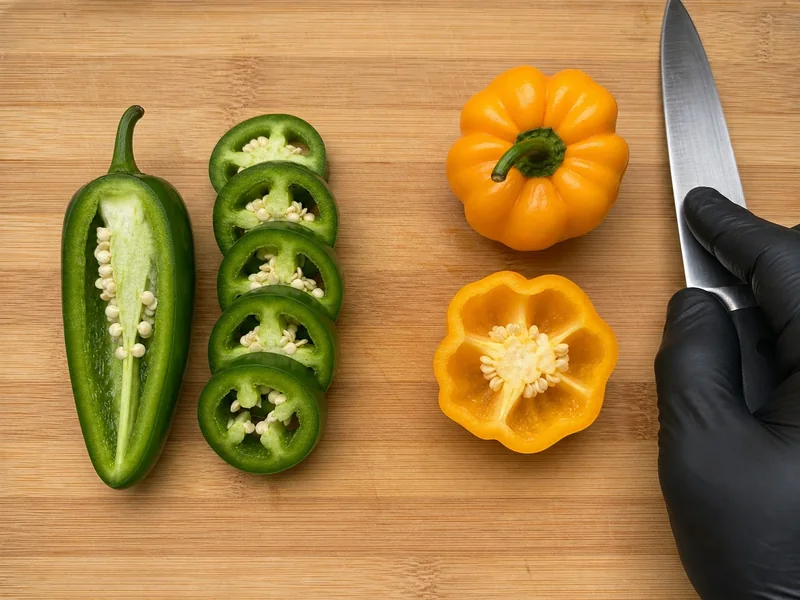
A jalapeño is commonly two to three inches long with enough flesh for rings, strips, diced pieces, or a hollow shell. That structure makes it useful when the recipe needs chile flavor and a physical component, such as crunch in salsa or a cavity for cheese.
A Scotch Bonnet is smaller, squatter, lobed, and thin-walled. Its irregular shape is less convenient for uniform slices, but its flesh and inner tissues blend readily into marinades, sauces, curry pastes, and stews where the pepper should disappear into the seasoning.
Cut style controls exposure. Slicing a jalapeño into rings keeps some heat concentrated in individual bites, while finely mincing or blending either pepper spreads the hot compounds through the full dish.
Colorado State University explains that capsaicin glands sit between the placenta and endocarp, close to the seeds.
The seeds can carry capsaicin from contact but do not produce it, so scraping only loose seeds while leaving the pale inner tissue does not remove the main heat source.
Which Pepper Suits Jerk Marinade or Pico de Gallo?
- For jerk marinade, Caribbean pepper sauce, curry, or a large stew, choose Scotch Bonnet when its ripe fruit aroma is part of the dish's identity.
- For pico de gallo, guacamole, nachos, pickles, sandwiches, and fresh garnish, choose jalapeño for green flavor, manageable heat, and pieces that retain texture.
- For stuffed peppers or poppers, choose jalapeño because the pod shape and flesh are part of the recipe.
- For a mixed group with different tolerances, cook the base without Scotch Bonnet and offer a hot sauce separately, or use jalapeño as the shared pepper.
- For a sauce that needs Scotch Bonnet aroma but less capsaicin, use a smaller tested amount of the pepper and increase the non-pepper ingredients. Adding many jalapeños creates more green flesh without recreating the aroma.
Can Jalapeño Replace Scotch Bonnet?
Jalapeño is a practical replacement when the goal is to make a Scotch Bonnet recipe much milder. It preserves fresh chile character and adds useful body, but the result will taste greener and less tropical.
Do not add enough jalapeño to chase the original heat. That approach can introduce a large volume of watery pepper flesh, dilute the sauce base, and still miss the floral aroma.
Keep the recipe's non-pepper aromatics intact and treat the jalapeño as a deliberate mild variation. In jerk-style seasoning, that means the allspice, thyme, scallion, ginger, garlic, and acid still need to carry their own roles instead of asking the jalapeño to imitate Scotch Bonnet.
If authentic Scotch Bonnet flavor and comparable heat are both required, habanero is a closer substitute than jalapeño.
The published heat ranges align, and both belong to Capsicum chinense, although their flavor is not identical.
Can Scotch Bonnet Replace Jalapeño?
Replacing jalapeño with Scotch Bonnet changes the safety margin as well as the flavor. It is unsuitable for poppers, pickled rings, nacho slices, or any dish where the original quantity makes the pepper a vegetable.
For a blended salsa or cooked sauce, first decide whether the extra-hot character is intentional. If it is, prepare the Scotch Bonnet separately, disperse a very small amount through the full batch, then evaluate the mixture after it has been stirred thoroughly.
Do not rely on a universal fraction such as one eighth of a pod.
Published SHU ranges are too broad, pods vary, and a lobed fruit is difficult to divide into chemically equal pieces.
A safer workflow is to make the food edible without the Scotch Bonnet, add a measured spoonful of a separately blended pepper mixture, and stop well before the first taste feels impressive. Heat can continue to spread as a sauce rests, while removing it after mixing is not practical.
Do Pickled and Bottled Forms Change the Comparison?
The comparison on this page applies to fresh fruit. Pickled jalapeños bring vinegar and salt, while bottled Scotch Bonnet sauces may also contain acid, sugar, fruit, thickeners, or other peppers.
Pickled rings still provide a visible garnish and a manageable bite, but their tang can shift salsa, sandwiches, and cheese fillings. A fresh Scotch Bonnet cannot replace that acid or texture, even when the cook wants more heat.
Bottled Scotch Bonnet sauce is easier to add by the spoon or drop than a fresh pod, but the label does not create a universal strength. Compare products by their ingredient lists, taste a small amount, and account for the sauce's salt and acid, since two bottles bearing the same pepper name can still deliver different heat and seasoning.
Preserve the form when it performs a job: fresh for texture, pickled for tang and garnish, and sauce or puree for even dispersion. Changing both the pepper and its form at once makes it difficult to tell whether heat, aroma, acidity, or texture caused the result.
How Do You Control Scotch Bonnet Heat in a Batch?
Whole-pod infusion offers a different kind of control from mincing. A washed, unbroken Scotch Bonnet can perfume a stew and be removed, but any split, puncture, or burst releases more inner tissue and makes the result less predictable.
When the pepper must be chopped, use a dedicated board and utensil, wear gloves, and keep hands away from the face.
Iowa State University Extension warns that capsaicin transfers readily and can burn skin, eyes, mouth, and other sensitive tissue.
Taste from the finished mixture, not from a concentrated spoonful beside the blender blade. Stir completely, allow the sauce or stew to equalize, and test a normal serving portion with the other food it will accompany.
For guests, label a Scotch Bonnet preparation clearly and keep a milder version separate. Milk or another fatty food can help with oral discomfort, according to Iowa State, but it is not a reason to treat dosing casually.
What to Look for When Buying Each Pepper
A true Scotch Bonnet is usually squat with a flattened, folded cap shape, while a jalapeño is longer, smooth, and bluntly tapered.
Color alone is unreliable because both can be green while immature and red when fully ripe.
Markets sometimes group Scotch Bonnets and habaneros together because they share similar heat and ancestry. That substitution is usually closer than jalapeño for sauce work, but the label still matters when a regional recipe depends on Scotch Bonnet flavor.
Select firm fruit without wet spots, collapsed lobes, or mold around the stem. Refrigerate fresh peppers dry and uncut, then wash them just before use so surface moisture does not accelerate softening during storage.
The final choice is simple only after the task is clear: jalapeño gives controllable pieces and fresh green flavor, while Scotch Bonnet gives concentrated, aromatic heat to a batch. Treating them as interchangeable pods ignores the difference that most affects the cook.
Scotch Bonnet vs Jalapeño FAQ
- UF/IFAS Gardening Solutions: Peppers by Scoville Units
- Iowa State University Extension: Growing Peppers in the Home Garden
- UF/IFAS Extension: Pepper Production in Miami-Dade County, Florida
- Colorado State University Food Source Information: Jalapeño Peppers
- PubMed: Placenta, Pericarp, and Seeds of Tabasco Chili Pepper Fruits