Habanero vs Red Savina Habanero: Key Differences Explained
The habanero and Red Savina habanero share the same species, similar fruity character, and nearly identical appearance — but the Red Savina was once certified as the world's hottest pepper, and it still hits nearly twice as hard as a standard habanero. Understanding where they diverge helps you pick the right one for your heat tolerance and recipe goals.

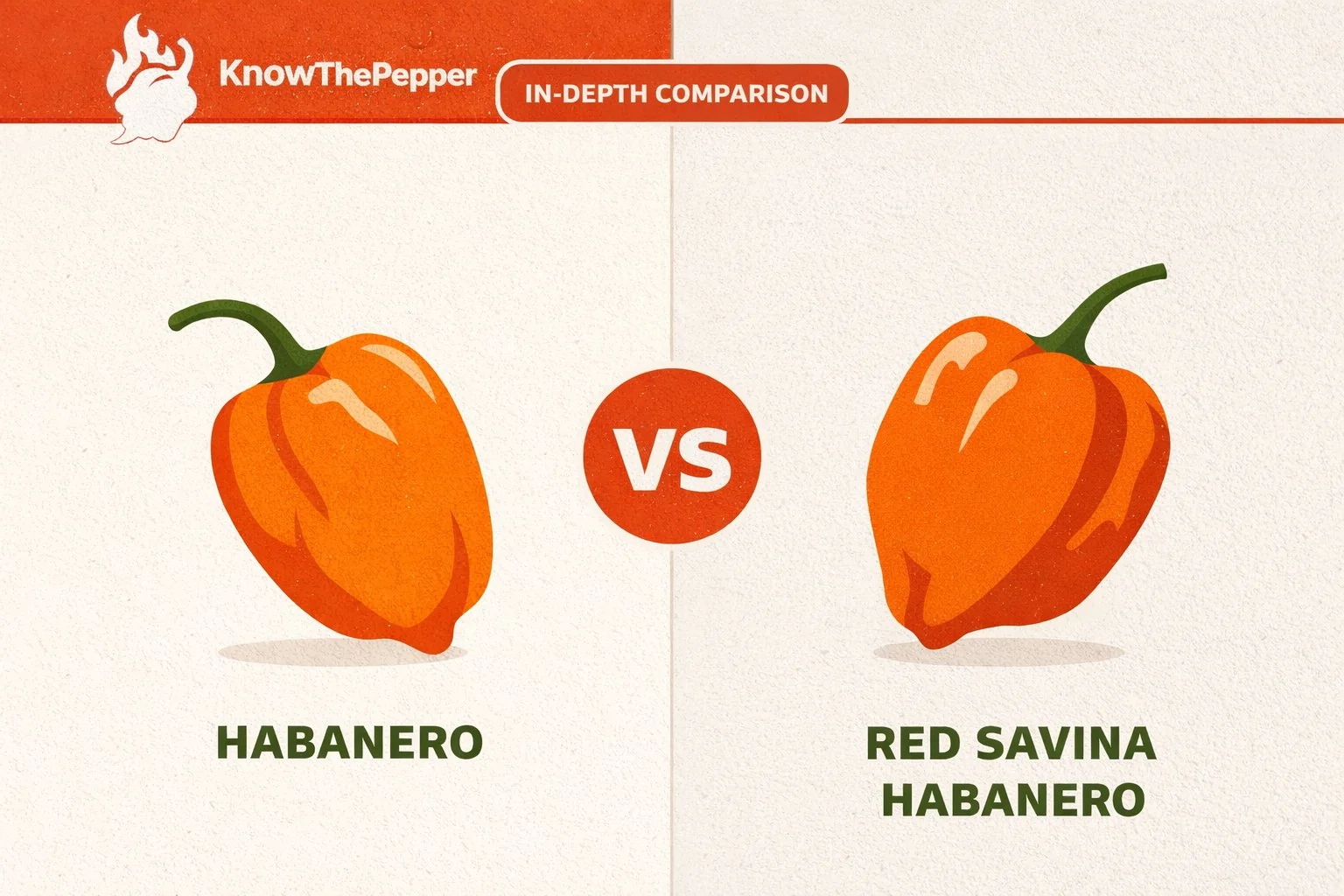
Habanero measures 100K–350K SHU while Red Savina Habanero registers 350K–580K SHU — making Red Savina Habanero 2× hotter. Habanero is known for its fruity and citrusy flavor (C. chinense), while Red Savina Habanero offers fruity and intense notes (C. chinense).
- Heat difference: Red Savina Habanero is 2× hotter
- Species: Both are C. chinense
- Best for: Habanero excels in hot sauces and extreme dishes, Red Savina Habanero in hot sauces and spicy dishes
Habanero
Extra-HotRed Savina Habanero
Extra-HotHabanero vs Red Savina Habanero Comparison
Habanero vs Red Savina Habanero Heat Levels
The standard habanero's fruity orange fire lands between 100,000 and 350,000 SHU — already a serious pepper that sits firmly in the extra-hot heat classification. At the low end, that's roughly 12 times hotter than a jalapeño; at the top of its range, closer to 40 times hotter. Most grocery-store habaneros cluster around 150,000-200,000 SHU in practice.
The Red Savina habanero operates in a different league entirely. Its range runs 350,000-580,000 SHU, which means even its mildest specimens match the hottest standard habaneros. At peak heat, a Red Savina can be nearly 70 times hotter than a jalapeño — and about 1.6 times hotter than a typical habanero.
From 1994 to 2006, the Red Savina held the Guinness World Record for hottest pepper, a record confirmed through HPLC capsaicinoid testing. It lost that title to the ghost pepper's record-breaking capsaicin levels, which eventually pushed the conversation into super-hot territory entirely.
The burn character matters as much as the number. Both peppers share the chinense slow-build pattern — heat arrives 10-15 seconds after contact, then climbs steadily and lingers. The Red Savina's burn tends to sit higher in the mouth and throat, while the standard habanero's heat often stays more centered on the tongue. Neither is forgiving to the uninitiated.
Flavor Profile Comparison
Few peppers balance heat and flavor as well as the habanero.
Frank Garcia of GNS Spices in Walnut, California developed the Red Savina through selective breeding during the late 1980s, isolating the hottest, most individuals from standard habanero populations.
Both peppers belong to Capsicum chinense, and that shared genetics shows in the flavor: fruity, floral, with a citrus-forward aroma that distinguishes the species from the earthier C. annuum varieties. Cut either one open and the smell alone signals serious heat.
The standard habanero delivers bright citrus and tropical fruit notes — think mango, apricot, and a faint floral quality that makes it surprisingly useful in fruit-based salsas and hot sauces. Its flavor is assertive but not overwhelming when used in moderation, which is why it became the backbone of so many Caribbean and Mexican hot sauces. The habanada pepper's heatless habanero flavor profile exists precisely because that underlying taste is worth preserving.
The Red Savina carries those same fruity notes but with more intensity and a slightly deeper, almost wine-like richness underneath. Some growers describe it as more complex — the heat doesn't just amplify, it seems to concentrate the flavor alongside it. That said, at Red Savina heat levels, most palates are processing burn signals more than subtle flavor nuances.
In cooking, the standard habanero's flavor integrates more gracefully into dishes where you want heat and flavor contribution. The Red Savina is better suited to applications where you want maximum heat with fruity backup — hot sauce blends, fermented mashes, or small-batch extracts. The aroma of both is intensely floral when roasted, though the Red Savina's capsaicin concentration can make working with it without gloves genuinely unpleasant.
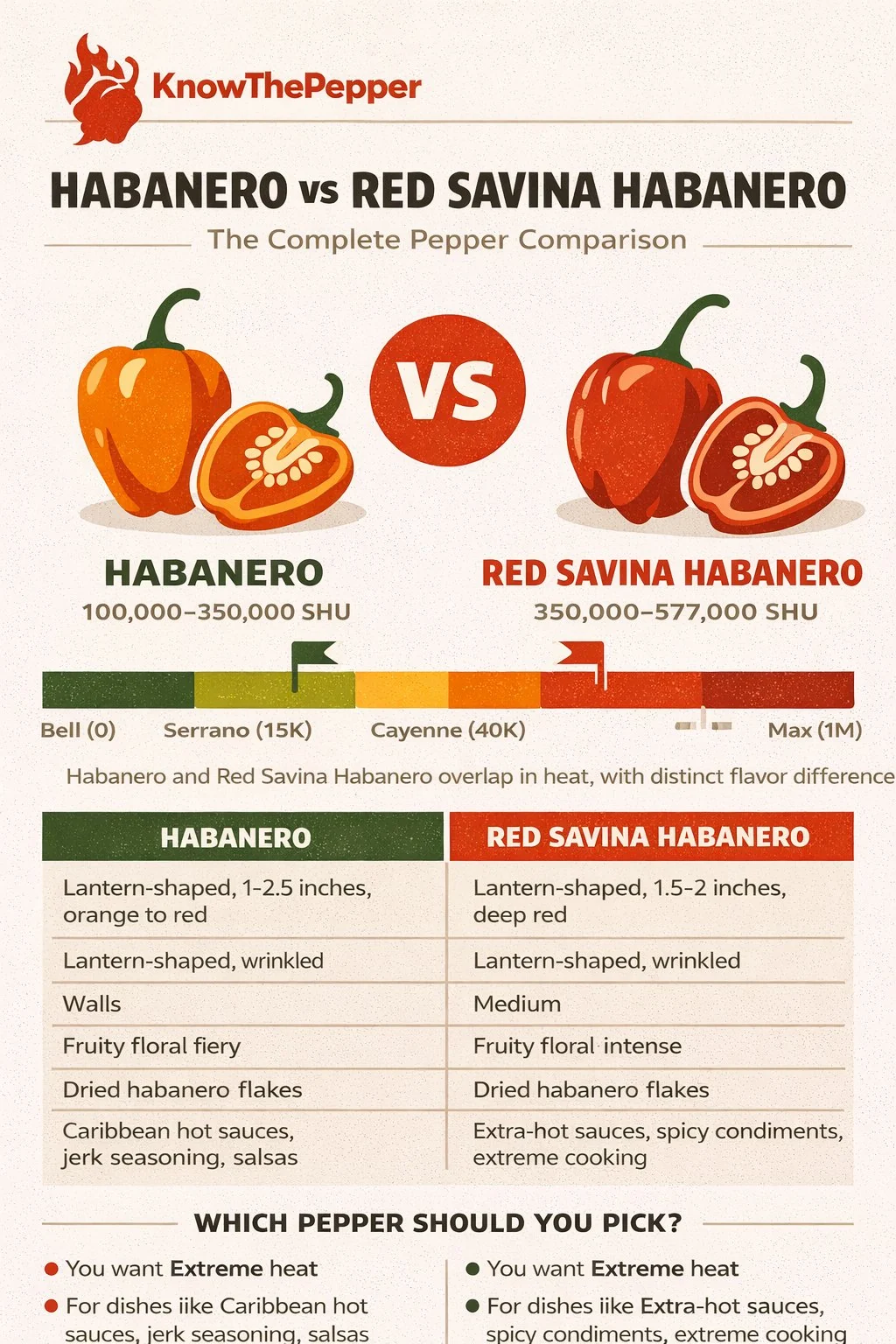
Culinary Uses for Habanero and Red Savina Habanero
For everyday cooking, the standard habanero is the workhorse. It anchors Mexican pepper-based sauces and marinades from the Yucatan, where habanero salsa is table-standard. A single pepper, seeded and minced, adds serious heat to a pot of black beans or a mango salsa for 4-6 people. Whole roasted habaneros blended with garlic, lime, and oil make a fast hot sauce that keeps refrigerated for weeks.
The Red Savina demands more respect in the kitchen. Treat it the way you'd treat any high-capsaicin ingredient — use gloves, ventilate the space, and start with half the quantity you'd use for a standard habanero. A Red Savina where a recipe calls for one habanero will roughly double the heat output. For hot sauce makers, the Red Savina shines in small-batch ferments where its intensity can be diluted with volume — a few peppers go a long way in a half-gallon jar.
Both peppers work well in the same flavor contexts: tropical fruit pairings (pineapple, mango, papaya), citrus-based marinades, Caribbean jerk blends, and fermented hot sauces. The Fresno pepper's milder fruity profile is a useful reference point — the habanero sits dramatically above it in heat, and the Red Savina above that.
For drying and powder, the Red Savina produces an intensely hot powder that should be measured in pinches, not teaspoons. Standard habanero powder is more versatile for general seasoning. Both peppers freeze well — flash freeze on a sheet pan, then bag them for storage up to 12 months without significant flavor loss.
Substitution ratio when swapping Red Savina for standard habanero: use 0.5-0.6 Red Savinas per habanero called for, adjusting to taste.
Which Should You Choose?
If you cook regularly with habaneros and want manageable, well-rounded heat with genuine flavor contribution, the standard habanero is the practical choice. It's widely available, predictable in heat output, and versatile across salsas, marinades, and hot sauces.
The Red Savina is for people who specifically need more heat from the same fruity chinense flavor base — hot sauce producers chasing intensity, growers interested in cultivating the C. chinense species at its upper limits, or experienced chileheads who find standard habaneros comfortable.
Neither pepper is a casual weeknight ingredient for heat-sensitive cooks. But between the two, the standard habanero offers more control. The Red Savina rewards those who know exactly what they're doing with it — and punishes those who don't. For most home kitchens, the habanero is the better tool. For those chasing the ceiling of fruity-hot flavor, the Red Savina is worth the extra care it demands.
Can You Substitute One for the Other?
Proceed with caution. Red Savina Habanero is 2× hotter than Habanero.
Need a different option altogether? Search for peppers that match your target heat and flavor with precise swap ratios.
Growing Habanero vs Red Savina Habanero
If you’re deciding which pepper to grow at home, consider your climate and patience level. Habanero and Red Savina Habanero have different maturation times and temperature preferences. Hotter varieties generally need a longer, warmer growing season to develop their full capsaicin content. Our zone-based planting date tool can pinpoint the best sowing window for your area.
Starting habaneros from seed requires patience. Germination takes 10–21 days at soil temperatures of 80–85°F — a heat mat is not optional, it's essential.
Transplant seedlings outdoors only after nighttime temperatures stay consistently above 55°F. Habaneros are frost-intolerant and will stall in cold soil.
Full sun — at least 6–8 hours daily — is non-negotiable. In containers, use a 5-gallon minimum; habaneros develop substantial root systems.
Growing Red Savinas takes patience and heat. Start seeds indoors 10-12 weeks before last frost - this variety needs a long season to reach full production.
Germination runs 14-21 days at soil temperatures of 80-85°F. A heat mat is essentially mandatory; germination rates drop sharply below 75°F.
For transplanting and cultivation, Red Savinas want full sun and consistent moisture without waterlogging. They're slightly more demanding than standard habaneros - they stall in cool summers and struggle in heavy clay soils.
History & Origin of Habanero and Red Savina Habanero
Both peppers carry centuries of culinary heritage. Habanero traces its roots to Mexico, while Red Savina Habanero originates from USA. Understanding their backstory helps explain why each pepper developed its distinctive traits.
Buying & Storage
Whether you’re shopping for Habanero or Red Savina Habanero, the same quality indicators apply. Fresh peppers should feel firm and heavy for their size, with taut, glossy skin and no soft or wet spots. Minor stem cracks known as “corking” are perfectly normal and often indicate a mature, flavorful pod.
- Firm pods with taut skin and consistent color
- Should feel heavy relative to size
- Minor stem cracks (“corking”) are normal
- Avoid anything soft, shriveled, or with dark wet spots
- Fresh: Paper bag, crisper drawer — 1–2 weeks
- Frozen: Wash, dry, freeze on sheet pan — 6+ months
- Dried: Airtight, away from light — up to 1 year
The Verdict: Habanero vs Red Savina Habanero
Habanero and Red Savina Habanero sit in the same heat tier but serve different roles. Red Savina Habanero delivers 2× more heat with its distinctive fruity and intense character. Habanero, with its fruity and citrusy profile, excels in everyday cooking.
Frequently Asked Questions
Related Comparisons
Sources pending verification.