7 Pot Douglah vs Trinidad Moruga Scorpion: Compared
Both the 7 Pot Douglah and the Trinidad Moruga Scorpion come from the same island, share the same species, and sit at the absolute top of the super-hot pepper classification — yet they deliver heat and flavor in distinctly different ways. The Douglah brings a dark, nutty earthiness wrapped in extreme heat, while the Moruga Scorpion layers fruity, floral notes onto a burn that can push past 2,000,000 SHU. Choosing between them depends less on tolerance and more on what you want your food to taste like.

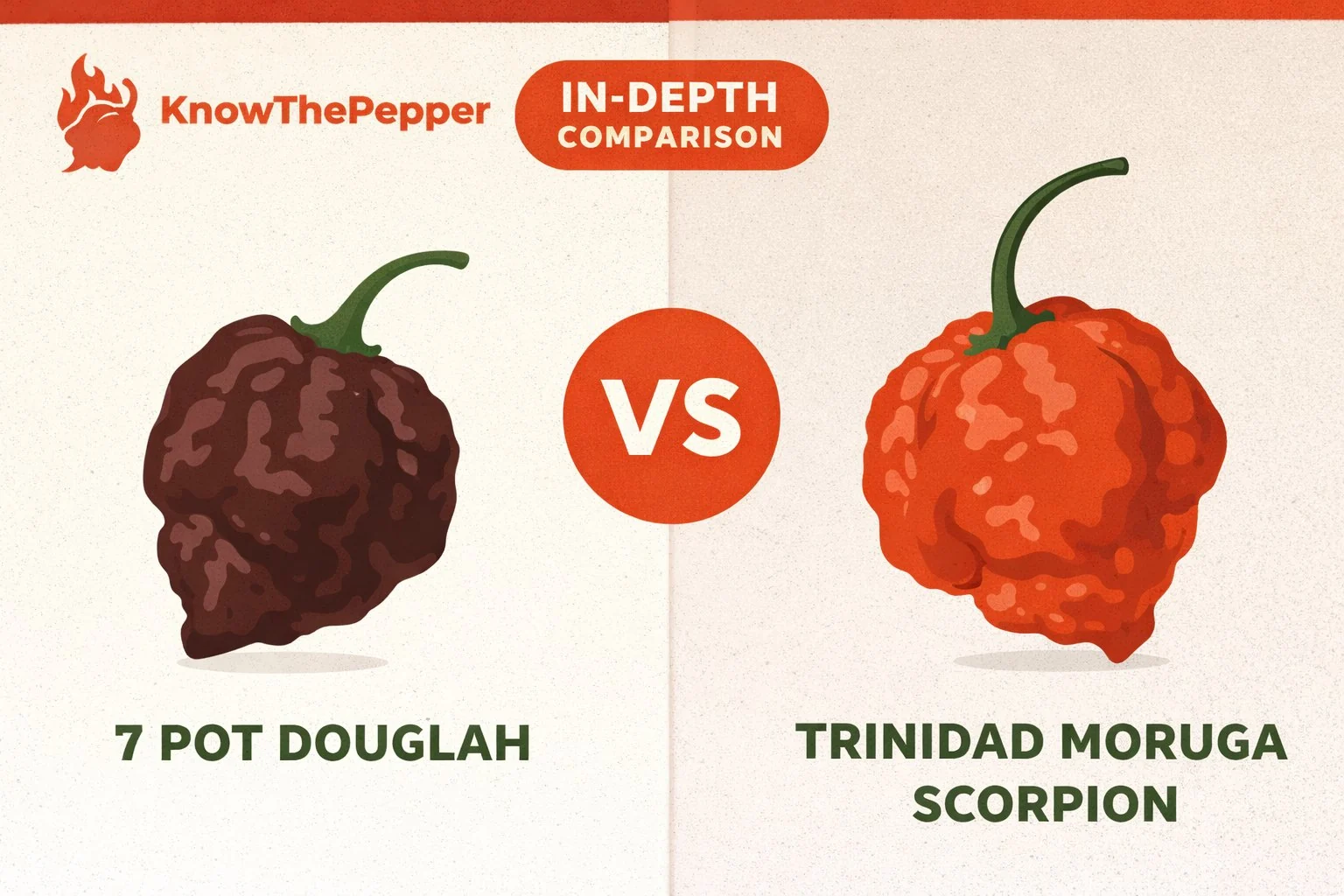
7 Pot Douglah measures 1.2M–1.9M SHU while Trinidad Moruga Scorpion registers 1.2M–2M SHU — roughly equal in heat. 7 Pot Douglah is known for its nutty and earthy flavor (C. chinense), while Trinidad Moruga Scorpion offers fruity and floral notes (C. chinense).
- Species: Both are C. chinense
- Best for: 7 Pot Douglah excels in hot sauces and extreme dishes, Trinidad Moruga Scorpion in hot sauces and spicy dishes
7 Pot Douglah
Super-HotTrinidad Moruga Scorpion
Super-Hot7 Pot Douglah vs Trinidad Moruga Scorpion Comparison
7 Pot Douglah vs Trinidad Moruga Scorpion Heat Levels
On paper, these two are close enough to cause arguments. The 7 Pot Douglah ranges from 1,200,000 to 1,853,986 SHU, while the Trinidad Moruga Scorpion runs 1,200,000 to 2,009,231 SHU — meaning the Moruga Scorpion holds the higher ceiling by roughly 155,000 SHU at peak measurements.
To put that in perspective using a reference most hot sauce fans know: a chipotle's smoky moderate heat sits around 2,500-8,000 SHU. The Douglah at its average is roughly 200 times hotter than a chipotle. The Moruga Scorpion, at its documented peak, can hit 250 times that same benchmark.
Both peppers belong to the Trinidad pepper growing tradition and are classified as Capsicum chinense botanical relatives, the species responsible for most of the world's most extreme heat. That shared genetics explains why both deliver a slow-building, full-body burn rather than a quick sharp sting.
The character of the heat differs meaningfully. The Douglah's burn tends to spread across the entire mouth and throat with sustained intensity — growers and cooks consistently describe it as a heavy, enveloping heat. The Moruga Scorpion hits fast at the front of the palate, then builds into waves that can last 30-45 minutes. Neither is forgiving, but the Scorpion's heat has more of an initial spike before settling into the long burn the Douglah delivers from the start.
For context against other extreme peppers, the Douglah versus Ghost Pepper heat contrast shows just how far above the Ghost Pepper both of these sit — roughly double the SHU at minimum.
Flavor Profile Comparison
Most super-hots taste like pure fire.
Few peppers command the same respect as the Trinidad Moruga Scorpion.
Heat aside, this is where the two peppers genuinely diverge. The 7 Pot Douglah — identifiable by its dark brown, almost chocolate-colored skin — carries a nutty, earthy flavor that's unlike most other super-hots. There's a depth to it, something almost savory, that makes it surprisingly useful in applications where you want heat with substance rather than brightness.
The Trinidad Moruga Scorpion goes in the opposite direction. Its flavor profile is fruity and floral, with a sweetness at the front that's almost disarming given what follows. Some describe notes of tropical fruit, others pick up something closer to citrus blossom. Either way, it shares DNA with the broader fruity Caribbean pepper flavor tradition that includes habaneros and Scotch bonnets — just amplified to an extreme degree.
Aroma matters here too. The Douglah has a more muted, earthy smell before cooking — it doesn't telegraph its intensity the way some super-hots do. The Moruga Scorpion smells noticeably fruity and sweet off the plant, which can catch people off guard when the heat arrives.
Both belong to C. chinense, a species known for pairing extreme capsaicin levels with genuine flavor complexity — which is part of why both peppers have dedicated followings among serious hot sauce makers rather than just heat seekers. The Douglah's earthiness makes it pair naturally with chocolate and coffee-based preparations. The Scorpion's fruitiness lends itself to mango salsas and tropical-style hot sauces where the flavor can actually be tasted before the burn takes over.
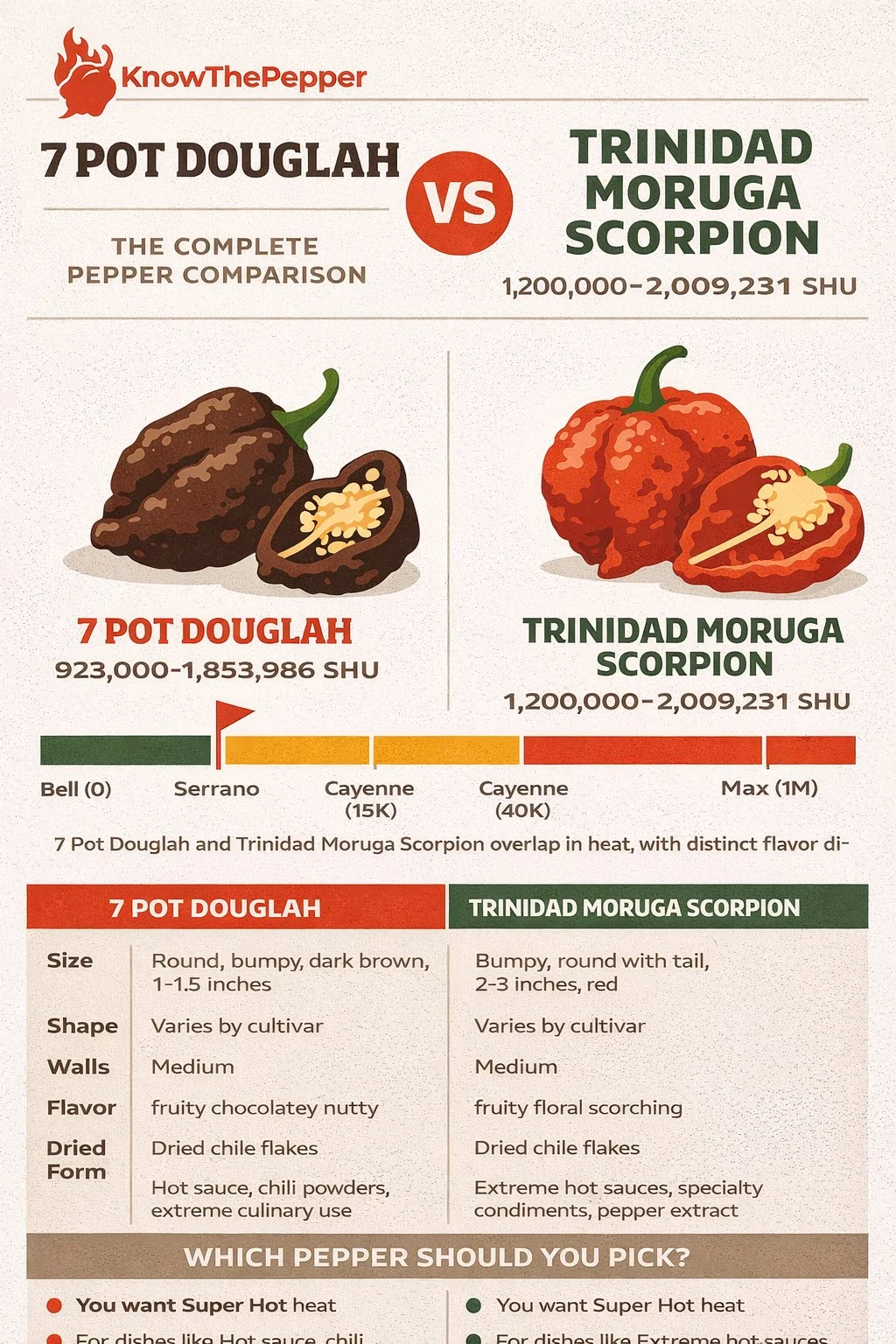
Culinary Uses for 7 Pot Douglah and Trinidad Moruga Scorpion
The Douglah's nutty, earthy depth makes it a natural fit for mole-style sauces, dry rubs for beef or lamb, and any preparation where dark, complex flavors matter. It works well in small quantities in chili — the kind where you want heat that builds slowly and a richness that reads as almost chocolatey. A single dried Douglah pod ground into a spice blend can anchor an entire batch.
For the Moruga Scorpion, that fruity, floral character points toward fruit-forward hot sauces, Caribbean-style jerk marinades, and pineapple or mango-based condiments. The sweetness at the front of the flavor gives sauce makers something to work with before the heat overwhelms everything else. It's the better choice when you want the pepper's flavor — not just its fire — to be part of the final dish.
Substitution ratios matter at these heat levels. If a recipe calls for one Moruga Scorpion and you're using a Douglah, the heat output is similar enough that a 1:1 swap works for most purposes — though the flavor shift from fruity to earthy will be noticeable. If you're scaling down to a ghost pepper, use roughly 1.5 ghost peppers per Douglah or Scorpion to approximate the heat, accepting that the flavor profile changes significantly. The Douglah versus Chocolate Bhutlah comparison is worth reading if you're trying to dial in substitutions within the dark super-hot category.
Both peppers respond well to fermentation, which rounds out the sharpness and lets the underlying flavors develop. Fermented Moruga Scorpion mash in particular produces a hot sauce with remarkable complexity. Dried and powdered Douglah is potent enough that a quarter-teaspoon is a meaningful addition to most dishes — treat it like a seasoning, not a vegetable.
For anyone sourcing fresh pods, the Douglah versus Carolina Reaper head-to-head covers availability differences that affect which one you're likely to find at specialty markets.
Which Should You Choose?
If flavor drives your decision, the choice is straightforward: the Moruga Scorpion for fruity, tropical applications — the Douglah for savory, earthy, chocolate-adjacent preparations. Both sit firmly at the top of the super-hot heat tier with enough firepower to demand respect regardless of which you choose.
For hot sauce makers who want complexity with their heat, the Moruga Scorpion's fruit-forward profile gives you more to build around in a sauce. For dry rubs, chili blends, and spice applications where depth matters more than brightness, the Douglah's nutty earthiness is harder to replicate with any other pepper.
Heat-tolerance-wise, they're close enough that neither is the 'safer' option — both can deliver prolonged, intense burns that last well beyond the meal. The TRPV1 response these peppers trigger is among the most sustained in the pepper world.
New to super-hots? Start with neither. Already comfortable at habanero-plus levels? The Moruga Scorpion's fruity entry makes it marginally more approachable as a first extreme pepper. Experienced with super-hots and want something distinctive? The Douglah's flavor profile is genuinely unlike anything else at this heat level.
Can You Substitute One for the Other?
Proceed with caution. Trinidad Moruga Scorpion is 1× hotter than 7 Pot Douglah.
Need a different option altogether? Search for peppers that match your target heat and flavor with precise swap ratios.
Growing 7 Pot Douglah vs Trinidad Moruga Scorpion
If you’re deciding which pepper to grow at home, consider your climate and patience level. 7 Pot Douglah and Trinidad Moruga Scorpion have different maturation times and temperature preferences. Hotter varieties generally need a longer, warmer growing season to develop their full capsaicin content. Our zone-based planting date tool can pinpoint the best sowing window for your area.
Growing a Douglah requires patience before anything else. Seeds take 14-21 days to germinate and need soil temperatures of 80-85°F - a heat mat under your seed tray is not optional at this stage.
Start seeds 10-12 weeks before last frost. Transplant outdoors only after nighttime temperatures stay consistently above 60°F.
Full sun is non-negotiable: 8+ hours daily. The plants are heavy feeders; a balanced fertilizer through vegetative growth transitioning to a lower-nitrogen, higher-phosphorus formula once flowering begins will push pod development.
The Moruga Scorpion is a long-season grower. From seed to first ripe pod typically runs 150 to 180 days, which means starting indoors 10 to 12 weeks before your last frost date is non-negotiable in most climates.
Germination requires consistent soil temps of 80-85°F. A heat mat under the seed tray isn't optional — it's the difference between 70% germination and 20%.
Once seedlings reach 4-6 inches, pot up gradually rather than jumping straight to a large container. The Moruga Scorpion responds well to slightly root-bound conditions early on — it triggers more aggressive flowering.
History & Origin of 7 Pot Douglah and Trinidad Moruga Scorpion
Both peppers carry centuries of culinary heritage. 7 Pot Douglah traces its roots to Trinidad, while Trinidad Moruga Scorpion originates from Trinidad. Understanding their backstory helps explain why each pepper developed its distinctive traits.
Buying & Storage
Whether you’re shopping for 7 Pot Douglah or Trinidad Moruga Scorpion, the same quality indicators apply. Fresh peppers should feel firm and heavy for their size, with taut, glossy skin and no soft or wet spots. Minor stem cracks known as “corking” are perfectly normal and often indicate a mature, flavorful pod.
- Firm pods with taut skin and consistent color
- Should feel heavy relative to size
- Minor stem cracks (“corking”) are normal
- Avoid anything soft, shriveled, or with dark wet spots
- Fresh: Paper bag, crisper drawer — 1–2 weeks
- Frozen: Wash, dry, freeze on sheet pan — 6+ months
- Dried: Airtight, away from light — up to 1 year
The Verdict: 7 Pot Douglah vs Trinidad Moruga Scorpion
7 Pot Douglah and Trinidad Moruga Scorpion sit in the same heat tier but serve different roles. Trinidad Moruga Scorpion delivers its distinctive fruity and floral character. 7 Pot Douglah, with its nutty and earthy profile, excels in everyday cooking.
Frequently Asked Questions
Related Comparisons
Sources pending verification.