Malagueta vs Peri Peri – Heat & Flavor Compared
Malagueta and peri peri are two small, fiery chilies with deep roots in Afro-Portuguese food culture — one native to Brazil, the other tied to sub-Saharan Africa. Both punch well above their size, but they differ in heat character, aroma, and how they behave in the kitchen. This comparison breaks down everything you need to know to choose between them.

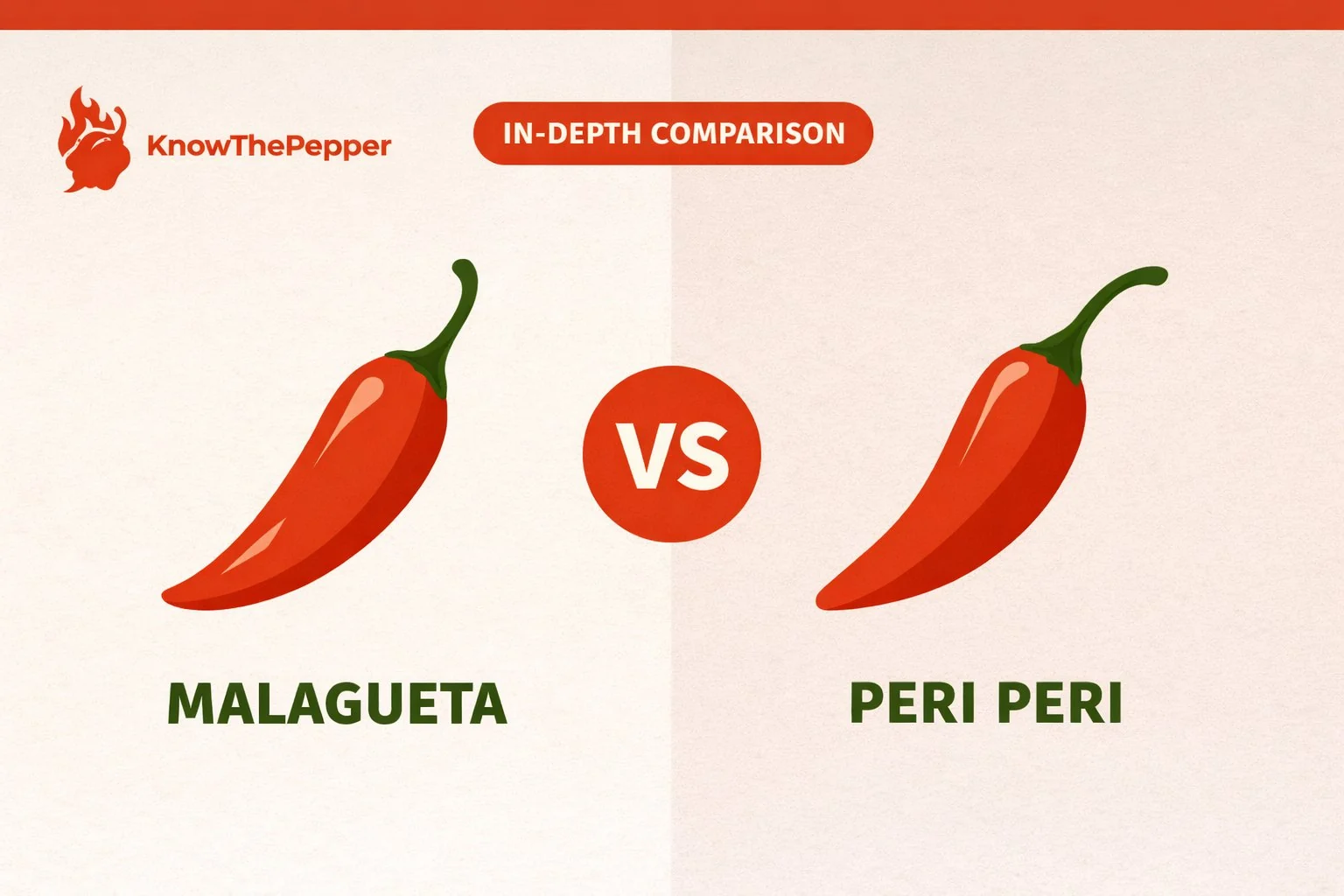
Malagueta measures 60K–100K SHU while Peri Peri registers 50K–175K SHU — making Peri Peri 2× hotter. Malagueta is known for its bright and citrusy flavor (C. frutescens), while Peri Peri offers citrusy and hot notes (C. frutescens).
- Heat difference: Peri Peri is 2× hotter
- Species: Both are C. frutescens
- Best for: Malagueta excels in hot sauces and extreme dishes, Peri Peri in hot sauces and spicy dishes
Malagueta
Extra-HotPeri Peri
Extra-HotMalagueta vs Peri Peri Comparison
Malagueta vs Peri Peri Heat Levels
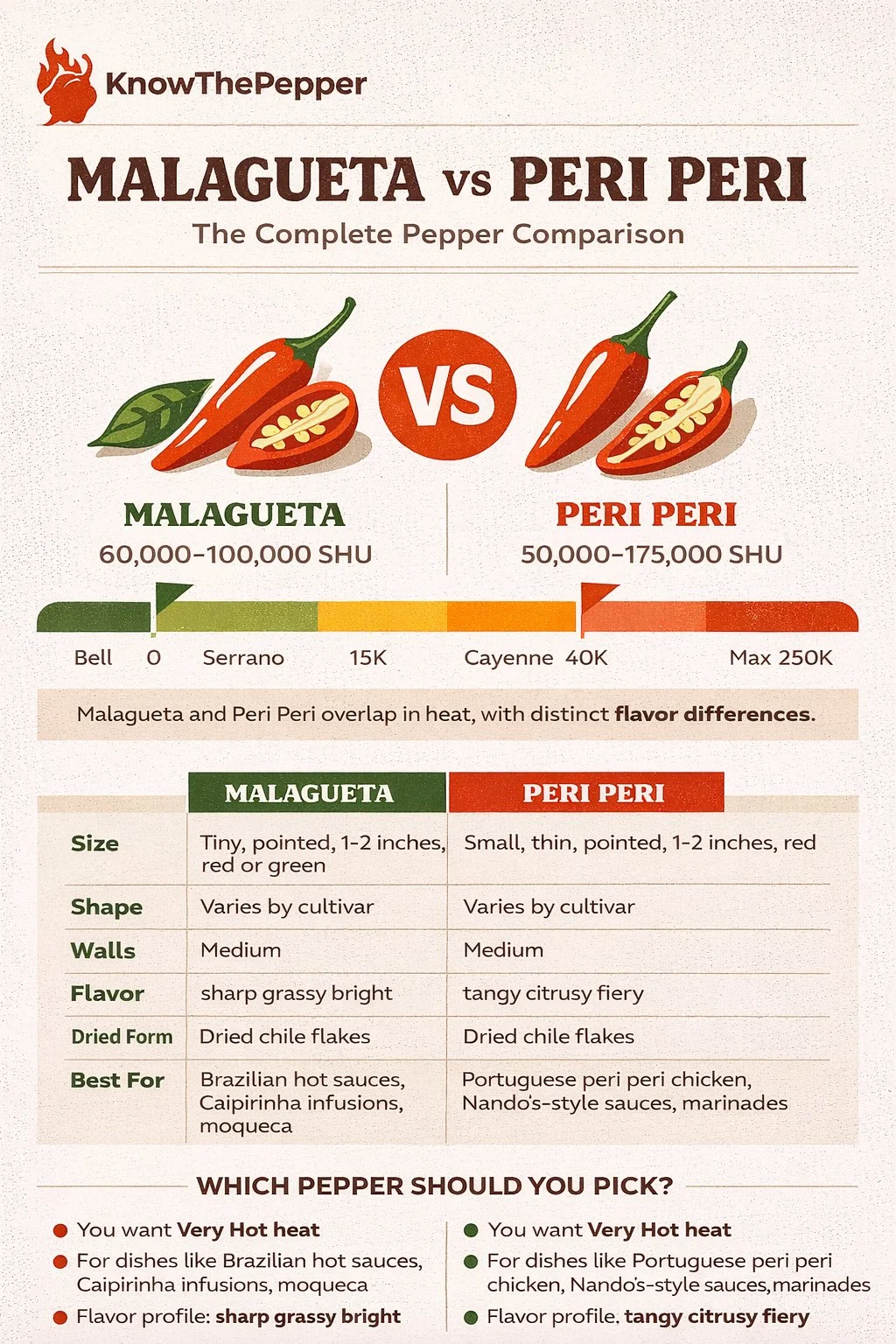
Both malagueta and peri peri sit in the hot-to-extra-hot range on the Scoville rating scale position, though pinning down exact SHU figures is tricky because both peppers show significant variation depending on growing conditions, soil, and regional ecotype.
Malagueta is generally cited between 60,000 and 100,000 SHU. That puts it roughly 12 to 20 times hotter than a typical Fresno chili (which averages around 5,000 SHU). The heat arrives fast — a sharp, forward bite that hits the front of the mouth before spreading back.
Peri peri (also spelled piri piri or African bird's eye) typically ranges from 50,000 to 175,000 SHU, making it a wider-swinging pepper. At the low end it's comparable to malagueta; at the high end it edges into territory that's nearly 35 times hotter than a Fresno. The burn is often described as more persistent — it builds and lingers rather than spiking quickly.
Both peppers belong to the hot pepper intensity range that most heat-tolerant cooks handle comfortably, though high-end peri peri specimens can nudge into extra-hot territory.
The capsaicin delivery mechanism matters here too. Understanding why capsaicin triggers the burn response explains why malagueta's quick spike feels different from peri peri's slow-building intensity — it's about receptor binding duration, not just total capsaicin content.
For practical purposes: if you're cooking for a mixed crowd, malagueta is the more predictable heat source. Peri peri's variability means a batch from one supplier can be dramatically hotter than the last.
Flavor Profile Comparison
Malagueta punches well above its small frame.
The first time I encountered peri peri in its raw form - not the bottled sauce, but the actual fresh pepper - I was struck by how the citrus hit before the heat.
Strip away the heat and these two peppers taste noticeably different — which matters a lot when you're building a sauce or marinade.
Malagueta has a grassy, slightly herbaceous quality with a clean, almost citrus-adjacent brightness. There's minimal fruitiness; the flavor is lean and direct. In Brazil, where it's used extensively in cachaça-based hot sauces and seafood dishes, that clean heat profile is the point — it adds fire without muddying other flavors.
Peri peri carries more complexity. Grown across Mozambique, South Africa, and Portugal's former territories, it has a distinctly fruity-floral note beneath the heat — something closer to a berry or stone fruit suggestion, especially in fresh or lightly dried form. When dried and smoked (as it often is in commercial preparations), a deeper, slightly earthy character emerges.
Aroma is another dividing line. Fresh malagueta smells sharply vegetal — think green pepper with an edge. Peri peri, particularly the African varieties, has a more aromatic, almost perfumed quality that becomes the backbone of dishes like peri peri chicken.
In sauces, malagueta blends into the background as a heat amplifier. Peri peri tends to assert itself as a flavor, not just a heat source. That's why peri peri chicken is named for the pepper — the flavor is identifiable — while Brazilian malagueta dishes are rarely named after the chili.
For cooks who want heat without flavor distraction, malagueta wins. For dishes where the pepper is meant to be the star, peri peri has more to say.
Culinary Uses for Malagueta and Peri Peri
Piri piri chicken is the obvious starting point for peri peri — the dish that put the pepper on menus worldwide. A proper marinade blends fresh or dried peri peri with lemon, garlic, and oil, then gets worked under the skin before grilling. The pepper's fruity heat survives high heat better than many chilies, making it ideal for open-flame cooking.
Malagueta shines in molho de pimenta, the Brazilian table condiment made by steeping whole malagueta pods in cachaça or vinegar with garlic and onion. A few drops go into moqueca (fish stew), acarajé (black-eyed pea fritters), and vatapá. The clean heat integrates without overpowering the coconut and dendê oil that define Bahian cooking.
Both peppers work in hot sauces, but the base recipe differs. Peri peri sauces typically include citrus and herbs to complement the pepper's fruitiness. Malagueta sauces lean on vinegar and salt — the pepper does the heavy lifting.
For substitution: if you need malagueta and only have peri peri, use about 75% of the called-for quantity since peri peri can run hotter. Going the other direction — replacing peri peri with malagueta — add roughly 25% more to compensate for the potential heat gap, and consider adding a small amount of smoked paprika to approximate peri peri's depth.
Dried versions of both peppers are shelf-stable and work well in spice rubs. Peri peri's fruitiness survives drying better than malagueta's grassy freshness, which fades somewhat when dried.
For the African bird's eye versus peri peri heat and flavor matchup, it's worth noting that bird's eye and peri peri are sometimes conflated — understanding that distinction helps when sourcing these peppers from specialty suppliers.
Both peppers are available dried or as hot sauce at Brazilian and African grocery stores, and increasingly at mainstream retailers carrying international ingredients.
Which Should You Choose?
Choose malagueta when you want reliable, clean heat that integrates into a dish rather than dominating it. It's the workhorse of Brazilian hot cooking — consistent, sharp, and versatile across seafood, bean dishes, and table sauces. Growing your own is straightforward; the germination and cultivation walkthrough for small hot peppers applies well to malagueta, which is a compact, productive plant.
Choose peri peri when the pepper's flavor is meant to be part of the dish's identity. The fruity-floral character makes it more than a heat delivery system — it's an ingredient with personality. It's the right call for marinades, grilled meats, and any preparation where the sauce is the centerpiece.
If you cook across both Brazilian and Southern African cuisines, keep both on hand. They're not true substitutes for each other — the flavor profiles diverge enough that swapping one for the other changes the dish in ways that matter. For the heat difference between bird's eye and peri peri styles, that comparison offers more context on sourcing the right peri peri type.
Can You Substitute One for the Other?
Proceed with caution. Peri Peri is 2× hotter than Malagueta.
Need a different option altogether? Search for peppers that match your target heat and flavor with precise swap ratios.
Growing Malagueta vs Peri Peri
If you’re deciding which pepper to grow at home, consider your climate and patience level. Malagueta and Peri Peri have different maturation times and temperature preferences. Hotter varieties generally need a longer, warmer growing season to develop their full capsaicin content. Our zone-based planting date tool can pinpoint the best sowing window for your area.
Malagueta is a grower's pepper in the best sense - challenging enough to be interesting, rewarding enough to keep you coming back. Start seeds indoors 10-12 weeks before last frost, as *C.
For container growing, check the container pepper guide before committing to pot size - malagueta's woody stems and extensive root system do best in 12-15 liter containers minimum. Smaller pots restrict yield significantly.
Full sun is non-negotiable. Six hours is the floor; eight or more produces noticeably denser fruit sets.
Peri peri grows best in full sun with well-draining soil and consistent warmth - it's a tropical species that does not tolerate frost. Start seeds indoors 10-12 weeks before last frost, keeping soil temperature at 80-85°F for germination.
The plants stay compact, typically reaching 18-24 inches, which makes them workable in containers. A 5-gallon pot with quality potting mix and a slow-release fertilizer will carry a plant through a full season.
For comparison, the cultivation approach for its close botanical relative is nearly identical - both prefer the same temperature ranges and soil conditions.
History & Origin of Malagueta and Peri Peri
Both peppers carry centuries of culinary heritage. Malagueta traces its roots to Brazil, while Peri Peri originates from Africa. Understanding their backstory helps explain why each pepper developed its distinctive traits.
Buying & Storage
Whether you’re shopping for Malagueta or Peri Peri, the same quality indicators apply. Fresh peppers should feel firm and heavy for their size, with taut, glossy skin and no soft or wet spots. Minor stem cracks known as “corking” are perfectly normal and often indicate a mature, flavorful pod.
- Firm pods with taut skin and consistent color
- Should feel heavy relative to size
- Minor stem cracks (“corking”) are normal
- Avoid anything soft, shriveled, or with dark wet spots
- Fresh: Paper bag, crisper drawer — 1–2 weeks
- Frozen: Wash, dry, freeze on sheet pan — 6+ months
- Dried: Airtight, away from light — up to 1 year
The Verdict: Malagueta vs Peri Peri
Malagueta and Peri Peri sit in the same heat tier but serve different roles. Peri Peri delivers 2× more heat with its distinctive citrusy and hot character. Malagueta, with its bright and citrusy profile, excels in everyday cooking.
Frequently Asked Questions
Related Comparisons
Sources pending verification.