Banana Pepper vs Cubanelle Pepper – Heat & Flavor Compared
Banana peppers and cubanelle peppers are both mild, sweet, thin-walled peppers that sit at the very bottom of the Scoville scale — each registering 0-0 SHU in their sweetest forms. The differences between them are almost entirely about flavor character and culinary application rather than heat. Knowing which to reach for comes down to texture, taste profile, and what you're cooking.

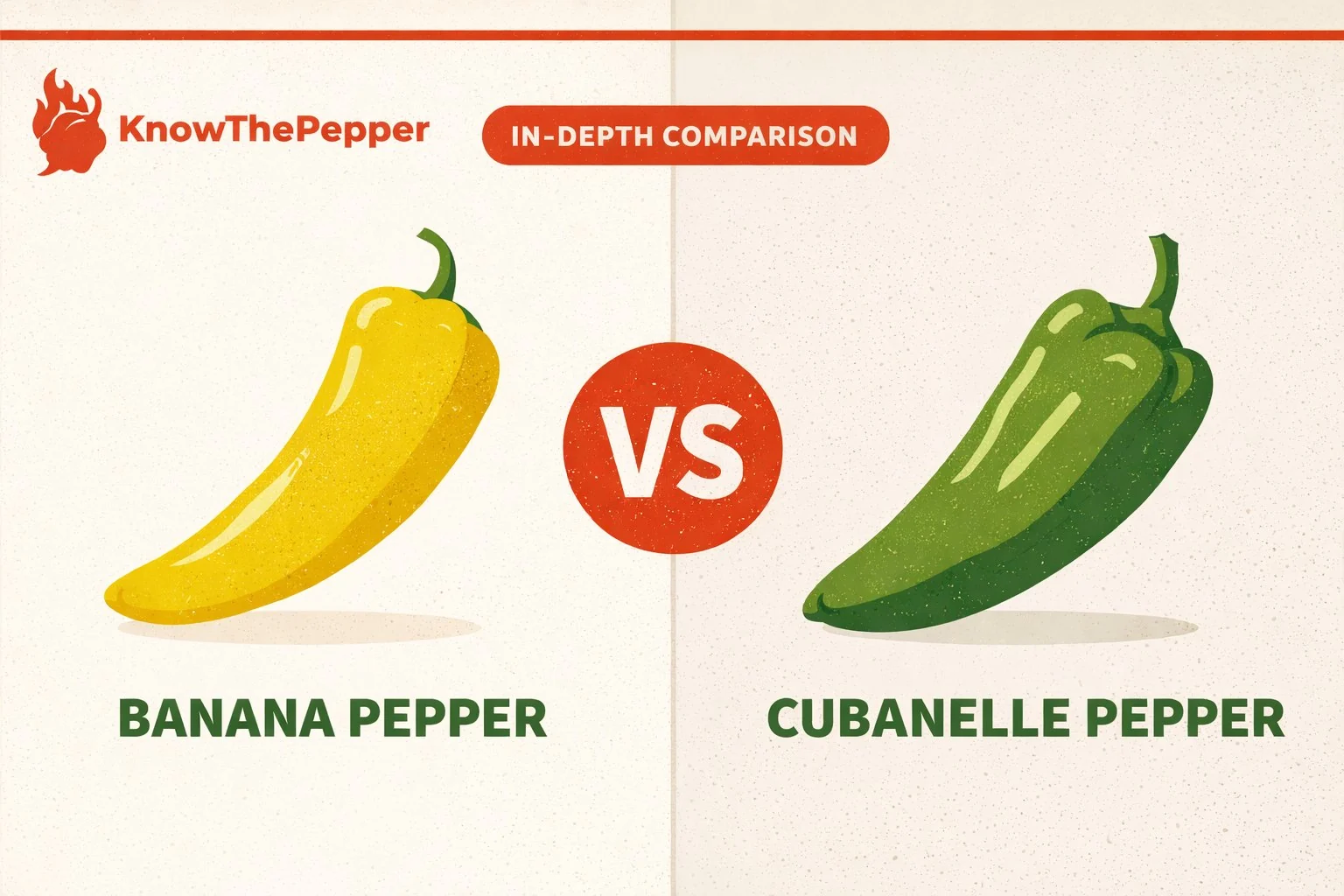
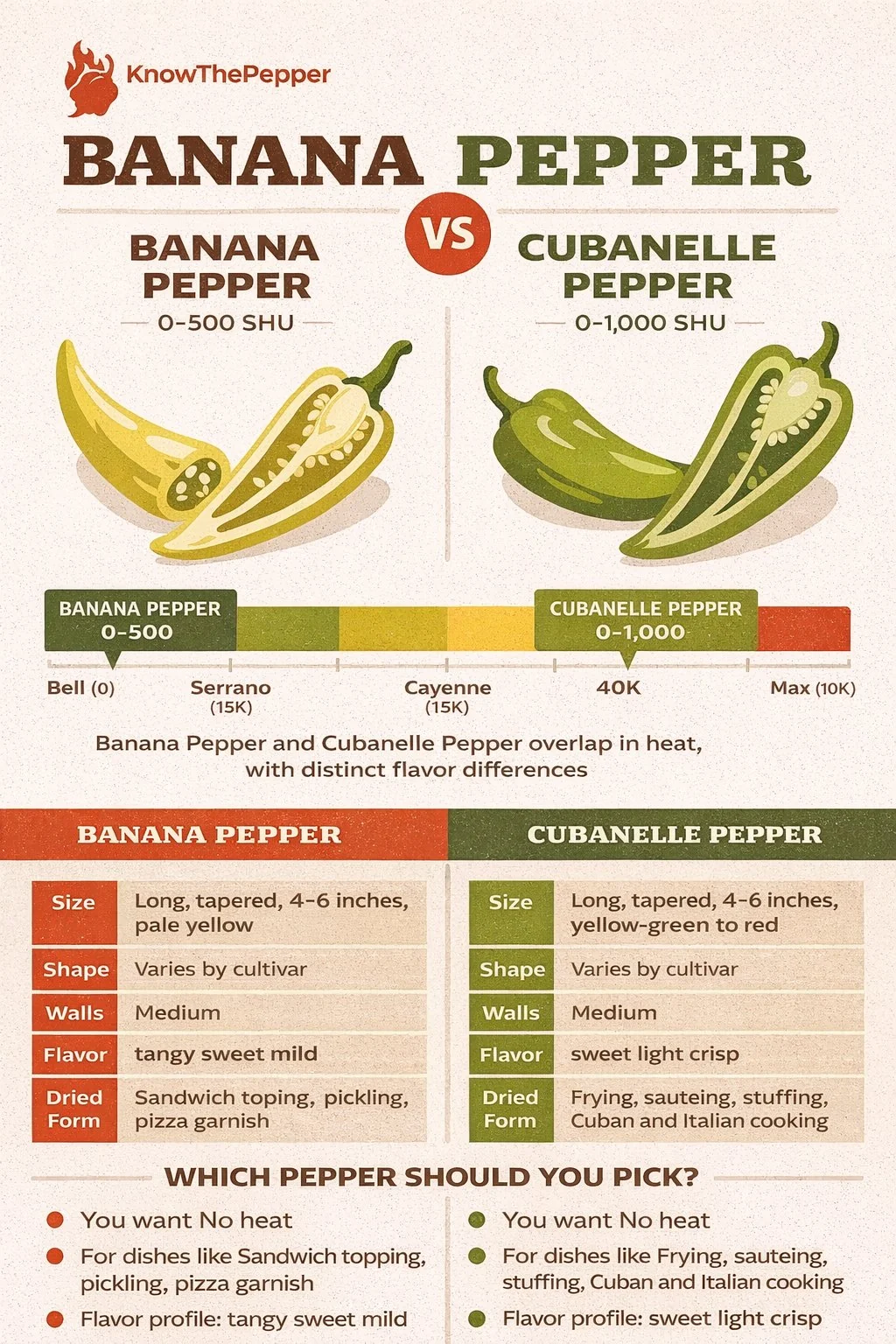
Banana Pepper measures 0–500 SHU while Cubanelle Pepper registers 100–1K SHU — making Cubanelle Pepper 2× hotter. Banana Pepper is known for its mild and tangy flavor (C. annuum), while Cubanelle Pepper offers sweet and mild notes (C. annuum).
- Heat difference: Cubanelle Pepper is 2× hotter
- Species: Both are C. annuum
- Best for: Banana Pepper excels in everyday cooking and salsas, Cubanelle Pepper in fresh salsas and mild recipes
Banana Pepper
MildCubanelle Pepper
MediumBanana Pepper vs Cubanelle Pepper Comparison
Banana Pepper vs Cubanelle Pepper Heat Levels
Both peppers land at the absolute floor of the mild heat spectrum — 0 SHU for their sweetest cultivars, with some banana pepper varieties creeping up to a barely perceptible warmth in certain growing conditions. Neither will challenge anyone's tolerance.
For context, a guajillo's moderate dried-pepper warmth sits at roughly 2,500-5,000 SHU — meaning even a spicy banana pepper variant is still dramatically milder than a guajillo at its gentlest. These are peppers you can eat whole without flinching.
The distinction worth noting: banana peppers actually come in two types — the sweet banana pepper (essentially 0 SHU) and the hot banana pepper, sometimes called Hungarian wax, which can nudge toward 500 SHU or slightly beyond. Cubanelles, by contrast, are consistently non-hot across virtually all cultivars. If you're buying unlabeled peppers at a farmers market, a quick taste test settles any uncertainty fast.
Capsaicin content in both is negligible to nonexistent. The science behind why peppers produce heat involves capsaicinoid binding to TRPV1 receptors — a mechanism that simply isn't triggered at these SHU levels. Both peppers are genuinely appropriate for heat-sensitive diners, children, and anyone who wants pepper flavor without the physiological burn response.
Flavor Profile Comparison
The first time I bit into a raw banana pepper straight from the garden, the tanginess caught me off guard — more like a mild vinegar note than anything I expected from a fresh pepper.
Walk through any Italian neighborhood market in New York or a Cuban home kitchen, and you will almost certainly find cubanelles.
Start with aroma, because that's where cubanelles assert themselves first. Fresh cubanelles carry a grassy, slightly floral scent — almost reminiscent of green bell pepper but thinner and more delicate. Banana peppers, by comparison, smell tangier on the nose, with a faint acidic brightness that hints at the vinegary pickled form most people encounter in delis.
In terms of taste, cubanelles are sweeter and more vegetal when raw, with a thin skin that cooks down quickly into silky, almost buttery strips. The flavor mellows considerably under heat, losing its raw grassiness and developing a gentle sweetness. They're closer to a refined bell pepper than anything else.
Banana peppers bring more tang to the table — a subtle tartness that persists even when cooked, making them more assertive in raw applications like salads and sandwiches. The pickled version amplifies this quality dramatically, which is why they're a staple on hoagies and antipasto plates.
Texturally, both are thin-walled and floppy compared to bell peppers, but cubanelles are slightly more irregular in shape — longer, twisted, and tapered — while banana peppers are more uniformly cylindrical. This matters for stuffing: banana peppers hold their shape better. Cubanelles tend to collapse more readily during cooking, which is actually desirable in Italian frying applications.
For raw eating, banana peppers win on brightness. For cooked dishes where you want the pepper to melt into the background, cubanelles are the better pick.
Culinary Uses for Banana Pepper and Cubanelle Pepper
Cubanelles are the pepper of choice in Italian-American cooking — specifically for frying peppers, the classic preparation where thin strips are sauteed in olive oil with onions and sometimes sausage. Their thin walls cook in minutes and develop a sweet, slightly caramelized character. They're also traditional in Puerto Rican and Cuban sofrito, where they're blended with onion, garlic, and herbs as a flavor base. For a direct comparison of how cubanelles stack up against another mild cooking pepper, the cubanelle vs. poblano matchup in terms of heat and body is worth reading — poblanos are noticeably thicker and carry a faint earthiness that cubanelles lack.
Banana peppers shine in cold applications. Raw rings on sandwiches, layered into salads, or stuffed with cream cheese and served as an appetizer — these are their best uses. Pickled banana peppers are practically essential on Italian beef sandwiches and Chicago-style hot dogs (the mild version). The heat difference between banana peppers and Hungarian wax peppers matters here: if your recipe calls for pickled banana peppers and you grab hot Hungarian wax by mistake, the result will be noticeably spicier.
For stuffing, banana peppers are the practical choice — their consistent cylindrical shape accommodates fillings cleanly. A classic preparation: halve lengthwise, fill with a mixture of cream cheese, sharp cheddar, and herbs, then bake at 375°F for about 20 minutes.
Substitution ratios are essentially 1:1 between these two peppers in most cooked recipes. Raw substitutions work too, though the slight tang of banana pepper will be noticeable if you swap it into a dish designed around cubanelle's neutral sweetness. If you're comparing either to a jalapeño — a common reference point — the banana pepper vs. jalapeño contrast in raw heat shows just how dramatically different these mild peppers are from even a moderately spicy variety.
Which Should You Choose?
Choose cubanelles when heat is irrelevant and texture is everything — they're the superior frying pepper, better suited to Italian-style preparations, sofrito bases, and any dish where you want the pepper to cook down into something soft and sweet.
Reach for banana peppers when raw brightness matters, when you need a consistent shape for stuffing, or when you're building a sandwich or cold dish that benefits from a little tangy edge. Pickled banana peppers are essentially their own category — no cubanelle substitution works there.
For heat-sensitive cooking or feeding guests who avoid spice entirely, both are safe choices. The practical distinction is cooking method: high-heat saute favors cubanelles, while raw or lightly cooked applications favor banana peppers. Neither will ever be mistaken for a hot pepper, which is precisely the point — these are flavor-first vegetables that happen to be classified as peppers.
Can You Substitute One for the Other?
Yes — direct substitution works. Banana Pepper and Cubanelle Pepper are close enough in heat to swap at roughly 1:1. The main difference will be flavor. For more swap options, explore ranked alternatives with conversion ratios.
Growing Banana Pepper vs Cubanelle Pepper
If you’re deciding which pepper to grow at home, consider your climate and patience level. Banana Pepper and Cubanelle Pepper have different maturation times and temperature preferences. Hotter varieties generally need a longer, warmer growing season to develop their full capsaicin content. Our zone-based planting date tool can pinpoint the best sowing window for your area.
Banana peppers are forgiving plants — a good starting point if you want a step-by-step growing guide to work from. They thrive in full sun with consistent moisture and warm soil, performing best where daytime temperatures stay between 70°F and 85°F.
Start seeds indoors 8 to 10 weeks before the last frost date. Transplant once nighttime temperatures stay reliably above 55°F — cold soil stunts early growth noticeably.
Fertilize at transplant with a balanced formula, then switch to a lower-nitrogen feed once flowering begins. Too much nitrogen pushes leafy growth at the expense of fruit set.
Cubanelles are among the more forgiving peppers to grow, which makes them a good choice for gardeners who want reliable production without fussing over soil conditions. Start seeds indoors 8–10 weeks before last frost — transplanting seedlings after soil temperature reaches 65°F consistently gives them the best start.
Plants typically reach 24–30 inches tall and produce heavily once established. Days to maturity run around 65–70 days from transplant to green-stage harvest, which is when most cooks want them.
They prefer full sun and well-drained soil with consistent moisture. Inconsistent watering leads to blossom drop and uneven fruit set.
History & Origin of Banana Pepper and Cubanelle Pepper
Both peppers carry centuries of culinary heritage. Banana Pepper traces its roots to USA, while Cubanelle Pepper originates from Cuba. Understanding their backstory helps explain why each pepper developed its distinctive traits.
Buying & Storage
Whether you’re shopping for Banana Pepper or Cubanelle Pepper, the same quality indicators apply. Fresh peppers should feel firm and heavy for their size, with taut, glossy skin and no soft or wet spots. Minor stem cracks known as “corking” are perfectly normal and often indicate a mature, flavorful pod.
- Firm pods with taut skin and consistent color
- Should feel heavy relative to size
- Minor stem cracks (“corking”) are normal
- Avoid anything soft, shriveled, or with dark wet spots
- Fresh: Paper bag, crisper drawer — 1–2 weeks
- Frozen: Wash, dry, freeze on sheet pan — 6+ months
- Dried: Airtight, away from light — up to 1 year
The Verdict: Banana Pepper vs Cubanelle Pepper
Banana Pepper and Cubanelle Pepper occupy very different positions on the heat spectrum. Cubanelle Pepper delivers 2× more heat with its distinctive sweet and mild character. Banana Pepper, with its mild and tangy profile, excels in everyday cooking.
Frequently Asked Questions
Related Comparisons
Sources pending verification.