How Do You Control Thrips on Pepper Plants Without Overspraying?
Confirm thrips with a tap test and fresh damage before treating. Protect flowers and new growth first, then stop active control after two clean checks rather than spraying permanent old scars.
Control thrips by confirming live insects first, then reducing the population with pruning, plain water, sanitation, and close checks of new growth. Use a labeled contact treatment only when fresh feeding continues, because old silver scars never disappear and cannot tell you whether the infestation is still active.
The decisive evidence is concentrated in flowers, folded tips, young leaves, and newly set fruit. A hand lens, white-paper tap test, and two follow-up checks reveal more than spraying every marked leaf.
How do you know a pepper plant has thrips?
Tap an open pepper flower or curled shoot over white paper and watch for narrow insects that move like tiny slivers. UC Integrated Pest Management describes adult western flower thrips at about 1.5 mm long and onion thrips at about 1.3 mm, both small enough to require a hand lens.
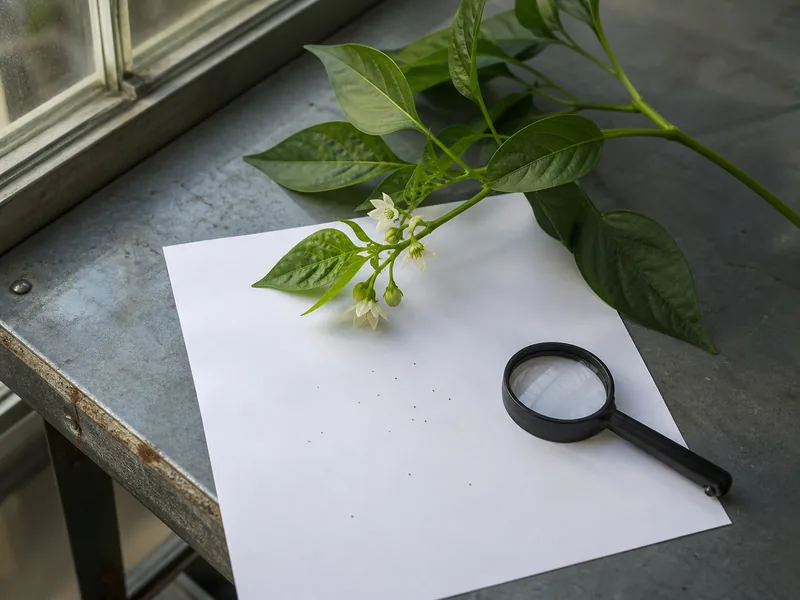
Body shape matters more than color. Adults have narrow fringed wings, while the lighter immature stages share the same slender outline but lack wings.
Feeding marks provide a second line of evidence. University of Maryland Extension identifies pale stippling, silvered tissue, black frass specks, crinkled young leaves, damaged flowers, and rough scars on tender fruit as common thrips signs.
Inspect tissue that is still expanding because thrips feed in protected crevices. A quick look across mature upper leaves can miss larvae inside a flower or folded tip.
Do not diagnose from curl alone.
Aphids usually leave sticky honeydew and clustered pear-shaped insects.
Spider mites produce fine stippling and may leave webbing under leaves.
Does old thrips damage still need treatment?
Fresh injury decides whether the plant still needs active control. Silver patches and distorted leaves remain after the insects are gone, so count new scars, new black specks, and live thrips instead of damaged tissue from earlier weeks.
A lightly marked plant with normal new leaves may need monitoring rather than a pesticide. University of Maryland field guidance reports that pepper flowers can tolerate about five thrips per flower without fruit-development problems, although a home gardener should treat that number as field context rather than a universal threshold.
| Current evidence | What it means | Next move |
|---|---|---|
| Old silver scars, clean new leaves | Past injury is still visible | Monitor flowers and tips without spraying |
| Live thrips in flowers, no new fruit scars | Adults are present but damage is limited | Remove dirty flowers, rinse, and recheck |
| Freshly distorted leaves or scarred young pods | Feeding is continuing | Use the full cleanup sequence and assess treatment |
| Bronzing, necrotic rings, stunting, or fruit rings | A virus or another disease may be involved | Isolate the plant and seek a diagnosis |
Plant age changes the decision. A small transplant can lose useful growth quickly, while an established pepper with a broad healthy canopy can tolerate a few damaged leaves without losing its crop.
How do you reduce thrips on peppers without pesticides?
Begin with actions that remove exposed insects without leaving a pesticide residue. University of Maryland recommends a strong spray of plain water as a mechanical control, especially against softer immature thrips.
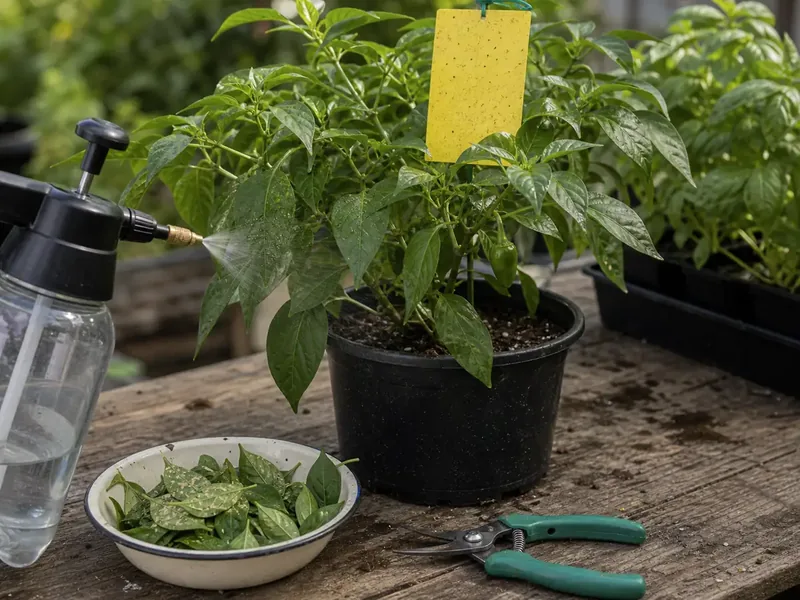
| Timing | Action | Evidence to record |
|---|---|---|
| Day 1 | Tap-test three to five flowers and inspect both sides of the newest leaves | Live thrips, black specks, silvering, and the worst plant location |
| Day 1 | Remove only heavily infested flowers or badly distorted tips | Enough healthy foliage and clean blooms remain |
| Day 1 or 2 | Rinse flowers, folded tips, and leaf undersides with plain water | Plant dries normally and tender tissue is not bruised |
| Days 2 to 6 | Keep weeds and spent flowers out of the immediate growing area | Fewer hiding places and outside hosts surround the pepper |
| Day 7 | Repeat the same flower and new-growth inspection | New injury is absent, stable, or increasing |
The seven-day check fits the insect's pace without pretending that every thrips is gone. Warm conditions can shorten development from egg to adult to about 14 days, according to UC IPM and University of Maryland guidance.
Remove the worst tissue selectively. Stripping every marked leaf reduces the photosynthetic area the pepper needs to replace damaged shoots and fill existing fruit.
Do not dig deeply around the roots to chase pupal stages in soil or litter. Clearing loose debris and weeds addresses habitat without cutting the shallow feeder roots that support recovery.
Inspect flowers before young pods scar
Flowers deserve their own inspection because they provide shelter, pollen, and direct access to tender fruit.
Open several blooms and check around the anthers rather than judging the plant from three feet away.
Remove a flower when it holds several moving larvae or heavy black specking. Keep clean blooms on the plant, since wholesale flower removal trades a manageable pest problem for a lost fruit set.
A newly set pod can develop rough pale patches while nearby mature leaves still look acceptable. That sequence explains why flower evidence can predict fruit injury sooner than a general leaf check.
Sticky cards can show whether winged adults continue to enter the canopy, but they do not measure larvae hidden inside flowers. Place blue or yellow cards near the newest growth without letting the adhesive touch leaves, then compare catch trends across checks.
Fruit scars are permanent but usually cosmetic once the skin has hardened.
Protect the next flowers and pods rather than trying to reverse damage that has already formed.
When should you use oil or soap sprays on thrips?
Consider a pesticide only when live thrips and fresh injury persist after the cleanup sequence. University of Maryland lists horticultural oil and insecticidal soap among lower-toxicity contact options, but the product must be labeled for vegetables and for the place where the pepper grows.
Contact products work only where spray reaches the insect.
Aim at leaf undersides, folded tips, and flower crevices, then stop at even coverage rather than letting liquid run into the pot or bed.
Test a small area first and avoid treating heat-stressed foliage in strong sun.
Follow the label's pollinator precautions, preharvest interval, application limit, and directions for open flowers.
Repeated spraying can make control harder. University of Maryland warns that more than four or five thrips sprays within four to five weeks can remove susceptible species and natural enemies while resistant western flower thrips remain.
Spinosad and azadirachtin sit between simple contact and systemic activity, according to University of Maryland. Their presence in garden products does not override the label, and homemade detergent mixtures are not substitutes for registered insecticidal soap.
Stop escalating when the next growth remains clean. A calendar does not justify another application when the evidence no longer shows active feeding.
Is it thrips damage or tomato spotted wilt virus?
Ordinary thrips feeding causes silvering, specks, distortion, and surface scars.
Tomato spotted wilt virus can add bronzing, dead leaf spots or rings, stunting, wilting, and bumpy fruit with concentric rings, according to UC IPM.
No single symptom confirms the virus because herbicide injury, nutrient problems, and other diseases can overlap.
Isolate a suspicious plant and ask a local extension or plant diagnostic clinic before handling healthy peppers.
Thrips acquire the virus during immature stages and can transmit it as adults for the rest of their lives. Killing visible adults cannot cure an infected pepper, which is why disease suspicion requires a different decision from cosmetic feeding damage.
Remove a confirmed infected plant rather than composting it beside the crop. The goal is to reduce a virus source that incoming thrips could carry to healthy plants.
Where do thrips on pepper plants come from?
Thrips pressure can come from the growing area rather than one missed leaf. UC IPM lists cereals, onions, garlic, broadleaf crops, ornamentals, and several weeds among hosts, so inspect what touches or overhangs the pepper canopy.
- Remove weeds and spent blooms where thrips can feed or reproduce.
- Inspect new transplants and flowering ornamentals before placing them beside peppers.
- Space branches so flowers and leaf undersides remain visible during checks.
- Keep soil moisture steady enough for normal new growth without saturating the root zone.
- Move sticky cards upward as the canopy grows so they remain near active shoots.
Protected spaces need tighter monitoring because wind and rain do not knock insects from the plant. A grow tent, greenhouse, or sheltered balcony can also keep adults close to flowers for longer periods.
Natural enemies include minute pirate bugs, lacewing larvae, predatory mites, and other small predators identified by University of Maryland. Avoid broad routine spraying that removes those insects while leaving resistant thrips behind.
If only one edge of the bed produces fresh scars, map the nearby weeds, flowers, or incoming plants.
Changing that source can matter more than rotating to another pesticide.
When can you stop treating thrips?
Recovery appears first in the tissue produced after control began. Look for normally opening leaves, clean flower parts, unscarred young pods, and fewer adults on cards at the same inspection points.
Use two clean checks several days apart as the practical stop point.
Continue light scouting during warm weather, but do not treat a recovering plant because old silver patches remain.
If damage resumes, repeat the white-paper test before choosing the next action. A rebound can be thrips, while new curl or discoloration without insects may come from water stress, mites, nutrient problems, or disease.
Record the first plant affected, the flower count, and whether new fruit stays clean. Those observations show whether the colony is shrinking, moving in from one side, or being confused with a separate care problem.
The finished response is evidence-driven: confirm the insect, protect new growth, escalate only while damage continues, and stop when the pepper proves it is recovering.
How Do You Control Thrips on Pepper Plants Without Overspraying? FAQ
- UC IPM - Thrips on Peppers
- UC IPM - Tomato Spotted Wilt on Peppers
- University of Maryland Extension - Thrips in Home Gardens
- University of Maryland Extension - Watch for Thrips in Vegetables