Why Are My Pepper Leaves Turning Yellow? Check Where the Yellowing Began
Pepper leaves can turn yellow from root-zone moisture, nutrient uptake trouble, pests, disease, cold, or normal aging. Start with the first leaves affected, then check moisture, veins, spots, insects, and the speed of spread before changing care.
Start With the Yellowing Pattern
Pepper leaves turn yellow when the plant loses chlorophyll or can no longer maintain that leaf. The color alone cannot identify the cause, so first note where the yellowing began and what changed around the plant.
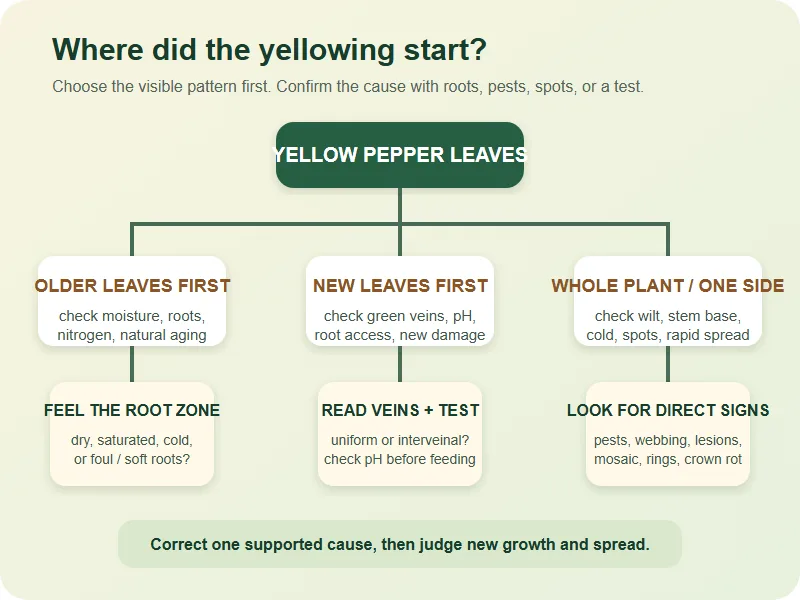
A few old leaves fading slowly at the base can be normal. Treat the pattern as a problem when it climbs the plant, reaches new growth, appears with wilt or spots, or affects several leaves in a short time.
Recent context can shorten the search. Yellowing that begins just after transplanting, a cold night, a long cloudy spell, a fertilizer application, or a change in watering deserves investigation before an unrelated deficiency is assumed.
- Locate the first affected leaves. Separate old lower leaves, new upper leaves, the whole plant, and one-sided damage.
- Touch the root zone. Check moisture below the surface and look for slow drainage, standing water, or a root ball that has pulled away from the container.
- Read the leaf itself. Note whether the veins stay green, the whole blade fades evenly, or yellow tissue surrounds spots and feeding marks.
- Check the pace. A stable lower leaf calls for observation. Rapid spread, collapse, or distorted new growth calls for immediate inspection.
The decision tree below prevents the most common mistake, which is adding fertilizer before checking whether damaged or saturated roots can absorb it.
Check Roots and Moisture Before Feeding
Yellowing plus wilt does not prove that a pepper needs water. University of Minnesota Extension lists both excess and insufficient soil moisture among causes of wilted pepper leaves, so the root zone must settle that question.
Push a finger or narrow trowel several inches into the soil away from the stem. Surface soil can look dry while the root zone remains wet, especially in a large pot or dense garden bed.
| What you find | What it suggests | Next action |
|---|---|---|
| Wet soil, soft leaves, slow drainage | Roots lack air or have begun to decline | Pause watering, empty saucers, open blocked drainage, and let the root zone approach moist rather than saturated |
| Dry soil, light pot, crisp edges, wilt | The root ball dried too far | Water slowly until the full root ball is moist, then recheck below the surface before the next watering |
| Wet soil, dark stem base, one-sided wilt, rapid collapse | A root or crown disease is possible | Isolate the plant and inspect the crown and roots instead of repeatedly watering it |
| Normal moisture, firm stem, yellow lower leaves only | Water is less likely to be the sole cause | Move to leaf age, vein pattern, pH, and feeding history |
Roots that are pale and firm support recovery. Brown, soft roots or dark tissue at the crown make disease more likely, while roots circling a container can leave the plant short of both water and nutrients even when the potting mix is adequate.
Do not use a fixed watering calendar as the correction for overwatering. Pot size, temperature, wind, plant size, and soil texture change how quickly the root zone dries.
Use Leaf Age and Veins to Test Nutrient Causes
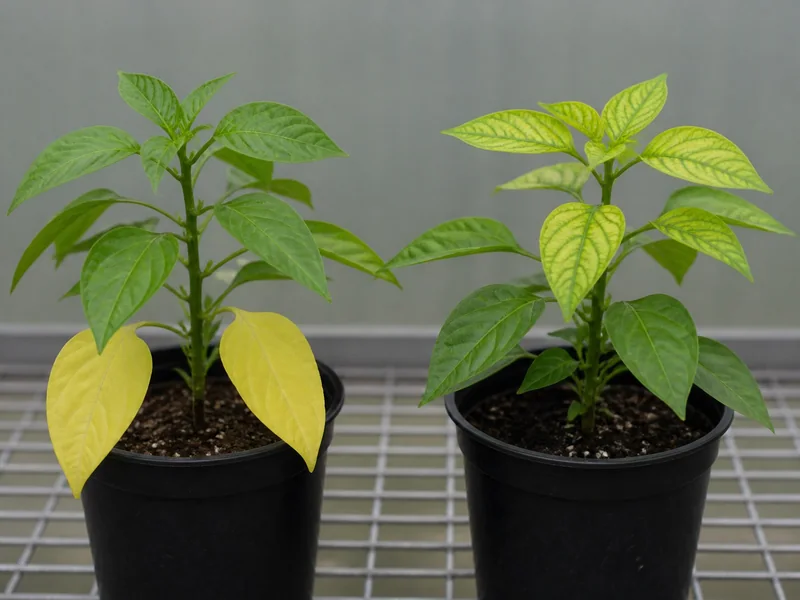
After moisture and roots check out, the position of the yellow leaves narrows the nutrient question. University of Maryland Extension notes that mobile nutrient deficiencies show first on older foliage, while problems involving less mobile nutrients appear first on younger leaves.
| Leaf pattern | Working hypothesis | What to verify before treating |
|---|---|---|
| Older leaves fade evenly, including the veins | Nitrogen shortage is possible | Check feeding history, container age, root health, and whether heavy rain leached the soil |
| Older leaves yellow between green veins | Magnesium shortage or uptake trouble is possible | Use a soil or tissue test when symptoms persist because several stresses can mimic this pattern |
| Young leaves yellow between green veins | Iron uptake trouble is possible | Check soil pH, drainage, and root condition before adding iron |
| Whole plant is pale after a recent feed | Root injury, excess salts, or unsuitable pH may block uptake | Review product rate and test the growing medium instead of applying another dose |
Clemson Cooperative Extension explains that soil pH changes nutrient availability. A pH result is useful because it can show why nutrients remain unavailable even when fertilizer is present.
Use a laboratory soil test for an in-ground bed when the pattern persists or affects several plants. For containers, review the potting mix, fertilizer label, water quality, and drainage together because a garden-soil pH result does not describe the pot.
If evidence supports a shortage, apply a complete fertilizer according to its label and the plant's growth stage. Avoid adding Epsom salt, chelated iron, nitrogen, or lime from leaf color alone because the wrong amendment can add salts without correcting the cause.
Fully yellow leaves may not regain their color. Judge the correction by healthier new growth and by whether yellowing stops spreading over the following days.
Look for Pest and Disease Evidence
Pest feeding and infection usually add a second clue beyond yellow color. Inspect both leaf surfaces, petioles, the stem base, and nearby plants before choosing a treatment.
| Direct sign | Likely problem | Decision |
|---|---|---|
| Fine pale stippling, webbing, tiny moving dots beneath leaves | Spider mites | Separate badly affected container plants, wash leaf undersides, and choose a product labeled for mites if physical removal is not enough |
| Clusters of soft insects, curled new growth, sticky honeydew | Aphids or whiteflies | Confirm the insect, knock down small colonies with water, and protect beneficial insects when selecting further control |
| Silvery scars with dark specks or distorted flowers and shoots | Thrips | Inspect flowers and folded growth, then use the pest identity to choose control |
| Brown or black lesions with yellow margins | Leaf spot disease | Remove badly affected tissue, avoid handling wet plants, reduce splash, and obtain a local diagnosis if spread continues |
| Rings, mosaic color, bronzing, stunting, distorted new leaves | A virus is possible | Isolate the plant and seek confirmation because fertilizer will not cure a virus |
| Dark crown, root decay, rapid wilt despite wet soil | Root or crown disease | Stop moving soil or water between plants and identify the disease before replanting the site |
UC Integrated Pest Management describes spider-mite injury as stippling that can progress to yellow or bronze foliage and leaf drop. That surface pattern differs from the even fade expected with a mobile nutrient shortage.
For spotted wilt, UC IPM lists bronzing, necrotic spots or rings, yellow mottling, and stunting among pepper symptoms. Those signs overlap with other problems, so symptom matching supports a diagnosis but does not replace confirmation.
Rapid wilt, crown discoloration, or a patch of declining plants deserves more caution than one pale leaf. Penn State Extension recommends diagnosing plant problems from the pattern, site conditions, plant history, and signs rather than treating one symptom in isolation.
Fix One Cause at a Time and Watch New Growth
Make the smallest correction supported by the evidence, then record the date and take a photo. Changing water, fertilizer, pH, and pest treatments together hides which action helped and can create a second stress.
| Supported cause | Correction | What to watch next |
|---|---|---|
| Saturated root zone without advanced decay | Restore drainage and wait for the root zone to lose excess water | Leaves become firmer and yellowing stops advancing |
| Dry root ball | Rehydrate the entire root zone slowly and improve moisture checks | Wilt eases while new leaves remain green |
| Test-supported nutrient or pH problem | Use the test recommendation and product label | New growth develops normally even if old leaves stay yellow |
| Confirmed sucking pest | Use physical removal or a labeled control suited to that pest | Live pest numbers and fresh feeding damage decline |
| Suspected contagious disease | Isolate the plant, sanitize tools, and seek local extension or laboratory confirmation | No spread to nearby plants while a diagnosis is pending |
Remove a yellow leaf when it is mostly dead, diseased, or obstructing inspection. Keep partly green leaves when they are clean and still functioning, and avoid stripping many leaves from a stressed pepper at once.
Escalate when yellowing spreads rapidly, the plant collapses in moist soil, the crown darkens, new growth becomes distorted, or several plants develop the same pattern. A county extension office or plant diagnostic laboratory can separate look-alike nutritional, environmental, and infectious problems before you treat the whole crop.
The useful recovery signal is not an old leaf turning green again. It is stable moisture, firm growth, fewer new symptoms, and healthy leaves emerging after the correction.
Why Are My Pepper Leaves Turning Yellow? Check Where the Yellowing Began FAQ
- Nutrient Deficiency of Vegetable Plants - University of Maryland Extension
- Pepper Leaves Wilt - University of Minnesota Extension
- How to Change Soil pH - Clemson Cooperative Extension
- Spider Mites - UC Integrated Pest Management
- Spotted Wilt Virus on Peppers - UC Integrated Pest Management
- Diagnosing Poor Plant Health - Penn State Extension