Should You Top Pepper Plants? When It Helps and Hurts
Topping is optional. It removes the terminal growing tip and may produce a shorter plant with more lateral branches, but credible extension guidance does not show that one cut guarantees more ripe peppers.
Top only a healthy, established plant when compact architecture solves a real space or support problem and enough season remains for regrowth plus fruit maturation. Leave stressed, flowering, fruiting, or short-season plants intact.
Should you top pepper plants for a bigger harvest?
Do not top a pepper plant only because a video promises more fruit. Topping removes the active end of the main stem, so the plant must replace lost height and leaf area with growth from lower nodes before those new branches can flower.
That trade can be useful when a healthy plant is growing as one awkward leader and a shorter, wider frame fits its container, lights, or support system better. It is a poor trade when the plant is weak, the first buds are already valuable, or frost will arrive before replacement branches can mature fruit.
University of Maryland Extension says there is not solid research-based information for one topping method that reliably increases chile yield.
University of Minnesota Extension is more direct about short seasons, where losing the growing tip can compromise the crop.
The plant is compact, branching on its own, carrying buds or fruit, or growing where the warm season is short. Its current leader is productive tissue, not a defect.
The transplant is newly moved, roots have not filled the new soil, or leaves still wilt each day. Establish the plant before considering an optional architecture cut.
The plant is healthy and actively growing, has no fruit to sacrifice, has ample season left, and needs a more compact branch framework for a specific space.
The plant already has a useful canopy but leans in wind or under fruit weight. A stake or row string preserves the growing tip and harvest schedule.
Illinois Extension recommends an establishment-phase topping method for selected Capsicum annuum peppers, while Maryland and Minnesota frame the evidence more cautiously.
The disagreement is useful because it shows why climate, plant stage, cultivar habit, and the grower's goal must remain attached to any recommendation.
A bushier outline is an observable result. A larger ripe harvest is a separate outcome that also depends on light, root volume, water, temperature, pollination, fruit size, and enough days for the later branches to finish.
What does topping actually change in a pepper plant?
The topping cut removes the terminal growing point at the end of the current leader. Nodes below that cut remain connected to leaves and hold small axillary buds in the angles where each leaf joins the stem.
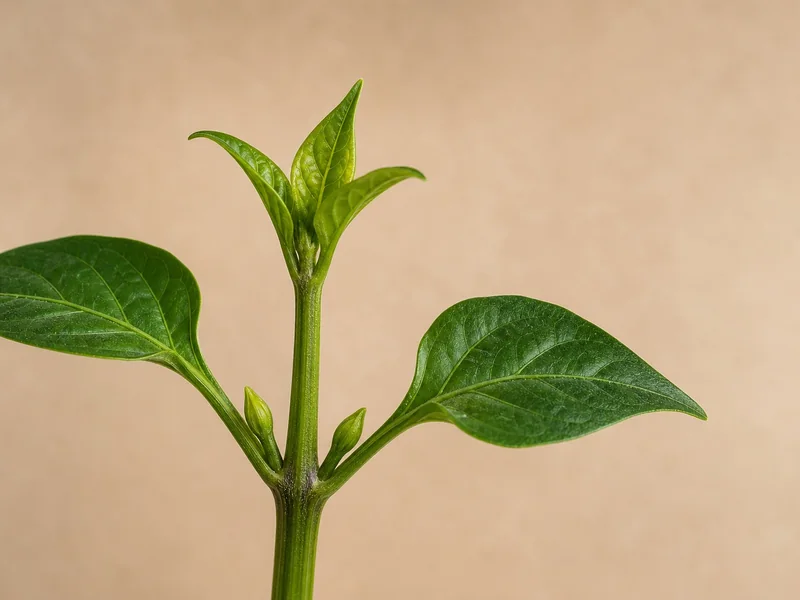
Once the terminal tip is gone, one or more of those retained buds may extend into lateral shoots.
The old leader does not repair itself by growing another tip from the cut surface.
University of Maryland Extension explains that removing a terminal bud releases lower buds from growth inhibition. The buds closest below the cut are most likely to grow when the retained stem has viable buds.
This response explains where regrowth comes from, but it does not prove that a topped pepper will yield more fruit.
The result still depends on how much leaf area remains and whether the new shoots have enough time and resources to flower.
| What the cut changes | Possible practical benefit | What the plant pays | What is not guaranteed |
|---|---|---|---|
| The terminal leader stops | A shorter frame can fit a shelf, cage, or protected space | Existing stem, young leaves, and possible bud sites are removed | A stronger root system or a larger container |
| Axillary buds may grow | More lateral branches can widen the canopy | Time and new leaf area are needed before later flowers form | More ripe fruit before frost |
| Fruit position changes | Branches may distribute small fruit across a broader plant | The first fruit set and first harvest can move later | Larger total fruit weight |
| The plant becomes easier to shape | Indoor lights may cover a compact canopy more evenly | Dense regrowth can still need thinning or support | Better airflow without later management |
University of Nebraska-Lincoln warns that topping peppers at transplant removes the first flower-bud area and delays first fruit set and harvest.
This is the central cost hidden by claims that the plant simply sends its energy elsewhere.
More branches help only when the roots and remaining leaves can supply them and the environment can turn their flowers into mature fruit.
A branch count by itself cannot measure success.
Which pepper plants are reasonable topping candidates?
A reasonable candidate is healthy before the cut. It has firm new leaves, a stem that is thickening rather than stretching rapidly, roots with adequate drained soil, and growth that continues after normal watering.
The grower also needs a concrete architecture problem.
A single tall leader under a fixed grow light, a plant that must stay below a cover, or an early indoor start that has months before outdoor harvest can justify considering one cut.
- The plant has resumed active growth after its latest potting or transplant.
- Several mature leaves will remain below the planned cut.
- At least one healthy node with visible axillary buds will remain near the top.
- No open flowers or developing fruit must be removed with the leader.
- The cultivar is not already forming a compact, well-branched canopy on its own.
- The local calendar leaves time for regrowth, new flowers, fruit set, and the desired harvest stage.
Do not top a plant to correct pale leaves, root crowding, cold soil, chronic wilt, or inadequate light. The cut reduces photosynthetic area while leaving the original limit in place.
A tall plant is not automatically leggy.
Some cultivars grow upright before their first natural fork, while a truly light-starved seedling shows long weak internodes, a thin stem, and leaves spaced farther apart than its healthy siblings.
Flowers and fruit also change the calculation. Removing a leader that carries them discards time the plant has already spent reaching reproduction, which is why the same cut costs more late than it does during vigorous vegetative growth.
Cornell CALS recommends a small stake for individual pepper plants or string between stakes for a row. If the actual problem is wind or fruit weight, support keeps the canopy and prevents broken branches from exposing fruit to sunscald.
Container size matters in a different way.
Topping may make the canopy shorter, but it cannot make a small root zone support unlimited lateral branches.
When is it too late to top a pepper plant?
It is too late when the expected recovery and replacement crop no longer fit before cold weather or another hard deadline.
Plant height alone cannot answer that question.
Start with the harvest stage you want. Utah State University notes that pepper fruit commonly needs about 35 to 45 days from flowering to full color, depending on variety and temperature.
Topping happens before a replacement branch flowers, so those 35 to 45 days cover only the final part of the clock.
The plant still needs an unknown interval to activate lateral buds, expand new leaves, form buds, flower, and set fruit.
- Mark the average first frost or the date the plant must leave its productive environment.
- Subtract the cultivar's normal flowering-to-harvest interval for green or fully colored fruit.
- Add a conservative buffer for lateral regrowth and new flower formation, because that interval changes with temperature and light.
- Leave additional time for heat, transplant shock, or slow-ripening fruit rather than treating the calculation as a deadline guarantee.
Open flowers, a set first fruit, or a natural fork are strong stop signals when early harvest matters.
University of Nebraska-Lincoln's warning about delayed first harvest becomes more important with each day the existing leader remains productive.
An indoor plant under stable warmth and adequate artificial light may have a longer recovery runway than the same cultivar newly planted outside. Indoor time counts only when the plant has enough light and root volume to produce sturdy growth rather than more weak height.
In a short northern season, leaving the tip intact is usually the safer default.
In a long warm climate, the calendar may tolerate the setback, but evidence still does not turn topping into a required yield step.
Where should you cut a pepper plant when topping?
Choose a healthy node below the terminal tip and make one clean cut a short distance above it. The mature leaves and axillary buds attached to that node must remain on the plant.
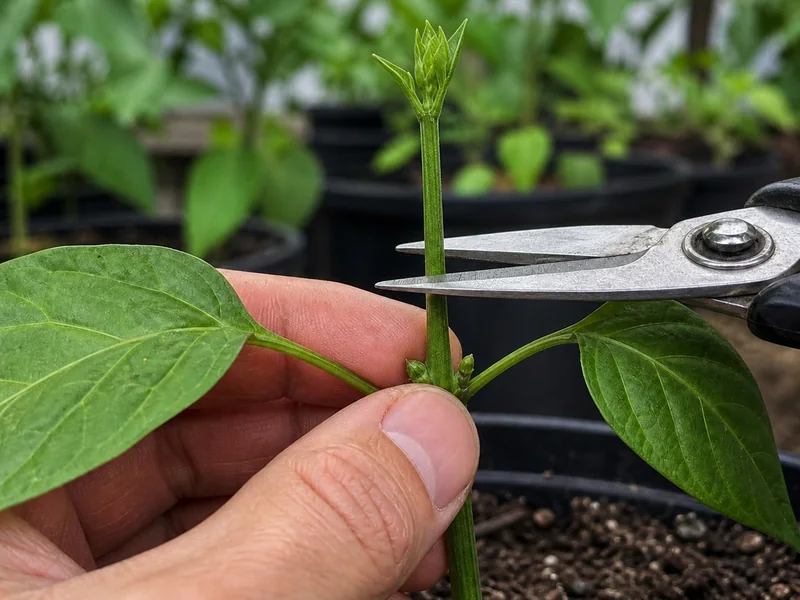
Do not cut through the swollen node itself.
A cut through that junction can damage the buds expected to form the replacement branches, while an unnecessarily long bare stub can die back and snag during handling.
- Water normally ahead of time if the root ball is dry, then wait until the leaves are firm rather than wilted.
- Clean sharp bypass pruners or fine snips with a product labeled for tool sanitation.
- Trace the main leader downward from the terminal tip and identify the node whose leaves and buds will remain.
- Confirm that enough mature leaf area and several lower nodes will stay below the cut.
- Support the stem below the chosen node and cut the single leader just above it without crushing the stem.
- Inspect the cut for torn fibers and leave it open to dry in moving air.
A bypass blade should pass cleanly through the stem instead of pinching it between two flat surfaces.
Fingers can pinch a very tender tip, but a clean tool gives better control once the stem has begun to toughen.
Topping is not the same as removing a flower. A flower-pinching decision removes a bud, bloom, or tiny fruit while leaving both growing tips and their leaves intact.
It also differs from bottom pruning. Removing old or soil-touching leaves later in the season can improve access or reduce splash risk, but it does not deliberately end the terminal leader.
What should happen after you top a pepper plant?
The fresh cut should dry without turning soft, dark, or water-soaked. The leaves below it should stay firm enough to support the axillary buds that now have an opportunity to grow.
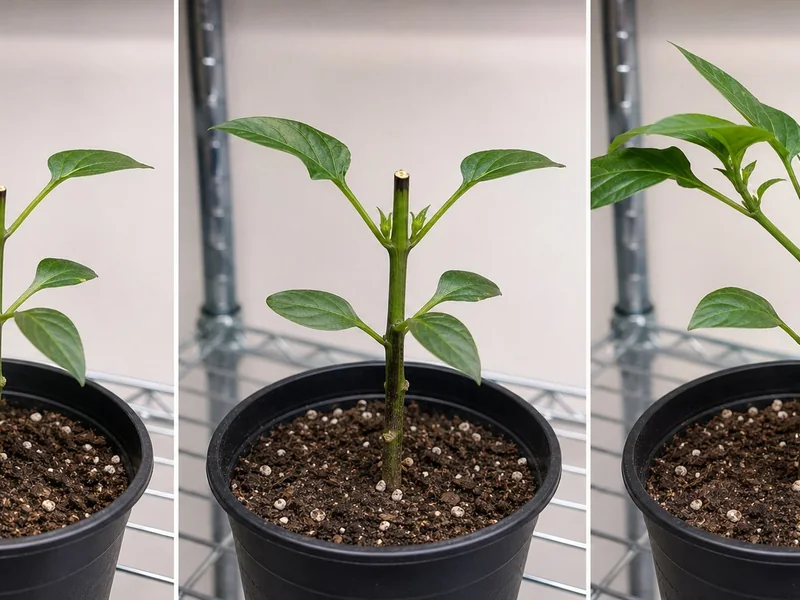
New laterals may not appear on a fixed day.
Warmth, light intensity, root activity, cultivar, and the number of retained leaves all affect the pace.
Normal recovery moves through visible states. First the wound dries, then one or more buds at retained nodes swell, and finally selected laterals extend their own leaves and internodes.
Keep the plant in its established light and watering routine rather than flooding the pot after the cut.
Utah State University warns that excessive nitrogen encourages foliage and delays fruit set, so topping is not a reason for an extra fertilizer dose.
Wait for buds below the cut to move. Do not make a second cut simply because the plant pauses while the wound dries.
Check light distance, daily light duration, crowding, and temperature. More branches do not help when each branch receives inadequate light.
Inspect root moisture, drainage, cold soil, pests, and stem discoloration. A soft or spreading wound is not normal regrowth.
When several laterals start together, keep the healthy shoots that fit the available space and avoid stripping every competing bud at once.
The plant needs leaf area before it needs a perfectly symmetrical outline.
Later support may still be necessary. A compact plant can carry several fruiting branches, and Cornell's warning about branch breakage still applies when fruit weight rises.
Judge the result by the goal that justified the cut.
A lower canopy that fits the light or resists wind can be a success even when fruit count is unchanged, while a bushier plant that ripens fewer peppers before frost is not a yield improvement.
Should You Top Pepper Plants? When It Helps and Hurts FAQ
- University of Maryland Extension: Topping Pepper Plants Early
- University of Minnesota Extension: Topping Peppers in a Short Season
- University of Nebraska-Lincoln Extension: Growing Peppers in Home Gardens
- Illinois Extension: Pruning Tomatoes and Peppers
- University of Maryland Extension: Pruning Tree and Shrub Basics
- Utah State University Extension: How to Grow Peppers in Your Garden
- Cornell CALS: Pepper Secrets