Should You Pinch Off Pepper Plant Flowers, and Which Ones?
Pinch off early pepper flowers only when the plant is still cramped, weak, or newly transplanted and enough warm season remains to replace the delayed fruit. Leave the flowers on a healthy established plant when early harvest matters more than extra vegetative growth.
The useful target is usually a crown flower at the first fork, not the growing tip. Research on bell peppers shows that selective flower removal can change fruit timing, size, or distribution, but it does not guarantee a larger total harvest in every system.
Should you pinch off pepper plant flowers?
Pinch selectively, not automatically. Remove an early flower when a small pepper is cramped in its pot, has not established after transplanting, or is trying to hold a large first fruit before its roots and branches can support it.
Leave the flower when the plant is rooted into its bed or final container, is producing firm new growth, and has a short window left to mature peppers. That first fruit may be more valuable than a possible increase in later branching.
A developing fruit draws sugars, water, and minerals from the same leaf and root system that supports new stems.
Removing one early demand can give an undersized plant time to build more leaf area, but a healthy plant can often grow and fruit at the same time.
The plant is still in a nursery cell, roots circle a small pot, or one large-fruited bell pepper has set on a thin young frame. Repot or transplant as needed, then remove only the early bloom or fruitlet.
The plant is actively growing in its final space, branches stay upright, and the local season is already moving toward its harvest window. Keep the flower and support the plant with steady water and light.
A tiny plant keeps blooming indoors or stalls after transplant. Check root space, light, soil warmth, and recent growth before treating every new flower as the problem.
University of Arkansas Extension says a plant can be stunted if it sets the first bloom under marginal conditions such as low fertility or moisture. Removing that first bloom lets the plant grow larger before fruit set and may raise total yield.
That distinction matters because pinching is a crop-load adjustment, not a guaranteed harvest booster.
The plant's condition and the time left for replacement flowers decide whether the trade is useful.
Does removing early pepper flowers increase yield?
No single study supports the claim that every pepper plant produces more total weight after its first flowers are removed. Trials show different results because researchers used different cultivars, production systems, flower positions, and removal intensities.
A 2010 greenhouse study by Ramon Jaimez and colleagues compared no removal with flower removal through the first, second, or third node on bell peppers under low-temperature conditions. Removing flowers at the first node produced a higher yield and more fruit in the 200 to 300 gram class, while stronger removal delayed peak production and was associated with smaller fruit.
A 2019 Universidad Autonoma Chapingo study tested selective flower pruning on four bell pepper cultivars in a dense hydroponic system with a four-month crop cycle. The treatments changed fruit number and where fruit developed, but yield per plant did not increase.
| Evidence | What was removed | Observed result | Limit for a home grower |
|---|---|---|---|
| University of Arkansas Extension guidance | The first few blooms on a young pepper plant | May let a plant grow larger before fruit set and increase total yield | Practical guidance for marginal growing conditions, not a controlled trial |
| Jaimez et al. 2010 | Flowers through the first, second, or third node | First-node removal improved yield in that trial, while heavier removal delayed peak production and reduced fruit size | Greenhouse bell peppers under low-temperature conditions |
| Moreno-Perez et al. 2019 | Selected flowers at specific branch positions | Fruit number changed, but yield per plant did not rise | Dense hydroponic bell peppers managed for a four-month cycle |
These results describe tradeoffs among early fruit load, later flower retention, fruit size, and harvest timing.
They do not turn one pinched blossom into a predictable number of extra peppers.
Large bell peppers also place a different early load on a plant than small cayenne, Thai, or ornamental fruit. A treatment that improves the distribution of 200 gram bell peppers cannot be transferred unchanged to a compact plant carrying pods that weigh a fraction as much.
The safest home-garden conclusion is narrow. Remove a limited early load when the plant clearly needs establishment time, then stop as soon as it can carry fruit and the season requires fruit set.
Which pepper flowers should you remove?
The most defensible target is the crown flower at the first fork on a small plant. It appears where the main stem divides into its first Y and may become the plant's first fruit.
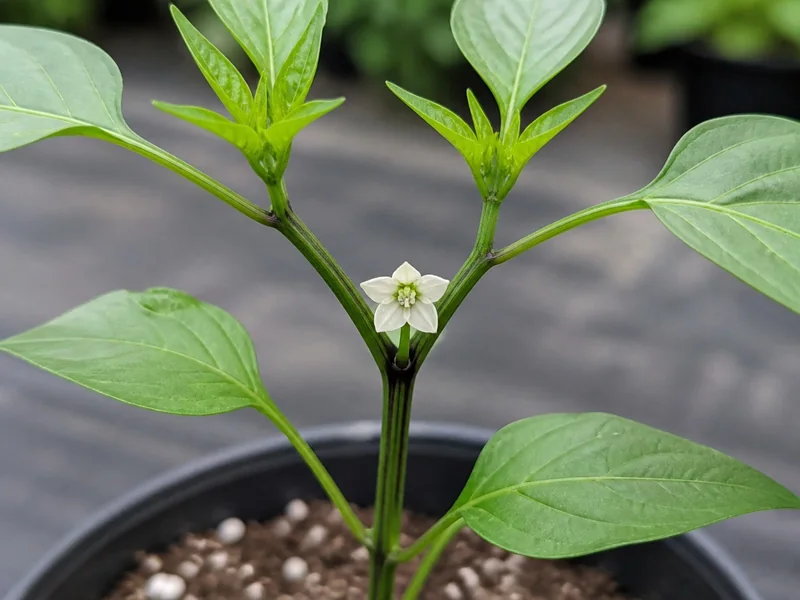
Government of Alberta greenhouse guidance identifies this fork flower as a separate fruit-load decision. Its commercial bell pepper system removes the fork flower, targets the first set above it, and then manages later nodes according to plant balance.
A home garden does not need that full node schedule.
The useful lesson is anatomical, because the crown flower is different from the two growing branch tips beside it.
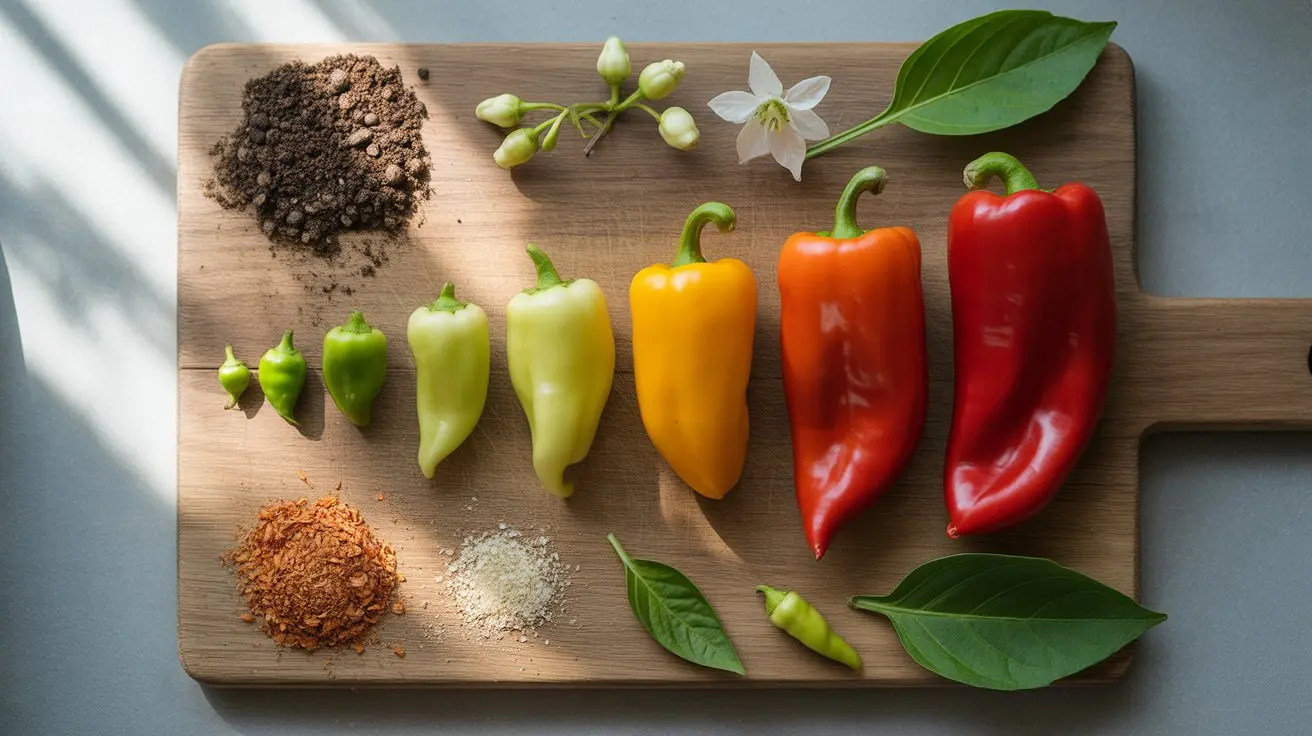
A closed bud has a green calyx around a pale center, an open pepper flower usually shows five white petals, and a pollinated flower leaves a swelling green ovary behind the petals.
Removing a tiny fruitlet creates a larger delay than removing an unopened bud because the plant has already invested more growth in it.
Do not remove the fork itself, the tender leaf cluster at either branch tip, or a pair of healthy leaves. Those tissues build the canopy that will support later flowers.
Flowers farther up an established plant should usually remain unless the branch is overloaded, damaged, or the season is too short for new fruit to finish.
Repeated removal after the plant is ready only moves the first harvest later.
How do you pinch a flower without damaging new growth?
Wait until the flower or bud has a visible short stem that can be held without touching the tender shoot tip.
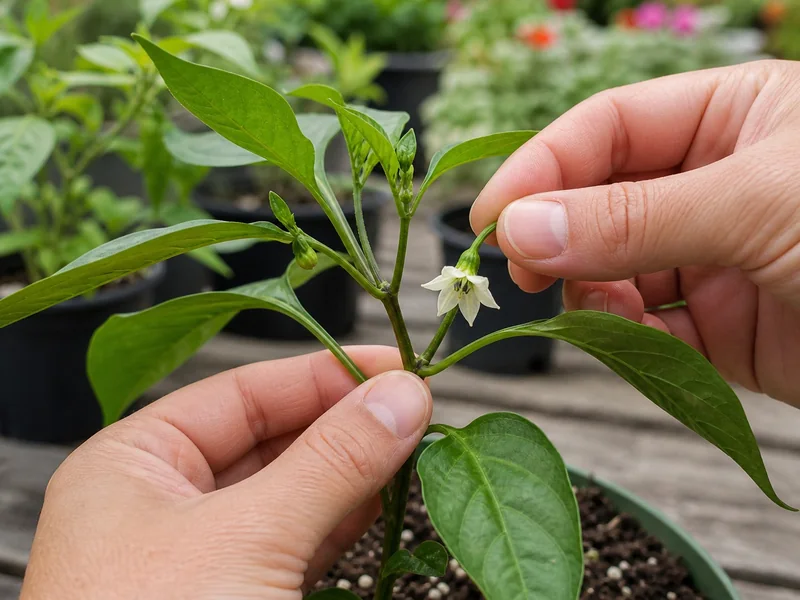
Very small buds tucked against new leaves are easier to damage than to remove, so give them a few days if the decision is not urgent.
- Wash your hands or clean fine snips with the disinfectant named on the tool or product label.
- Support the branch below the flower with one hand so the node does not twist.
- Hold the flower stem between thumb and forefinger, or place snips on that stem only.
- Pinch or cut with one controlled motion and leave the fork, leaves, and branch tips intact.
- Inspect the node for a torn strip of stem, then return the plant to its normal light and watering schedule.
Use fingers for a flower that releases with light pressure. Use pointed snips when the stem is tough, the plant is brittle, or reaching in with fingers would brush several buds.
Topping is a different cut. It removes the shoot tip and often some young leaves, which changes branching as well as flowering.
University of Nebraska-Lincoln Extension warns that topping peppers at transplant removes the first bud area and delays first fruit set and harvest.
Flower pinching should leave both growing tips at the fork in place.
The plant needs no special fertilizer after one flower is removed.
Correct a dry plug, a cold root zone, or transplant stress on its own evidence rather than feeding simply because a bloom was pinched.
When should you stop pinching and let peppers set fruit?
Stop when the plant is established enough to carry fruit or when the remaining warm season becomes the tighter limit.
A fixed height or a fixed number of weeks after transplant cannot represent every cultivar, container, and climate.
Look for several signals together. New leaves should be expanding, the root ball should no longer shift in the soil, midday leaves should recover without chronic wilt, and the main fork should hold itself upright.
- The plant has resumed visible growth after transplanting.
- Roots have enough drained soil volume and are not circling a small nursery pot.
- The first fork and side branches can hold the expected fruit size.
- Night and soil conditions are warm enough for continued pepper growth.
- Enough frost-free time remains for a new flower to become the harvest stage you want.
University of Nebraska-Lincoln recommends hardening pepper transplants for 10 days to two weeks and waiting until soil is above 55°F with low frost risk. Those conditions establish the plant more reliably than an instruction to pinch for exactly two weeks.
Season length can reverse the decision.
A gardener with a long warm autumn can trade an early flower for more establishment, while a gardener near the end of a short summer may need every flower already open.
Use the variety's days-to-maturity statement as a starting point, then add time when the goal is fully colored fruit rather than a mature green pepper. Slow-ripening superhot cultivars need an earlier stop than quick small-fruited types under the same frost date.
Move the plant into adequate soil volume and let it resume growth. Removing flowers without correcting the container leaves the original limit in place.
Check lamp coverage, daily light duration, and crowding. Pinching cannot replace the leaf area needed to support roots and later fruit.
Check cold soil, damaged roots, drainage, and watering before another flower is removed. Wait for new growth to show that the plant has re-established.
UC Agriculture and Natural Resources places early-blossom pinching beside warm-soil transplanting, hardening, and careful root handling. That context is more useful than treating flowers as the cause of every small plant.
If new buds return after one removal, the plant has not been harmed or forced into permanent vegetative growth.
Reassess the plant once, then allow fruit set when the stop signals are present.
Near the first frost, some growers remove new flowers that cannot mature so existing peppers receive the remaining warm days. Work backward from the cultivar's local flowering-to-harvest time instead of applying one calendar date nationwide.
Flowers that fall without being touched belong to a different diagnosis. Heat, cold, moisture, nitrogen, and pollination can interrupt fruit set, so spontaneous blossom drop should not be solved by continuing to pinch healthy flowers.
Should You Pinch Off Pepper Plant Flowers, and Which Ones? FAQ
- University of Arkansas Extension: Peppers
- University of Nebraska-Lincoln Extension: Growing Peppers in Home Gardens
- UC Agriculture and Natural Resources: Growing Peppers
- Government of Alberta: Production of Sweet Bell Peppers
- Jaimez et al. 2010: Flower Removal and Yield in Pepper
- Moreno-Perez et al. 2019: Selective Flower Pruning in Bell Pepper
- Ask Extension: Timing Late-Season Pepper Flower Removal