Seed Shell Stuck on Pepper Seedlings: When to Wait and How to Help
A seed shell stuck on pepper seedlings is usually a moisture and emergence problem, not a reason to panic. Wait if the cotyledons are partly open. If the shell still traps both seed leaves after a day or two, soften it with mist and remove it gently with clean tweezers.
A seed shell stuck on a pepper seedling means the seed coat stayed attached to the cotyledons after emergence. Growers often call it helmet head, and it is common with peppers because the seed coat is firm and seedlings emerge slowly.
Most cases are not emergencies. The decision is whether the shell is only riding on the tips, or trapping both seed leaves so tightly that the growing point cannot open.
Should you remove a stuck seed shell or wait?
Wait if one cotyledon is already free, the shell sits only on the tips, or the seedling is less than 24 hours above the mix. Pepper seedlings often push the shell off as the cotyledons expand.
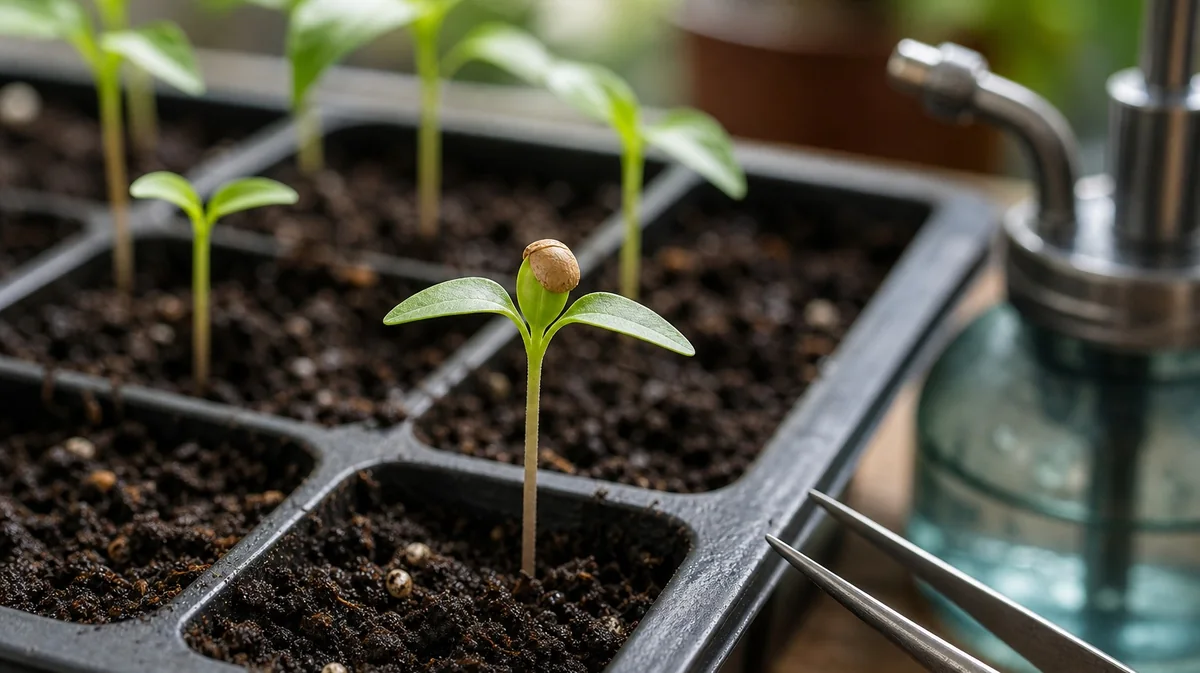
Intervene when both cotyledons stay clamped inside the shell, the stem is stretching without opening, or the shell has dried hard after 24-48 hours. At that point the seedling may stall.
Past day three or four the shell also starts blocking light from the cotyledons, and they begin to yellow. Waiting longer stops being the safe option.
- Wait: shell loose, cotyledons partly visible, seedling still straightening.
- Soften: shell dry, cotyledons trapped, seedling otherwise healthy.
- Discard: stem pinched, seedling blackened, or cotyledons torn off.
Do not yank. The cotyledons are the seedling's first food-producing leaves, and tearing them can set a slow-growing pepper back badly.
Why do seed shells stick to pepper seedlings?
The usual causes are shallow planting, dry air, dry seed-starting mix at emergence, or seed that was old enough to have a tougher coat. Ask Extension notes that shallow planting and dry air can leave seed coats stuck to new leaves or cotyledons.
Peppers also need warm soil.
UMN Extension recommends starting pepper seeds about eight weeks before planting outside and using warm germination conditions, the same starting point a jalapeno needs. A heating mat helps germination, but it can dry cell edges fast.
Our seed tray pattern: stuck shells show up most often on cells along the edge of the heat mat, where the mix dries first. The seed did germinate, but the coat hardened before the cotyledons had enough lift.
This is separate from leggy growth. If the seedling is tall, pale, and leaning, read the leggy pepper seedlings guide after the shell problem is solved.
A 48-hour rescue timeline
Hour zero is when the seedling first breaks the surface in the same tray the plant may later leave for a container. If the stem is still curved like a hook, wait.
The hook shape protects the growing point while the seedling pulls itself upright.
After the stem straightens, look at the cotyledons. If the shell is loose and one seed leaf is showing, keep the air slightly humid and leave it alone.
If both seed leaves are trapped and the shell is drying, begin misting.
At 24 hours, try the first gentle removal only if the shell has softened. At 48 hours, a still-clamped shell is less likely to release cleanly by itself, so a careful tweezer attempt is reasonable.
Moisture balance matters more than more water
Adding water to the whole tray is not the same as softening one stuck shell.
A tray can be too wet at the roots and still have dry air around the cotyledons.
Target the seed coat with a mister or a single drop of clean water. That keeps the shell flexible without turning the seed-starting mix into a soggy mat.
If several seedlings in the same tray have stuck shells, the system needs adjustment. Check sowing depth, heat mat temperature, dome removal timing, and whether the edge cells dried before the center cells.
What the cotyledons are actually doing
The two seed leaves are not decoration. Until true leaves appear, usually 2 to 3 weeks after germination, they are the only thing feeding the plant.
That is why the advice above is so cautious about pulling.
A torn cotyledon does not just look bad. The seedling carries the loss forward as slower growth, and a plant that starts weak tends to set fewer and smaller pods at the other end of the season.
The exception: a seedling that already has true leaves can survive losing a cotyledon.
Before that point it has no reserve to draw on, so five careful minutes now is worth more than five weeks of catching up later.
How to remove a stuck seed shell safely
Start by softening the shell. Mist it with warm water, wait 10-15 minutes, then mist again.
Some growers place a clear humidity dome over the tray for a short period, but remove it once the shell softens so the tray does not stay wet all day.
Use clean tweezers only after softening. Hold the stem steady below the cotyledons, grip the shell edge, and ease it apart.
If it resists, stop and re-mist instead of pulling harder.
- Wash hands and clean tweezers with alcohol.
- Mist the seed shell, not the whole tray.
- Wait until the shell darkens and softens.
- Hold the stem lightly below the cotyledons.
- Lift the shell from the side, not straight upward.
- Stop if the cotyledons stretch or tear.
One torn cotyledon is not always fatal. Two torn cotyledons plus a damaged growing point usually means starting another seed is faster.
Aftercare for the rescued seedling
After the shell comes off, give the seedling bright overhead light and gentle air movement. Do not fertilize immediately.
Let the cotyledons open and wait for the first true leaves.
Keep the mix lightly moist for the next day, then return to normal pepper seedling watering. Constantly wet mix is not a recovery plan because peppers still need oxygen around their roots.
- Keep lights close enough to prevent stretching.
- Remove humidity domes after most seeds emerge, then manage airflow before hardening off pepper plants.
- Thin weak duplicates once true leaves show.
- Do not transplant until the seedling is stable.
If the seedling stalls for a week with no true leaves, replace it. Pepper season is long, whether the final plant is a bell pepper growing or a hot chile, but a badly damaged seedling can lose more time than a fresh sowing.
How to prevent helmet-head seedlings next time
Plant pepper seeds about 1/4 inch deep in a sterile seed-starting mix. That depth gives the seedling enough media friction to shed the coat while still allowing emergence.
Keep the mix evenly moist until emergence. Bottom watering helps because it moistens the cell without crusting the surface.
Two things before the seed goes in do more than anything you can do afterwards.
- Soak first: 12 to 24 hours in warm water softens the coat before it ever has a chance to dry onto the cotyledons.
- Germinate warm: pepper seed does best at 80 to 85F, and a heat mat under the tray holds that far more steadily than a warm room does.
- Cover cheaply: a plastic dome for a standard tray costs a few dollars, and plastic wrap, a clear bag or a repurposed container do the same job until emergence.
| Cause | Prevention | Watch-out |
|---|---|---|
| Dry air | Short dome use before emergence | Vent after sprouts appear |
| Shallow sowing | Plant near 1/4 inch deep | Do not bury tiny weak seedlings later |
| Old seed | Pre-soak briefly or sow extras | Expect slower emergence |
| Heat mat drying | Check edge cells daily | Do not let mix crust |
Good prevention overlaps with growing peppers from seed. Sterile mix, warm soil, steady moisture, and strong light after emergence, then later transplant pepper seedlings only after roots hold the cell.
What not to do
Do not pinch the stem, scrape the cotyledons, or cut the shell with a knife. The seedling is too small for rough surgery.
Do not leave the whole tray under a sealed dome for days after most seedlings emerge. That can invite damping off and weak stems, especially if the light is not strong.
Discard diseased seedlings: if the stem is narrow, brown, and collapsing at the soil line, that is not a stuck-shell problem. Remove it and improve airflow.
For healthy peppers, a careful mist-and-tweezer rescue usually works.
The key is patience. Soften first, test gently, and stop before the cotyledons tear.
Which seedlings are worth saving?
Save the seedling when the stem is green, the growing point is intact, and at least one cotyledon can open. That plant may lag for a week, but it still has a path to recovery.
Skip the rescue when the stem is crushed, the seedling has collapsed at the soil line, or the cotyledons are torn away inside the shell. In those cases, a fresh sowing usually catches up faster than a damaged plant.
When starting over is better
Restart the cell if the seedling has no usable cotyledons, the growing point is gone, or the stem is pinched below the seed shell. A weak pepper can survive for a while and still lose three weeks before it proves it cannot grow.
Sow a backup seed whenever you rescue a questionable seedling. That gives you a replacement without forcing a rushed decision the same day.
Seed Shell Stuck on Pepper Seedlings: When to Wait and How to Help FAQ
- University of Minnesota Extension - Growing peppers in home gardens
- Ask Extension - Seed coat retention on cotyledons
- University of Illinois Extension - Seed structure
- University of Missouri Extension - Plants and their environment