Common Pepper Plant Problems: Diagnose the Symptom First
Inspect the pattern before treating. Check how many plants are affected, moisture at root depth, leaf undersides, stems and fruit, and recent weather or spraying. Make one supported correction, then judge new growth or continued spread.
Most pepper plant problems become easier to diagnose when you check where the symptom starts, whether it is spreading, and what changed just before it appeared.
Do not water, fertilize, or spray from the symptom name alone.
A wilted canopy can come from dry soil or damaged roots, while curled leaves can reflect heat, insects, chemical exposure, or infection.
This guide helps you sort those lookalikes, make the lowest-risk first correction, and recognize the signs that call for isolation or local plant diagnosis.
Inspect five clues before you reach for a treatment
Start by describing what you see without naming a cause.
Record the affected plant part, the side of the leaf or fruit, the age of the growth, and whether the boundary changed since yesterday.
Use evidence before products. A clear description such as "three lower leaves have angular brown spots after two wet days" is more useful than "the plant looks sick."
- Scan the planting. Decide whether one plant, a cluster, a full row, or every container is affected.
- Feel below the surface. Check moisture in the active root zone instead of judging only the dry or wet top layer.
- Turn leaves over. Look for insects, cast skins, eggs, sticky honeydew, webbing, stippling, and raised spots.
- Inspect the stem and fruit. Note damage at the soil line, on exposed fruit sides, or at the blossom end.
- Reconstruct recent events. Include heat, cold nights, strong wind, heavy rain, transplanting, fertilizer, and nearby spraying.
The pattern across the planting is often the fastest filter.
A matching symptom on every plant after the same cold night or irrigation event points toward a shared condition, while a problem that begins on one plant and expands can justify closer pest or disease inspection.
Penn State Extension uses spatial patterns in crop diagnosis because spray overlap, drainage, fertility, and weather can leave recognizable boundaries.
The boundary is evidence, so photograph it before disturbing roots or removing leaves.
Why is my pepper plant wilting?
Wilting means the leaves are losing water faster than the roots can replace it. It does not prove that the soil needs more water.
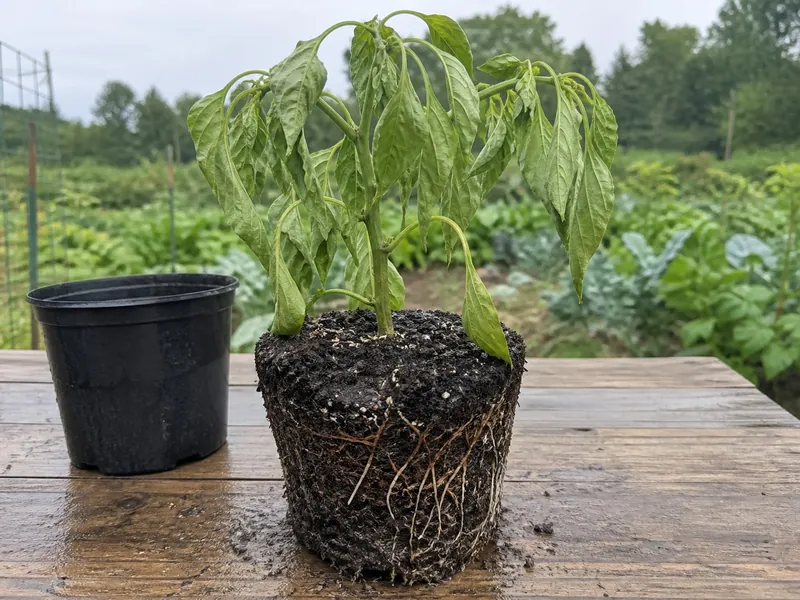
The mix feels dry at root depth, the container feels light, and several leaves lose firmness together. Water deeply, then confirm that drainage begins and the canopy recovers.
The soil stays saturated, the pot remains heavy, or the bed drains slowly. Stop adding water and inspect drainage because oxygen-starved or decaying roots cannot supply a wet plant.
The plant droops during peak heat while the root zone remains evenly moist, then regains firmness as conditions cool. Improve temporary shade and wind protection without flooding the roots.
Lift a container or dig a narrow inspection hole beside the root ball rather than directly through it.
Healthy pepper roots are firm and pale, while dark, soft tissue and a brown or water-soaked crown raise concern for root or crown rot.
UC Integrated Pest Management describes Phytophthora root and crown rot as rapid wilting associated with very dark, water-soaked root tissue, especially after warm, wet conditions in slow-draining soil.
A suddenly collapsing plant with a dark lesion at the soil line needs separation from routine thirst.
If the soil state and time-of-day pattern still do not settle the cause, use the dedicated wilting diagnosis before making another correction. Repeated watering can turn a recoverable moisture problem into root damage.
Why has my pepper plant stopped growing?
A pepper that is alive but producing no clean new leaves may be limited by cold roots, weak light, a cramped root ball, inconsistent moisture, or damaged roots.
Fertilizer helps only after the roots can use it.
- Compare plants in the same conditions. One stalled plant suggests a local root, irrigation, or stem problem, while a stalled row suggests a shared input.
- Check temperature and light. Peppers grow slowly in cool conditions, and a shaded plant may stretch without building a stronger canopy.
- Check root space and drainage. Circling roots or a small pot can make moisture swing rapidly between saturated and dry.
- Review what was applied. Extra nitrogen can produce dark leafy growth while delaying flowers and fruit.
University of Maryland Extension notes that cool conditions and stressed, overgrown transplants can slow early growth.
Utah State University Extension also warns that overfertilization promotes foliage and delays fruit set and maturity.
Correct the clearest limiting condition first, then judge the next growing tip. The detailed stalled-growth guide covers recovery when the plant remains unchanged after the root zone, warmth, and light have been checked.
Why are my pepper leaves yellow or curling?
Yellow does not automatically mean nitrogen deficiency, and curl does not identify one cause.
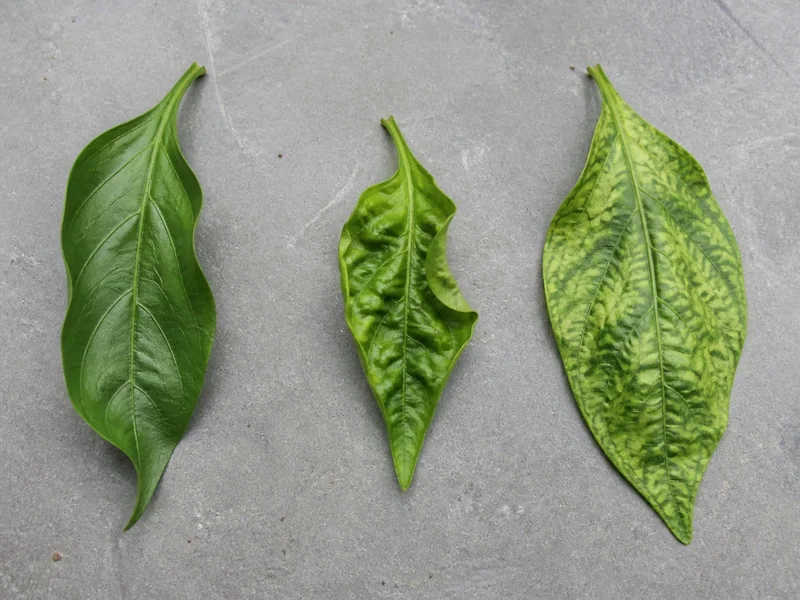
The useful clue is the combination of color, shape, texture, growth age, and distribution.
| Combined signs | First evidence to check | What the pattern may indicate |
|---|---|---|
| Lower leaves yellow while the root zone stays wet | Drainage, root smell, and recent watering | Root stress can reduce nutrient uptake even when fertilizer is present. |
| Downward roll across many otherwise green plants | Recent cool or wet conditions and whether growth is stunted | UC IPM describes physiological leaf roll without yellow new growth or stunting as noninfectious. |
| Tight distorted tips with insects or sticky residue below | Leaf undersides and growing points | Sap-feeding insects can deform tender growth before the leaf expands. |
| Mottling, blistering, rings, bronzing, or narrow malformed growth | Whether symptoms continue into new growth and appear on nearby plants | A virus becomes more plausible, though visual signs alone do not identify which virus. |
| Twisted or straplike new growth along a garden edge | Recent lawn, roadside, or neighboring herbicide use | Off-target chemical exposure can create a boundary and distort the newest tissue. |
UC IPM reports that ordinary physiological roll on peppers can affect plants without yellowing new leaves or stunting.
That stable pattern is different from malformed new growth that continues to emerge mottled, bronzed, narrowed, or blistered.
Oregon State University Extension lists mottling, blistering, malformed growth, bronzing, and ring patterns among important virus clues in peppers.
Viruses and herbicide injury can still overlap visually, so use the planting pattern and exposure history before deciding what the leaves mean.
For an isolated curl with no systemic color pattern, inspect water, heat, wind, and the leaf underside first. The leaf-curling guide follows those branches in greater detail.
What is feeding on my pepper plant?
Pest diagnosis begins with the trace left behind, then moves to the animal that made it. Spraying an empty hole does not confirm what fed there or whether it is still present.
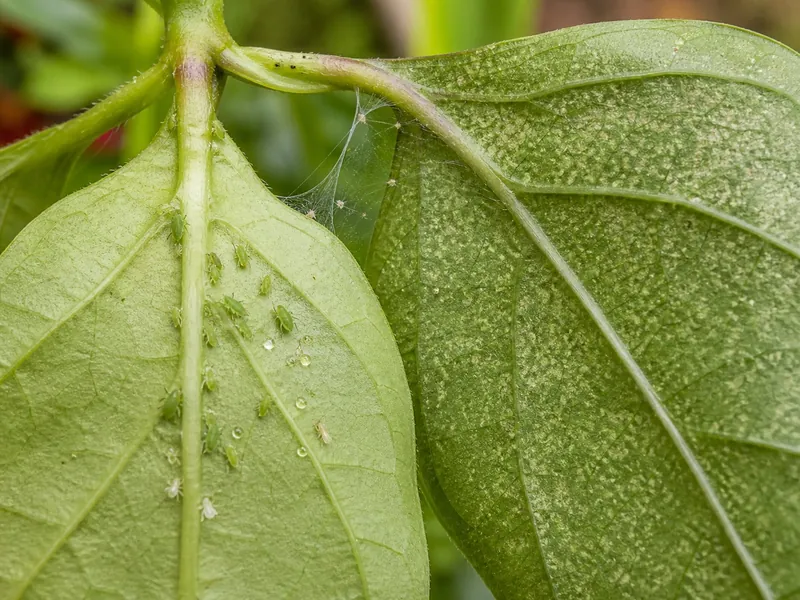
Check for tiny jumping beetles and inspect whether new holes continue to appear. Flea beetles often leave many small holes while the fruit remains sound.
Use a hand lens on leaf undersides. Mites remove cell contents and can create a dusty pale surface before webbing becomes obvious.
Look for aphid clusters, pale cast skins, and ants moving through the canopy. Honeydew is a feeding trace rather than a plant secretion.
Search stems, leaf edges, and nearby soil for caterpillars. Dark frass below fresh chewing damage shows that the feeder may still be active.
Utah State ties curled leaves and sticky honeydew to aphids, tiny holes to flea beetles, and defoliation with dark fecal material to caterpillars.
Oregon State recommends looking under leaves and along stems before using water or insecticidal soap against confirmed aphids.
Begin with physical removal when it fits the confirmed pest, such as a firm water spray for aphid clusters or hand removal for a visible caterpillar. Use the full pest and disease guide when damage continues or the organism needs a different control.
What causes spreading spots on pepper leaves?
A stable tan scar after wind or sun is different from small lesions that enlarge, merge, and appear on additional leaves.
Circle one lesion lightly on a photograph and compare the same tissue later instead of relying on memory.
University of Maryland Extension describes bacterial leaf spot as small water-soaked areas that develop gray or tan centers with darker borders.
Warm, humid weather can enlarge the lesions, and splashing rain or handling wet infected plants can move bacteria.
Do not work through wet foliage when spots are spreading. Water at soil level, keep hands and tools from moving directly between suspect and healthy plants, and remove badly affected debris from the garden rather than using it as compost.
UC IPM adds that bacterial spots can begin as small angular marks on the lower leaf surface and can produce raised lesions on stems and fruit.
These signs narrow the category, but they do not make a laboratory diagnosis from a photograph.
Seek help from a local extension office or plant diagnostic clinic when lesions progress despite dry foliage, reach the stem, or affect several plants. Local disease prevalence and sample examination matter before a pesticide decision.
Why are my pepper flowers falling off?
A pepper can flower normally and still lose blossoms when the conditions around pollination and early fruit growth move outside a workable range. Recent weather is the first record to inspect.
Temperature explains a sudden flush of dropped flowers after a cold or hot spell better than an instant nutrient deficiency. Protect from the short extreme when practical, then allow the next flowering cycle to show whether conditions improved.
Dry soil, low humidity, warm windy days, and irregular moisture can add stress during the same window.
Oregon State advises consistent moisture, while Utah State links irregular watering with flower drop and blossom-end rot.
A dark green plant that keeps expanding leaves but sets few pods may have received too much nitrogen. Pause unnecessary feeding and inspect the label rate rather than adding a bloom product on top of the same imbalance.
Use the dedicated no-flower, flower-drop, or no-fruit page when the corresponding stage continues to fail under moderate temperatures. Those pages own the deeper treatment branches.
What do marks on pepper fruit mean?
Fruit symptoms become more useful when you name the exact surface.
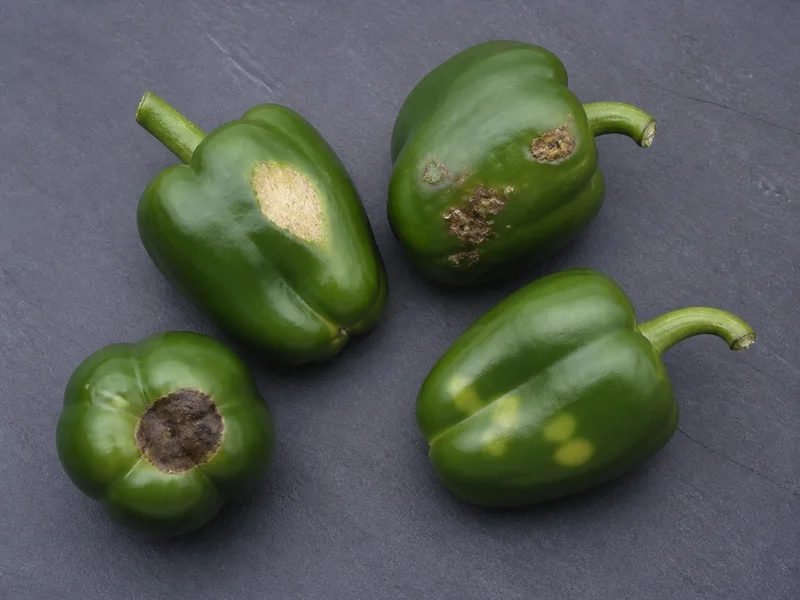
Check whether the mark sits at the blossom end, on the sun-facing shoulder, as a raised rough spot, or as a pale cloudy patch.
| Fruit mark | Strongest visual clue | First response |
|---|---|---|
| Dark sunken area at the blossom end | The lesion begins opposite the stem and becomes dry or leathery | Stabilize root-zone moisture and avoid excess nitrogen. Existing damage will not heal. |
| White or light-brown patch on an exposed side | The mark faces strong sun where foliage gives little shade | Protect exposed fruit and preserve canopy cover. The sunscald guide covers prevention. |
| Small raised rough or cracked spots | Wartlike texture may accompany leaf or stem lesions | Keep foliage dry, limit handling, and seek disease identification if the pattern spreads. |
| Pale yellow cloudy areas | Discoloration follows feeding beneath the skin rather than the blossom end | Inspect fruit and nearby foliage for stinkbugs before choosing a control. |
Oregon State links blossom-end rot mainly to water imbalance that disrupts calcium movement and says special fertilizers or sprays rarely solve it alone.
The same source identifies exposed light patches as sunscald and pale cloudy fruit areas as stinkbug injury.
University of Maryland and UC IPM describe bacterial fruit spots as raised and rough rather than sunken at the blossom end. Location plus texture is more reliable than color alone.
Weather and chemical injury leave a pattern across the planting
Abiotic injury often has an event boundary. Several plants may bend toward the windy side, bleach on the newly exposed surface, stop after a cold transplanting period, or develop distorted tips along the edge nearest a spray source.
Penn State notes that herbicide overlap or tank contamination can create damage in a band or along the width of a spray pass.
Growth-regulator herbicides can leave broadleaf plants with puckered, straplike, twisted, or brittle new growth.
Do not diagnose drift from leaf shape alone. Write down the onset date, wind direction, nearby applications, and which plants share the boundary, then contact the appropriate local extension or regulatory service if off-target exposure is plausible.
Heat, wind, and transplant stress usually align with a known event and stop producing new damage once the event passes. An infectious problem is more concerning when new lesions or distorted growth continue to appear under stable conditions.
When should you remove a sick pepper plant?
A single uncertain symptom usually supports observation, but a likely transmissible problem changes the risk to nearby plants.
Oregon State says pepper plants showing likely virus disease have no curative treatment and should be bagged and placed in the trash rather than composted.
Isolate or remove promptly when systemic mosaic or ring patterns continue into new growth, a plant collapses rapidly with a dark crown, or the same progressive lesions begin appearing on neighbors. Clean tools and hands before returning to healthy plants.
For a stable problem that has a plausible environmental cause, make one low-risk correction and preserve a baseline.
Several simultaneous changes may improve the plant, but they also prevent you from learning which condition was responsible.
- Photograph the whole plant and a close view from the same angle.
- Mark the edge of a spot or identify the newest affected leaf.
- Correct one supported condition, such as drainage, dry soil, or temporary heat exposure.
- Judge clean new growth, renewed fruit set, or continued spread rather than expecting damaged tissue to turn healthy again.
- Escalate to a diagnostic service when the boundary expands, the crown darkens, or several plants develop the same progressive signs.
The goal is not to rescue every old leaf.
It is to protect the root system and neighboring plants while the next growth reveals whether your diagnosis was sound.
Common Pepper Plant Problems: Diagnose the Symptom First FAQ
- Grow Your Own Peppers
- Growing Peppers in a Home Garden
- Peppers in the Garden
- Bacterial Leaf Spot on Peppers
- Bacterial Spot in Peppers
- Phytophthora Root and Crown Rot on Peppers and Eggplant
- Physiological Leaf Roll in Vegetables
- Solving the Case of Crop Disorders: The Role of Patterns in Diagnosis
- Introduction to Weeds and Herbicides