Korean Green Pepper vs Shishito Pepper: Compared
Both the Korean green pepper and the shishito register at 0 SHU on standardized tests, yet anyone who has eaten them knows heat is only part of the story. These two thin-walled, mild peppers share a snackable character but differ meaningfully in flavor, texture, and how they behave in the kitchen. Understanding those differences helps you pick the right one — or substitute confidently when the other is unavailable.

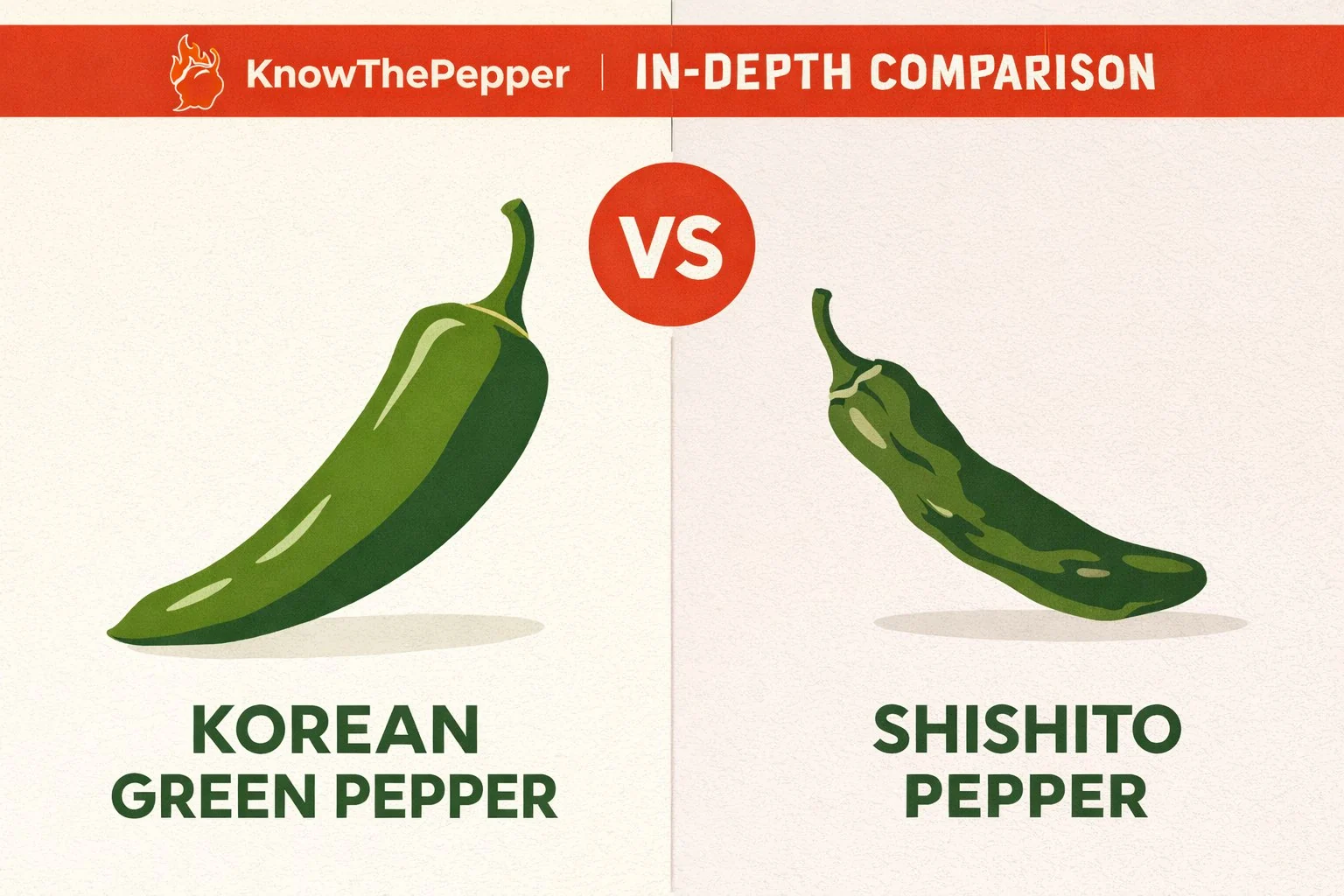
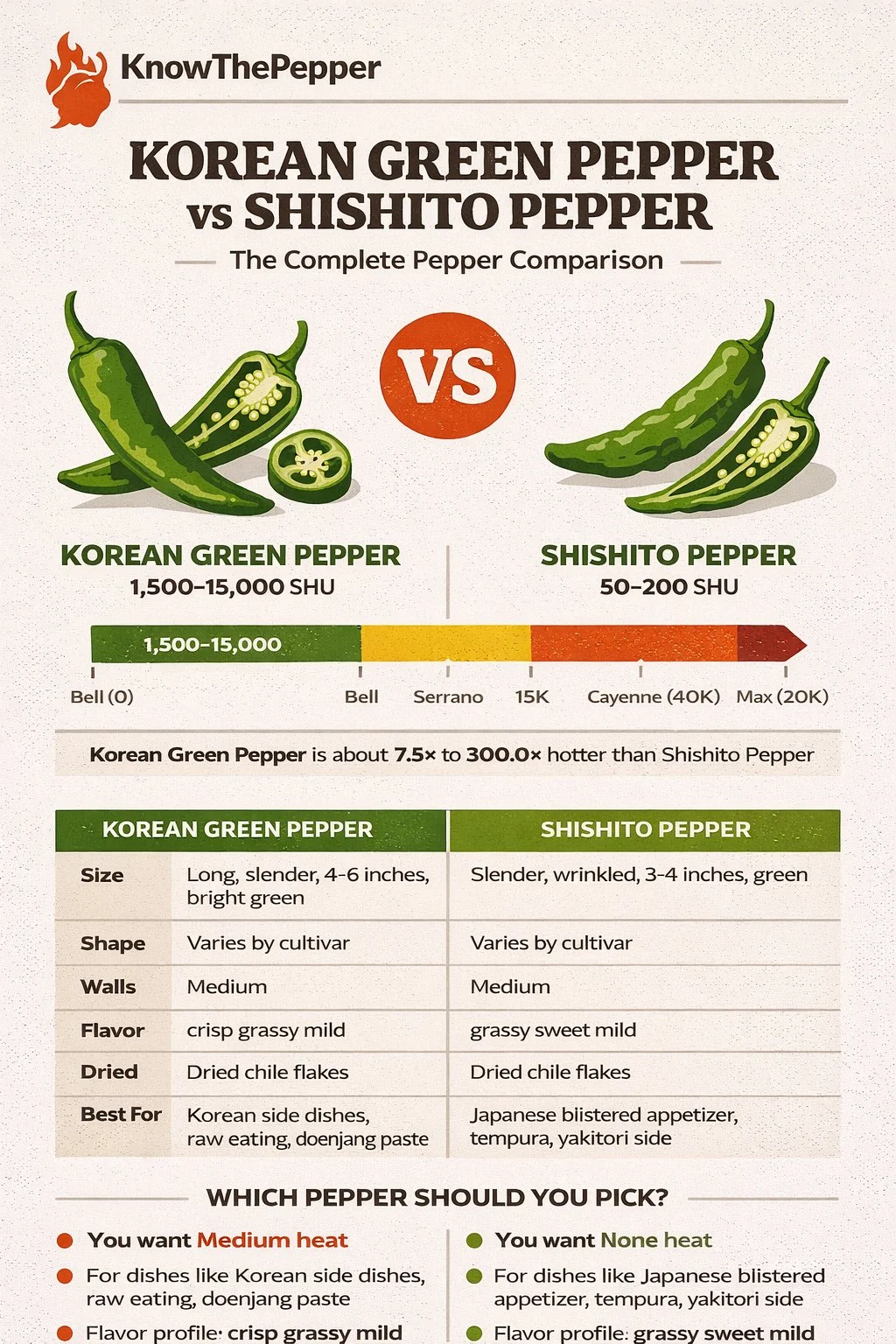
Korean Green Pepper measures 2K–10K SHU while Shishito Pepper registers 50–200 SHU — making Korean Green Pepper 50× hotter. Korean Green Pepper is known for its mild and grassy flavor (C. annuum), while Shishito Pepper offers sweet and grassy notes (C. annuum).
- Heat difference: Korean Green Pepper is 50× hotter
- Species: Both are C. annuum
- Best for: Korean Green Pepper excels in everyday cooking and salsas, Shishito Pepper in fresh salsas and mild recipes
Korean Green Pepper
HotShishito Pepper
MildKorean Green Pepper vs Shishito Pepper Comparison
Korean Green Pepper vs Shishito Pepper Heat Levels
On paper, both peppers measure 0 SHU, placing them firmly in the no-heat pepper classification alongside bells and banana peppers. That number is technically accurate for average specimens, but it undersells what actually happens when you eat them.
The Korean green pepper (called cheong-gochu in Korean) is reliably mild across nearly every fruit on the plant. There is essentially no capsaicin variation from pepper to pepper — you can eat a dozen and never feel a tingle. Compared to a [jalapeño's 2,500-8,000 SHU range](/peppers/jalapeño/), the Korean green pepper is as close to zero as a pepper gets.
The shishito is famously unpredictable. The widely cited figure is that roughly 1 in 10 shishitos carries a noticeable kick — not painful, but enough to register. That surprise element is part of the pepper's cultural appeal in Japan, where eating them is almost a game. The rogue fruits still fall nowhere near jalapeño territory; they might hit 200-500 SHU at most. But the variance is real, and it changes the eating experience.
For practical purposes, both belong in the same zero-heat pepper tier. Neither will challenge heat-averse eaters. The shishito's occasional warmth is more of a personality quirk than a heat warning — check the full Scoville heat index ranking if you want to see where both land relative to the broader pepper world.
Flavor Profile Comparison
Pull one of these off the plant and you might think you're holding a long, tapered banana pepper — but bite in and the difference is immediate.
Shishitos belong to Capsicum annuum, the same broad botanical family that includes bell peppers, jalapeños, and most of the peppers you'll find at any grocery store.
This is where the two peppers genuinely diverge. Korean green peppers have a clean, grassy flavor with a faint sweetness and a slight vegetal bitterness that reads as fresh rather than sharp. The flesh is moderately thick for their size, with a satisfying crunch when raw. That crisp texture makes them popular as a raw snack alongside doenjang (fermented soybean paste) or sliced into banchan. The flavor is straightforward — not complex, but honest and bright.
Shishitos are thinner-walled and more delicate, with a flavor that leans smoky and grassy when blistered. Raw, they taste mildly vegetal with a hint of pepper sweetness. But blistered in a hot cast iron or wok, they develop a charred, slightly smoky depth that Korean green peppers don't replicate as easily. The thin skin blisters and chars faster, which is central to their most popular preparation.
Aroma also differs. Korean green peppers smell fresh and green — almost like a mild bell pepper with more personality. Shishitos have a more herbal, slightly floral aroma that intensifies when heat hits them.
For raw applications — salads, crudités, stuffed preparations — the Korean green pepper's firmer texture and clean bite win out. For high-heat cooking where you want that blistered, slightly charred quality, shishitos are the better tool. The comparison to padron peppers and their blister-friendly thin walls is worth noting — shishitos and padrons share that quick-char quality that Korean green peppers lack.
Culinary Uses for Korean Green Pepper and Shishito Pepper
Korean green peppers are workhorses in Korean home cooking. They show up raw alongside fermented pastes, sliced into doenjang jjigae (soybean paste stew), stuffed with seasoned meat and steamed, or pickled in soy sauce and sesame oil. Their firm walls hold up to braising and stewing without turning to mush — a quality shishitos cannot match. For gochu-jeon (pepper pancakes stuffed with ground pork), the Korean green pepper is the traditional choice because the flesh stays intact during pan-frying.
Shishitos shine in high-heat, minimal-preparation contexts. Blister them in a screaming-hot skillet with neutral oil, finish with flaky salt and a squeeze of lemon — that is the canonical preparation, and it works because the thin walls collapse slightly and char beautifully in under five minutes. They also work well skewered for grilling, added whole to stir-fries, or used as a garnish. Japanese izakaya menus often feature them as a standalone appetizer for exactly this reason.
Substitution notes: When a recipe calls for shishitos and you only have Korean green peppers, the swap works with adjustment. Use Korean green peppers cut into smaller pieces to speed up blistering, and expect a slightly crunchier result. Going the other direction — shishitos for Korean green peppers — works in quick stir-fries but fails in stuffed or braised preparations where structural integrity matters.
For anyone exploring shishito swap options, padrons are the closest match due to similar size and skin thickness. The head-to-head between padrons and shishitos covers that substitution in more depth.
Both peppers take well to pickling. Korean green peppers pickled in soy, vinegar, and sesame oil (gochu-jangajji) are a staple side dish. Shishitos pickled quickly in rice vinegar make a bright accompaniment to grilled fish or rice bowls.
Which Should You Choose?
Choose Korean green peppers when texture and structural integrity matter — stuffed preparations, braises, stews, raw snacking with dips, or any dish where the pepper needs to hold its shape through cooking. The flavor is clean and reliable, with zero heat variation.
Choose shishitos when the goal is quick blistering, minimal preparation, and that lightly charred appetizer quality. The thin walls and slight flavor complexity make them ideal for high-heat pan cooking and grilling. The occasional warm fruit adds a playful unpredictability that makes eating them more interesting.
For heat-sensitive cooks, both are safe choices — neither will surprise anyone with serious spice. The shishito's 1-in-10 warm pepper is a conversation starter, not a warning. If your kitchen leans Korean, stock the green peppers. If you entertain frequently and want an easy crowd-pleasing appetizer, shishitos earn their place. Both deserve more attention than they typically get outside their home cuisines.
Can You Substitute One for the Other?
Yes — direct substitution works. Korean Green Pepper and Shishito Pepper are close enough in heat to swap at roughly 1:1. The main difference will be flavor. For more swap options, explore ranked alternatives with conversion ratios.
Growing Korean Green Pepper vs Shishito Pepper
If you’re deciding which pepper to grow at home, consider your climate and patience level. Korean Green Pepper and Shishito Pepper have different maturation times and temperature preferences. Hotter varieties generally need a longer, warmer growing season to develop their full capsaicin content. Our zone-based planting date tool can pinpoint the best sowing window for your area.
Korean green peppers are productive plants that do well in USDA zones 5–11 as annuals. Start seeds indoors 8–10 weeks before your last frost date.
Transplant outdoors after nighttime temperatures stay consistently above 55°F. Space plants 18–24 inches apart; they tend to branch heavily and need room to spread.
One thing worth knowing: Korean green peppers are susceptible to flower drop during heat spikes or inconsistent watering. The practical guidance on pepper flower drop is worth reading before your first bloom cycle if you're growing these for the first time.
Shishitos are productive, relatively compact plants that suit both garden beds and large containers. They thrive in the same conditions as most [*C.
Start seeds indoors 8–10 weeks before your last frost date. Germination is reliable at 75–85°F; a heat mat helps considerably.
The plants are vigorous and branch well without much intervention. Fruit sets prolifically once daytime temperatures settle between 70–85°F.
History & Origin of Korean Green Pepper and Shishito Pepper
Both peppers carry centuries of culinary heritage. Korean Green Pepper traces its roots to Korea, while Shishito Pepper originates from Japan. Understanding their backstory helps explain why each pepper developed its distinctive traits.
Buying & Storage
Whether you’re shopping for Korean Green Pepper or Shishito Pepper, the same quality indicators apply. Fresh peppers should feel firm and heavy for their size, with taut, glossy skin and no soft or wet spots. Minor stem cracks known as “corking” are perfectly normal and often indicate a mature, flavorful pod.
- Firm pods with taut skin and consistent color
- Should feel heavy relative to size
- Minor stem cracks (“corking”) are normal
- Avoid anything soft, shriveled, or with dark wet spots
- Fresh: Paper bag, crisper drawer — 1–2 weeks
- Frozen: Wash, dry, freeze on sheet pan — 6+ months
- Dried: Airtight, away from light — up to 1 year
The Verdict: Korean Green Pepper vs Shishito Pepper
Korean Green Pepper and Shishito Pepper occupy very different positions on the heat spectrum. Korean Green Pepper delivers 50× more heat with its distinctive mild and grassy character. Shishito Pepper, with its sweet and grassy profile, excels in everyday cooking.
Frequently Asked Questions
Related Comparisons
Sources pending verification.