Corno di Toro vs Jimmy Nardello: Key Differences Explained
Both the Corno di Toro and Jimmy Nardello are sweet Italian frying peppers with 0 SHU heat, but they differ meaningfully in shape, texture, skin thickness, and how they behave in the pan. One is a bull's horn built for roasting; the other is a thin-walled frying pepper that practically melts into silk. Choosing between them comes down to cooking method and the texture you are after.

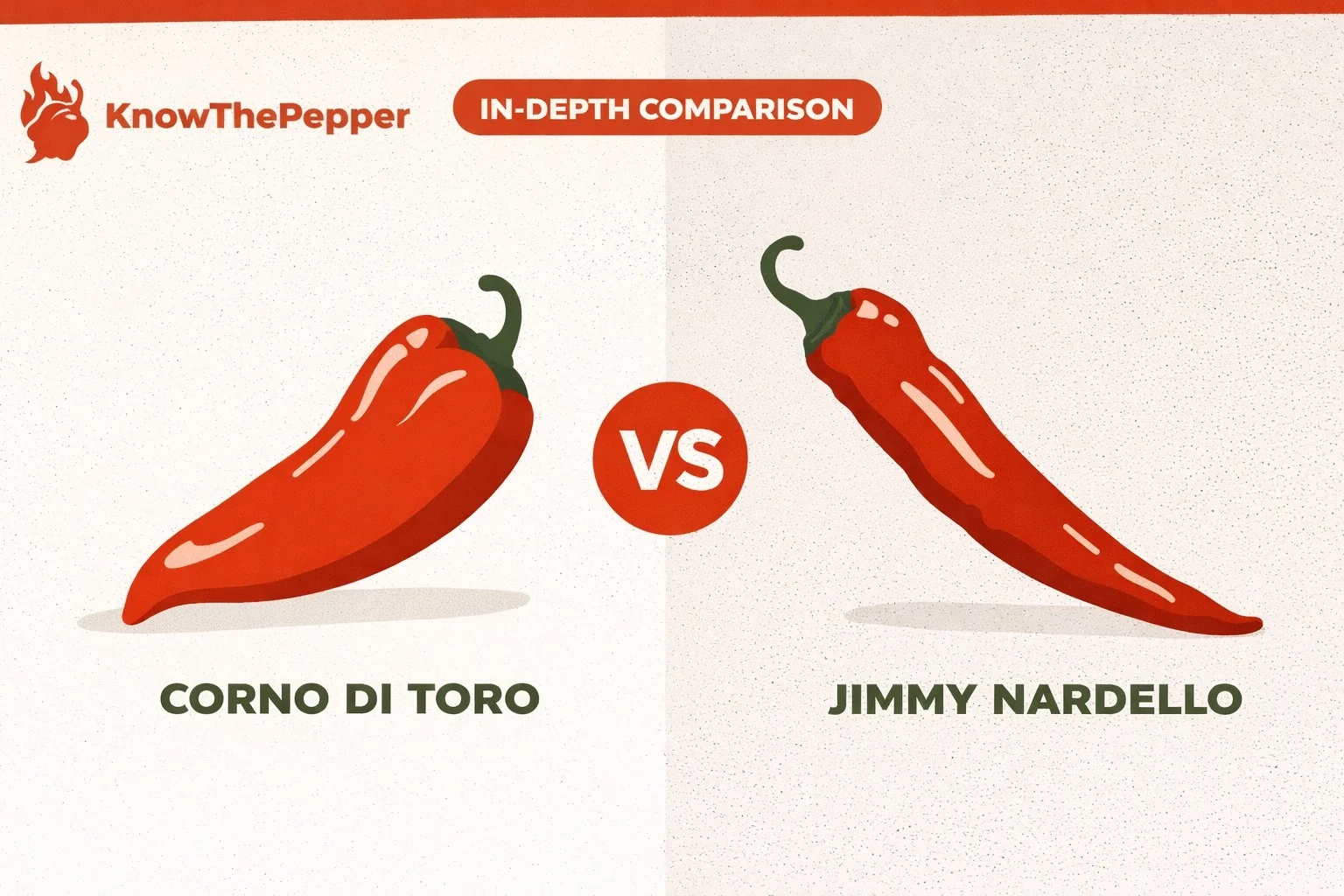
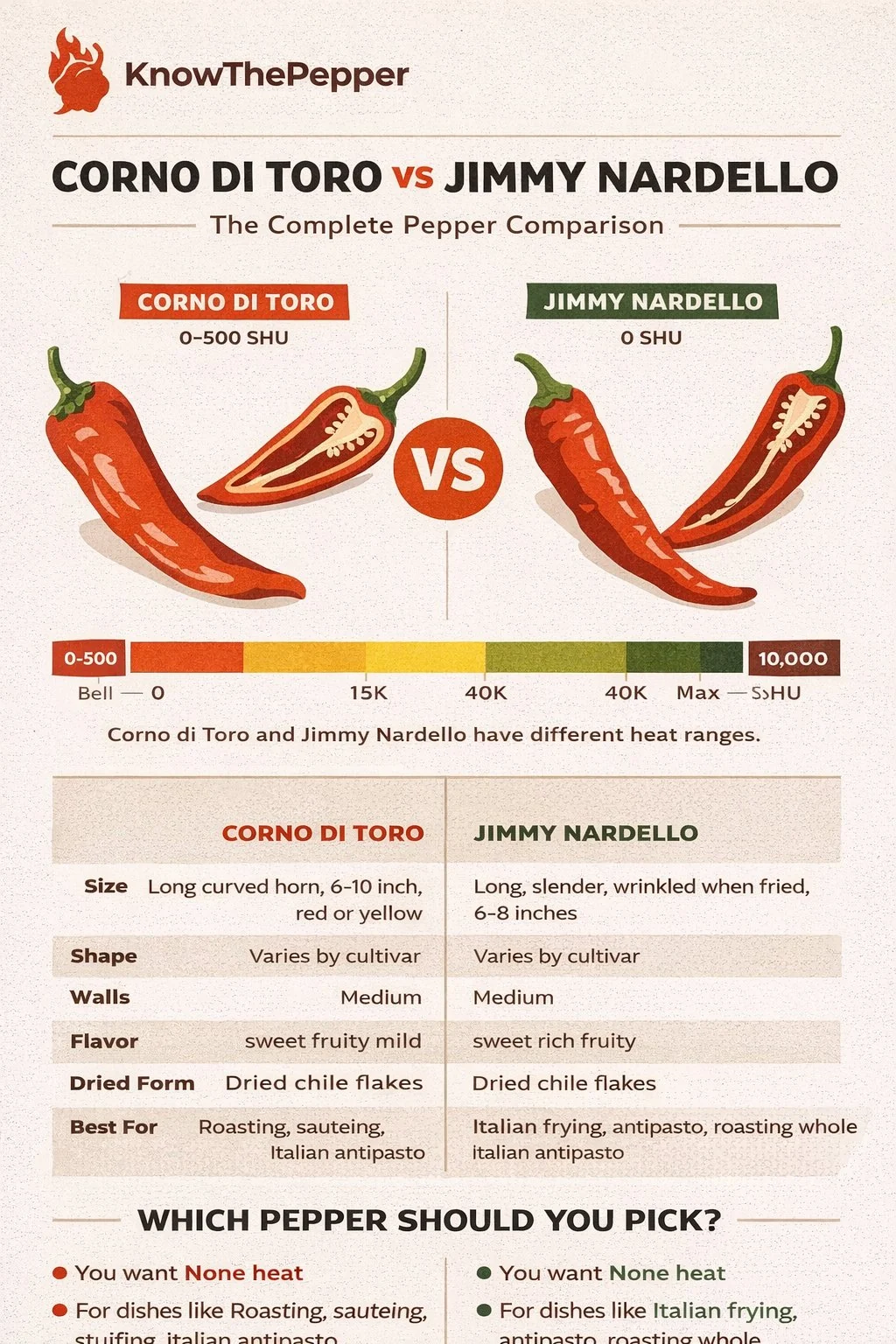
Corno di Toro measures 0–500 SHU while Jimmy Nardello registers 0–500 SHU — roughly equal in heat. Corno di Toro is known for its sweet and mild flavor (C. annuum), while Jimmy Nardello offers sweet and fruity notes (C. annuum).
- Species: Both are C. annuum
- Best for: Corno di Toro excels in everyday cooking and salsas, Jimmy Nardello in fresh salsas and mild recipes
Corno di Toro vs Jimmy Nardello Comparison
Corno di Toro vs Jimmy Nardello Heat Levels
Strip away the romance and the numbers are simple: both peppers register 0 SHU on the Scoville scale. There is no heat to compare, no capsaicin to measure, no TRPV1 molecular response to discuss. A sweet pepper's position on the zero-heat end of the scale tells you nothing about which one belongs in your skillet - that conversation belongs to flavor and texture.
For context, a smoked chipotle's moderate smoky burn sits somewhere around 2,500-8,000 SHU. Both the Corno di Toro and the Jimmy Nardello are infinitely milder - essentially in a different category altogether. Neither will challenge anyone who finds black pepper aggressive.
What separates them is not heat character but sugar content and water content. The Corno di Toro carries more moisture inside its thick walls, which means it steams slightly as it roasts. The Jimmy Nardello is famously low in moisture and high in natural sugar, which is exactly why it fries so fast and caramelizes so dramatically. Neither pepper offers the faintest tingle, but the Jimmy Nardello's sweetness hits differently - almost candy-like when the sugars concentrate in a hot pan. Both belong firmly in the zero-heat sweet pepper classification, yet they deliver entirely different sensory experiences despite sharing the same SHU floor.
Flavor Profile Comparison
Named for its resemblance to a bull's horn, the Corno di Toro stretches 6-10 inches long with a graceful taper and a characteristic curl at the tip.
Pull a ripe Jimmy Nardello off the vine and you'll notice the deep crimson skin before anything else — thin, wrinkled, almost translucent in spots.
The Corno di Toro - Italian for 'horn of the bull' - is a substantial pepper with thick, juicy walls and a flavor that reads as clean, grassy sweetness with a mild fruity depth. Raw, it has a satisfying crunch and a flavor somewhere between a bell pepper and a mild cubanelle, but more complex than either. Roasted, it turns silky and rich, developing a gentle smokiness without losing its structural integrity entirely.
The Jimmy Nardello is a different animal. Named after Jimmy Nardello, whose family brought the seeds from Basilicata, Italy to Connecticut in 1887, this pepper has an almost legendary reputation among market gardeners and chefs. Its walls are paper-thin, its sugar content is exceptionally high, and its flavor when fried in olive oil is genuinely extraordinary - sweet, almost jammy, with a complexity that makes it one of the most celebrated frying peppers in the world.
Aroma-wise, the Corno di Toro smells bright and vegetal when raw, turning sweeter and slightly caramelized under heat. The Jimmy Nardello's aroma when it hits a hot pan is something else - nutty, sweet, almost fruity, with none of the grassy sharpness you get from thicker-walled peppers.
For raw applications like salads or antipasto, the Corno di Toro holds up better due to its firmer flesh. For frying, the Jimmy Nardello is in a class by itself. Check the Jimmy Nardello vs. sweet Italian pepper flavor contrast if you want to see how it stacks up against other sweet varieties in the same family.
Culinary Uses for Corno di Toro and Jimmy Nardello
Corno di Toro excels wherever you need a sweet pepper that can take sustained heat without collapsing immediately. Roasting whole over an open flame or under a broiler is its signature move - the thick walls char beautifully on the outside while the interior turns tender and sweet. Peel them, dress with olive oil and salt, and you have one of the great simple Italian preparations. They also stuff well, holding their shape through a 35-40 minute oven roast. Sliced raw into salads or crudite platters, the Corno di Toro delivers real substance and crunch.
The Jimmy Nardello is almost exclusively a frying pepper, and arguing otherwise is missing the point. Toss them whole into a pan with plenty of olive oil over high heat, let them blister and collapse in about 4-5 minutes, and finish with flaky salt. That is the recipe. They also work beautifully in pasta aglio e olio, scattered over pizza just before serving, or layered onto sandwiches after frying. Their thin walls mean they are not candidates for stuffing or long braises.
For substitution: if a recipe calls for Corno di Toro and you only have Jimmy Nardellos, use roughly the same volume but cut cooking time significantly and expect a softer, sweeter result. Going the other direction - Corno di Toro in place of Jimmy Nardellos - works in a pinch but you lose that distinctive caramelized sweetness and gain a slightly more vegetal character.
Both peppers shine in late-summer Italian-American cooking. The Corno di Toro appears throughout southern Italian cuisine in peperonata and antipasto. The Jimmy Nardello, despite its Italian roots, became iconic partly through American farmers markets and chefs like Alice Waters championing it. If you grow either variety, start seeds indoors 8-10 weeks before last frost - both benefit from early indoor starting and careful transplanting timing to maximize the fruiting window.
Which Should You Choose?
If your kitchen runs toward roasting, stuffing, and raw preparations, the Corno di Toro is the more versatile tool. Its thick walls handle heat with patience and its flavor is clean enough to work across a wide range of dishes.
If you fry peppers regularly - and especially if you have never tasted a Jimmy Nardello fried in good olive oil - grow or buy the Jimmy Nardello first. The flavor payoff is disproportionate to the effort, and it has earned its cult status honestly.
For home gardeners who want one sweet frying pepper, the Jimmy Nardello edges ahead on flavor intensity alone. For cooks who need flexibility across multiple techniques, the Corno di Toro is the safer all-rounder. Ideally, grow both - they mature at similar times, take up the same amount of garden space, and complement each other perfectly on the same plate. Neither will disappoint anyone who appreciates sweet peppers done right.
Can You Substitute One for the Other?
Yes — direct substitution works. Corno di Toro and Jimmy Nardello are close enough in heat to swap at roughly 1:1. The main difference will be flavor. For more swap options, explore ranked alternatives with conversion ratios.
Growing Corno di Toro vs Jimmy Nardello
If you’re deciding which pepper to grow at home, consider your climate and patience level. Corno di Toro and Jimmy Nardello have different maturation times and temperature preferences. Hotter varieties generally need a longer, warmer growing season to develop their full capsaicin content. Our zone-based planting date tool can pinpoint the best sowing window for your area.
Starting Corno di Toro seeds indoors 8-10 weeks before the last frost gives transplants enough size to hit the ground running. Germination is reliable at soil temperatures above 70°F, typically taking 7-14 days.
The plants reach 24-36 inches tall and benefit from staking once fruits develop - those long peppers create leverage that can snap branches in wind. Consistent moisture matters more than heavy feeding; irregular watering produces blossom drop and misshapen fruit.
Learning to properly prune pepper plants pays dividends with this variety - removing early flowers and lower growth directs energy toward a larger main harvest rather than scattered small fruits.
Jimmy Nardello is a rewarding garden pepper, but it needs a long, warm season — plan for 80–90 days from transplant to ripe red pods. Start seeds indoors 8–10 weeks before your last frost date.
Transplant into full sun once nighttime temps stay consistently above 55°F. For practical guidance on pepper plant spacing, these plants get substantial — give them 18–24 inches between plants.
Soil prep matters more than fertilizer. Well-draining, slightly acidic soil (**pH 6.
History & Origin of Corno di Toro and Jimmy Nardello
Both peppers carry centuries of culinary heritage. Corno di Toro traces its roots to Italy, while Jimmy Nardello originates from Italy. Understanding their backstory helps explain why each pepper developed its distinctive traits.
Buying & Storage
Whether you’re shopping for Corno di Toro or Jimmy Nardello, the same quality indicators apply. Fresh peppers should feel firm and heavy for their size, with taut, glossy skin and no soft or wet spots. Minor stem cracks known as “corking” are perfectly normal and often indicate a mature, flavorful pod.
- Firm pods with taut skin and consistent color
- Should feel heavy relative to size
- Minor stem cracks (“corking”) are normal
- Avoid anything soft, shriveled, or with dark wet spots
- Fresh: Paper bag, crisper drawer — 1–2 weeks
- Frozen: Wash, dry, freeze on sheet pan — 6+ months
- Dried: Airtight, away from light — up to 1 year
The Verdict: Corno di Toro vs Jimmy Nardello
Corno di Toro and Jimmy Nardello sit in the same heat tier but serve different roles. Corno di Toro delivers its distinctive sweet and mild character. Jimmy Nardello, with its sweet and fruity profile, excels in everyday cooking.
Frequently Asked Questions
Related Comparisons
Sources pending verification.