7 Pot Brain Strain vs 7 Pot Primo: Key Differences Explained
The 7 Pot Brain Strain and 7 Pot Primo are two of the most extreme peppers ever developed in the USA, both sitting firmly in the super-hot tier with SHU ranges that overlap significantly. The Brain Strain tops out around 1,350,000 SHU while the Primo pushes to 1,469,000 SHU at its peak, but their real differences come down to morphology, aroma, and how that heat actually lands on the palate.

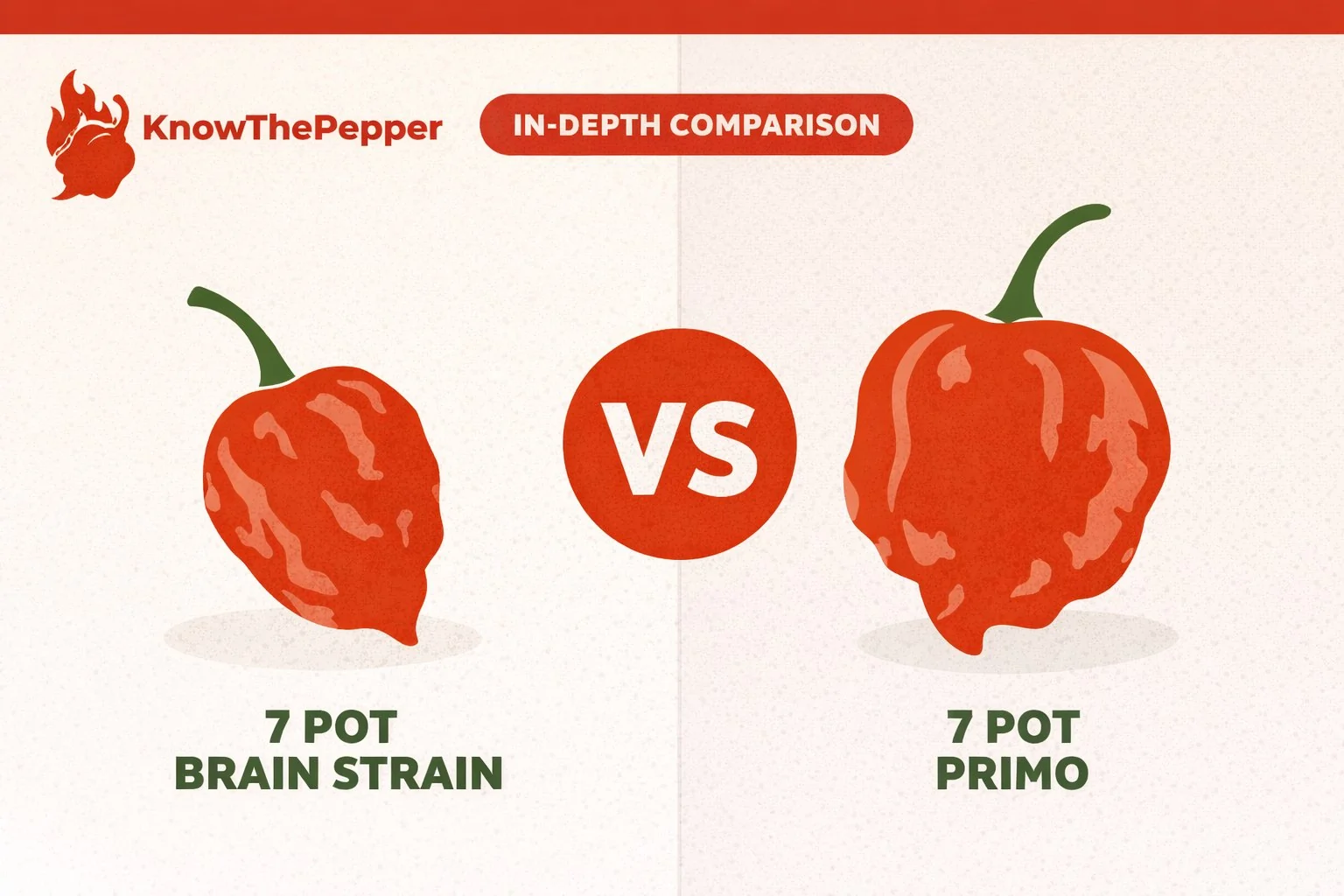
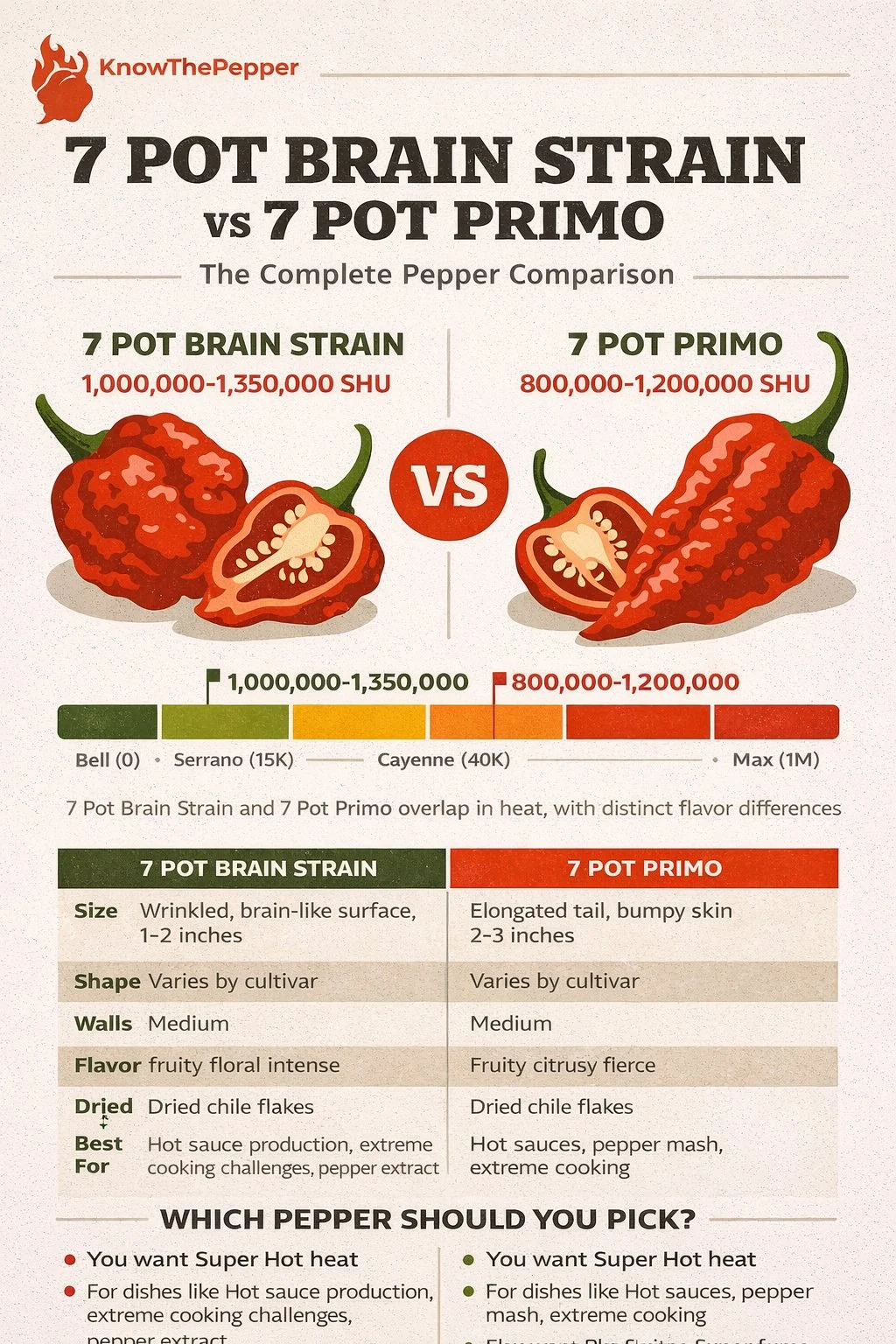
7 Pot Brain Strain measures 1M–1.4M SHU while 7 Pot Primo registers 1M–1.5M SHU — roughly equal in heat. 7 Pot Brain Strain is known for its fruity and intense flavor (C. chinense), while 7 Pot Primo offers fruity and floral notes (C. chinense).
- Species: Both are C. chinense
- Best for: 7 Pot Brain Strain excels in hot sauces and extreme dishes, 7 Pot Primo in hot sauces and spicy dishes
7 Pot Brain Strain
Super-Hot7 Pot Primo
Super-Hot7 Pot Brain Strain vs 7 Pot Primo Comparison
7 Pot Brain Strain vs 7 Pot Primo Heat Levels
Both peppers occupy the heat category for 7 Pot Brain Strain with authority, but there's a meaningful gap at the ceiling. The 7 Pot Brain Strain ranges from 1,000,000 to 1,350,000 SHU, while the 7 Pot Primo stretches from 1,000,000 to 1,469,000 SHU - a difference of roughly 119,000 SHU at maximum expression.
To put that in perspective against something more familiar: a guajillo pepper sits at roughly 2,500 to 5,000 SHU. The Brain Strain is approximately 200 to 540 times hotter than a guajillo, and the Primo can exceed that by another 20-25 times at peak heat. These are not cooking peppers in any conventional sense.
The lower bounds are identical, which matters for growers. Both peppers can underperform in poor conditions - thin walls, insufficient sun, or early harvest all push specimens toward the 1,000,000 SHU floor. Optimal growing conditions are what separate an average pod from a record-challenging one.
The character of the heat differs noticeably. Brain Strain hits fast and spreads across the entire mouth before settling into a deep, prolonged burn - some describe it as almost claustrophobic in intensity. The Primo's heat builds slightly more gradually but has a sharper, more piercing quality at the peak, likely connected to its distinct capsaicinoid profile. Neither is survivable raw in any quantity - both are extract-level peppers used in fractions.
Flavor Profile Comparison
Named for its deeply contorted, brain-textured pods, the 7 Pot Brain Strain sits firmly in the super-hot pepper tier — a category where heat stops being a seasoning and starts being an event.
Troy Primeaux, a horticulturist from Louisiana, developed the 7 Pot Primo by crossing a 7 Pot pepper with the wrinkled, tail-bearing pods that characterize some of the world's most extreme chiles.
Aroma is where these two diverge first, before a single bite. The 7 Pot Brain Strain carries a dense, tropical fruit scent - mango and citrus are the most common descriptors, with an underlying funkiness that's characteristic of extreme C. chinense varieties. Crack one open and the aroma hits immediately and hard.
The 7 Pot Primo smells different in a way that's immediately apparent side by side. It has that same fruity base but layered with something distinctly floral - almost perfumed, closer to a habanero's aromatic character but amplified and more complex. Troy Primeaux, the Louisiana grower who developed it, specifically selected for this quality, and it shows.
On the palate, the Brain Strain's fruitiness is intense but somewhat compressed - everything arrives at once in a wave of heat and tropical flavor that's hard to parse. The Primo's flavor profile stays slightly more legible at the edges of its heat, with the floral notes occasionally detectable even through the burn.
For sauce-making, this distinction matters. Fermented Brain Strain mashes tend toward a deep, almost jammy fruit character. Primo-based sauces retain more brightness and a floral high note that blends differently with acidic ingredients like vinegar or citrus. Neither pepper is subtle, but the Primo gives you a little more to work with aromatically. Both belong to the botanical family for 7 Pot Brain Strain, which explains their shared fruity DNA despite their different flavor expressions.
Culinary Uses for 7 Pot Brain Strain and 7 Pot Primo
Neither pepper belongs in everyday cooking - at least not in any meaningful quantity. The practical applications for both the Brain Strain and the Primo center on small-scale use: hot sauces, pepper mashes, spice blends, and challenge foods.
For hot sauce production, the Brain Strain is the more commonly chosen of the two. Its straightforward fruity-intense profile blends predictably with mango, pineapple, or citrus bases. A ratio of 1 Brain Strain pod per 2 cups of sauce base is already aggressive for most palates - serious heat seekers might push to 2 pods, but that's extract territory in terms of experience.
The Primo works particularly well in fermented preparations. Its floral character survives lacto-fermentation better than many super-hots, and a 3-4 week ferment at room temperature produces a mash with genuine complexity. Use 1 Primo to every 3-4 cups of base pepper (something like a roasted red bell) when building a sauce that needs to be shareable.
Dried and powdered, both peppers function as finishing spices in the same way ghost pepper powder does - a fraction of a teaspoon per dish. The Brain Strain's powder is slightly more one-dimensional as a spice; the Primo's floral notes come through even in dried form, making it the more interesting of the two for spice blending.
Neither pepper substitutes cleanly for the other without adjustment. If a recipe calls for Brain Strain and you only have Primo, reduce quantity by about 10% to account for the higher ceiling heat. Going the other direction, increase by roughly the same margin. For anyone sourcing either variety, the regional origin for 7 Pot Primo connects to a broader network of US-based super-hot growers who sell fresh pods and seeds seasonally.
Avoid cooking either pepper at high heat - the capsaicin volatilizes and the fumes are genuinely dangerous in an enclosed kitchen.
Which Should You Choose?
Choosing between these two comes down to what you're actually trying to do. The 7 Pot Primo has the higher heat ceiling at 1,469,000 SHU and a more complex aromatic profile - it's the better choice for fermented sauces, spice blends where you want some floral character, and growers chasing maximum SHU documentation.
The 7 Pot Brain Strain is slightly more predictable in its flavor delivery and marginally easier to source. Its fruity intensity without the floral complexity makes it a cleaner building block for straightforward hot sauces.
For pure heat, Primo wins narrowly at the top end. For flavor complexity, Primo also edges ahead. But the Brain Strain's consistency and availability give it a practical edge for regular use. Both trace their lineage through the regional origin for 7 Pot Brain Strain and represent the peak of American super-hot breeding. If you grow only one, the Primo is the more interesting plant - but neither will disappoint anyone who actually wants this level of heat.
Can You Substitute One for the Other?
Proceed with caution. 7 Pot Primo is 1× hotter than 7 Pot Brain Strain.
Need a different option altogether? Search for peppers that match your target heat and flavor with precise swap ratios.
Growing 7 Pot Brain Strain vs 7 Pot Primo
If you’re deciding which pepper to grow at home, consider your climate and patience level. 7 Pot Brain Strain and 7 Pot Primo have different maturation times and temperature preferences. Hotter varieties generally need a longer, warmer growing season to develop their full capsaicin content. Our zone-based planting date tool can pinpoint the best sowing window for your area.
Growing the 7 Pot Brain Strain is a long-season commitment. Start seeds indoors 10–12 weeks before your last frost date — this pepper needs a head start that shorter-season varieties don't require.
Germination is reliable at soil temperatures between 80–85°F. A seedling heat mat is worth the investment; germination rates drop noticeably below 75°F.
Transplant outdoors only after nighttime temps stay consistently above 55°F. Brain Strains are sensitive to cold soil even when air temps seem fine.
The 7 Pot Primo is a long-season pepper. Starting seeds indoors 10-12 weeks before the last frost date is standard practice - rushing this timeline results in smaller plants with lower yields.
Transplanting outdoors works best when nighttime temps stay consistently above 55°F. Plants reach 3-4 feet tall and benefit from staking once pod load increases.
For starting super-hots from transplant to harvest, patience is the main skill. The Primo can take 120-150 days from transplant to ripe red pods.
History & Origin of 7 Pot Brain Strain and 7 Pot Primo
Both peppers carry centuries of culinary heritage. 7 Pot Brain Strain traces its roots to USA, while 7 Pot Primo originates from USA. Understanding their backstory helps explain why each pepper developed its distinctive traits.
Buying & Storage
Whether you’re shopping for 7 Pot Brain Strain or 7 Pot Primo, the same quality indicators apply. Fresh peppers should feel firm and heavy for their size, with taut, glossy skin and no soft or wet spots. Minor stem cracks known as “corking” are perfectly normal and often indicate a mature, flavorful pod.
- Firm pods with taut skin and consistent color
- Should feel heavy relative to size
- Minor stem cracks (“corking”) are normal
- Avoid anything soft, shriveled, or with dark wet spots
- Fresh: Paper bag, crisper drawer — 1–2 weeks
- Frozen: Wash, dry, freeze on sheet pan — 6+ months
- Dried: Airtight, away from light — up to 1 year
The Verdict: 7 Pot Brain Strain vs 7 Pot Primo
7 Pot Brain Strain and 7 Pot Primo sit in the same heat tier but serve different roles. 7 Pot Primo delivers its distinctive fruity and floral character. 7 Pot Brain Strain, with its fruity and intense profile, excels in everyday cooking.
Frequently Asked Questions
Sources pending verification.