Jimmy Nardello vs Sweet Italian Pepper: Compared
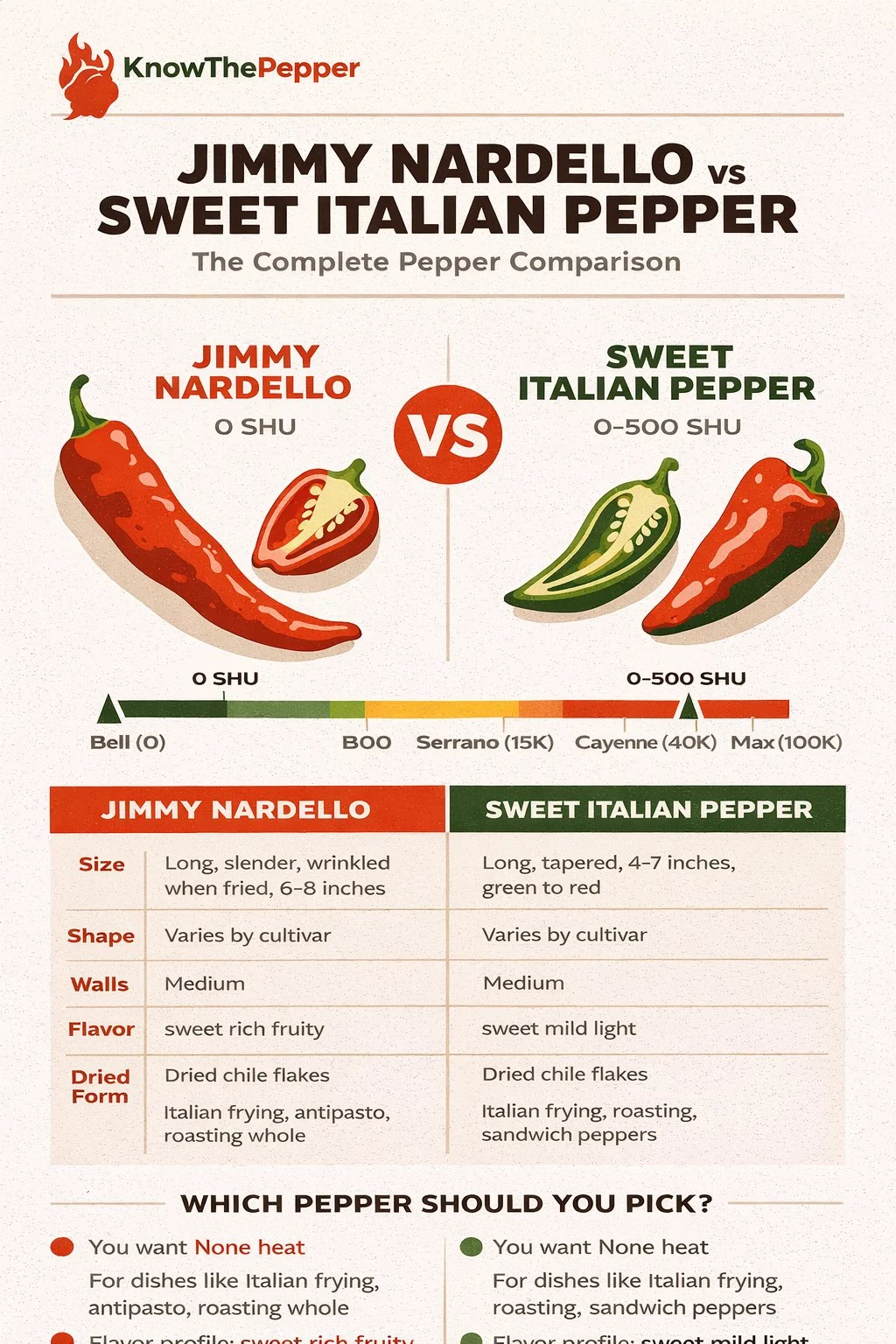
Both the Jimmy Nardello and Sweet Italian pepper register at 0 SHU — zero heat, full flavor. These are sweet frying peppers built for the pan, not the pain scale, but they differ meaningfully in shape, skin texture, sweetness intensity, and how they behave under high heat. Knowing which one suits your cooking style can change how you approach an entire summer harvest.

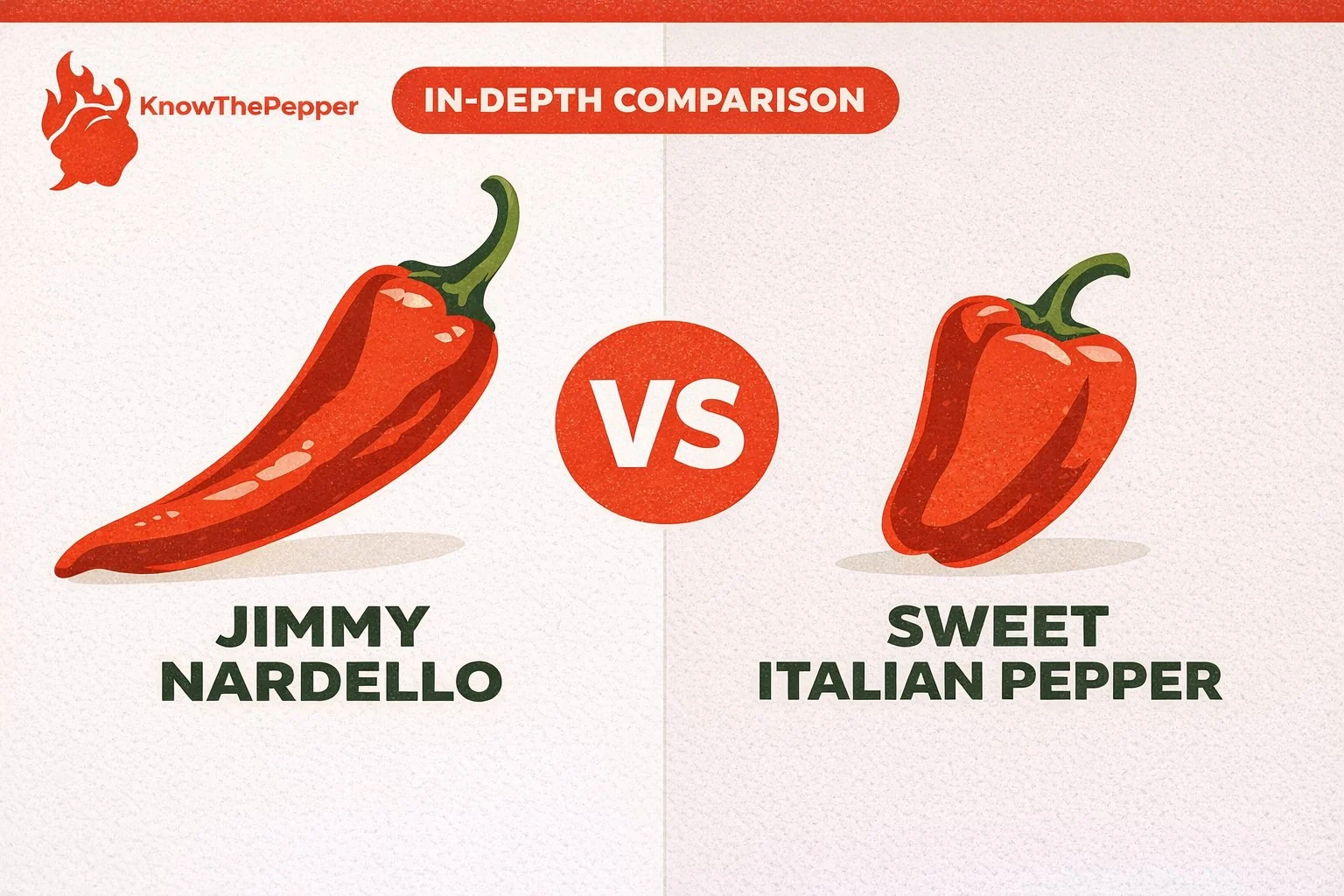
Jimmy Nardello measures 0–500 SHU while Sweet Italian Pepper registers 0–100 SHU — making Jimmy Nardello 5× hotter. Jimmy Nardello is known for its sweet and fruity flavor (C. annuum), while Sweet Italian Pepper offers sweet and mild notes (C. annuum).
- Heat difference: Jimmy Nardello is 5× hotter
- Species: Both are C. annuum
- Best for: Jimmy Nardello excels in everyday cooking and salsas, Sweet Italian Pepper in fresh salsas and mild recipes
Jimmy Nardello
MildSweet Italian Pepper
MildJimmy Nardello vs Sweet Italian Pepper Comparison
Jimmy Nardello vs Sweet Italian Pepper Heat Levels
At 0 SHU, both peppers sit at the absolute floor of the zero-heat sweet pepper range. There is no capsaicin present in either variety, which means no burn, no build, and nothing to measure on the Scoville rating system. For context, a serrano pepper typically lands between 10,000 and 23,000 SHU — so both of these are literally infinitely milder. That is not a rounding error; it is their defining characteristic.
The absence of heat is not a flaw. These peppers were bred and selected specifically to deliver sweetness and depth without any pungency. The Jimmy Nardello, in particular, was preserved for generations in the Basilicata region of southern Italy precisely because its flavor — not its heat — was worth protecting.
Where they diverge is in how that zero-heat profile expresses itself on the palate. Jimmy Nardello peppers carry a concentrated, almost jammy sweetness that intensifies dramatically when fried in olive oil. Sweet Italian peppers (often sold as Cubanelle or Italian frying peppers) are milder and more vegetal in their raw state, with a thinner wall that chars quickly.
Neither pepper will challenge your heat tolerance. Both are genuinely accessible to anyone, including those who avoid spice entirely. The comparison here is purely about flavor architecture and culinary behavior — two very different expressions of the same Scoville reading.
Flavor Profile Comparison
Pull a ripe Jimmy Nardello off the vine and you'll notice the deep crimson skin before anything else — thin, wrinkled, almost translucent in spots.
Bite into a Sweet Italian Pepper and you get nothing but sweetness — no slow creep of warmth, no tingle, just pure pepper flavor.
The Jimmy Nardello has a flavor profile that surprises people the first time they cook it. Raw, it tastes pleasant but unremarkable — mildly sweet, slightly grassy. The transformation happens in a hot pan. Within minutes of hitting olive oil, the sugars concentrate and the skin blisters into something that tastes closer to a sun-dried tomato than a fresh pepper. That depth is the reason chefs seek it out specifically.
Sweet Italian peppers — whether you are working with Cubanelle, Italian frying, or similar types sold under that umbrella — deliver a brighter, more straightforward sweetness. The flesh is thicker in some varieties, with a mild bitterness in the seeds that disappears with cooking. Raw, they work well in salads where Jimmy Nardellos would feel slightly flat.
Aroma-wise, Jimmy Nardellos have a more pronounced fruity note when cooked, almost floral at peak ripeness. Sweet Italian peppers smell cleaner and more neutral — useful when you want the pepper to support a dish rather than lead it.
For the sweet, thin-skinned frying style of Jimmy Nardello, the skin almost dissolves during cooking, which means you get flavor without texture interruption. Sweet Italian pepper skins hold their structure longer, which works better for stuffed preparations or dishes where you want some bite.
If you have ever compared these against the elongated bull's horn shape of Corno di Toro, you will notice the Jimmy Nardello is thinner-walled and more intensely sweet — the Corno sits somewhere between the two in terms of flesh density.
Culinary Uses for Jimmy Nardello and Sweet Italian Pepper
Jimmy Nardello peppers shine in one preparation above almost all others: shallow-fried in good olive oil until blistered and slightly collapsed. Salt them after. That is the whole recipe, and it is genuinely hard to improve on. They also work sliced into pasta with anchovy and garlic, folded into frittatas, or draped over grilled bread with ricotta. Dried Jimmy Nardellos, ground into a powder or crumbled, add a sweet pepper depth to sauces that no commercial paprika quite replicates.
Sweet Italian peppers are more versatile in the structural sense. Their thicker walls make them the better candidate for stuffing — a classic preparation with ground meat, rice, and tomato sauce. They hold up on the grill without collapsing, and raw they add crunch and mild sweetness to antipasto plates or sandwiches. Cubanelle-style Sweet Italian peppers are the standard choice for sausage and pepper sandwiches precisely because they soften without disappearing.
For substitution: if a recipe calls for Jimmy Nardello and you only have Sweet Italian, use them at a 1:1 ratio by weight but expect a less concentrated sweetness and a slightly firmer texture. Going the other direction — subbing Jimmy Nardello into a stuffed pepper recipe — works only if you layer several peppers together, since the thin walls will not hold a filling on their own.
Both peppers pair naturally with olive oil, garlic, capers, anchovies, and cured meats. They belong in Italian-American cooking, but Jimmy Nardellos have found a second home in New American restaurant kitchens where chefs prize heirloom vegetables with a story.
For anyone growing their own, the full pepper growing guide covers transplant timing and spacing — both varieties benefit from the same warm-season schedule, though Jimmy Nardellos need a longer season to develop their characteristic sweetness fully.
Which Should You Choose?
If your goal is maximum flavor impact from a sweet pepper — particularly in high-heat cooking — Jimmy Nardello is the clear choice. Its transformation in a hot pan is remarkable, and no other sweet pepper quite replicates that jammy, concentrated sweetness. It rewards growers and cooks who are willing to seek out seeds and give the plant a full season to develop.
Sweet Italian peppers win on accessibility and structural versatility. You can find them at any grocery store, they stuff and grill without falling apart, and their clean flavor makes them excellent team players in complex dishes where you do not want the pepper stealing focus.
For a side-by-side look at how elongated Italian sweet peppers stack up against each other, the Corno di Toro versus Jimmy Nardello comparison is worth reading — it adds useful context about how shape and wall thickness affect cooking behavior across this whole family of peppers.
Both sit at 0 SHU. Neither will challenge your heat tolerance. The choice is entirely about what you are cooking and how much flavor intensity you want from your pepper.
Can You Substitute One for the Other?
Yes — direct substitution works. Jimmy Nardello and Sweet Italian Pepper are close enough in heat to swap at roughly 1:1. The main difference will be flavor. For more swap options, explore ranked alternatives with conversion ratios.
Growing Jimmy Nardello vs Sweet Italian Pepper
If you’re deciding which pepper to grow at home, consider your climate and patience level. Jimmy Nardello and Sweet Italian Pepper have different maturation times and temperature preferences. Hotter varieties generally need a longer, warmer growing season to develop their full capsaicin content. Our zone-based planting date tool can pinpoint the best sowing window for your area.
Jimmy Nardello is a rewarding garden pepper, but it needs a long, warm season — plan for 80–90 days from transplant to ripe red pods. Start seeds indoors 8–10 weeks before your last frost date.
Transplant into full sun once nighttime temps stay consistently above 55°F. For practical guidance on pepper plant spacing, these plants get substantial — give them 18–24 inches between plants.
Soil prep matters more than fertilizer. Well-draining, slightly acidic soil (**pH 6.
Sweet Italian Peppers are among the more forgiving varieties to grow, which makes them a smart choice whether you are starting your first pepper garden or filling out an established one. Start seeds indoors 8–10 weeks before your last frost date; they germinate best at 80–85°F soil temperature.
Transplant outdoors once nighttime temps stay reliably above 55°F. Space plants 18–24 inches apart in full sun — they need at least 6–8 hours of direct light daily to set fruit well.
The plants benefit from staking as fruit load increases; a single bamboo stake per plant usually suffices. Water deeply but infrequently, letting the top inch of soil dry between waterings.
History & Origin of Jimmy Nardello and Sweet Italian Pepper
Both peppers carry centuries of culinary heritage. Jimmy Nardello traces its roots to Italy, while Sweet Italian Pepper originates from Italy. Understanding their backstory helps explain why each pepper developed its distinctive traits.
Buying & Storage
Whether you’re shopping for Jimmy Nardello or Sweet Italian Pepper, the same quality indicators apply. Fresh peppers should feel firm and heavy for their size, with taut, glossy skin and no soft or wet spots. Minor stem cracks known as “corking” are perfectly normal and often indicate a mature, flavorful pod.
- Firm pods with taut skin and consistent color
- Should feel heavy relative to size
- Minor stem cracks (“corking”) are normal
- Avoid anything soft, shriveled, or with dark wet spots
- Fresh: Paper bag, crisper drawer — 1–2 weeks
- Frozen: Wash, dry, freeze on sheet pan — 6+ months
- Dried: Airtight, away from light — up to 1 year
The Verdict: Jimmy Nardello vs Sweet Italian Pepper
Jimmy Nardello and Sweet Italian Pepper sit in the same heat tier but serve different roles. Jimmy Nardello delivers 5× more heat with its distinctive sweet and fruity character. Sweet Italian Pepper, with its sweet and mild profile, excels in everyday cooking.
Frequently Asked Questions
Related Comparisons
Sources pending verification.