
7 Pot Brain Strain vs 7 Pot Primo: Which Is Hotter?
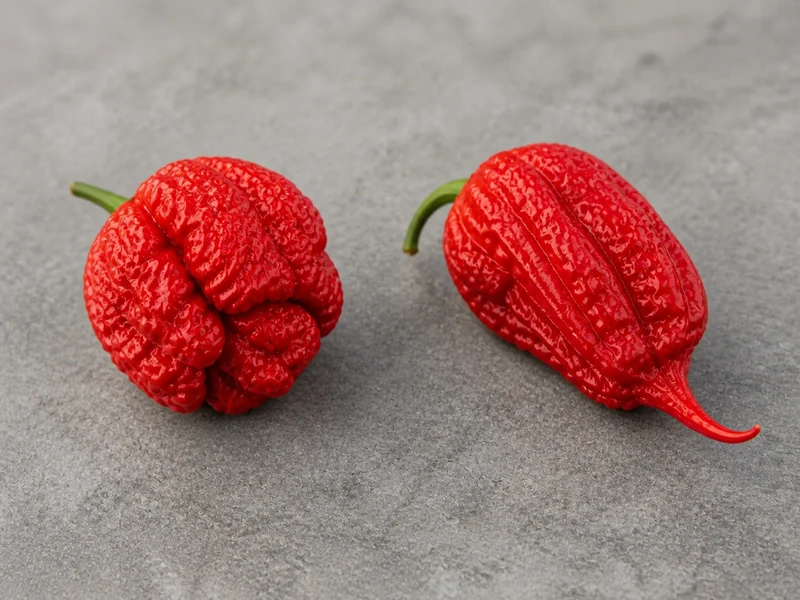
7 Pot Primo has the higher published ceiling at 1,790,150 SHU, compared with Brain Strain's listed 1,000,000 to 1,350,000 SHU range, but the figures are not one head-to-head lab test. Choose Brain Strain for repeated squat, brain-like folds and Primo for a longer pod with a narrow tail, then verify either identity through a documented seed line.

Primo carries the higher published ceiling, but the sources are not a head-to-head lab test. Choose by repeated pod shape and documented seed-line history, then dose either pepper by weight in a diluted batch.
- Published heat evidence: 1,000,000 to 1,350,000 SHU vs Up to 1,790,150 SHU
- Pod silhouette: Squat with dense brain-like folds vs Longer, distorted, often with a narrow tail
- Development: David Capiello selection from Trinidad 7 Pot material vs Troy Primeaux line from Naga Morich and Trinidad 7 Pot material
- Best identity check: Repeated compact, deeply folded ripe pods vs Repeated elongated pods with a blossom-end tail
- Flavor evidence: Vendor descriptions, no controlled head-to-head tasting vs Fruity and floral vendor description, no controlled head-to-head tasting
- Choose it for: Brain-like pod identity and selected 7 Pot history vs Louisiana lineage, stinger shape, and higher reported ceiling
7 Pot Brain Strain
Super-Hot7 Pot Primo
Super-HotWhat Decides the Choice Between Brain Strain and Primo?
| Attribute | 7 Pot Brain Strain | 7 Pot Primo |
|---|---|---|
| Published heat evidence | 1,000,000 to 1,350,000 SHU | Up to 1,790,150 SHU |
| Pod silhouette | Squat with dense brain-like folds | Longer, distorted, often with a narrow tail |
| Development | David Capiello selection from Trinidad 7 Pot material | Troy Primeaux line from Naga Morich and Trinidad 7 Pot material |
| Best identity check | Repeated compact, deeply folded ripe pods | Repeated elongated pods with a blossom-end tail |
| Flavor evidence | Vendor descriptions, no controlled head-to-head tasting | Fruity and floral vendor description, no controlled head-to-head tasting |
| Choose it for | Brain-like pod identity and selected 7 Pot history | Louisiana lineage, stinger shape, and higher reported ceiling |
How Hot Are 7 Pot Brain Strain and 7 Pot Primo?
7 Pot Primo has the higher published heat ceiling. Primo's Peppers lists its official seed line at 1,790,150 SHU, while Pepper Joe's lists 7 Pot Brain Strain at 1,000,000 to 1,350,000 SHU.
The figures do not come from one controlled head-to-head test. They support a higher reported ceiling for Primo, but they do not prove that every Primo pod is hotter than every Brain Strain pod.
New Mexico State University's Chile Pepper Institute explains that high-performance liquid chromatography measures capsaicinoids before the result is expressed in Scoville Heat Units. The institute also notes that genetics, weather, growing conditions, and fruit age can change measured heat, so the tested fruit matters as much as the cultivar label.
Primo's listed maximum is 440,150 SHU higher than the top of the Brain Strain range, a difference of about 33 percent. That gap is useful for comparing published claims, but it is not a recipe conversion ratio because pod mass and placental tissue vary.
How Do Brain Strain and 7 Pot Primo Pods Differ?
Pod shape is the clearest practical separator. Brain Strain is usually squat and densely folded with a grainy, brain-like surface, while Primo is generally longer and distorted with a narrow tail at the blossom end.
SuperHotChiles describes Primo pods as lumpy and sometimes finished with a skinny tail. Its Brain Strain listing traces the line to selection for the deeply folded phenotype, while Pepper Joe's describes mature fruit as red, wrinkled, and bumpy.
A stinger alone does not prove a pod is Primo, and one folded fruit does not prove a Brain Strain line. Compare several ripe pods from the same plant, then check whether the seed source names the breeder history, species, ripe color, and expected shape.
SuperHotChiles describes Primo as fruity and floral, and seed vendors use similar fruity language for Brain Strain. No controlled tasting source compares the two side by side, so shape and provenance are stronger identifiers than flavor adjectives.
How Do You Cook With Brain Strain or 7 Pot Primo?
Use either pepper as a concentrated seasoning, not as a bulk vegetable. Weigh a very small piece, blend it through a full sauce batch, and increase only after the heat is distributed evenly.
Brain Strain is the more useful choice when the finished product should preserve that cultivar's squat, heavily folded identity. Primo fits when the named Louisiana line, stinger-shaped fruit, or higher published heat claim is part of the sauce or powder story.
For fermented sauce, vinegar sauce, fruit sauce, chili oil, or dry seasoning, the safer comparison is equal weight in separate diluted batches. Equal pod counts hide differences in fruit size, wall thickness, and placental tissue, while raw bites expose the taster to extreme heat without producing a reliable identity test.
New Mexico State University identifies the placenta as the main site of capsaicinoid production. Removing seeds alone therefore does not make either pepper mild, and dried powder can spread irritating particles beyond the cutting board.
Treat both peppers as capsaicinoid concentrates
Wear gloves, keep knives and boards separate, avoid airborne powder, and label every container. If skin exposure occurs, stop handling the peppers and follow the pepper-burn guide before touching the face or eyes.
Which Should You Choose, Brain Strain or 7 Pot Primo?
Choose 7 Pot Brain Strain when you want the David Capiello selection, a compact fruit, and dense brain-like folds. Choose 7 Pot Primo when you want Troy Primeaux's Louisiana line, a longer wrinkled pod with a narrow tail, and the higher published heat ceiling.
Do not choose by the largest SHU number or a seed packet photo alone. A documented true-to-type line is more valuable than a dramatic name on a mixed or mislabeled seed lot.
Neither cultivar is an everyday fresh pepper, and neither has reliable evidence of a universal yield or flavor advantage. The useful decision comes from identity, intended product, and seed provenance rather than a generic winner label.
How Can You Verify a True Seed Line?
Start with a seller that names the cultivar and its development history rather than listing a generic red 7 Pot. The listing should also state Capsicum chinense, the ripe color, the expected pod silhouette, and how seed plants were isolated.
Both SuperHotChiles listings say seed-production plants are isolated to prevent cross-pollination. That practice does not certify every packet, but it gives buyers a concrete question to ask before paying a premium for a named line.
Grow more than one plant and photograph several mature pods from each. A Brain Strain line should repeatedly trend toward squat fruit with dense folds, while a Primo line should repeatedly trend toward a longer distorted body and narrow blossom-end tail.
One off-type pod can reflect normal variation, but repeated disagreement across the plant is a reason to question the label. If seed saving matters, isolate flowers from compatible peppers and keep the source, season, and plant records attached to the saved lot.
Can Brain Strain Replace 7 Pot Primo?
Brain Strain and Primo can fill the same extreme-heat role in a diluted sauce or powder blend when cultivar identity does not matter. Start below the original weight, blend through the full batch, and adjust in small steps because the published ranges do not create a dependable conversion ratio.
The substitution fails when the label, pod display, seed saving, or collector value depends on the named line. In those cases, use the correct cultivar and verify it through the seed source and repeated ripe-pod traits.
7 Pot Brain Strain vs 7 Pot Primo FAQ
- Primo's Peppers - Official 7-Pot Primo Seeds
- Refining Fire Chiles / SuperHotChiles - Trinidad 7 Pot Primo Peppers
- Refining Fire Chiles / SuperHotChiles - 7 Pot Brain Strain Pepper
- Pepper Joe's - Brain Strain Hot Pepper Seeds
- New Mexico State University Circular 706 - Chile Pepper Cultivars for New Mexico