Why Do Hot Sauces Separate? Settled Solids, Split Oil, and When to Toss It
Hot sauce usually separates because pepper solids settle, or because the water-and-oil side of the sauce is no longer holding together cleanly. That is often a texture issue, not automatic spoilage, but gas, mold, rotten odor, or unsafe homemade storage change the answer fast.
Hot sauce usually separates for one of two physical reasons: solids sink, or the sauce loses emulsion stability. Neither one automatically means the bottle is unsafe.
The real question is what else you see with it. A clean-smelling sauce that splits into layers after sitting is usually a texture problem.
A bottle that swells, hisses aggressively, grows mold, or smells rotten belongs in the same category as actual hot sauce spoilage.
What separation usually means in a hot sauce bottle
Most hot sauces are not perfectly uniform liquids. They are suspensions of pepper solids, seeds, pulp, spices, salt, acids, and sometimes oil, fruit puree, or garlic.
Leave that mixture alone long enough and gravity starts sorting it.
A thin vinegar sauce often throws a light sediment to the bottom. A thicker mash-style sauce can leave a dense pulp layer below and a brighter liquid layer above.
Oil-heavy sauces can split the other way, with a glossy layer floating on top because the water phase and fat phase are no longer staying evenly dispersed.
That visual split does not tell you the whole safety story. Safety depends more on acid level, salt, process control, sanitation, and storage than on whether the bottle looks perfectly smooth on the shelf.
Settling and a broken emulsion are not the same problem
Settling is the simpler one. Heavier pepper particles and spice fragments drift downward while the thinner liquid rises around them.
Shake the bottle and it usually comes back together for a while.
A broken emulsion is different. That happens when oil droplets stop staying suspended in the water phase, so you start seeing a distinct oily band, a greasy ring at the neck, or a sauce that re-separates almost immediately after shaking.
| What you see | Most likely cause | Best next step |
|---|---|---|
| Thin sediment at the bottom | Pepper solids or spices settling out | Shake well and check whether texture returns evenly |
| Clear top layer and dense pulp below | Coarse mash or under-strained puree | Reblend, then strain or reduce particle size next batch |
| Oily band floating on top | Broken oil-in-water emulsion | Reblend and reduce added oil, or use a stabilizer in future batches |
| Foam, gas, leaking cap, or pressure | Active fermentation or spoilage pressure | Refrigerate immediately and evaluate safety before using |
| Mold, rotten odor, or slimy cap buildup | Spoilage, not normal separation | Discard the bottle |
If the bottle resets after one hard shake, you are usually dealing with settling. If it snaps back into separate layers within a minute or two, the sauce structure itself is weak.
Does separation mean hot sauce has gone bad?
This is the point most people get wrong. Separation can look ugly long before a sauce becomes unsafe.
FDA acidified-food guidance focuses on finished equilibrium pH, water activity, and process control. In plain kitchen terms, the thing that makes a shelf-stable hot sauce safe is not perfect smoothness.
It is whether the sauce was built and processed to control microbial growth.
That is why a commercial cayenne-and-vinegar sauce can darken or separate a bit and still be usable, while a fresh blended mango or roasted garlic sauce may need refrigeration even if it still looks smooth. Appearance is a clue.
It is not the whole decision.
If you want the safety side of the question, start with how long hot sauce lasts and the signs it has gone bad. This guide is narrower.
It is about why the layers form in the first place, and what the layers tell you about the formula.
Why does homemade hot sauce separate faster than store bottles?
Homemade sauces are usually less filtered, less standardized, and less stabilized. That is often a good thing for flavor.
It is not a good thing for visual uniformity.
When we make hot sauce at home, we often keep more pepper flesh, more seeds, more char, more fruit, or more garlic in the blender. Those bits carry flavor, but they also give gravity more material to pull downward over time.
Fresh pepper choice matters too. A sauce built from a thick-fleshed pepper like the Jalapeño behaves differently from one built around a thinner-walled, more aromatic pepper such as the Habanero.
Pulp load, skin thickness, water content, and seed volume all change how much suspended matter the sauce has to carry.
Dry ingredients matter as well. A sauce made with dried chile powders or rehydrated pods will not settle the same way a fresh mash does.
The texture shift is one reason our fresh-vs-dried pepper treats moisture loss as a structural change, not just a flavor change.
Why do fermented hot sauces separate?
Fermented sauces often look more active because they are more active. A fermented pepper mash can carry fine pulp, live or recently active microbes, trapped gas, and a looser liquid phase once it has been blended and bottled.
That does not make fermentation a flaw. It just means a fermented sauce may need more shaking than a filtered vinegar sauce, especially if you leave more mash in the final bottle for body.
The National Center for Home Food Preservation treats fermentation as a controlled preservation method driven by microorganisms in low-oxygen conditions. That is very different from a random bottle left warm on the counter.
If the sauce was meant to ferment, a little sediment and texture drift is normal.
If it was not meant to keep fermenting, pressure buildup is your warning sign to slow down and reassess.
That distinction matters when you compare a raw pepper mash, a cooked vinegar sauce, and a sauce in the higher-heat Scoville range that still contains lots of pulp and skin. The hotter bottle does not necessarily separate less. Capsaicin heat chemistry is not a stabilizer.
How to fix a separated sauce at home
Start with the least invasive fix first. Shake hard for 10 to 15 seconds and pour a little onto a spoon.
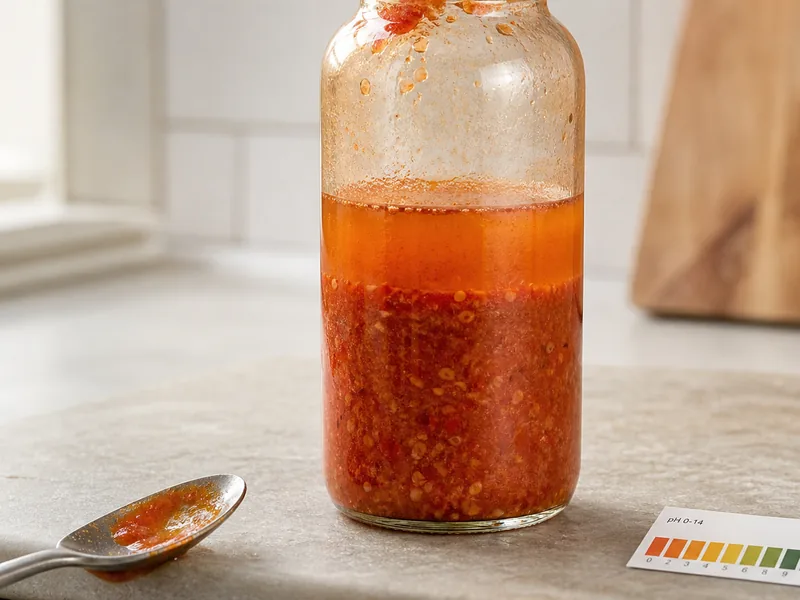
If the texture looks even again and stays even through the pour, you probably do not need to do anything else.
- For simple settling: shake and refrigerate after opening for slower drift.
- For coarse pulp layers: reblend the bottle, then strain if you want a cleaner finished texture.
- For oily top layers: reblend and cut back the oil in the next batch.
- For active gas pressure: chill the bottle, vent carefully, and treat it as a fermentation-control question, not a cosmetic one.
If a sauce keeps separating because it is too chunky, the fix is usually mechanical. Blend longer.
Strain more aggressively.
Reduce the seed and skin load. Cook a little longer to tighten the body if the recipe allows it.
If it keeps separating because the oil phase keeps floating off, the fix is structural.
Commercial processors often use xanthan gum specifically to maintain uniform viscosity, suspend particles, and improve emulsion stability in sauces. That does not mean every homemade sauce needs it, but it explains why many store bottles stay visually smooth longer than a loose home blend.
How do you keep hot sauce from separating?
The best repair for separation is upstream. Fix the formula before bottling the next batch.
- Keep oil modest unless the recipe is designed as an oil-forward chile sauce.
- Blend until the mash is truly fine, not just loosely broken down.
- Strain when clarity matters, especially for table sauces meant to pour cleanly.
- Use a stabilizer on purpose when you want a smoother commercial-style finish.
- Store cold after opening when the sauce is homemade, fruit-heavy, or only loosely acidified.
This is also why a thicker cooked sauce and a raw table sauce should not be judged by the same visual standard.
A rough, lively bottle can still be the better-tasting one. The goal is not sterile smoothness.
The goal is a bottle whose structure matches its purpose.
When should you throw out separated hot sauce?
Stop treating it as a texture issue if you see mold, a fuzzy cap ring, ropey slime, rotten odor, violent pressure release, or obvious leakage around the seal. Those are not ordinary layer lines.
A sour smell by itself can still be normal in an acidified sauce. A rotten, cheesy, or solvent-like smell is different.
Trust the combination of signs, not one visual alone.
Use this rule at home: if the sauce separates but smells clean, tastes normal, and was stored correctly, it usually needs a shake. If it separates and also shows gas, mold, off odor, or uncontrolled homemade storage, it needs a trash can.
That is the whole frame. Separation tells you about structure first, and safety second.
Read it in that order and most hot sauce bottles make a lot more sense.
Why Do Hot Sauces Separate? Settled Solids, Split Oil, and When to Toss It FAQ
- FDA - Acidified and Low-Acid Canned Foods Guidance Documents and Regulatory Information
- National Center for Home Food Preservation - Fermenting
- eCFR 9 CFR Part 424 Subpart C - Xanthan gum for uniform viscosity, suspension of particulate matter, and emulsion stability
- Mun et al. Development of reduced-fat mayonnaise using 4?GTase-modified rice starch and xanthan gum