How to Store Peppers Fresh for About a Week or Dried for Six to 12 Months
Fresh peppers keep about a week in a standard home refrigerator, and dried peppers keep six to 12 months once conditioned. Hot peppers need no blanching before freezing, drying should stay at or below 140 F to avoid case hardening, and peppers in oil carry a botulism risk that sets hard time limits.
How long do peppers last in the fridge?
Clemson Extension puts the ideal storage temperature for fresh peppers at 45 °F and notes they last about one week in a typical home refrigerator running near 40 °F. Most home fridges sit at that colder setting, so one week is the number to plan around rather than the two weeks often quoted.
Thick-walled poblanos and bells hold a little better than thin-skinned serranos and cayennes, but neither reaches two weeks at standard refrigerator temperature.
The same Clemson guidance is specific about moisture, and it comes down to three things.
- Get the peppers dry before they go in.
- Set them in a paper bag, or wrap them in paper towels, so the paper pulls surface humidity away.
- Do not wash them until you are ready to cook, because water sitting on the skin is what turns a firm pepper soft at the stem end.
A sealed plastic bag does the opposite of the paper, trapping the moisture the pepper gives off and holding it against the skin.
Once a pepper is cut, the exposed flesh drives the timeline instead of the skin. Wrap the cut face, refrigerate it, and judge it by smell and firmness rather than by a date on the container.
How do you freeze peppers, and do they need blanching?
Whether a pepper needs blanching depends only on whether it is hot or sweet, and the hot-pepper answer is the shorter one.
Hot peppers
The National Center for Home Food Preservation gives the whole procedure in three steps, with no blanching anywhere in it.
- Wash and stem the peppers.
- Package them leaving no headspace.
- Seal and freeze.
Sweet and bell peppers
These have two accepted routes, and what separates them is headspace rather than difficulty.
- Raw pack for a crisper texture. Package with no headspace, then seal and freeze.
- Water blanch for cooked dishes. Blanch halves 3 minutes or strips and rings 2 minutes, cool promptly, drain, then package leaving ½ inch of headspace.
Only the blanched route leaves headspace, because those peppers carry water that expands as it freezes.
Roasting before freezing is a flavor choice rather than a repair. Neither source treats raw thick-walled peppers as a problem needing to be fixed.
Spreading the pieces in a single layer on a tray before bagging keeps them from setting into one block. That flash-freezing step is what lets you pour out a handful later instead of chiselling at a brick.
Label the bag with the variety and the date. Frozen peppers lose their distinguishing color and shape within a few weeks, and an unlabelled bag of superhots is a genuine hazard in a shared kitchen.
The National Center puts freezer quality for fruits and vegetables at 8 to 12 months at 0 °F, and is explicit that food held longer than that is still safe and simply lower in quality.
What temperature should you dry peppers at?
Penn State Extension starts vegetables at 145 °F while surface moisture is still present, then drops the dehydrator to 135 to 140 °F after the first hour to finish. Colorado State Extension gives 140 °F as the working figure for oven drying.
Running hotter to save time works against you. Penn State names the failure as case hardening, where the outer surface hardens and stops moisture escaping from the center of the slice.
A pepper that case hardens looks finished and is not. The trapped water is what shows up later as mold inside a sealed jar.
Peppers are also among the vegetables that need no blanching before drying, which Penn State groups with onions, garlic, and herbs. Colorado State does call for a 4-minute blanch on sweet peppers and red chiles, so the two agree on temperature and part ways on pretreatment.
Colorado State gives 12 to 24 hours for chile peppers and 8 to 12 hours for sweet peppers.
Vegetables are dry when they are tough, brittle, or crunchy. A piece that still bends without snapping needs more time.
Which drying method you pick changes the timing far more than the target temperature does.
A string of thin pods in dry air and a loaded dehydrator tray are both aiming at the same finish point.
Conditioning dried peppers before they go in the jar
Drying leaves moisture unevenly spread between pieces, and sealing at that moment concentrates it in whichever pod dried least. Conditioning is the step that evens it out, and it is the one most home batches skip.
Colorado State Extension gives the method as four things to do with the cooled batch.
- Fill large glass or plastic containers about two thirds full.
- Cover them lightly rather than sealing them.
- Hold them somewhere warm, dry, and well ventilated for four to 10 days.
- Shake or stir the container daily so the pieces stay separate.
Condensation on the inside of the glass during that window means the batch was never dry.
Return it to the dehydrator instead of sealing it.
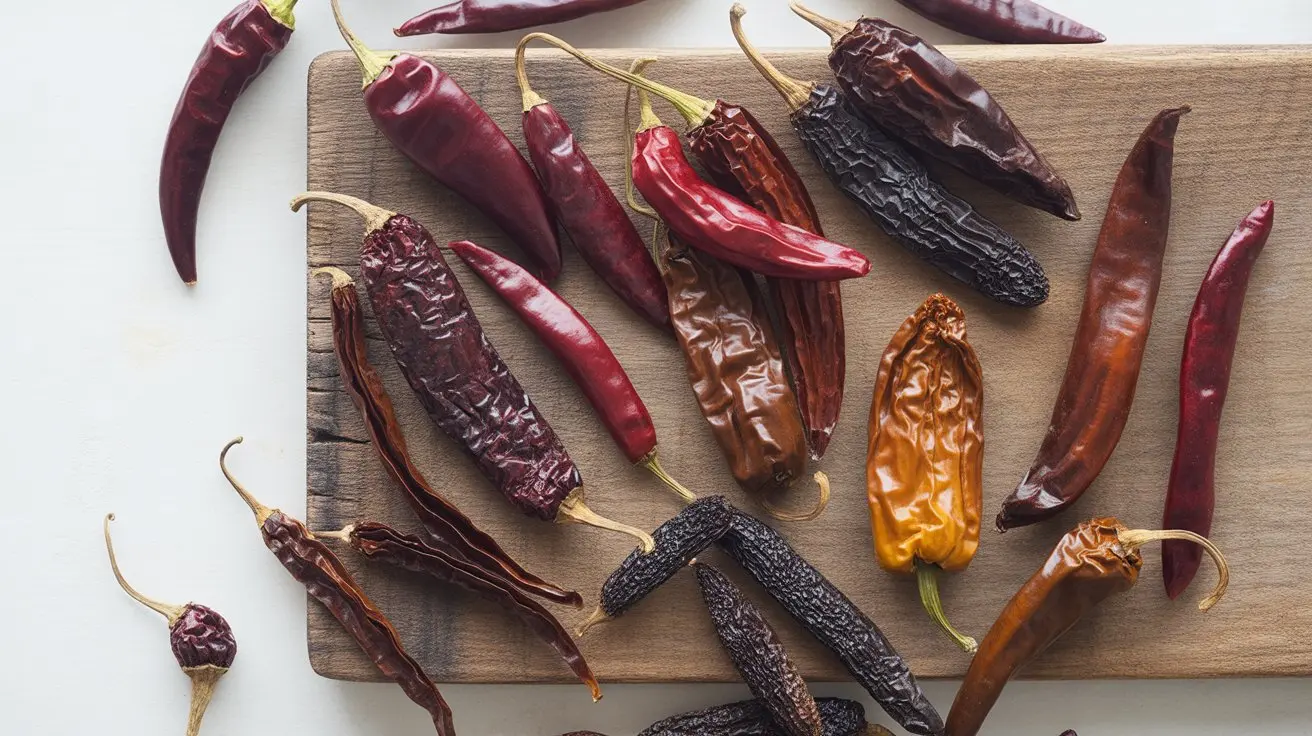
Once conditioned, dried peppers keep well for six to 12 months in a cool, dry, dark place. That is a considerably shorter window than the multi-year figures that circulate for dried chiles.
Light is the other variable. Penn State notes that exposure fades peppers quickly and that dried peppers held in the refrigerator or freezer keep their color best.
Ground peppers fade faster than whole pods because grinding exposes far more surface to air.
Splitting a batch across several small jars means you are not opening the entire stock every time you cook.
Is it safe to store peppers in oil?
Peppers are a low-acid vegetable, and covering them in oil creates exactly the oxygen-free environment Clostridium botulinum needs. Penn State Extension describes the spores growing at room temperature once oil surrounds them, then producing toxin as they grow.
Safe handling depends on whether the peppers went in fresh or dried, and the two windows are nothing alike.
Oil infused with fresh peppers or garlic must be refrigerated and used within 2 to 4 days. Oil made with dried peppers can be refrigerated for up to three months, and neither version is safe held at room temperature.
For longer keeping, Penn State's method is acidifying the peppers before they meet the oil. Soak them in a 3% citric acid solution for at least 24 hours, then drain the solution away.
That solution is one tablespoon of citric acid stirred into two cups of water, used at one part chopped garlic to three parts solution, or one part fresh herbs to 10 parts solution.
The bottle of chili oil sitting on a warm counter is the version to avoid. Botulism toxin gives no warning by smell, taste, or appearance.
Can you store peppers by pickling or fermenting?
Both methods change what the pepper is, which is why they sit apart from the fridge and freezer options.
A quick vinegar pickle is refrigerator storage with a sharper result. Pickling moves the pepper into acid, so the jar keeps because of the vinegar rather than because of the cold.
Fermenting works the other way, using salt concentration to let the right bacteria take over. That salt figure is a safety threshold rather than a seasoning preference, which is why the two processes are not interchangeable.
Do plain peppers need a pressure canner?
Plain peppers are a low-acid vegetable, and that single fact decides the equipment before any recipe does. Penn State Extension lists peppers among the vegetables that must be pressure canned.
A boiling water bath is not safe for plain peppers. Penn State is explicit that water will not rise above 212 °F however long it boils, while a pressure canner reaches the 240 °F needed to destroy botulism spores.
Pickling moves the jar into the high-acid group, where a boiling water bath becomes the appropriate method.
That shift only holds if the vinegar proportion comes from a tested recipe. Improvising the ratio is where home canning goes wrong, and the tested-recipe and pH side of it lives in our preserving chili peppers guide.
How to tell a pepper has gone bad
Fresh peppers fail in a predictable order, and each signal means something different for what you do next.
- Soft spots come first, then wrinkling, then white or gray fuzz and a sour smell.
- Wrinkled skin alone is water loss rather than spoilage. That pepper still cooks fine, though it has stopped being a salad pepper.
- Visible mold ends it, because cutting the fuzzy part away does not remove what has already grown through the flesh.
- A musty smell or oily film on dried pods usually means the batch went into the jar before it was properly dry.
- Freezer burn shows up as white papery patches. Those peppers are safe to eat and taste flat, so trim the affected areas before they go in the pot.
Dried peppers give the least warning of the three forms, which is why conditioning matters more than it looks.
Storage times at a glance
Every figure below comes from the extension sources cited through this guide. Pickled and fermented peppers are left out because their shelf life depends on the acidity or brine strength used, which the linked guides set out.
| Storage method | Keeps for | Source |
|---|---|---|
| Fresh, home refrigerator near 40 °F | About one week | Clemson HGIC |
| Frozen at 0 °F | 8 to 12 months for quality | NCHFP |
| Dried and conditioned, cool dark storage | Six to 12 months | Colorado State Extension |
| Oil with fresh peppers, refrigerated | 2 to 4 days | Penn State Extension |
| Oil with dried peppers, refrigerated | Up to three months | Penn State Extension |
Choosing between them is mostly a question of what the peppers are for. Freezing suits anything heading into a cooked dish, drying suits grinding and long pantry storage, and the refrigerator is only ever a short bridge.
How to Store Peppers Fresh for About a Week or Dried for Six to 12 Months FAQ
- Pepper Basics - Clemson Home and Garden Information Center
- Freezing Hot Peppers - National Center for Home Food Preservation
- Freezing Bell or Sweet Peppers - National Center for Home Food Preservation
- How Long Can I Store Frozen Foods - National Center for Home Food Preservation
- Let's Preserve: Peppers - Penn State Extension
- Let's Preserve: Drying Fruits and Vegetables - Penn State Extension
- How to Safely Make Infused Oils - Penn State Extension
- Preserving Those Colorful Garden Peppers - Penn State Extension
- Drying Vegetables - Colorado State University Extension
- Selecting a Canning or Processing Method - Penn State Extension
- Canning Peppers - National Center for Home Food Preservation