Hand Pollinating Pepper Plants: When Tapping or Brushing Flowers Helps
Pepper flowers contain both pollen-producing and receptive parts, so one plant can set fruit without a partner. Hand pollination is a targeted test for healthy flowers in still air, not a daily ritual or a fix for heat, water, root, or pest stress.
Do Pepper Plants Need Hand Pollination?
A pepper plant can set fruit with pollen from the same flower, so it does not need a second plant. Hand pollination is useful when healthy open flowers receive little vibration from wind or insects and repeatedly fail to form peppers.
NDSU Extension describes peppers as perfect-flowered crops with both male and female structures. Wind can shake pollen from the anthers onto the stigma, while bumble bees improve that movement by vibrating the flower.
Outdoor plants that already set peppers need observation rather than routine handling. Indoors, a gentle fan or normal plant movement may provide enough vibration before you ever touch a flower.
| What you observe | Best first action | Reason |
|---|---|---|
| Outdoor flowers receive wind or insect visits and some ovaries are enlarging | Leave the flowers alone | Natural pollen movement is already producing fruit set |
| Healthy flowers open in still indoor or screened air but do not enlarge | Test hand pollination on a marked group | Lack of movement is a plausible limit |
| Buds fall before opening or every flower drops during stressful weather | Correct plant conditions first | A tool cannot restore nonviable pollen or a stressed flower |
| You want true-to-type seed or a deliberate cross | Use isolation and parent labels | Pollen source matters to the next generation |
Use a comparison instead of treating the whole plant. Mark several similar newly opened flowers, pollinate some, leave the others untouched, and compare whether their ovaries remain attached and enlarge under the same conditions.
When Is the Best Time to Hand Pollinate Peppers?
Flower condition matters more than a rigid schedule. Work with a newly opened, dry flower during the cooler part of the morning, then stop if heat, humidity, or flower damage makes useful pollen movement unlikely.
Bayer's greenhouse pepper guidance reports that pollen production is favored by nights from 55 to 70°F (13 to 21°C), while daytime temperature should stay at or below 90°F (32°C). It gives a relative-humidity range of 50 to 80 percent for adequate pollination.
| Condition | Greenhouse reference | What happens outside it |
|---|---|---|
| Night temperature | 55 to 70°F (13 to 21°C) | Cooler or warmer nights can reduce pollen production or fruit set |
| Day temperature | No higher than 90°F (32°C) | Hotter conditions can damage pollination and cause flower abortion |
| Relative humidity | 50 to 80 percent | Very dry pollen may not adhere, while very humid pollen can become too sticky to release |
These figures are diagnostic references from commercial greenhouse production, not a promise that every cultivar will set fruit anywhere inside the range. Sun on a window, leaf temperature, root stress, and cultivar response can make one home plant behave differently from the greenhouse average.
Bayer also notes that greenhouse bumble bees visit early in the morning when pollen release and stigma receptivity are high. For a home grower, that supports choosing a fresh morning flower rather than repeatedly revisiting the same aging bloom.
Pollinate today when the flower passes these checks:
- The petals are fully open, dry, and not browning at the edges.
- The yellow anthers and central pistil are visible without pulling petals apart.
- The flower stem is firm, and the plant is not wilted from heat or dry roots.
- No aphids, thrips, webbing, or damaged tissue surrounds the bloom.
- A similar untreated flower is available if you are testing whether the method helps.
Skip a closed bud, a wet flower, or a bloom whose petals detach at a light touch. Waiting for the next fresh flower gives a cleaner test than forcing a technique onto one that is already declining.
What Are the Parts of a Pepper Flower?
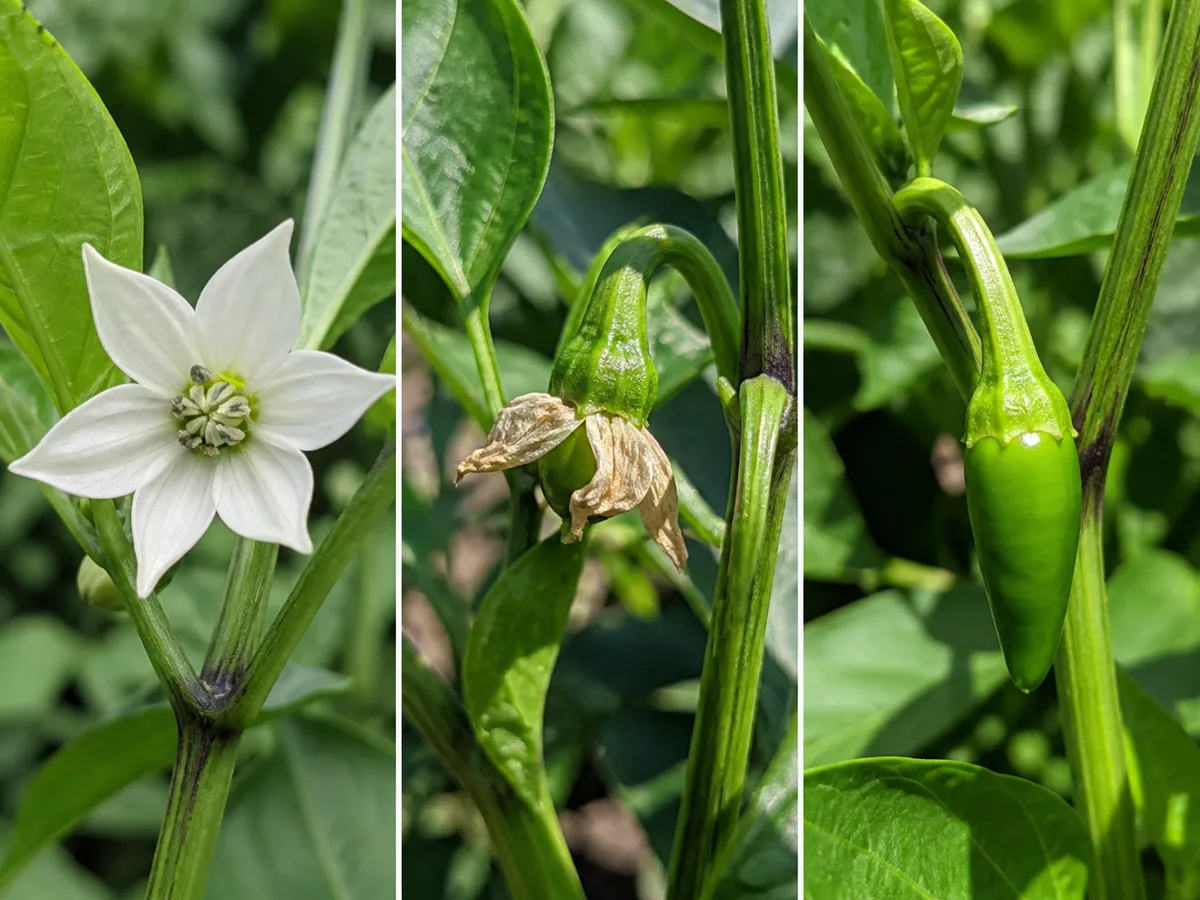
The yellow anthers produce pollen around the flower's central pistil. At the top of that pistil, the stigma receives pollen, while the ovary at the base becomes the pepper after fertilization.
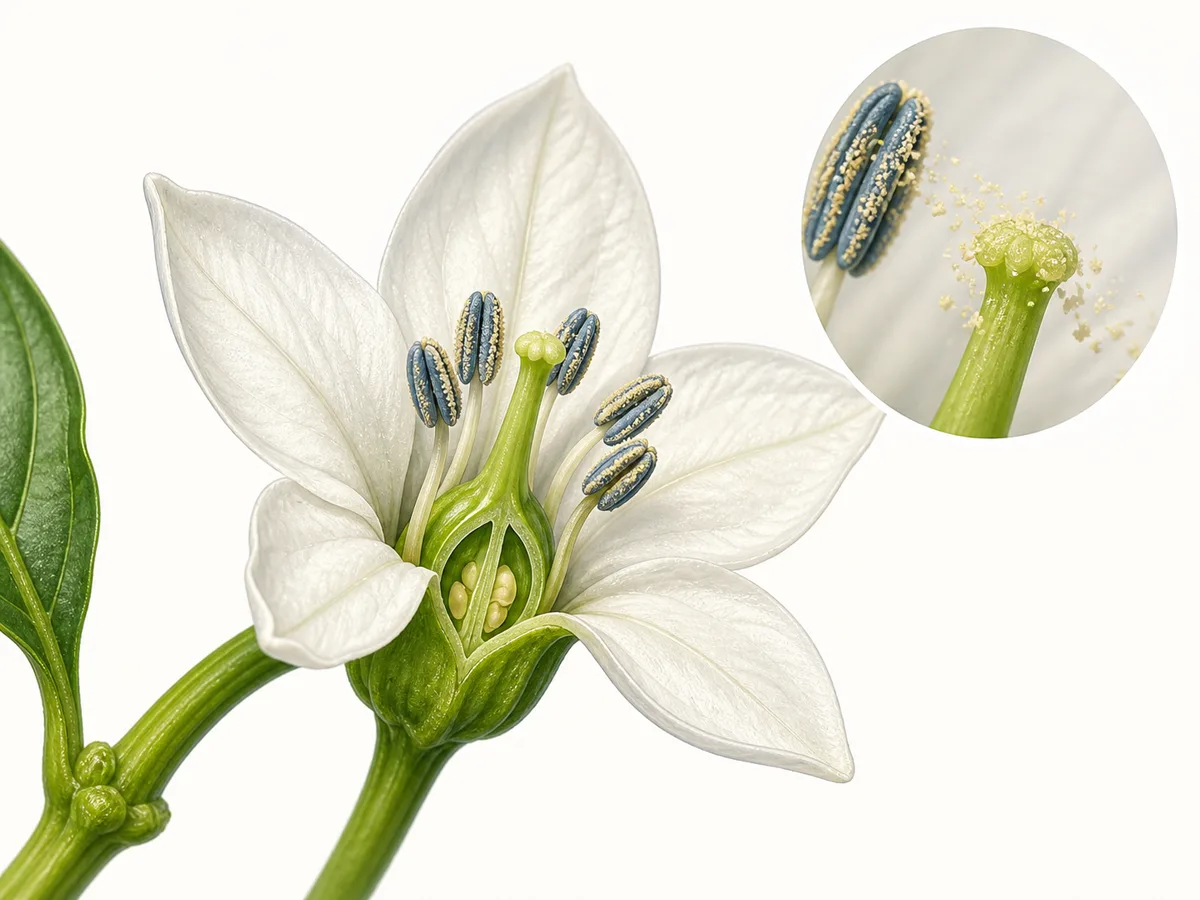
The slender flower stalk below the calyx is the pedicel. Tapping or vibrating this support can release pollen without placing a tool against the petals, anthers, stigma, or ovary.
A useful flower view should show several separate anthers around one central stigma, with the green ovary behind the petals. That arrangement explains why a light shake can release pollen toward the receptive center without a tool touching every structure.
Look before touching. Visible yellow dust around the anthers confirms pollen release, but some viable flowers shed too little pollen to see easily, so the absence of a visible cloud does not prove failure.
Do not scrape the stigma or remove anthers when the goal is ordinary fruit set. Emasculation belongs to controlled breeding, where a grower deliberately prevents self-pollination before applying pollen from a chosen parent.
Should You Tap, Vibrate, or Brush Pepper Flowers?
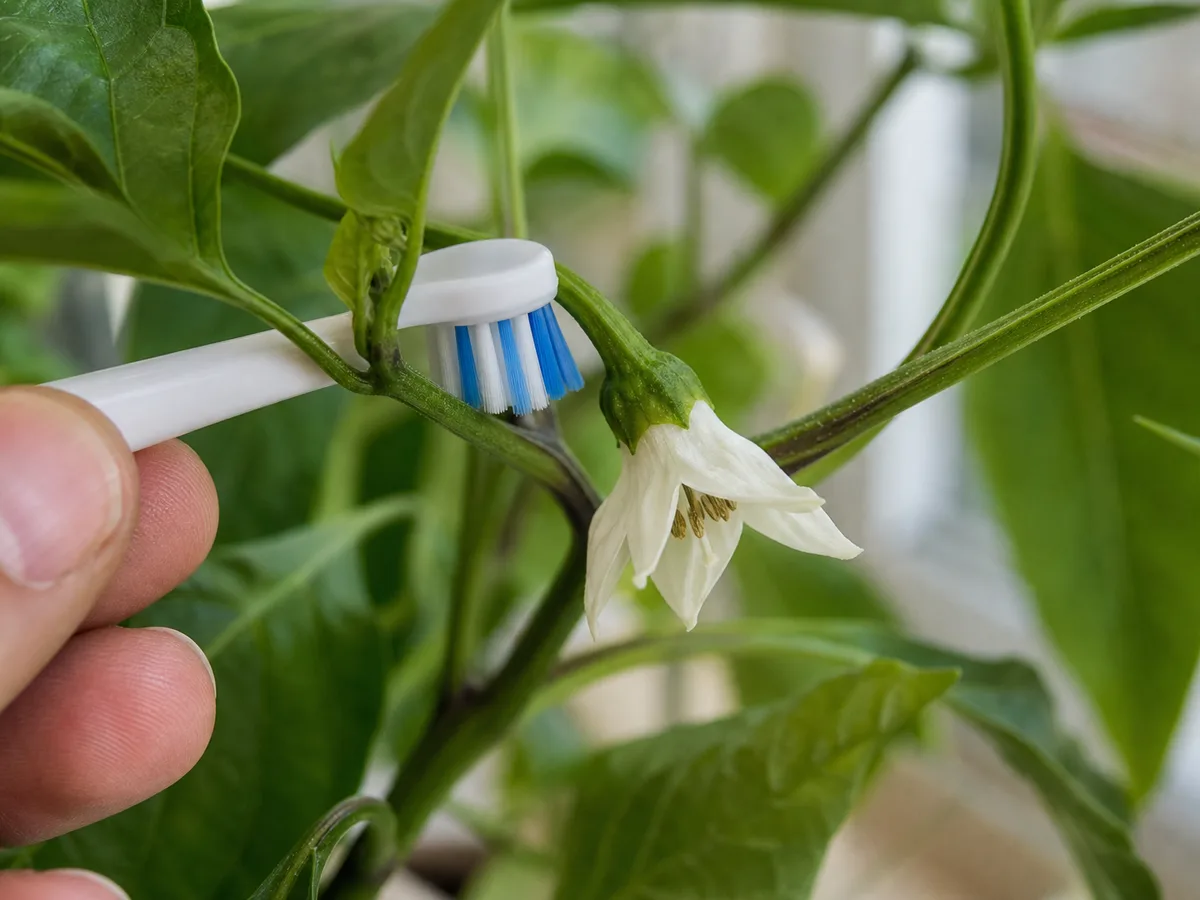
Choose the least-contact method that can move pollen. Tapping suits many healthy flowers, brief vibration helps in still air, and a soft brush gives control when you need to choose the pollen source.
| Method | Best fit | How to use it | Stop or clean when |
|---|---|---|---|
| Tap the branch | Several open flowers on one sturdy plant | Tap a flowering branch lightly so the blooms tremble without whipping the stem | Branches bend sharply or stressed flowers begin to drop |
| Electric toothbrush | A few clusters in still indoor or greenhouse air | Touch the back of the running head briefly to the pedicel or flower support | The tool reaches petals or the flower shakes violently |
| Small soft brush | A few flowers, controlled transfer, or seed-parent tracking | Lift loose pollen from the anthers and touch it lightly to the stigma | Moving to another variety or encountering a diseased flower |
Montana State University Extension recommends applying an electric toothbrush to the back of a flower for about one second when bees are absent. The useful action is vibration, so longer contact and harder pressure do not improve the method.
UC Marin Master Gardeners lists a small brush as an option when pepper pollination is a problem. Keep the bristles clean and dry, and use a separate or sanitized brush between varieties when saved-seed parentage matters.
Pollinate Once, Mark the Flower, Then Wait
Treat hand pollination as one bounded test, not a reason to touch the same flower every day. Select fresh flowers under suitable conditions, apply one gentle method, record what you did, and watch the ovary rather than searching for pollen residue.
- Select: choose newly opened, dry flowers on firm stems and identify comparable untreated flowers.
- Record: write the date, plant or variety, and method on a small tag before handling the flower.
- Move pollen: tap the branch, vibrate the pedicel briefly, or touch loose pollen to the stigma with a clean brush.
- Stop: leave the treated flower alone after one light pass and avoid pulling petals apart to inspect it.
- Compare: watch treated and untreated flowers under the same temperature, light, and watering conditions.
- Recheck: look for petal fade, flower retention, and an ovary that becomes firm and starts to enlarge.
New flowers can receive the same test as they open, but do not turn one treated bloom into a repeated daily task. Repeated handling can damage fragile tissue and makes it harder to tell whether the first treatment changed anything.
The Northern Organic Vegetable Improvement Collaborative and Cornell AgriTech pepper-crossing guide says developing fruit should begin expanding within about one week of pollination. Home fruit-set timing varies, but that interval is more useful than judging success immediately after touching the flower.
Petals normally fade and may fall after fertilization. The important part is the green ovary behind them, which stays attached and grows into a small pepper instead of yellowing, shriveling, or dropping with the whole flower.
A retained flower without enlargement is still inconclusive. Compare the same marked point over several days, and photograph it from the same angle if the change is difficult to see.
Why Do Pepper Flowers Still Drop After Hand Pollination?
Hand pollination cannot correct a flower that never became viable or a fruit that aborts after fertilization. The stage at which growth stops tells you whether to revisit technique, environment, or the whole plant.
University of Maryland Extension connects pepper blossom drop and poor fruit set with cool nights and hot days. Temperature therefore belongs ahead of another round of brushing when treated and untreated flowers fail together.
| Failure pattern | What it suggests | Check next |
|---|---|---|
| Buds fall before they open | The problem started before pollen transfer was possible | Temperature swings, root-zone moisture, light, pests, and overall plant vigor |
| Treated and untreated flowers drop at the same rate | Lack of vibration is less likely to be the main limit | Day and night temperature, humidity, water consistency, and flower health |
| Treated ovaries enlarge while comparable untreated flowers do not | Extra pollen movement may be helping in that location | Continue with newly opened flowers using the same light method |
| A tiny pepper forms, then yellows and drops | Pollination may have occurred before later fruit abortion | Root condition, water swings, heat, nutrient excess, and existing crop load |
| One plant fails while nearby plants set fruit | A plant-specific condition is more plausible than room-wide still air | Roots, pests, disease signs, cultivar condition, and branch health |
Check the root zone several inches below the surface rather than watering from leaf posture alone. Saturated roots, a dry inner root ball, or rapid wet-dry swings can all keep a flowering pepper from carrying new fruit.
Inspect flowers for thrips, aphids, distorted petals, scars, or webbing before moving a brush between plants. A pollination tool can also move pests or contaminated plant material when it is reused without cleaning.
Stop escalating contact when buds fail before opening, the whole plant wilts, or small fruit aborts after it begins to grow. Those patterns require a plant-health diagnosis, while more tapping only adds another disturbance.
When Should You Bag Pepper Flowers?
Bagging and parent labels are unnecessary when you only want peppers to eat. They become useful when you want true-to-type seed or an intentional cross because insects can carry compatible pollen among pepper varieties.
UNH Extension explains that cross-pollination does not change the flavor, shape, or heat of the pepper growing this season. It changes the genetic combination inside the seeds, so plants grown from those seeds may differ from the fruit's parent plant.
| Goal | Flower handling | Record |
|---|---|---|
| Edible fruit this season | Move pollen within the flower or plant without bagging | Date and method only when comparing fruit set |
| True-to-type open-pollinated seed | Bag an unopened bud, allow or assist self-pollination inside the barrier, and protect it through set | Variety, date, isolation method, and marked fruit |
| Intentional cross | Isolate the unopened flower, control both pollen parents, transfer chosen pollen, and rebag | Seed parent, pollen parent, flower, date, and resulting fruit |
Cornell Cooperative Extension recommends bagging a pepper bud before it opens, keeping the barrier in place until fruit set, then removing the bag and marking the fruit. Use a breathable flower bag rather than plastic that traps heat and moisture around the bloom.
Detailed emasculation and controlled crossing require more precision than ordinary home fruit-set work. For an edible harvest, healthy flowers, suitable conditions, light pollen movement, and evidence of ovary growth are enough.
Hand Pollinating Pepper Plants: When Tapping or Brushing Flowers Helps FAQ
- Pollination in Vegetable Gardens and Backyard Fruits - NDSU Extension
- Pollination of Greenhouse Peppers - Bayer Vegetable Seeds
- Pepper Pollination Guide - Cornell AgriTech and eOrganic
- Garden Vegetables and Fruits That Need Pollination - Montana State University Extension
- Peppers - UC Marin Master Gardeners
- Peppers - University of Maryland Extension
- Saving the Future, One Seed at a Time - Cornell Cooperative Extension
- How Do I Save Seeds for Next Year's Garden? - UNH Extension