Germinating Pepper Seeds Near 85°F in an Evenly Moist, Airy Mix
Pepper seeds germinate most reliably near 85°F in an evenly moist, airy seed-starting mix. Many viable lots emerge in 7 to 14 days under favorable conditions.
Pepper seeds germinate most reliably when the seed-starting mix stays near 85°F, evenly moist but still airy, and covered only until seedlings begin to emerge. Many viable lots sprout in 7 to 14 days under favorable conditions, but the packet's stated window and the measured temperature inside the mix matter more than the room temperature.
The dependable method is simple. Pre-moisten a clean soilless mix, sow the seeds shallowly, hold the root zone at a controlled temperature, and inspect the tray every day instead of adding water on a schedule.
What do pepper seeds need to germinate?
A pepper seed needs water to restart growth, oxygen for respiration, and enough warmth for those reactions to proceed. Penn State Extension lists 85°F as the optimum temperature for pepper germination, while Utah State University recommends an 86°F germination setting for pepper transplants.
Measure the mix at seed depth with a probe thermometer.
A room that feels warm can still leave a tray cold near a window, and an unregulated heat mat can make the bottom of a cell hotter than its top.
The three conditions to verify before sowing
- Warm mixSet the probe near seed depth and aim near 85°F.
- Even moistureSqueeze-tested mix should hold together without releasing water.
- Air spaceUse a porous mix and never leave cells standing in water.
Moist does not mean saturated. Water fills the same pore spaces that otherwise hold air, so repeatedly soaking a slow tray can reduce the oxygen the seeds need and increase the chance of decay.
A clear dome or loose cover slows evaporation during germination. Keep it out of direct sun, inspect beneath it daily, and vent briefly if water is running down the cover or pooling on the mix.
A reliable way to germinate pepper seeds
Direct sowing in a tray avoids handling the first delicate root.
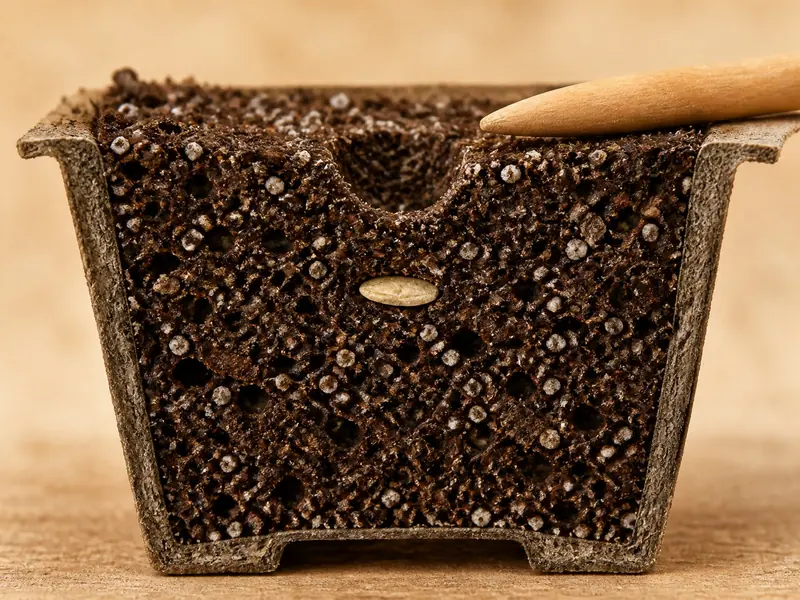
It also gives each seedling an immediate path into the medium once the root breaks through the seed coat.
- Moisten the mix first. Add water to fresh seed-starting mix and stir until it is evenly damp. Fill clean cells without packing them hard.
- Label before sowing. Record the cultivar and date so a late tray is not confused with a later planting.
- Sow shallowly. Place one or two seeds per cell about 1/4 inch deep, then cover them lightly with the same mix.
- Cover and warm the tray. Put the dome on and use a heat mat with a thermostat if the measured root zone is below the target.
- Inspect every day. Look for a pale root or a bent stem lifting the surface. Add a small amount of water only when the upper mix is beginning to lighten and dry.
Bottom watering can rehydrate a drying tray evenly, but drain the tray once the mix has wicked up moisture. The cells should not sit in a reservoir while the seeds are waiting.
Light is not the main trigger for pepper seed germination, so darkness under the mix is normal. Light becomes urgent at emergence, which is why the tray should already have a bright growing area ready.
How long do pepper seeds take to germinate?
Seven to 14 days is a useful favorable-condition range, not a deadline that every cultivar and seed lot must meet. Cooler mix, older seed, uneven moisture, and lot quality can spread emergence across a longer period.
| Observation | What it tells you | What to do |
|---|---|---|
| Some seedlings appear inside the packet window | The setup supports germination, but individual seeds are emerging at different times | Keep the unopened cells evenly moist and continue daily checks |
| No seedlings and the mix measures below 75°F | Temperature is a likely reason for the slow start | Raise the root-zone temperature gradually and keep the original tray |
| No seedlings by the packet's upper window | The tray or seed lot needs a controlled check | Start a backup sowing or a wet-towel sample while leaving the first tray undisturbed |
Germination percentage is the number of normal seedlings divided by the number of seeds tested, multiplied by 100. If 8 of 10 sample seeds germinate, the observed rate is 80 percent.
Federal seed rules list 55 percent as the minimum germination standard for pepper seed moving in interstate commerce. That number is a sale and labeling threshold, not a promise that a home tray should stop at 55 percent and not proof that a lower result came from the grower.
Should you soak pepper seeds before sowing?
Sow untreated pepper seed directly unless you have a reason to compare treatments.
Direct sowing removes an extra handling step and makes the moisture exposure easier to control.
Research on priming does not support a universal claim that a household soak always speeds pepper seed. A 2024 study found that a controlled 24-hour water treatment reduced mean germination time in four Capsicum annuum cultivars, while a separate experiment found no significant improvement from 48-hour or 72-hour hydropriming.
Those results apply to the tested cultivars, treatment lengths, and laboratory conditions. They do not establish chamomile tea, peroxide, bleach, or freezer treatment as a better home method.
If you want to test a plain-water soak, compare equal samples from the same lot. Soak one sample for no more than 24 hours, leave the other dry, sow both immediately under identical conditions, and record time to emergence as well as the final count.
Test questionable seed without digging up the tray
Digging through a planted cell can break a root that has already emerged below the surface. A separate wet-towel test gives better evidence and leaves the original sowing intact.
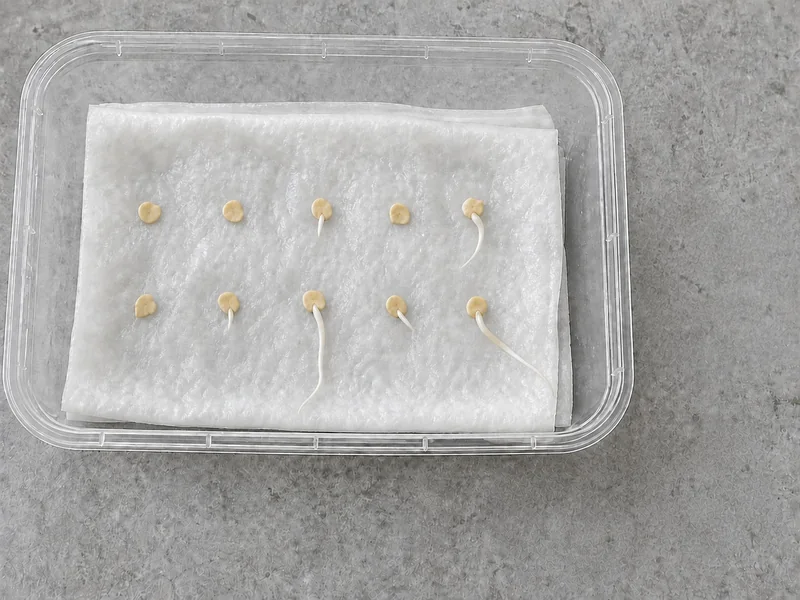
- Choose a representative sample from the same seed lot and count it before starting.
- Moisten a paper towel so it is damp but not dripping, then space the seeds so air can remain around them.
- Fold or roll the towel loosely, place it in a container that limits drying, and label the cultivar and date.
- Keep the sample at the same controlled warmth used for the tray and check it without letting the towel dry out.
- Count seeds that produce a normal root and seedling, then calculate the percentage from the original sample size.
A sample of 10 is easy to calculate, but it gives a rough estimate because each seed changes the result by 10 percentage points.
Use more seeds when the packet contains enough to spare and the planting decision is important.
The test answers whether the lot can germinate under controlled conditions. It does not prove that every planted cell had the same temperature, moisture, depth, or disease pressure.
Why are my pepper seeds not sprouting?
Start with measurements and visible evidence, not a new additive. The first useful question is whether the root zone actually stayed warm and moist without remaining saturated.
| Evidence in the tray | Likely problem | Next move |
|---|---|---|
| Mix is cool when measured at seed depth | Metabolism is slow even if the room feels comfortable | Use controlled bottom heat and check the probe again after the tray stabilizes |
| Mix is glossy, heavy, or smells sour | Pore spaces are water-filled and decay risk is rising | Drain standing water, improve air movement, and start a backup in fresh porous mix |
| Surface repeatedly dries hard | The seed may be losing moisture between waterings | Rehydrate gently and use a cover to reduce evaporation |
| Seed is much deeper than 1/4 inch | A weak seedling may exhaust its reserves before reaching light | Correct the depth in the backup sowing instead of excavating every original cell |
| Control seed sprouts but the target lot does not | The target lot is the main variable | Continue through its stated window, then replace or resow from a known viable lot |
Penn State Extension identifies excess moisture, cool pre-emergence conditions, contaminated materials, and crowding as conditions that favor seed rot or damping off. Fresh soilless mix and clean trays lower that risk, but they cannot rescue seed that was already nonviable.
Do not keep increasing both heat and water at the same time.
Change one measurable condition, record it, and start a labeled backup when the packet's upper window has passed so the calendar does not depend on one uncertain tray.
Are superhot pepper seeds harder to germinate?
Heat level does not tell you why a seed failed. The word superhot describes the fruit's capsaicinoid heat, while germination is also shaped by cultivar genetics, seed maturity, storage, age, and the conditions around the seed.
Research collections of Capsicum chinense show meaningful differences among accessions and genotypes. That variation is why a universal claim that every superhot seed needs a fixed 21-day or 30-day wait is less useful than the cultivar packet, a measured tray, and a viable comparison seed.
Give a cultivar the longer window stated by its supplier when one is provided. At the same time, sow a known viable pepper lot under the same conditions, because a control that emerges separates a seed-lot problem from a whole-tray problem.
When the first seedling breaks the surface
Emergence changes the job immediately.
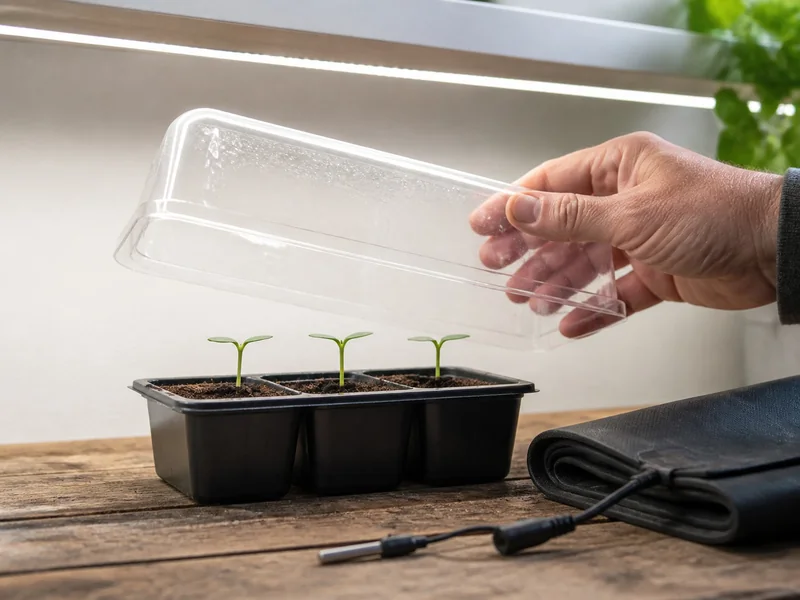
Remove the humidity cover, move the tray under strong light, and take it off germination heat unless the growing area itself is unusually cold.
- Place the light close enough to prevent stretching, following the fixture maker's safe distance.
- Keep the mix moist around the small roots without restoring the sealed, saturated environment used before emergence.
- Let later cells continue to emerge, but do not hold the first seedlings in a hot covered tray while waiting for every seed.
From this point, light, airflow, thinning, potting up, and hardening off belong to seedling care rather than germination. Continue with the full growing sequence once the cotyledons have opened.
Germinating Pepper Seeds Near 85°F in an Evenly Moist, Airy Mix FAQ
- Seed and Seedling Biology
- Starting Vegetable Seeds Indoors: Germination
- Pepper Transplant Production
- Procedures for the Wet Towel Germination Test
- Damping Off
- 7 CFR Part 201, Federal Seed Act Regulations
- Variety Selection and Seed Saving for Organic Growers
- Seed Priming Improves Germination in Capsicum annuum Cultivars
- Effect of Priming Treatments on Pepper Seed Germination
- Biomorphological Characterization of Brazilian Capsicum chinense Germplasm