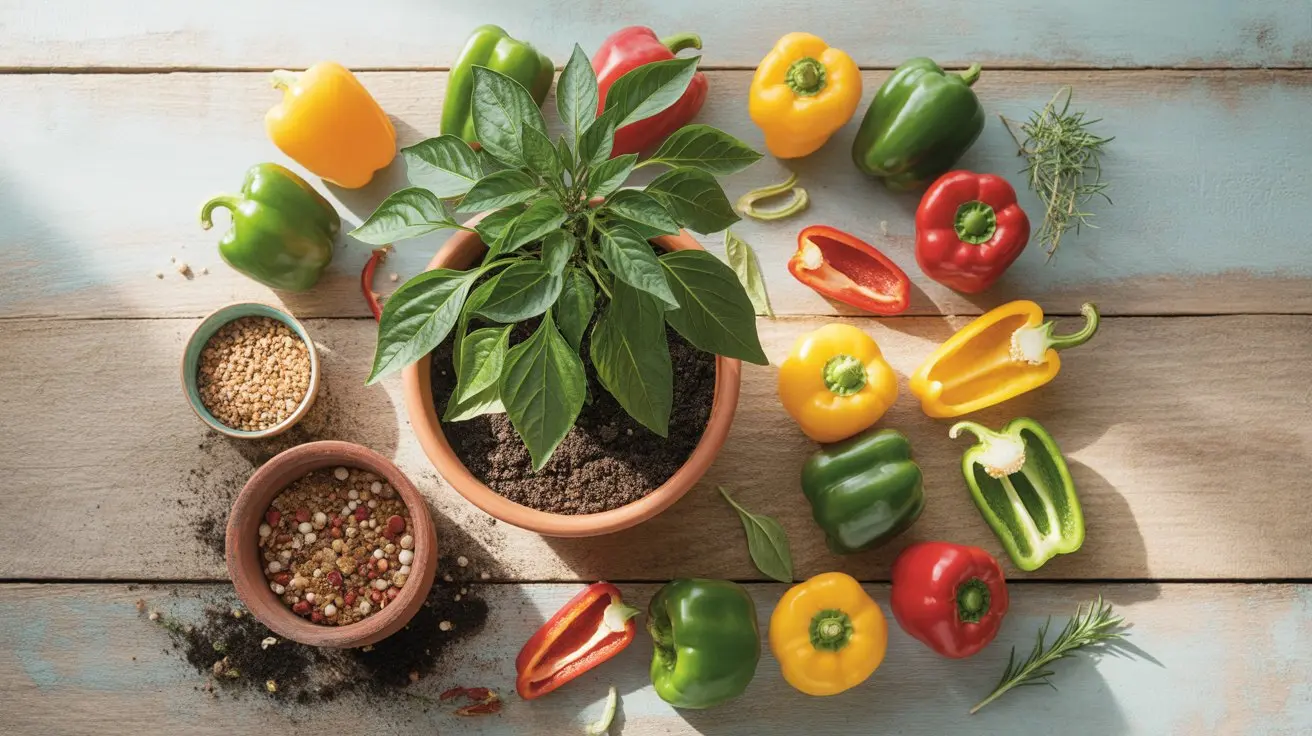
How to Fertilize Pepper Plants
Pepper fertilizer schedule from seedling to harvest. We cover NPK ratios, organic options, when to switch from nitrogen to phosphorus, and signs of defi...

Why Most Pepper Growers Get Fertilizer Wrong
My first serious pepper season ended with beautiful dark green plants that barely set fruit. Nitrogen overload — I kept pushing the same balanced fertilizer straight through summer without switching gears. That mistake taught me more about pepper nutrition than any seed catalog ever did.
Pepper plants have dramatically different nutritional demands depending on their growth stage. Feed them the wrong ratio at the wrong time and you get lush foliage with empty branches, or worse, burned roots and stunted plants.
Understanding NPK for Peppers
NPK stands for nitrogen (N), phosphorus (P), and potassium (K) — the three macronutrients listed on every fertilizer bag. The numbers represent the percentage of each by weight.
Nitrogen drives leafy green growth. Phosphorus supports root development, flowering, and fruiting. Potassium regulates water movement, disease resistance, and overall plant vigor. Peppers need all three, but the ratio shifts as the season progresses.
Secondary nutrients also matter. Calcium prevents blossom end rot, magnesium supports chlorophyll production, and sulfur aids enzyme function. A complete fertilizer program accounts for all of these.
Most pepper varieties — from the mild Fresno's approachable medium heat to the compact ornamental Prairie Fire's intense clustered pods — respond well to the same basic NPK progression. What changes is the scale of feeding based on plant size and pot volume.
Pre-Plant Soil Preparation
Fertilizing starts before seeds go in the ground. Building a strong soil foundation reduces how much supplemental feeding you'll need later.
Work 2-4 inches of compost into your planting bed or container mix. Compost provides a slow-release baseline of nutrients while improving drainage and water retention simultaneously.
For in-ground beds, a soil test from your local extension office will tell you exactly what's deficient. A pH between 6.0 and 6.8 is the sweet spot for pepper nutrient uptake — outside that range, plants can't absorb certain minerals even when they're present in the soil.
If your soil test shows phosphorus deficiency, incorporate bone meal or rock phosphate at planting. These slow-release forms will be available to roots for months without risk of burning young seedlings.
Seedling Stage: Light Nitrogen, Gentle Start
Seedlings are sensitive. Their root systems are small and undeveloped, which makes them vulnerable to fertilizer burn from concentrated salts.
Start feeding at 25-50% of the recommended dose once seedlings develop their first true leaves — typically 2-3 weeks after germination. A balanced formula like 10-10-10 or a diluted liquid fish emulsion works well here.
Frequency matters more than concentration at this stage. Feeding every 10-14 days with a diluted solution gives roots consistent access to nutrients without overwhelming them.
Avoid high-nitrogen formulas on seedlings. Too much nitrogen early produces succulent, soft growth that's more susceptible to damping off and transplant shock. The goal is steady, sturdy development — not explosive size.
For growers following a full step-by-step pepper growing walkthrough, seedling nutrition is one of the most commonly skipped details, and it shows at harvest time.
Vegetative Growth: Ramp Up Nitrogen
Once plants are in their final containers or garden beds and showing strong new growth, nitrogen becomes your primary tool. This phase runs from transplant through the first flower buds appearing — roughly 4-8 weeks depending on your climate and variety.
A fertilizer ratio of 5-1-2 or similar nitrogen-forward blend feeds the leaf and stem expansion that will eventually support a heavy fruit load. Liquid formulas applied every 7-10 days give you precise control over feeding intensity.
Slow-growing varieties like the Teja Chili's thin-walled Indian pod structure may need slightly less nitrogen than larger-fruited types, since their plants naturally stay more compact. Bigger varieties with heavy branching can handle more aggressive nitrogen feeding during this window.
Watch leaf color closely. Deep, even green is your target. Yellowing between leaf veins often signals magnesium deficiency — a foliar spray of Epsom salt (1 tablespoon per gallon) corrects this quickly without disrupting your main fertilizer program.
The Critical Transition: Switching to Phosphorus and Potassium
This is where most growers either win or lose their season. When flower buds first appear, nitrogen needs to step back and phosphorus needs to step forward.
Continuing high-nitrogen feeding after buds form pushes the plant to keep making leaves instead of setting fruit. Flowers drop, pods are sparse, and the plant looks lush but unproductive — exactly what happened in my first season.
Switch to a formula with a higher middle number, like 5-10-10 or 3-15-15, as soon as you see the first buds. This shift signals the plant to redirect energy into reproductive growth.
Potassium becomes increasingly important through fruiting. It regulates the movement of sugars from leaves into developing pods, which directly affects pod size, wall thickness, and flavor concentration. A potassium-heavy formula during peak fruiting is standard practice among serious growers.
The Sugar Rush Stripey's exceptionally sweet pod flavor is partly genetic, but potassium availability during fruit development plays a real role in how much of that sweetness actually expresses itself at harvest.
Organic Fertilizer Options
Synthetic fertilizers offer precision and speed, but organic options build soil biology over time and reduce the risk of salt buildup in containers.
Bone meal (3-15-0) is the organic equivalent of a phosphorus boost — ideal for the transition to flowering. It releases slowly, so apply it a week or two before buds appear for best timing.
Kelp meal provides a broad spectrum of trace minerals and natural growth hormones. It's not a primary nutrient source, but it supports overall plant health in ways that synthetic programs sometimes miss.
Worm castings mixed into potting soil at 10-20% by volume provide slow, gentle nutrition that won't burn roots. They're particularly useful for seedlings and young transplants.
Compost tea — brewed from finished compost and aerated for 24-48 hours — delivers soluble nutrients and beneficial microbes directly to the root zone. Apply as a soil drench every 2-3 weeks as a complement to your main feeding program.
Container vs. In-Ground Fertilizing
Container plants need more frequent feeding than in-ground plants. Every time you water, nutrients leach out through drainage holes. A pepper in a 5-gallon pot may need feeding every 7 days during peak growth, while an in-ground plant in amended soil might only need supplemental fertilizer every 2-3 weeks.
Pot size also affects concentration. Smaller containers concentrate salts more quickly, which can burn roots. If you're growing in pots smaller than 3 gallons, reduce fertilizer concentration by half and increase frequency instead.
In-ground peppers benefit from a side-dress of granular fertilizer mid-season. Apply 1-2 tablespoons of a balanced granular formula in a ring around the plant's drip line, then water in thoroughly. This gives a slow nutrient release over several weeks without the labor of weekly liquid feeding.
Varieties like the smoke-dried Chipotle's thick-walled jalapeño base are typically grown in-ground where consistent soil moisture and nutrition support their relatively long growing season. Container growing these heavier producers requires diligent feeding to compensate for the restricted root zone.
Reading Deficiency Signs
Plants communicate nutritional problems clearly if you know what to look for. Catching deficiencies early saves the season.
- Pale yellow leaves overall: Nitrogen deficiency — increase nitrogen feeding or apply fish emulsion immediately
- Yellow between leaf veins, green veins remain: Magnesium or iron deficiency — check pH first, then apply Epsom salt foliar spray
- Dark purple leaf undersides: Phosphorus deficiency, often triggered by cold soil temperatures below 55°F rather than actual soil shortage
- Brown leaf edges: Potassium deficiency or fertilizer salt burn — flush the soil with plain water, then resume feeding at reduced concentration
- Blossom end rot on pods: Calcium deficiency or inconsistent watering disrupting calcium uptake — apply calcium spray directly to developing pods
- Stunted growth with dark green leaves: Phosphorus excess blocking zinc or iron uptake — reduce phosphorus and check soil pH
Overfertilizing is as damaging as underfertilizing. If leaves curl, develop brown tips, or the plant wilts despite adequate moisture, flush the root zone with plain water and hold off feeding for 1-2 weeks.
Seasonal Fertilizer Schedule at a Glance
- Pre-plant: Amend beds with compost; incorporate bone meal if phosphorus is low; test and adjust pH to 6.0-6.8
- Seedling (weeks 2-6): Balanced formula at 25-50% dilution every 10-14 days
- Early vegetative (weeks 6-10): Nitrogen-forward formula (5-1-2 or similar) every 7-10 days
- Late vegetative / pre-flower (weeks 10-14): Transition to balanced formula; begin reducing nitrogen
- Flowering and fruit set: Switch to phosphorus and potassium-heavy formula (5-10-10 or 3-15-15); feed every 7-10 days
- Peak fruiting: Maintain potassium-forward feeding; supplement calcium if blossom end rot appears
- Late season: Reduce or stop feeding 3-4 weeks before first frost to allow remaining pods to mature
Micronutrients Worth Knowing
Macronutrients get all the attention, but trace minerals quietly determine whether a plant reaches its full potential or falls short.
Calcium is critical for cell wall integrity in developing pods. Inconsistent watering is usually the culprit when calcium deficiency appears, even in calcium-rich soil — the plant can't move calcium without steady water flow through its tissues.
Boron supports pollen viability and fruit set. Deficiency is rare in amended soil but shows up as distorted new growth and poor fruit set. A single foliar application of borax solution (1 teaspoon per gallon) typically resolves it.
Zinc affects overall growth regulation and is often locked out when phosphorus levels are too high or soil pH drifts above 7.0. Small, distorted new leaves are the telltale sign.
A quality all-in-one fertilizer that includes chelated micronutrients covers most of these bases without requiring separate applications. Look for products that list iron, manganese, zinc, boron, and copper on the label.
Pepper Varieties and Fertilizer Demands
Not all peppers are equally demanding. Understanding the general nutritional profile of your variety helps calibrate your feeding program.
High-yielding, large-fruited varieties need more total nutrition to support their output. A productive plant like those producing the jalapeño's familiar medium-heat thick walls benefits from consistent feeding throughout the season because it's continuously setting new pods while earlier ones mature.
Ornamental and compact varieties are less demanding. Plants producing small pods in dense clusters — like those in the hot pepper category of ornamentals — often perform well with less frequent feeding because their overall biomass and fruit load is lower.
Long-season varieties that take 100+ days to maturity need sustained nutrition over a longer window. Plan your fertilizer program with that extended timeline in mind rather than tapering off in late summer as you might with faster-maturing crops.
Peppers across the mild pepper range through extreme heat varieties share the same fundamental nutritional needs — the NPK progression doesn't change based on capsaicin content. What changes is plant architecture, fruit size, and season length, all of which affect how much total fertilizer you'll use.
Common Mistakes to Avoid
Fertilizing too early in cold soil is one of the most common errors. Roots can't absorb nutrients efficiently below 60°F, and applying fertilizer before soil warms just means those nutrients leach away before the plant can use them.
Using the same formula all season is the other big one — the mistake that cost me a season's worth of fruit. Peppers need different ratios at different stages, and a one-size-fits-all approach always favors one stage at the expense of another.
Foliar feeding is sometimes oversold as a shortcut. Spraying diluted fertilizer on leaves can correct specific deficiencies quickly, but it doesn't replace soil feeding — leaves simply can't absorb enough volume to meet a plant's full nutritional needs.
Finally, never fertilize a water-stressed plant. Concentrated nutrients in dry soil burn roots. Always water first, let the soil absorb moisture, then apply fertilizer solution. This single habit prevents most fertilizer burn issues.
Frequently Asked Questions
-
Switch to a phosphorus and potassium-heavy formula like 5-10-10 or 3-15-15 once flower buds appear. High nitrogen at this stage causes flowers to drop and reduces fruit set significantly.
-
Container peppers typically need feeding every 7 days during active growth because nutrients leach out with each watering. In-ground plants in amended soil usually need supplemental fertilizer every 2-3 weeks.
-
Yes — Epsom salt (magnesium sulfate) corrects magnesium deficiency, which shows as yellowing between leaf ve