Habanero vs Jalapeño: Heat, Flavor & Key Differences
The habanero and jalapeño both trace their roots to Mexico, but they occupy entirely different positions on the heat spectrum. At 100,000-350,000 SHU, the habanero can be more than 40 times hotter than a jalapeño's 2,500-8,000 SHU. Beyond heat, their flavor profiles diverge sharply — fruity and citrusy versus bright and grassy — making each pepper suited to different cooking applications.

Habanero measures 100K–350K SHU while Jalapeño registers 3K–8K SHU — making Habanero 44× hotter. Habanero is known for its fruity and citrusy flavor (C. chinense), while Jalapeño offers bright and grassy notes (C. annuum).
- Heat difference: Habanero is 44× hotter
- Species: C. chinense vs C. annuum
- Best for: Habanero excels in hot sauces and extreme dishes, Jalapeño in fresh salsas and mild recipes
Habanero
Extra-HotJalapeño
MediumHabanero vs Jalapeño Comparison
Habanero vs Jalapeño Heat Levels
Before the numbers, consider the burn itself. A jalapeño delivers a straightforward, manageable heat that builds slowly and fades cleanly — it's the pepper most people use as their baseline for 'spicy.' A habanero hits differently: the initial fruity sweetness gives way to an intense, lingering heat that spreads across the palate and stays.
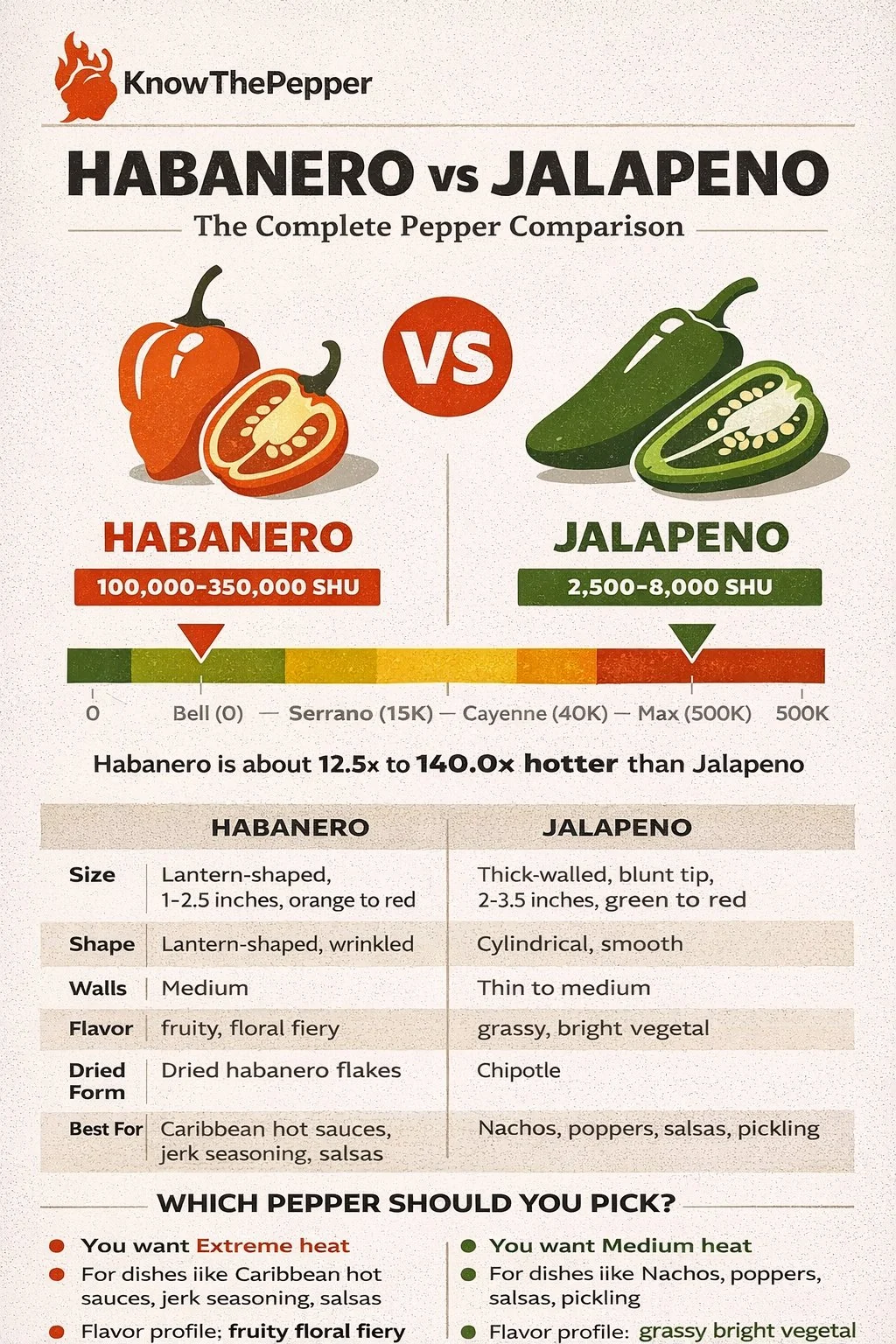
Now the numbers. The jalapeño's medium-tier heat sits at 2,500-8,000 SHU, making it approachable for most eaters. The habanero, firmly in the extra-hot heat category, registers 100,000-350,000 SHU. At minimum, that's a 12x difference. At maximum, a fully ripe habanero can be 140 times hotter than a mild jalapeño specimen.
The practical multiplier most cooks should remember: an average habanero runs about 40-50 times hotter than a typical grocery store jalapeño. That's not a small step up — it's a category change.
The difference comes down to capsaicin chemistry and how it activates heat receptors. Habaneros belong to C. chinense, a species known for producing high capsaicinoid concentrations. Jalapeños are C. annuum, the most widely cultivated pepper species, which generally produces moderate capsaicin levels.
Heat also varies within each pepper. Jalapeños with corky streaking (called 'corkiness') tend to run hotter. Habaneros picked before full ripeness are somewhat milder, though still dramatically hotter than any jalapeño.
Flavor Profile Comparison
Few peppers balance heat and flavor as well as the habanero.
Few peppers have earned their reputation as thoroughly as the jalapeño.
Heat aside, these two peppers taste genuinely different — and that matters as much as the SHU gap when choosing between them.
The habanero's fruity, citrus-forward flavor profile is distinctive enough that experienced cooks can identify it blind. There's a tropical quality — hints of mango, peach, and apricot — that makes habanero hot sauces taste complex rather than just hot. That fruitiness isn't a consolation prize for the heat; it's the reason habaneros show up in Caribbean cuisine, fruit-based salsas, and glazes where the pepper needs to contribute flavor, not just fire.
Jalapeños read as bright and grassy, with a clean vegetal quality that complements rather than competes with other ingredients. Fresh jalapeños have a mild bitterness and a slight tang. Roasted or smoked (as chipotle), they develop a deep, earthy richness that transforms the flavor entirely.
Aroma differs too. Cut a habanero and the room fills with a sweet, almost floral scent — deceptive given what follows. Jalapeños smell green and fresh, more like a bell pepper than anything tropical.
Culinary substitution between the two is possible but requires adjustment. Replacing a jalapeño with habanero means using a fraction of the quantity and accepting a flavor shift toward the fruity end. Going the other direction — using jalapeño where habanero is called for — adds grassy brightness but loses the tropical depth entirely.
For a comparison that splits the difference between these flavor worlds, the heat and flavor contrast between aji amarillo and habanero is worth understanding — aji amarillo offers its own fruity heat that sits between the two.
Culinary Uses for Habanero and Jalapeño
These peppers rarely compete for the same recipe slot. Their heat gap is too large and their flavors too distinct for direct swaps without significant recipe adjustments.
Jalapeños shine wherever you want background heat with broad appeal. Nachos, queso, pico de gallo, jalapeño poppers, cornbread — these are dishes where the pepper supports other flavors without overwhelming them. The jalapeño's grassy, approachable flavor makes it the default choice when cooking for mixed heat tolerances. Pickling jalapeños mellows the heat further while adding a tangy brightness that works on sandwiches, tacos, and grain bowls.
Habaneros are flavor-forward peppers that work best when the recipe is built around them. Caribbean jerk marinades, mango habanero hot sauce, fruit salsas, and spicy glazes for grilled proteins — these applications let the habanero's tropical character come through. A single habanero can season an entire pot of soup for four people. Use them where you want heat AND a specific flavor contribution.
Substitution ratios matter here. If a recipe calls for 1 habanero and you want to use jalapeño instead, start with 6-8 jalapeños and expect a flavor shift toward grassy rather than fruity. Going the other direction — 1 jalapeño replaced by habanero — use roughly 1/8 of a habanero and taste as you go.
For context on how jalapeños compare at the milder end of the spectrum, the heat gap between banana pepper and jalapeño illustrates how even 'mild' peppers vary significantly. Similarly, the heat and flavor differences between Anaheim pepper and jalapeño show how C. annuum varieties can range widely in character.
If you need alternatives that match the habanero's fruity heat, Scotch bonnets are the closest functional substitute — same species, similar SHU range, comparable tropical flavor. For habanero heat without the fruit notes, a small amount of cayenne can approximate the intensity but not the flavor.
Both peppers freeze well. Habaneros can go in whole; jalapeños are better sliced first. Neither needs blanching before freezing.
Which Should You Choose?
Choose based on two factors: your heat tolerance and the flavor role the pepper needs to play.
For everyday cooking — tacos, dips, eggs, sandwiches — the jalapeño is the practical choice. It's widely available, predictable in heat, and its grassy brightness works with almost everything. It's also forgiving; if you add too much, the dish is still edible.
For hot sauces, Caribbean-inspired dishes, fruit-based salsas, or any recipe where you want the pepper to carry a tropical, citrusy flavor note alongside serious heat, the habanero earns its place. Just respect the 40-50x heat multiplier relative to a typical jalapeño — a little goes a long way.
If you're heat-curious but not yet heat-experienced, start with jalapeños and work toward habaneros gradually. If you're already comfortable with jalapeños and want the next level, habaneros are a significant but rewarding jump. Use the Scoville scale testing methodology to calibrate expectations before committing to a full habanero in any dish.
Can You Substitute One for the Other?
Proceed with caution. Habanero is 44× hotter than Jalapeño.
Need a different option altogether? Search for peppers that match your target heat and flavor with precise swap ratios.
Growing Habanero vs Jalapeño
If you’re deciding which pepper to grow at home, consider your climate and patience level. Habanero and Jalapeño have different maturation times and temperature preferences. Hotter varieties generally need a longer, warmer growing season to develop their full capsaicin content. Our zone-based planting date tool can pinpoint the best sowing window for your area.
Starting habaneros from seed requires patience. Germination takes 10–21 days at soil temperatures of 80–85°F — a heat mat is not optional, it's essential.
Transplant seedlings outdoors only after nighttime temperatures stay consistently above 55°F. Habaneros are frost-intolerant and will stall in cold soil.
Full sun — at least 6–8 hours daily — is non-negotiable. In containers, use a 5-gallon minimum; habaneros develop substantial root systems.
Jalapeños are among the most forgiving hot peppers to grow, but they do have preferences worth knowing.
Start seeds indoors 8–10 weeks before your last frost date. Soil temperature for germination should stay between 75–85°F — a heat mat under the seed tray makes a real difference in germination speed and uniformity.
Transplant outdoors once nighttime temps stay consistently above 55°F. Jalapeños want full sun — at least 6 hours daily — and well-drained soil with a pH around **6.
History & Origin of Habanero and Jalapeño
Both peppers carry centuries of culinary heritage. Habanero traces its roots to Mexico, while Jalapeño originates from Mexico. Understanding their backstory helps explain why each pepper developed its distinctive traits.
Buying & Storage
Whether you’re shopping for Habanero or Jalapeño, the same quality indicators apply. Fresh peppers should feel firm and heavy for their size, with taut, glossy skin and no soft or wet spots. Minor stem cracks known as “corking” are perfectly normal and often indicate a mature, flavorful pod.
- Firm pods with taut skin and consistent color
- Should feel heavy relative to size
- Minor stem cracks (“corking”) are normal
- Avoid anything soft, shriveled, or with dark wet spots
- Fresh: Paper bag, crisper drawer — 1–2 weeks
- Frozen: Wash, dry, freeze on sheet pan — 6+ months
- Dried: Airtight, away from light — up to 1 year
The Verdict: Habanero vs Jalapeño
Habanero and Jalapeño occupy very different positions on the heat spectrum. Habanero delivers 44× more heat with its distinctive fruity and citrusy character. Jalapeño, with its bright and grassy profile, excels in everyday cooking.
Frequently Asked Questions
Related Comparisons
Sources pending verification.