
Facing Heaven vs Tien Tsin: Wok Chile Differences

Choose Facing Heaven pepper when the dish needs aromatic Sichuan-style dried chile flavor, especially in chili oil, braises, or dishes where the chile remains visible. Choose Tien Tsin when you want sharper whole-pod heat for quick wok dishes. They are both Chinese dried chiles, but they do not work the same way in hot oil.

Facing Heaven and Tien Tsin peppers side by side with sliced pods on a wooden board
Quick Comparison

Facing Heaven Pepper measures 30K–50K SHU while Tien Tsin registers 50K–75K SHU. That makes Tien Tsin about 1.5x hotter by upper SHU range. Facing Heaven Pepper is known for its fruity and smoky flavor (C. annuum), while Tien Tsin offers sharp and smoky notes (C. annuum).

Facing Heaven Pepper
30K–50K SHU
Hot · fruity and smoky
Tien Tsin
50K–75K SHU
Hot · sharp and smoky
  • Heat difference: Tien Tsin is about 1.5× hotter by upper SHU range
  • Species: Both are C. annuum
  • Best for: Facing Heaven Pepper excels in everyday cooking and salsas, Tien Tsin in hot sauces and spicy dishes

Facing Heaven Pepper vs Tien Tsin Comparison

Attribute Facing Heaven Pepper Tien Tsin
Scoville (SHU) 30K–50K 50K–75K
Heat Tier Hot Hot
vs Jalapeño 6x hotter 9x hotter
Flavor fruity and smoky sharp and smoky
Species C. annuum C. annuum
Origin China China

Facing Heaven Pepper vs Tien Tsin Heat Levels

Position on the Scoville Scale
Facing
Tien
0 SHU3.2M SHU

Tien Tsin is about 1.5× hotter than Facing Heaven Pepper.

Facing Heaven Pepper spans 30K–50K SHU, roughly 6× a jalapeño at the upper end. Tien Tsin spans 50K–75K SHU, about 9× a jalapeño at the upper end. Use the ranges to decide whether the recipe needs a measured dose, a mild overlap, or a hard substitution limit. Tools: Scoville chart and SHU calculator.

Flavor Profile Comparison

Facing Heaven Pepper
fruity smoky C. annuum

The name comes from how the pods grow: straight up, facing the sky. That visual quirk made it iconic in Chinese markets long before it became a staple in Sichuan hot pots and chili oils.

Heat-wise, 30,000-50,000 SHU puts this pepper firmly in the the hot-tier SHU range - about 10 times hotter than a jalapeño and comparable to the vivid fruity burn of Aji Limo. The heat builds steadily rather than hitting all at once, giving you time to appreciate what's happening before the capsaicin fully arrives.

Tien Tsin
sharp smoky C. annuum

Named after the northern Chinese city now spelled Tianjin, this slender C. annuum variety has been central to Chinese cooking for centuries. The pods grow 2-3 inches long, tapering to a fine point, and ripen from green to a vivid red that deepens as they dry.

At 50,000-75,000 SHU, Tien Tsin sits firmly in the hot pepper heat range - that sustained burn zone where heat lingers on the palate rather than fading quickly. Compare that to a serrano at around 10,000-23,000 SHU and you get a sense of the gap.

Both peppers belong to C. annuum, so they share some underlying flavor chemistry. However, Facing Heaven Pepper’s fruity and smoky notes contrast with Tien Tsin’s sharp and smoky character.

Facing Heaven Pepper brings fruity and smoky notes, so it fits recipes where that flavor should remain visible. Tien Tsin leans sharp and smoky, which can change the sauce, filling, marinade, or garnish even when the heat range looks close.

Facing Heaven Pepper and Tien Tsin comparison

Culinary Uses for Facing Heaven Pepper and Tien Tsin

Facing Heaven Pepper

Toasting dried Facing Heaven peppers in a dry wok is the starting point for most Sichuan preparations. The aroma that comes off a hot wok - smoky, faintly sweet, with a roasted depth - signals the pepper releasing its fat-soluble compounds.

For peppers in Chinese cooking, Facing Heaven is the reference point. It goes into mapo tofu, kung pao chicken, and the red-stained chili oil that defines Sichuan hot pot.

Whole dried pods are often left intact in dishes and eaten around rather than consumed directly. Ground into flakes or powder, the pepper works in dry rubs for roasted meats.

Tien Tsin

Kung Pao chicken is the dish most people associate with Tien Tsin - those whole dried red pods charred briefly in hot oil until they just begin to blacken. That quick char is the technique: the pods release their smoky heat into the oil, which then coats every other ingredient in the wok.

Beyond stir-fries, dried Tien Tsin pods work in chili oils, Sichuan braises, and any preparation where whole dried chilies are toasted and infused. For homemade hot sauce, the dried pods rehydrate well and produce a sauce with clean, sharp heat rather than the rounded sweetness of fresher varieties.

Fresh pods can be sliced thin for pickles or chopped into dipping sauces, though most culinary use is in the dried form. The thin flesh means they can be ground into flakes or powder without a dehydrator - just air-dry them in a warm spot for a week.

Which Should You Choose?

Best fit

Choose Facing Heaven Pepper if…

You want milder heat
You prefer fruity and smoky flavors
You need a C. annuum variety

Best fit

Choose Tien Tsin if…

You want maximum heat
You prefer sharp and smoky flavors
You need a C. annuum variety

Can You Substitute One for the Other?

Start near 1:1 by amount. The heat ranges are close enough that flavor, form, and recipe role matter more than a strict Scoville conversion.

Growing Facing Heaven Pepper vs Tien Tsin

Growing notes

Facing Heaven Pepper

Facing Heaven performs best in warm climates with long summers - think USDA zones 8-11 for outdoor growing, though container cultivation extends the range considerably. Seeds germinate in 10-21 days at soil temperatures around 80-85°F.

The upright pod orientation isn't just aesthetically interesting - it actually helps with air circulation around the fruit, reducing fungal pressure during humid stretches. Plants reach 24-36 inches tall and benefit from staking once they're loaded with pods.

For companion planting strategy, the pepper companion planting guide covers what works well alongside C. annuum varieties like this one. Basil and carrots are solid neighbors; fennel is not.

Growing notes

Tien Tsin

Tien Tsin is a rewarding garden pepper once it gets established, though germination requires patience. Start seeds indoors 8-10 weeks before last frost.

Transplant outdoors after all frost risk passes, spacing plants 18 inches apart in full sun. The plants grow to about 2-3 feet tall and tend to branch heavily, which means good airflow matters.

For a complete seed-starting germination walkthrough for hot pepper varieties, the basics apply here: consistent moisture without waterlogging, bright light from the start, and hardening off over 7-10 days before outdoor planting.

Where They Come From

Origin & background

Facing Heaven Pepper

China · C. annuum

Chili peppers arrived in China via Portuguese and Spanish trade routes in the late 16th century, and by the 18th century they had transformed the cuisines of Sichuan, Hunan, and Guizhou provinces. The Facing Heaven variety emerged as a regional selection prized for its upright pod orientation - practical for harvesting and drying - and its exceptional flavor complexity.

The Chinese pepper cultivation tradition developed distinct regional varieties, and Facing Heaven became synonymous with Sichuan cooking. It appears extensively in doubanjiang (fermented chili bean paste), chili oils, and the aromatic base of countless braised dishes.

Origin & background

Tien Tsin

China · C. annuum

Tien Tsin chilies take their name from Tianjin, a major port city in northeastern China. Trade routes through that region in the 19th century helped distribute the variety widely, both within China and eventually to Western markets where Chinese cooking ingredients were increasingly sought after.

In Chinese cuisine, small dried red chilies of this type have appeared in records going back several hundred years, particularly in Sichuan and Hunan provinces where the regional pepper tradition built entire flavor profiles around their sharp heat. The pepper gained wider Western recognition as Chinese-American restaurants popularized dishes like Kung Pao chicken, which relies on whole dried Tien Tsin pods for its characteristic heat.

Buying & Storage

Whether you’re shopping for Facing Heaven Pepper or Tien Tsin, the same quality indicators apply. Fresh peppers should feel firm and heavy for their size, with taut, glossy skin and no soft or wet spots. Minor stem cracks known as “corking” are perfectly normal and often indicate a mature, flavorful pod.

Selection

What to look for

  • Firm pods with taut skin and consistent color
  • Should feel heavy relative to size
  • Minor stem cracks (“corking”) are normal
  • Avoid anything soft, shriveled, or with dark wet spots

Storage

How to store them

  • Fresh: Paper bag, crisper drawer, 1 to 2 weeks
  • Frozen: Wash, dry, freeze on sheet pan, 6+ months
  • Dried: Airtight and away from light, up to 1 year

Mistakes to avoid

Common misses

Facing Heaven Pepper

  • Blaming the seeds. Membranes hold most capsaicin.
  • Adding heat too early. Capsaicin breaks down with cooking.
  • Not tasting individual pods. Heat varies 30%+.

Common misses

Tien Tsin

  • Blaming the seeds. Membranes hold most capsaicin.
  • Adding heat too early. Capsaicin breaks down with cooking.
  • Not tasting individual pods. Heat varies 30%+.
Final call

Facing Heaven Pepper vs Tien Tsin

Facing Heaven Pepper and Tien Tsin sit in the same heat tier but serve different roles. Tien Tsin delivers about 1.5× more upper-range heat with its distinctive sharp and smoky character. Facing Heaven Pepper, with its fruity and smoky profile, excels in everyday cooking.

Heat gap about 1.5× by upper range Facing Heaven Pepper fruity and smoky Tien Tsin sharp and smoky
Additional Facing Heaven Pepper and Tien Tsin comparison view

Wok Aroma Test

Smell is the fastest test. Facing Heaven gives a rounder toasted aroma first, with fruit and faint smoke showing before the burn lands.

Tien Tsin announces itself more sharply. In a hot wok it turns dry, pungent, and direct, which is why it makes sense in dishes where whole pods perfume the oil and then sit beside the main ingredients.

If the dish depends on chile fragrance after the heat fades, Facing Heaven is the safer pick. If the dish needs a short, hard bite from whole dried pods, Tien Tsin has the cleaner job.

Whole Pod Or Flake

Keep Tien Tsin whole when you want heat in the oil but not a mouthful of chile skin. Crush or snip Facing Heaven when the flakes should become part of the sauce, especially in Chinese pepper cooking with chile oil, braises, or dry-fried dishes.

Oil Timing

Timing changes the result more than the label. Facing Heaven can tolerate a slower bloom because the aroma is part of the payoff.

Tien Tsin needs a shorter window. Let the pods darken too far and the oil turns bitter before the rest of the dish catches up.

For chili oil, start Facing Heaven in warm oil and judge by fragrance. For Kung Pao-style cooking, move Tien Tsin through hot oil quickly, then let peanuts, chicken, or aromatics carry the finish.

The common mistake is treating both as generic dried red chiles. That flattens the dish: Facing Heaven loses fragrance when scorched, and Tien Tsin tastes harsh when ground too finely into a sauce that needed a rounder chile.

Heat Without Same Job

The DB puts Facing Heaven at 30,000-50,000 SHU and Tien Tsin at 50,000-75,000 SHU. Tien Tsin is hotter on paper, but the bigger difference is delivery.

Whole Tien Tsin pods mostly season oil unless diners eat them. Facing Heaven flakes or pieces become part of the bite, so a lower SHU range can still feel more present in the finished spoonful.

Shopping Names

Facing Heaven may appear as Chao Tian Jiao, heaven-facing chile, or a Sichuan dried chile. Tien Tsin may be sold as Tianjin chile, Chinese red pepper, or dried red chile, which is less precise.

Buy by visible pod shape and use. Upright, plumper Facing Heaven pods suit aromatic chile oil and braises. Slimmer Tien Tsin pods suit quick wok heat. Store either one airtight, away from light, and replace bags that smell dusty instead of fragrant.

Fact-Checked & Expert Reviewed
Editorial Standards: Head-to-head comparisons include blind tasting when applicable. Heat levels cross-referenced with multiple sources. All substitution ratios tested side-by-side.
Review Process: Written by James Thompson (Lead Comparison Reviewer) , reviewed by Karen Liu (Lead Fact-Checker & Science Editor) . Last updated June 29, 2026.

Facing Heaven Pepper vs Tien Tsin FAQ
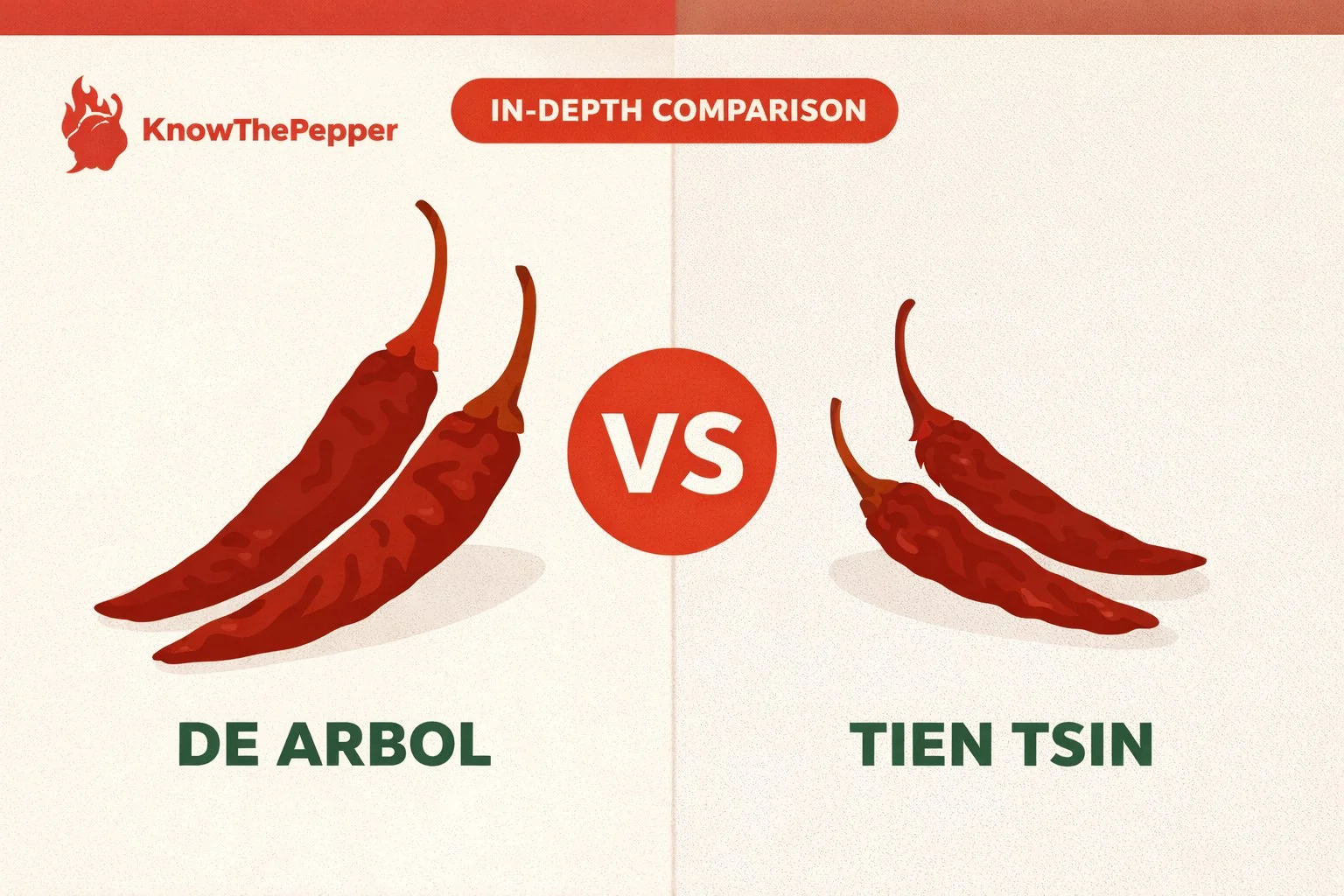
No. Both are Chinese dried chiles, but Facing Heaven is usually rounder and more aromatic, while Tien Tsin is sharper and often used whole in quick wok dishes.

Tien Tsin is hotter in this DB range: 50,000-75,000 SHU versus 30,000-50,000 SHU for Facing Heaven. The cooking effect still depends on whether the chile stays whole, gets crushed, or blooms into oil.

Facing Heaven is usually better for aromatic chili oil because its dried-fruit and toasted notes survive a slower bloom. Tien Tsin can work, but keep the oil timing short to avoid bitterness.

Yes for heat, not for the same aroma. Use fewer Tien Tsin pods, keep them whole when possible, and add another fragrant dried chile if the recipe needs the rounder Sichuan chile character.

Sources & References
KL
Fact-checked by Karen Liu
Research Contributor
SHU Verified
Sources Cited
Expert Reviewed
All Comparisons Browse Peppers Scoville Scale