Does Sweet Chili Sauce Need to Be Refrigerated? Pantry vs Fridge
Commercial sweet chili sauce does not need refrigeration for safety unless its label says so. The fridge is still the better everyday choice, because the sugar and body make an opened bottle darken and crust around the cap.
Sweet chili sauce sits in an awkward middle ground. It is more shelf-stable than a fresh homemade sauce, yet stickier and messier around the cap than a thin vinegar-forward hot sauce.
A commercial bottle usually does not have to go into the fridge for safety. Refrigeration is still the better everyday choice, because sugar, garlic, chili solids and a syrupy texture all make an opened bottle feel old faster.
Use the label first, then choose the fridge for quality
For a sealed bottle, the package direction is the whole answer. USDA FoodKeeper guidance treats commercial chili sauce as a stable packaged condiment rather than a fresh refrigerated food.
The major brands do not actually disagree here. Thai Kitchen prints Refrigerate after opening on the bottle, and Kikkoman gives the same instruction for its sauces.
Kikkoman goes further, recommending an opened bottle be used within one month for best quality.
A printed instruction outranks any general condiment advice, including this article.
Where a label stays silent, the choice becomes a quality decision. The fridge buys a cleaner bottle, slower color change, slower flavor fade, and less dried crust around the neck.
Sweet chili sauce lands between its two closest neighbours on the shelf. It is sweeter and stickier than sriracha storage has to account for, and smoother than chili garlic sauce storage, which carries far more solids.
Denser jarred pastes shift the answer again, which is why chili paste storage lands on the fridge more often.
| Bottle condition | Storage decision | Reason |
|---|---|---|
| Unopened commercial bottle | Follow the package direction | The sealed product is still under the manufacturer's original conditions |
| Opened, label says refrigerate | Refrigerate | A product-specific instruction outranks general advice |
| Opened, label permits pantry | Cool cabinet for fast use, fridge for slow use | Cold preserves color, flavor and cap condition longer |
| Homemade or decanted unlabelled | Refrigerate | The commercial process and its instruction no longer apply |
Why does sweet chili sauce age faster?
Sweet chili sauce is not hot sauce with extra sugar.
It carries vinegar, sugar or syrup, garlic, chili and often starch or gums, with enough body to coat food instead of splashing across it.
Sugar leads the ingredient list on both the Thai Kitchen and Kikkoman labels, ahead of water and vinegar. That ordering is the formulation reason this bottle behaves more like a syrup than like a thin hot sauce.
That body is what changes the storage job. A thin sauce pours clean, while sweet chili sauce leaves residue under the cap, around the rim and down the neck.
Sticky residue is not the bottle spoiling.
It does make the bottle look and feel older well before anything is actually wrong with the sauce.
The sweeter formula also makes flavor drift obvious sooner. A bottle past its best tastes flatter and more candy-like rather than balanced against the vinegar.
When is the pantry actually fine?
The pantry case is strongest for a commercial bottle whose label allows it and that you are actually using. A cool cabinet away from the stove beats a warm shelf beside the oven or a sunny windowsill.
Speed of use decides the rest. A bottle emptied within weeks has little time to darken, while one that sits half-open for months does not.
Serving habits matter as much as the shelf. Pour into a separate dish rather than dipping into the bottle, because returning food, crumbs or a used utensil changes the conditions the package guidance assumed.
Keep the original label with the sauce if you decant it. Ingredient list, lot code, date and storage direction all disappear the moment an unmarked squeeze bottle replaces the package.
A restaurant bottle sitting out on a table proves less than it appears. Service volume, cleaning routine, package size and manufacturer instruction can all differ from your kitchen.
Pour a serving into a small dish instead of dipping. One contaminated bottle is a bigger loss than one dish to wash.
Write the opening date on any bottle you expect to use slowly. It does not replace the manufacturer's guidance, but it answers whether the darkening took three weeks or nine months.
Why refrigeration is often the smarter everyday answer
Even where the pantry is allowed, the fridge usually wins in practice. Sweet chili sauce stays usable in a cabinet while aging in ways that are obvious and annoying: a sticky bottle, a messy cap, a darker sauce.
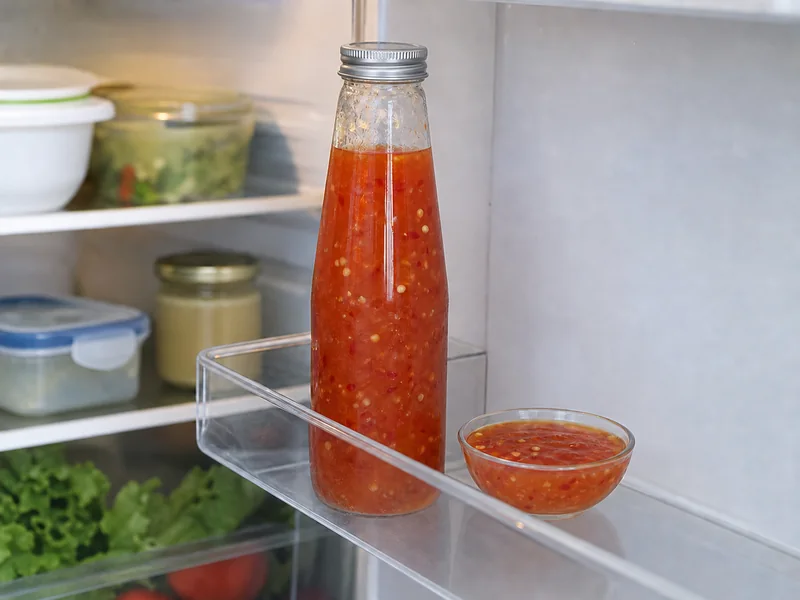
Cold slows all of that. It holds the sweet-acid balance fresher, reduces oxidation speed, and keeps the cap from turning into a ring of dried sugar.
Handling is the other half. Every opening adds air and mess, so a bottle shared by several people or opened with sauce-coated fingers drifts faster than the label alone suggests.
The fridge answer is realism rather than fear. If the bottle is used occasionally, cold is simply the safer practical home for it.
Why does sweet chili sauce thicken in the fridge?
Thickness in a chilled bottle is not a spoilage signal.
Cold sweet chili sauce simply pours more slowly, especially where starch or gums give it body.
Take out what the meal needs and return the bottle rather than warming the whole thing. Repeatedly warming and cooling adds handling time and leaves more sauce around the cap.
For glazing hot food, measure the sauce cold. It loosens as it warms on the food, so topping up because it looked thick in the bottle leaves the dish too sweet or too wet.
Does homemade sweet chili sauce need refrigeration?
A homemade batch is a different category.
Starting from fresh chilies, garlic, sugar and vinegar loses the predictable factory formula that lets a commercial bottle sit out at all.
Treat your own sauce as fridge-first unless you followed a tested preservation process built for shelf stability. Tasting sharp is not evidence of measured acidity, validated processing or a sealed pack.
Fruit puree, extra garlic or cornstarch all strengthen that case rather than weakening it. The same reasoning separates a home batch from a general making hot sauce at home method, which assumes nothing about your finished acidity.
Store a homemade batch in a clean dated container and keep the tasting spoon out of it. Freezing a portion beats guessing at a longer room-temperature life.
Send the recipe and its storage instruction along with any jar you give away. Sweetness tells a recipient nothing about acidity, processing or expected refrigerator life.
How do you know the bottle has gone off?
The sauce does not need to look perfect to be fine. Mild darkening, some thickening and a sticky cap ring are all normal age rather than spoilage.
Judge the whole bottle instead of one crusted spot. Dried sugar at the opening is ordinary, while mold, pressure or an unfamiliar odor is a different problem entirely.
- Discard it if mold appears on the sauce, cap liner or bottle neck.
- Discard it after unexpected bubbling, pressure or gas release in a product not sold as fermenting.
- Discard it when a sour or rotten smell replaces the original sweet, garlic and vinegar aroma.
- Discard a bottle contaminated by food pieces or a used utensil when its history is uncertain.
- Clean ordinary dried sauce off the cap and judge the sauce again, because crust alone proves nothing.
The wider condiment family follows the same logic, which is why hot sauce spoilage uses these same signals. Sweet chili sauce only shows its age sooner, because the sugar makes every change visible.