
Choricero vs Ñora: Meaty Basque Depth or Sweet Mediterranean Fruit?
Both the choricero and the ñora are dried Spanish peppers with zero measurable heat, but they play distinctly different roles in the kitchen. The choricero brings a meaty, slightly tannic depth that anchors Basque sauces and chorizo, while the ñora offers a sweeter, more rounded fruitiness favored across Catalonia and Valencia. Understanding which to reach for, and when, can meaningfully change a dish.

Choricero Pepper
MildÑora Pepper
MediumQuick Comparison
| Attribute | Choricero Pepper | Ñora Pepper |
|---|---|---|
| Scoville evidence | 175-300 SHU | 500-1K SHU |
| Heat Tier | Mild | Medium |
| vs Jalapeño | n/a | n/a |
| Flavor | sweet and mild | sweet and mild |
| Species | C. annuum | C. annuum |
| Origin | Spain | Spain |
Are Choricero and Ñora Peppers Spicy?
At 0 SHU, both the choricero and the ñora sit firmly in the zero-heat mild tier of the Scoville scale, meaning neither registers any capsaicin-driven burn whatsoever. To put that in perspective, a serrano pepper typically lands between 10,000 and 23,000 SHU, so both of these Spanish dried peppers are not merely milder than a serrano, they are categorically heatless by comparison.
This absence of heat is not a limitation. It is the whole point, since both peppers were bred and selected over centuries specifically for their flavor contribution, not their fire.
The Scoville scale reference for these varieties essentially functions as confirmation that you are working with pure flavor vehicles, no thermal distraction involved.
Where they differ is not in heat degree but in how their zero-heat profiles express themselves on the palate. The choricero tends toward a deeper, more savory warmth, not spicy warmth, but the kind of richness that reads as substantial and almost meaty.
The ñora runs sweeter and brighter, with a fruitiness that sits closer to the surface. Neither pepper will challenge heat-sensitive diners, making both excellent entry points for anyone exploring Spanish pepper traditions without wanting to manage burn.
How Do Choricero and Ñora Taste Different?
The flavor gap between these two peppers is where the real story lives. Choricero peppers carry a pronounced savory depth, think sun-dried tomato meets smoked paprika, with a slight bitterness at the finish that adds structure rather than harshness.
The flesh is thick and oily when rehydrated, releasing a concentrated, almost meaty paste that clings to sauces. There is a subtle earthiness running through it, which is part of why Basque cooks have relied on it for generations in dishes like marmitako and bacalao a la vizcaína.
Ñora peppers take a different direction entirely. Smaller and rounder in shape, they dry to a deep brick-red and rehydrate into something noticeably sweeter and more aromatic.
The fruitiness is genuine: there is a dried cherry or raisin quality that sits alongside a mild, clean pepper flavor. Less bitter than the choricero, the ñora integrates smoothly into rice dishes and seafood preparations without dominating other ingredients.
Aromatically, the choricero has more presence when soaking, since the liquid it releases is darker and more pungent. Ñora soaking water is lighter and faintly floral.
Both repay patience: a good 20-30 minute soak in warm water before scraping the flesh unlocks far more complexity than a quick rinse.
For dishes where you want the pepper to announce itself, choricero. For dishes where the pepper should support and sweeten without taking over, ñora is the better call.
How Are Choricero and Ñora Used in Spanish Cooking?
Choricero peppers are most at home in the Basque Country, where they are a non-negotiable ingredient in bacalao a la vizcaína, the classic salt cod stew that has defined Basque cooking for centuries. The technique is consistent: soak dried choricero pods in warm water, then scrape the softened flesh from the skin with a spoon.
That paste goes directly into sauces, braises, and, as the name suggests, into the spice blend for traditional Spanish chorizo sausage.
For a rough substitution ratio, one dried choricero pod yields approximately one tablespoon of scraped flesh. When the pepper itself is unavailable, commercial pimiento choricero paste sold in jars is a reasonable stand-in, though the paste lacks some of the textural depth of freshly scraped flesh.
Ñora peppers are the backbone of romesco sauce, the Catalan roasted pepper and nut sauce that accompanies everything from grilled spring onions to fish. They also appear in fideuà (the Valencian noodle dish), arròs negre, and countless rice preparations across eastern Spain.
The ñora's sweetness plays particularly well with saffron, which is why it shows up so often alongside it. A single ñora pod yields slightly less flesh than a choricero due to its smaller size, about two teaspoons of scraped paste.
For romesco-style sauce recipes, the standard ratio is 2-3 ñora pods per cup of roasted tomatoes. Both peppers can be used in the same dish, and some cooks layer them for complexity, but they are not interchangeable.
Swapping ñora for choricero in vizcaína sauce will produce something noticeably sweeter and less structured. Going the other direction in romesco yields a more bitter, heavier result, so respect what each pepper is designed to do.
Which Should You Choose, Choricero or Ñora?
If your cooking leans Basque (salt cod, bean stews, chorizo making), the choricero is the pepper you need. Its savory depth and slight bitterness are structural elements in those dishes, not decorative ones, and no other pepper replicates what it does in vizcaína sauce.
If your focus is Catalan or Valencian cooking (romesco, rice dishes, seafood preparations), the ñora is the right tool. Its sweetness and fruity lift are what make those dishes work, and trying to substitute choricero will throw the balance off.
For a single pantry purchase, the ñora is arguably more versatile across a wider range of Spanish recipes, and its sweeter profile adapts more easily to non-Spanish applications like pepper-based dips or roasted vegetable sauces. The choricero is more specialized but irreplaceable within its domain.
Both are worth keeping on hand if Spanish cooking is a regular part of your repertoire. They are inexpensive, shelf-stable, and the flavor payoff from even a single pod is significant.
Buying And Prep Notes
Choricero peppers are often sold dried whole or as jarred pulp. Jarred pulp is convenient for Basque sauces, but check salt and preservatives before seasoning the pot.
Ñora peppers are small, round, and dried. They should smell sweet and red-pepper-like, not dusty, and brittle pods can still work if soaked long enough, though old pods give less color.
For either pepper, remove the stem and seeds first, then soak in hot water for 20-30 minutes until pliable. Scrape the softened flesh from the skin when you want a smooth traditional texture, or blend and strain if speed matters more than exact texture.
The common mistake is using only paprika powder for either Spanish dried pepper. Powder gives color, but it cannot fully replace soaked pepper flesh in traditional sauces.
Reserve the soaking liquid only if it tastes clean, since some dried Spanish peppers release bitterness into the soak, and that bitterness can flatten a delicate sauce.
How Do You Use Choricero Pulp and Ñora in Sauces?
Choricero is often used specifically for pulp. After soaking, the softened flesh can be scraped from the skin and stirred into a sauce base, giving body as well as color.
Ñora can also be soaked and scraped, but it is more often part of a broader sauce structure alongside nuts, tomato, garlic, bread, or rice, including salmorreta and picada-style bases. Its sweetness supports the sauce rather than taking over the texture.
That means choricero is usually better when the pepper flesh itself should thicken the dish. Ñora is better when the pepper should round out a sauce built from several other ingredients.
As a quick backup heuristic for a mild sauce, one soaked ñora can stand in for one choricero, then adjust body with roasted red pepper if the sauce still needs more thickness.
| Decision | Choricero | Ñora |
|---|---|---|
| Pod form | Long and conical | Small and round |
| Main contribution | Savory pulp and body | Sweet fruit and aromatic lift |
| Classic direction | Basque-style sauces and stews | Romesco-style bases, seafood, and rice |
| Prep control | Measure scraped pulp | Measure scraped pulp, nuts, and tomato together |
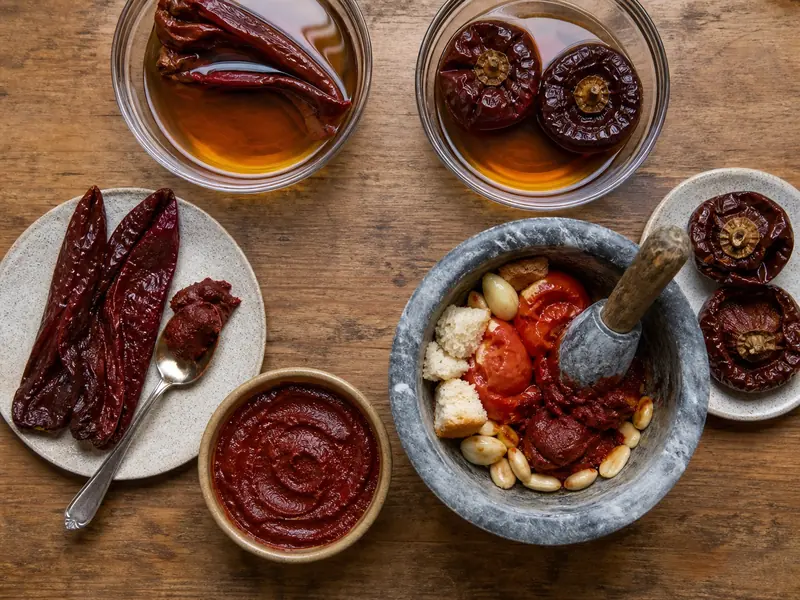
Regional Cooking Identity
Choricero belongs most clearly to Basque cooking, where its scraped pulp builds body in sauces such as vizcaína. Gerald Hirigoyen's Basque cookbook supports that cooking frame without requiring an exact cultivar-development timeline.
Ñora belongs to Spanish Mediterranean sauce and rice traditions, especially romesco-style bases. Spain's Ministry of Agriculture documents protected regional pepper traditions, but the stored source does not prove every former claim about 16th-century Murcia selection or accidental invention.
The practical boundary is stable even when the historical record is limited: choose long choricero for savory scraped pulp and round ñora for sweeter support in tomato, nuts, garlic, bread, seafood, or rice.
Serving Form Matters More Than Nutrition
No cultivar-specific nutrient comparison was located for choricero and ñora. Generic fresh-pepper values cannot establish exact calories or vitamins for dried pods and scraped pulp, so nutrition does not decide this choice.
Serving form is the useful measure. One long choricero usually provides more scraped flesh than one small round ñora, but pod size varies, so build sauce by tablespoons of pulp rather than assuming a universal pod conversion.
Neither pepper should be promised as universally 0 SHU because published and market values vary by cultivar and lot. Taste a small amount of the prepared pulp before serving heat-sensitive diners, and wear gloves if the package reports capsaicin heat.
Choricero Pepper vs Ñora Pepper FAQ
- Peppers: Vegetable and Spice Capsicums - Paul Bosland & Eric Votava
- The Basque Kitchen - Gerald Hirigoyen
- La Vera Pimentón and Spanish Pepper Traditions - Spain's Ministry of Agriculture